element14 Community
element14 Community
    Register Log In
  • Site
  • Search
  • Log In Register
  • Community Hub
    Community Hub
    • What's New on element14
    • Feedback and Support
    • Benefits of Membership
    • Personal Blogs
    • Members Area
    • Achievement Levels
  • Learn
    Learn
    • Ask an Expert
    • eBooks
    • element14 presents
    • Learning Center
    • Tech Spotlight
    • STEM Academy
    • Webinars, Training and Events
    • Learning Groups
  • Technologies
    Technologies
    • 3D Printing
    • FPGA
    • Industrial Automation
    • Internet of Things
    • Power & Energy
    • Sensors
    • Technology Groups
  • Challenges & Projects
    Challenges & Projects
    • Design Challenges
    • element14 presents Projects
    • Project14
    • Arduino Projects
    • Raspberry Pi Projects
    • Project Groups
  • Products
    Products
    • Arduino
    • Avnet & Tria Boards Community
    • Dev Tools
    • Manufacturers
    • Multicomp Pro
    • Product Groups
    • Raspberry Pi
    • RoadTests & Reviews
  • About Us
  • Store
    Store
    • Visit Your Store
    • Choose another store...
      • Europe
      •  Austria (German)
      •  Belgium (Dutch, French)
      •  Bulgaria (Bulgarian)
      •  Czech Republic (Czech)
      •  Denmark (Danish)
      •  Estonia (Estonian)
      •  Finland (Finnish)
      •  France (French)
      •  Germany (German)
      •  Hungary (Hungarian)
      •  Ireland
      •  Israel
      •  Italy (Italian)
      •  Latvia (Latvian)
      •  
      •  Lithuania (Lithuanian)
      •  Netherlands (Dutch)
      •  Norway (Norwegian)
      •  Poland (Polish)
      •  Portugal (Portuguese)
      •  Romania (Romanian)
      •  Russia (Russian)
      •  Slovakia (Slovak)
      •  Slovenia (Slovenian)
      •  Spain (Spanish)
      •  Sweden (Swedish)
      •  Switzerland(German, French)
      •  Turkey (Turkish)
      •  United Kingdom
      • Asia Pacific
      •  Australia
      •  China
      •  Hong Kong
      •  India
      • Japan
      •  Korea (Korean)
      •  Malaysia
      •  New Zealand
      •  Philippines
      •  Singapore
      •  Taiwan
      •  Thailand (Thai)
      • Vietnam
      • Americas
      •  Brazil (Portuguese)
      •  Canada
      •  Mexico (Spanish)
      •  United States
      Can't find the country/region you're looking for? Visit our export site or find a local distributor.
  • Translate
  • Profile
  • Settings
Arduino
  • Products
  • More
Arduino
Arduino Forum Help me
  • Blog
  • Forum
  • Documents
  • Quiz
  • Events
  • Polls
  • Files
  • Members
  • Mentions
  • Sub-Groups
  • Tags
  • More
  • Cancel
  • New
Join Arduino to participate - click to join for free!
Actions
  • Share
  • More
  • Cancel
Forum Thread Details
  • State Not Answered
  • Replies 15 replies
  • Subscribers 403 subscribers
  • Views 1274 views
  • Users 0 members are here
  • tutorial
  • help
  • prototyping
  • arduino
Related

Help me

tejaswivarma
tejaswivarma over 12 years ago

Hi,

          I am from india. I want to control the celing fan speed in my workshop (220V AC voltage) using arduino. can any one provide me with a circuit.

I need to control the speed by sending the data to arduino from my PC.


   thankyou in advance


                                                                      Have a nice day

  • Sign in to reply
  • Cancel

Top Replies

  • mcb1
    mcb1 over 12 years ago in reply to shabaz +1
    Shabaz You are quite right in that its complicated. Personally I would just go down to the local electrical store, and for a few dollars buy something that is approved and won't invalidate your insurance…
  • billabott
    billabott over 12 years ago +1
    For those interested in this topic; I think you may find this of interest: http://extremeelectronics.co.in/avr-projects/avr-project-remote-controlled-fan-regulator/ To purchase kit : http://store.extremeelectronics…
  • shabaz
    shabaz over 12 years ago in reply to billabott +1
    Hi Bill, You're better at google than me - that's actually not bad a circuit at the link you found, I couldn't find any! I can't see the PCB layout (so I'm not sure on the spacing between mains and low…
Parents
  • billabott
    0 billabott over 12 years ago

    For those interested in this topic; I think you may find this of interest: http://extremeelectronics.co.in/avr-projects/avr-project-remote-controlled-fan-regulator/


    To purchase kit : http://store.extremeelectronics.co.in/Remotea-Controlled-AC-Fan-Speed-Regulator-KIT.html


    Designer's Choice:  MOC3021 (Opto-Isolated)  and a  BT136 TRIAC  looks to be an interesting combo according to this circuit.  All you are doing with the UNO (in place of the 555) is turning a 10mA LED on and off inside the MOC3021.


    I want to hear more about this zero crossing requirement, Mark and shabaz.

    • Cancel
    • Vote Up +1 Vote Down
    • Sign in to reply
    • Verify Answer
    • Cancel
  • shabaz
    0 shabaz over 12 years ago in reply to billabott

    Hi Bill,


    You're better at google than me - that's actually not bad a circuit at the link you found, I couldn't find any! I can't see the PCB layout (so I'm not sure on the spacing between mains and low voltage), but at least the schematic looks pretty good.

    Basically, these triac type of devices are pretty much absent (i.e. glossed over in a few pages if any) in many books on semiconductor devices (or at least any books I have), I guess they come under power theory and more expensive books I don't have!.  I don't like playing with mains either! but basically from limited use of them, they act like a latching switch, controlled by the gate current. Once triggered, they remain conducting, until the current through the switch drops to some threshold for the triac. Latches are usually not nice (ideally you want a switch like a normal BJT) but conveniently triacs become useful for controlling mains devices, since the sinewave AC voltage will reach zero 100 or 120 times per sec, so you know that the triac will eventually switch off anyway. If you want to dim or control speed, then you could do it in one of two ways: (a) check when the AC voltage reaches some adjustable level, and then turn the triac on. It will switch off at the end of the cycle. Then repeat. or (b) turn on the triac at the start of the cycle, and it will switch off at the end of the cycle. Then skip N cycles. Then repeat.

    If you're switching a large load, then it's good to switch it on at the point when the voltage is at zero, so that there is no spike in current which generates noise. That implies that the (b) method may be better.

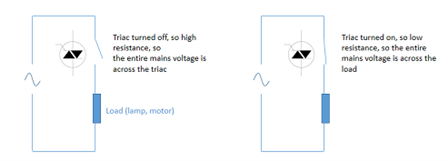
    The other complication is that if the load is inductive, then the current through the load is not in phase with the voltage. So, when the triac switches off (i.e. when the current has dropped below the threshold for the triac), actually the voltage may be quite high. When the triac is on, the voltage across the triac is low because the load sees it (the triac resistance is low when on, so the voltage across the triac is low).

    (Edit: added this quick diagram to explain this):

    image

    When the triac switches off, the voltage is across the triac (since it is no longer across the load, since the triac resistance is now high as a switch) and the fact that the voltage went from near zero across the triac to a higher voltage (due to the load being inductive) means that there was some dV/dt rate, and unfortunately large rate of change of voltage with time (i.e. dV/dt) kills triacs. This is the figure 14 from the doc mentioned earlier, where you can see that that the triac remained conducting (i.e. voltage across it was low) even after triggered, and even after the zero crossing, because the current was not in phase. When the current dropped, then the triac experienced the high voltage, and you can see the dV/dt is quite sharp.

    image

    Another thing is, how to know when there is a zero crossing. They achieve something close to that in the circuit posted, although the exact implementation depends on what they coded too, because you can see that the optocoupler won't switch on until there is a certain forward voltage for the LED inside it (and by that time the mains voltage is not zero, it is higher, i.e. many times the LED forward voltage, since they are driving the opto by a low voltage transformer). So, they could in thoery compensate for that by knowing the frequency of the mains voltage (50 or 60 Hz) and figuring out how much time would have elapsed from the true zero crossing, to the time that their optocoupler circuit reported it to the microcontroller, and taking that into account on the next cycle. There are other zero crossing circuits that won't need the compensation since they don't rely on the optocoupler, but the opto method may be cheaper and just as useful I guess, if they compensate in the code.

    • Cancel
    • Vote Up +1 Vote Down
    • Sign in to reply
    • Verify Answer
    • Cancel
  • billabott
    0 billabott over 12 years ago in reply to shabaz

    I gather that the BT136 TRIAC is rated for 4 amps@120Vac/220Vac.  But since it is on sale this week at Newark, I want to know if it is serviceable with 18 volts DC for robot motor controller.


    The NTE5632 - TRIAC,100V V(DRM),10A I(T)RMS,TO-220 is a nice device but it is 12 time more expensive.


    Post Script:  Okay, The triac latches into the on state once turned on.  So DC is a bit of a challenge unless the circuit has something like a limit switch that cuts the power.  How else can that be accomplished?   Okay, wow, cool idea:  AC motors only go in one direction only, but a DC motor goes in both CW and CC directions.  So, robot arm motor(s) are active and once the primary limit signal (max. arm extension) is detected then the power can be cut and polarity inverted and the motor can go in the other direction when commanded until the secondary limit signal is detected, then Reset.  But, the H-Bridge chips do that job for us now.


    How does the ceiling fan change its direction?  Double windings, I'll bet.

    • Cancel
    • Vote Up 0 Vote Down
    • Sign in to reply
    • Verify Answer
    • Cancel
Reply
  • billabott
    0 billabott over 12 years ago in reply to shabaz

    I gather that the BT136 TRIAC is rated for 4 amps@120Vac/220Vac.  But since it is on sale this week at Newark, I want to know if it is serviceable with 18 volts DC for robot motor controller.


    The NTE5632 - TRIAC,100V V(DRM),10A I(T)RMS,TO-220 is a nice device but it is 12 time more expensive.


    Post Script:  Okay, The triac latches into the on state once turned on.  So DC is a bit of a challenge unless the circuit has something like a limit switch that cuts the power.  How else can that be accomplished?   Okay, wow, cool idea:  AC motors only go in one direction only, but a DC motor goes in both CW and CC directions.  So, robot arm motor(s) are active and once the primary limit signal (max. arm extension) is detected then the power can be cut and polarity inverted and the motor can go in the other direction when commanded until the secondary limit signal is detected, then Reset.  But, the H-Bridge chips do that job for us now.


    How does the ceiling fan change its direction?  Double windings, I'll bet.

    • Cancel
    • Vote Up 0 Vote Down
    • Sign in to reply
    • Verify Answer
    • Cancel
Children
  • mcb1
    0 mcb1 over 12 years ago in reply to billabott

    Sorry William, your triac to control a DC motor won't work.

    From Wikipedia http://en.wikipedia.org/wiki/TRIAC

    Once triggered, the device continues to conduct until the current drops below a certain threshold, called the holding current.

    If you can interrupt the current, then fine, however I can't really see an advantage.


    re AC Motors.

    Generally they use a second winding.

    One of the ceiling fans I viewed simply changed the blades from 'pulling' air, to 'pushing'.


    Mark

    • Cancel
    • Vote Up +1 Vote Down
    • Sign in to reply
    • Verify Answer
    • Cancel
  • billabott
    0 billabott over 12 years ago in reply to mcb1

    Mark, my friend, there is nothing that will make me want to work very hard to prove you wrong as telling me that I cannot do it.  image

    • Cancel
    • Vote Up 0 Vote Down
    • Sign in to reply
    • Verify Answer
    • Cancel
  • mcb1
    0 mcb1 over 12 years ago in reply to billabott

    William


    You're on....


    Probably not worded very well, but ..

    The triac can indeed switch ON, however to switch it Off, you need a relay or large power transistor, so I'm not sure what you would gain by adding it into the circuit.


    Mark

    • Cancel
    • Vote Up +1 Vote Down
    • Sign in to reply
    • Verify Answer
    • Cancel
  • shabaz
    0 shabaz over 12 years ago in reply to mcb1

    Ah, I think I know where William is going with this! Something like a normally-on microswitch to cut the power when the arm reaches a limit maybe? :-)

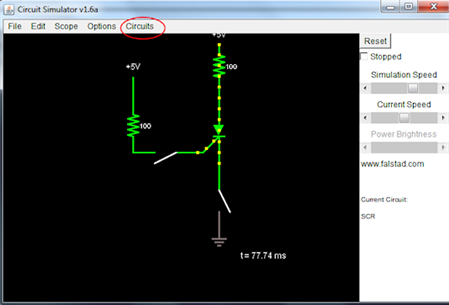
    Btw, you might like this site if you've already not seen it. I'm not super-familiar with the site, but it's nice to see the circuit simulated (and animated), so if you click on the link to go to the applet (needs java), then it opens up a new window like below, and if you click on Circuits->Misc Devices->Silicon Controlled Rectifiers->SCR (which for DC is close enough  and will work for DC as will a triac) then you'll see a circuit where you can click on the switches to turn them on and off. You could also modify the circuit, since it is a complete simulator, by right-clicking anyhere.

    image

    But for low voltage DC control, nothing beats the MOSFET, since it can switch lots of amps, and may be cheaper and smaller than triacs. The only problem is that most are surface-mount, but I remember someone finding some TO-92 packaged ones. I'll see if I can find the name. The discrete mosfets are good for controlling power in one direction, but for two-direction then the circuit does start to get big, so an IC becomes more practical. Recently I used an IC for the control, and used it to switch four external mosfets, using MC33033 (old IC, but still manufactured and quite nice - it's designed for brushless motors, but it can be used with DC motors, shown in figure 45 of the datasheet).

    • Cancel
    • Vote Up +1 Vote Down
    • Sign in to reply
    • Verify Answer
    • Cancel
  • mcb1
    0 mcb1 over 12 years ago in reply to shabaz

    shabaz


    For a DC cct, I can't see much point in including the scr, since you need something capable of passing the full current anyway.


    I have used IR4427 as the H-bridge in a small robot.

    http://nz.element14.com/international-rectifier/ir4427pbf/driver-mosfet-dual-low-side-4427/dp/1023267?Ntt=1023267

    They are designed as the driver for Mosfets, but 20v and 2.3A.

    You need to add diodes across each mosfet as unlike the real deal, they aren't built in.


    (sorry about the NZ site reference, but I'm sure you can find them)


    Okay so you can use an SCR to control a DC motor, but you need two (see page 128)

    http://www.scribd.com/doc/18485460/26/DC-MOTOR-CONTROL-WITH-THYRISTORS


    Mark

    • Cancel
    • Vote Up +1 Vote Down
    • Sign in to reply
    • Verify Answer
    • Cancel
  • billabott
    0 billabott over 12 years ago in reply to shabaz

    That is a nifty simulator site.   Thanks for sharing how to find it.

    • Cancel
    • Vote Up 0 Vote Down
    • Sign in to reply
    • Verify Answer
    • Cancel
  • shabaz
    0 shabaz over 12 years ago in reply to mcb1

    You're right, it's likely rare to use a SCR for this, although the SCR manufacturer would prefer it. That's a great book you found, I've downloaded it, I don't have many on power related circuits, so this is really useful.

    • Cancel
    • Vote Up 0 Vote Down
    • Sign in to reply
    • Verify Answer
    • Cancel
  • mcb1
    0 mcb1 over 12 years ago in reply to shabaz

    shabaz


    The On semiconductor site has a few very useful looking documents.

    http://www.onsemi.com/PowerSolutions/supportTechDoc.do?lctn=header


    Mark

    • Cancel
    • Vote Up +1 Vote Down
    • Sign in to reply
    • Verify Answer
    • Cancel
element14 Community

element14 is the first online community specifically for engineers. Connect with your peers and get expert answers to your questions.

  • Members
  • Learn
  • Technologies
  • Challenges & Projects
  • Products
  • Store
  • About Us
  • Feedback & Support
  • FAQs
  • Terms of Use
  • Privacy Policy
  • Legal and Copyright Notices
  • Sitemap
  • Cookies

An Avnet Company © 2025 Premier Farnell Limited. All Rights Reserved.

Premier Farnell Ltd, registered in England and Wales (no 00876412), registered office: Farnell House, Forge Lane, Leeds LS12 2NE.

ICP 备案号 10220084.

Follow element14

  • X
  • Facebook
  • linkedin
  • YouTube