

Technical Specification
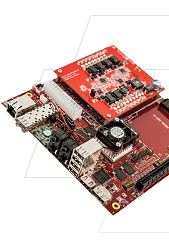
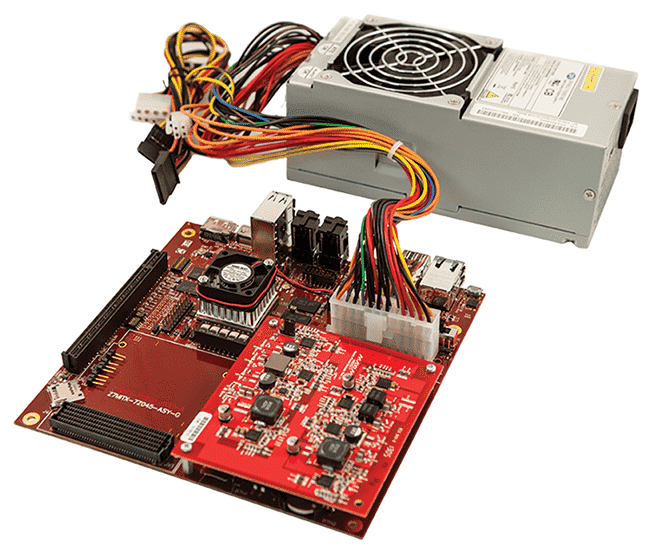
Mini-ITX Base Kit: The Xilinx Zynq -7000 All Programmable SoC Mini-ITX Base Kit provides a complete development platform for designing and verifying applications based on the Xilinx Zynq-7000 All Programmable SoC family. Along with the Mini-ITX development board, available with the Zynq XC7Z045-2FFG900 or the XC7Z100-2FFG900 device, the kit includes the cables, hardware and software needed to create a complete development system. Product Brief (Datasheet)
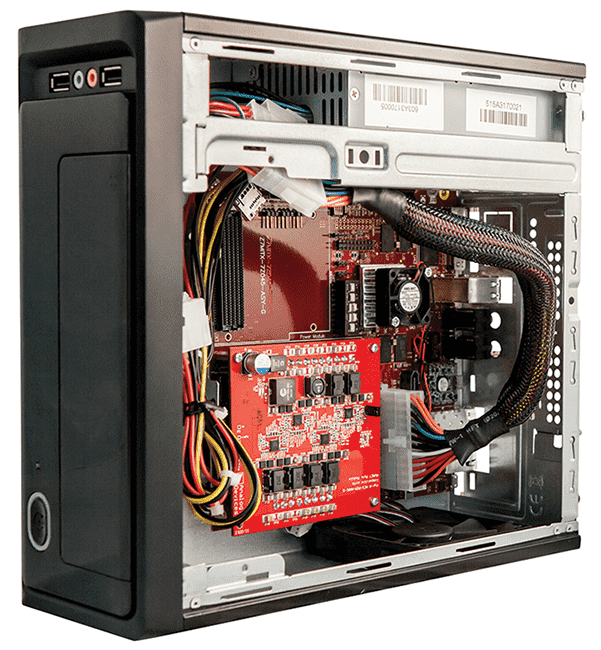
Mini-ITX System Kit:The Xilinx Zynq-7000 All Programmable SoC Mini-ITX System Kit builds on the Xilinx Zynq-7000 All Programmable SoC Mini-ITX Base Kit, and includes the hardware to create a complete standalone system.
Click on the images to enlarge
Kit Includes
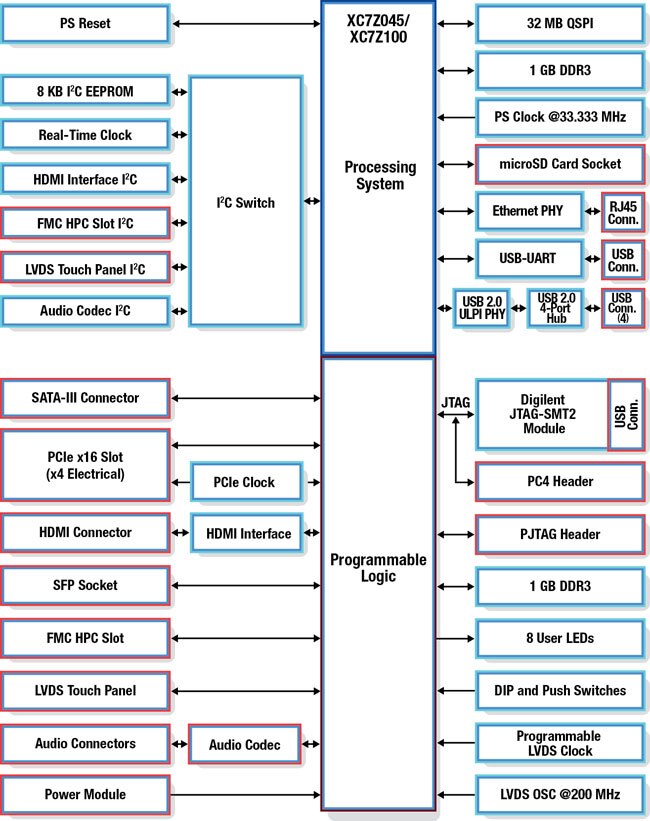
- Board Kit
- Xilinx XC7Z045/XC7Z100-2FFG900
- 1 GB PS DDR3 SDRAM & 1 GB PL DDR3 SDRAM
- 32 MB of QSPI Flash
- 8 KB of I2 C EEPROM
- Real-Time Clock
- 10/100/1000 Ethernet Interface
- USB-UART Interface
- microSD Card Interface
- USB 2.0 4-Port HUB
- PCIe Gen2 x4 Root Complex (x16 physical Slot)
- SATA-III Interface
- FMC HPC Slot (VADJ of 1.8 V, 2.5 V, or 3.3 V)
- SFP Socket
- LVDS Touch Panel Interface
- HDMI Interface
- Audio Codec
- User LEDs and Switches
- Programmable LVDS Clock Source (GTX reference clock)
- 200 MHz LVDS Oscillator (system clock)
- JTAG Header
- Processor PJTAG Header
- Digilent USB-JTAG Module (JTAG-SMT2)
- Base Kit
- Mini-ITX development board
- FMC Adapter
- Two micro USB cables
- 4 GB microSD card
- 200 W ATX power supply
- Xilinx Vivado Design Edition software license voucher (device locked to 7Z045 or 7Z100)
- System Kit
- Mini-ITX Base Kit
- Mini-ITX Chassis
- FMC Adapter
- 500 GB SATA-III Hard Drive
Hardware Specification
| Specification | Description |
|---|---|
| ZYNC PROCESSOR |
|
| MEMORY |
|
| CONNECTIVITY |
|
| EXPANSION |
|
| OTHER PERIPHERALS |
|
| USER I/O |
|
| CLOCKS |
|
| DEBUG/PROGRAMMING |
|
| POWER |
|
| DIMENSIONS |
|
| CERTIFICATION |
|

Reference Designs
Out-of-Box Designs
This is the software and hardware platform, boot files, Linux kernel and RAMdisk that are provided on the pre-installed SD card.
Using USB for Secondary Boot Images
This application note builds on a PetaLinux BSP and demonstrates how to use a USB device to store Linux and bitstream images. The BOOT.BIN file is reduced to < 400 KB in size, and u-boot is responsible for loading the programmable logic via PCAP.
HDMI Bare Metal Reference Design Using ADV7511 and ADI IP
This reference design demonstrates how to create a bare metal system to output HDMI video and audio using the ADI ADV7511 HDMI transmitter. The IP used in this design is free and publicly available through ADI.
PetaLinux Board Support PackagesCompressed PetaLinux BSPs for Avnet Zynq system platforms.
PetaLinux Software Reference Design
This reference design demonstrates how to create, customize and execute a PetaLinux kernel on Avnet Zynq system platforms.
SFP Socket IBERT Reference Design
This reference design demonstrates how to use the Xilinx IBERT to test the SFP interface on the Mini-ITX board.
SATA-III Hard Drive Interface Reference Design
This reference design is based on a standalone OS and demonstrates how to test a SATA-III hard drive connected to the Mini-ITX board.
Embedded Standalone OS (Bare-Metal) Reference Design ITX
This reference design is based on a standalone OS and demonstrates the basic functionality of the Mini-ITX board.
PCIe Root Complex Reference Design
This reference design demonstrates how to build a PCIe Root Complex System on the Mini-ITX board.
ARM DSTREAM Interface Reference Design
This reference design demonstrates how to interface the ARM DSTREAM debug adapter to the Mini-ITX board.
Development Using Ubuntu Desktop Linux
These tutorials provide a means to integrate several different technologies on a single platform. Using the Avnet target boards, we have the power of ARM processors, combined with the unrivaled flexibility of Xilinx programmable logic to implement custom hardware systems. We use a Linux kernel as the foundation operating system running on the processor cores which enables a very large ecosystem of software to be run on our development kits. Virtual machines can provide a very convenient Ubuntu development environment for building the hardware platform and cross-compiling software to target the Processing System.


