


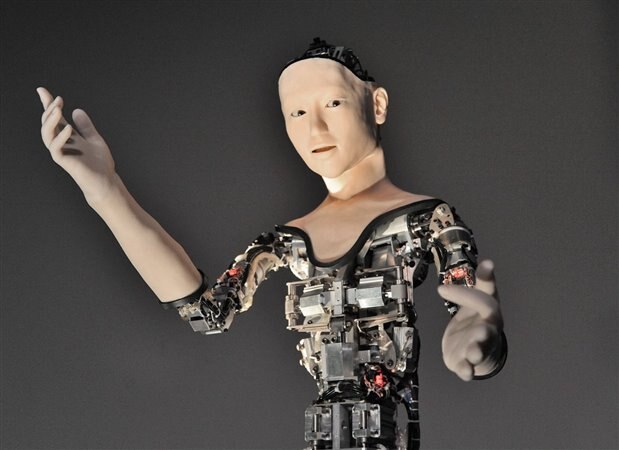
Advanced programming techniques could turn robots into the next dance floor phenomenon...but much remains to be done before they’re less terrifying. This humanoid robot moves on its own due to advances in neural programming (via Osaka University via Japan Times)
In case you thought that the world of robotics was mostly steered towards developing automated versions of what you do for a living, don’t worry, now you can also enjoy nightmarish humanoid simulations while jobs are being usurped by automatons.
Eerily human androids have been around for awhile, but now, thanks to a team of researchers at Osaka University in Japan, they’ve quite literally taken a leap forward. Led by Hiroshi Ishiguro and Takashi Ikegami, renowned figures in the world of robotics research, the programming team developed a system that allows the machine to react to environmental stimuli on its own, with no other outside control. Called a ‘central program generator’, the technology features ‘pneumatic actuators’, devices which convert air into mechanical motion. This allows the robot to be sensitive to temperature, proximity, noise and humidity.
While robots have previously been able to imitate human speech and facial expressions, they’ve looked more like they’re rehearsing lines than going live. You can decide for yourself, though, since Ishiguro designed a robot that looks just like him, called the Geminoid.
The latest prototype developed by the team, dubbed “Alter”, moves with a degree of freedom not seen before. While the emphasis in designing androids has previously been on imitating human appearance, the emphasis with Alter was to communicate aliveness solely through movement.
In theory, this allows the robot to actually react to things, with a randomized response to stimuli that makes movement seem more fluid. In reality, watching Alter move inspires more feelings of creepiness than wonder.
Instead of appearing alive, Alter seems more like the undead. It’s probably the singing that does it-the vocalized sine waves generated by the programming that control the movement of the android’s fingers.
It’s a step towards making robots appear more alive and dynamic, but as with so much android technology, it’s an in-between, eery, unsettling kind of progress, more an inspiration for a horror movie than something you’d want at home. It’ll be awhile before you see convincing dancebots at the local club.
Have a story tip? Message me at: