element14 Community
element14 Community
    Register Log In
  • Site
  • Search
  • Log In Register
  • Community Hub
    Community Hub
    • What's New on element14
    • Feedback and Support
    • Benefits of Membership
    • Personal Blogs
    • Members Area
    • Achievement Levels
  • Learn
    Learn
    • Ask an Expert
    • eBooks
    • element14 presents
    • Learning Center
    • Tech Spotlight
    • STEM Academy
    • Webinars, Training and Events
    • Learning Groups
  • Technologies
    Technologies
    • 3D Printing
    • FPGA
    • Industrial Automation
    • Internet of Things
    • Power & Energy
    • Sensors
    • Technology Groups
  • Challenges & Projects
    Challenges & Projects
    • Design Challenges
    • element14 presents Projects
    • Project14
    • Arduino Projects
    • Raspberry Pi Projects
    • Project Groups
  • Products
    Products
    • Arduino
    • Avnet & Tria Boards Community
    • Dev Tools
    • Manufacturers
    • Multicomp Pro
    • Product Groups
    • Raspberry Pi
    • RoadTests & Reviews
  • About Us
    About the element14 Community
  • Store
    Store
    • Visit Your Store
    • Choose another store...
      • Europe
      •  Austria (German)
      •  Belgium (Dutch, French)
      •  Bulgaria (Bulgarian)
      •  Czech Republic (Czech)
      •  Denmark (Danish)
      •  Estonia (Estonian)
      •  Finland (Finnish)
      •  France (French)
      •  Germany (German)
      •  Hungary (Hungarian)
      •  Ireland
      •  Israel
      •  Italy (Italian)
      •  Latvia (Latvian)
      •  
      •  Lithuania (Lithuanian)
      •  Netherlands (Dutch)
      •  Norway (Norwegian)
      •  Poland (Polish)
      •  Portugal (Portuguese)
      •  Romania (Romanian)
      •  Russia (Russian)
      •  Slovakia (Slovak)
      •  Slovenia (Slovenian)
      •  Spain (Spanish)
      •  Sweden (Swedish)
      •  Switzerland(German, French)
      •  Turkey (Turkish)
      •  United Kingdom
      • Asia Pacific
      •  Australia
      •  China
      •  Hong Kong
      •  India
      •  Japan
      •  Korea (Korean)
      •  Malaysia
      •  New Zealand
      •  Philippines
      •  Singapore
      •  Taiwan
      •  Thailand (Thai)
      •  Vietnam
      • Americas
      •  Brazil (Portuguese)
      •  Canada
      •  Mexico (Spanish)
      •  United States
      Can't find the country/region you're looking for? Visit our export site or find a local distributor.
  • Translate
  • Profile
  • Settings
BeagleBoard
  • Products
  • Dev Tools
  • Single-Board Computers
  • BeagleBoard
  • More
  • Cancel
BeagleBoard
Blog BBB - Building a DAC
  • Blog
  • Forum
  • Documents
  • Quiz
  • Polls
  • Files
  • Members
  • Mentions
  • Sub-Groups
  • Tags
  • More
  • Cancel
  • New
Join BeagleBoard to participate - click to join for free!
  • Share
  • More
  • Cancel
Group Actions
  • Group RSS
  • More
  • Cancel
Engagement
  • Author Author: shabaz
  • Date Created: 6 Jul 2013 7:19 PM Date Created
  • Views 16737 views
  • Likes 8 likes
  • Comments 126 comments
  • onsemi
  • audio
  • dac
  • bbb
  • texas_instruments
  • bb_black
  • beagle_bone_black
  • ti
Related
Recommended

BBB - Building a DAC

shabaz
shabaz
6 Jul 2013

Introduction

This project was about getting audio out of the BeagleBone Black. The aim was to have stereo audio, at least as good as an iPod. See further below for the circuit, and also a video showing it working.

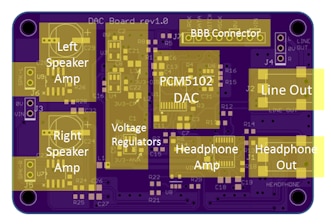
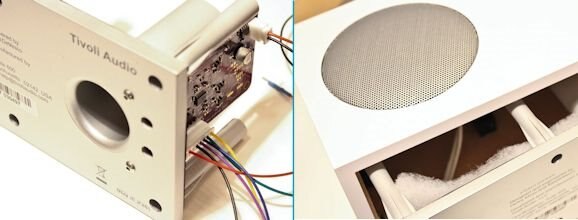
Later, this project was used to build a PCB design (see below for the link to this part 2, and then the PCB was used to make a home Sonos-type hi-fi audio player (see the link to part 3 below).


The BBB has an on-board I2S interface, which makes interfacing an external DAC easy. The I2S interface is connected from the AM3359 processor to the HDMI chip (TDA19988) but it is not required for HDMI to be used in order to make use of the I2S interface. The I2S interface is brought out to some pins on port P9 (see here for details). It was encouraging that Technoshaman and Donald Miller had some success with the interface, so I wanted to try it out and I got some time today.


Part 2 to this post, which implements the prototype, can be found by clicking here.
image

Part 3 implements a complete design in an enclosure for a Sonos-like solution.
image

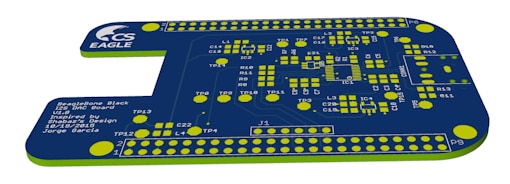
See Creating an Internet Radio for a complete project by the EAGLE team including board layouts
image


Parts Selection

Since the interface is capable of 24-bit/192kHz audio, it was worthwhile picking a nice DAC. A good but not over-the-top device seemed to be the Texas Instrument's PCM5101 which is nice because it has reasonable specs and also provides a built-in charge pump so that it can function from a single supply. A headphone amp was connected, and this was ON Semi's NCP2811A. The combination of PCM5101 (actually my prototype used PCM5101A which can also function from 1.8V, but this was not needed)  and NCP2811A was chosen so that the entire circuit could operate from the BBB supply if desired, even if it was from a Li-Ion battery that was powering the BBB, and for low noise and distortion. The only problem is that the PCM5101 has quite a high output (clearly a good thing!) but the audio amp minimum recommended gain is 1 and it cannot meet the required output voltage, and it means that it will distort at high volume. So, at a lower volume (and lower SNR) it will be fine, and I prefer this particular amp because of the very low distortion. The ON semi datasheet was sparse though.


Building It

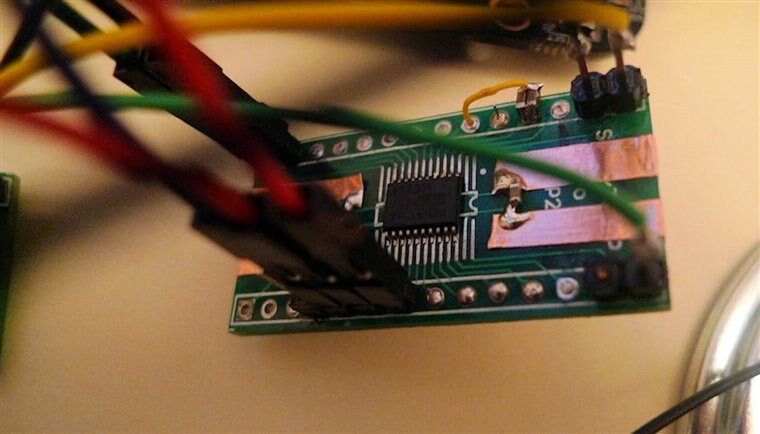
This is the DAC prototype:
image

This is the whole thing connected up:
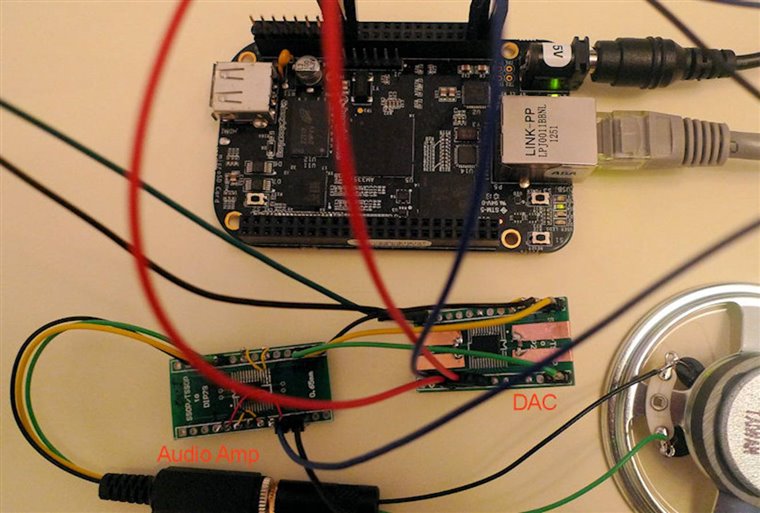
image

This is the rear of the board - a bit messier! It was built on a SMD to DIP adapter board with some copper tape for supply rails:
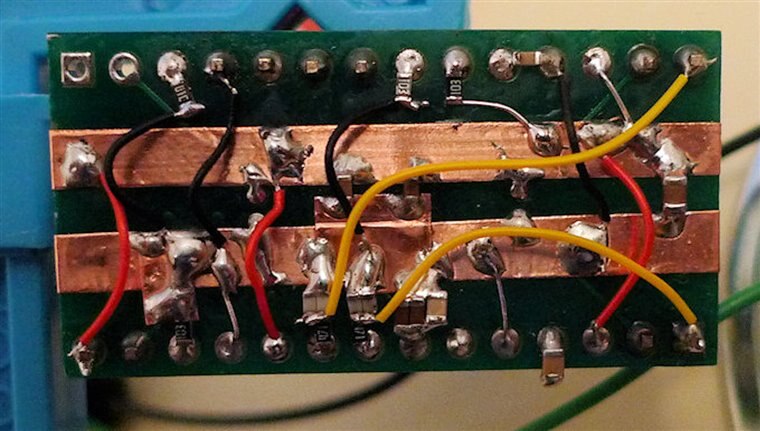
image

This is the audio amp - not a lot to it, since it is so integrated.
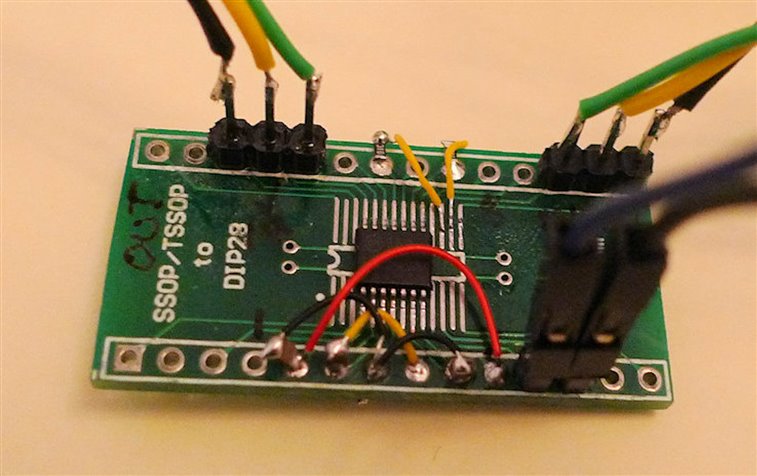
image


Testing It

I made a recording, but excuse the quality. The audio is from a small 64 ohm speaker picked up by a simple camera in-built microphone so it sounds bad, but connecting to headphones is a different story - it sounds as good as an ipod (although this is subjective - I don't have a way to measure). Another thing I still need to check is that originally I thought the data was read on the falling edge of the bitclock on the BBB, but I2S specifies the opposite. Maybe I made a mistake in my initial observations (I have not had a chance to re-check), or maybe it changed in a build. But the circuit as shown here works for me.


This is running on an not-recent Angstrom downloaded build (maybe a few weeks old image), and I still hear some very slight audio issues - it sounds like perhaps a break for a few tens of milliseconds occasionally, only if you're listening closely. I really hope it is resolved in a build soon (or maybe it is due to ffmpeg - perhaps avconv gives better results).

EDIT: I've since been using mplayer (command line is mplayer -ao alsa -volume 4 AmyWinehouse-BackToBlack.mp3  and either I'm not noticing any audio issues or they have disappeared). I've concluded it sounds at least as capable as my old ipod touch, maybe better).


I played audio using the command line:

ffmpeg -i AmyWinehouse-YouKnowImNoGood.mp3 -f alsa "default:CARD=Black" -re -vol 150

and it reported the stream as:

Stream #0.0: Audio: pcm_s16le, 44100 Hz, stereo, s16, 1411 kb/s


You don't have permission to edit metadata of this video.
Edit media
x
image
Upload Preview
image


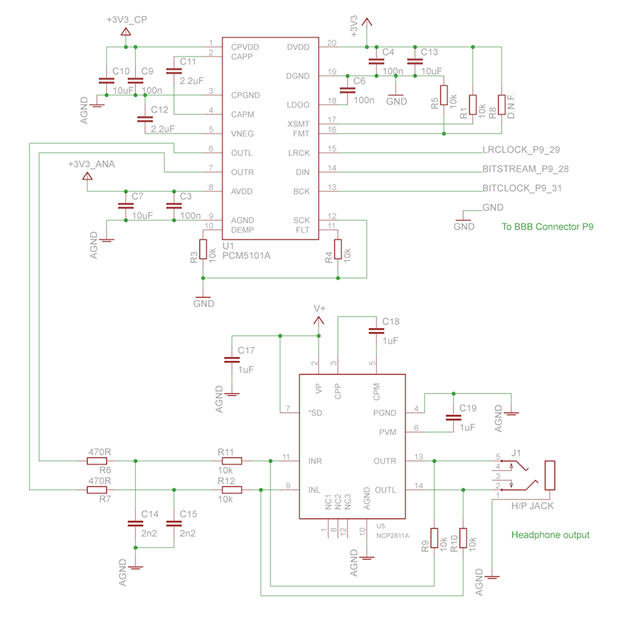
Circuit Diagram

This is the circuit. All the 3.3V supplies were connected together for the prototype (I wouldn't do that for real, although it sounded very good in my limited tests). The amplifier V+ can be connected to 3.3V or the 5V supply (or the Li-Ion battery directly).

Note 16th Jan 2014: See the comments section below for more detail; the SCK pin on the PCM5101A was disconnected from 0V and instead connected to the BBB P9 pin 25. This will provide the lowest jitter by disabling the DAC's internal PLL. A sample capture of the audio quality (captured from the headphone output of the NCP2811A, just to give an approximate idea of what it sounds like from headphones) is attached to the post below, in the zip file dac-output.zip. More info on it in the comments section below.

Note 2: Please add a logic inverter to the bitclock connection. For more detail, see the comments below (search for the word 'bitclock' to make it easier to find). See the part 2 blog post, and the attached file there called dac-documentation.zip for the circuit diagram, showing the bitclock inversion. More recent BBB images may not need it, but it was certainly needed for the images I tested with.
image


Experiments with FLAC

I've also tried a FLAC file, but I'm hitting some limitation with ffmpeg it seems, and it picks a 16-bit format when it ought to be 24-bit. Meanwhile, avconv I couldn't get to work for MP3 or FLAC (it reported 'av_interleaved_write_frame(): Resource temporarily unavailable'). If anyone knows, any tips on how to play FLAC at 24-bit would be gratefully appreciated.


root@beaglebone:~# ffmpeg -i Taxman_2009_Digital_Remaster.flac -f alsa "default:CARD=Black" -re -vol 5
ffmpeg version v0.8.4, Copyright (c) 2000-2012 the Libav developers
  built on May 20 2013 13:00:42 with gcc 4.7.3 20130205 (prerelease)
This program is not developed anymore and is only provided for compatibility. Use avconv instead (see Changelog for the list of incompatible changes).
[flac @ 0x2da80] max_analyze_duration reached
Input #0, flac, from 'Taxman_2009_Digital_Remaster.flac':
  Metadata:
    ORIGREFERENCE   : 6C05C9F79EE74052A7991B9669B98533
    ORIGDATE        : 2009:09:14
    ORIGTIME        : 11:57:01
    TIMEREFERENCE   : 5292000
    CODINGHISTORY   : A=PCM,F=44100,W=24,M=stereo,T=SADiE5
    ORGANIZATION    : EMI
    TITLE           : Taxman
    track           : 1
    ARTIST          : The Beatles
    ALBUM           : Revolver (24 BIT Remastered)
    DATE            : 2009
  Duration: 00:02:37.85, bitrate: 1892 kb/s
    Stream #0.0: Audio: flac, 44100 Hz, 2 channels, s32
Incompatible sample format 's32' for codec 'pcm_s16le', auto-selecting format 's16'
Output #0, alsa, to 'default:CARD=Black':
  Metadata:
    ORIGREFERENCE   : 6C05C9F79EE74052A7991B9669B98533
    ORIGDATE        : 2009:09:14
    ORIGTIME        : 11:57:01
    TIMEREFERENCE   : 5292000
    CODINGHISTORY   : A=PCM,F=44100,W=24,M=stereo,T=SADiE5
    ORGANIZATION    : EMI
    TITLE           : Taxman
    track           : 1
    ARTIST          : The Beatles
    ALBUM           : Revolver (24 BIT Remastered)
    DATE            : 2009
    encoder         : Lavf53.21.0
    Stream #0.0: Audio: pcm_s16le, 44100 Hz, 2 channels, s16, 1411 kb/s
Stream mapping:
  Stream #0.0 -> #0.0

Attachments:
dac-output.zip
  • Sign in to reply

Top Comments

  • e14 Contributor
    e14 Contributor over 12 years ago in reply to e14 Contributor +2
    Current test rig. BBB ($45), cs4271 on breadboard (about $15 parts and dozens of hours of labor), Cary Audio SE-1 amp (about $1K), pair of B&W DM302 speakers (about $200). I assembled this system that…
  • shabaz
    shabaz over 8 years ago in reply to shabaz +2
    Also, unrelated, but for after you have resolved the device tree issue, I just wanted to confirm, if you're following the circuit, make sure you include the 'bitclock inversion' functionality. The BBB…
  • shabaz
    shabaz over 8 years ago in reply to jithu_element14 +2
    Hi Jithu, Just to follow up on this, I re-tried on another image too, but still no luck. I've posted a request for help on the Beagleboard.org BBB-Wireless forum, in case anyone else has had success. Reproducing…
  • shabaz
    shabaz over 12 years ago in reply to e14 Contributor

    Hi Marco,

    No problem at all, I hope it helps. By the way, that is interesting information that the audio cape driver can allow the rate to be adjusted.

    I just looked now, it took a while to find the schematic for the audio cape, it seems it uses the same MCASP because it is connected to the same pins (28, 29, 31).

    I'm wondering if we can just use that driver (i.e. force it using the dts file for the audio cape). The only thing is, the audio cape uses I2C to the codec. Maybe it just programs registers and doesn't read anything back, and maybe it is more for audio input switching, levels etc., and might not notice the DAC is different : ) It is worth trying. My BBB is in a state of transition (updating images and connecting to some other hardware) and unfortunately next week I may not be close to an oscilloscope, but I will try to test this soon, either toward the end of this week or after a week.

    • Cancel
    • Vote Up 0 Vote Down
    • Sign in to reply
    • More
    • Cancel
  • e14 Contributor
    e14 Contributor over 12 years ago in reply to shabaz

    Hi Shabaz,

    Thanks a lot for the kindness image


    Well, I have listened the track and it sounds pretty good! It seems that the " mixing" on output to 48KHz doesn't cause large distorsion. Sure, it must be measured with other equipment.


    Anyway, there's a strange thing in my opinion.  My colleague have done the same test with the oscilloscope on the previous release of the beaglebone (the white one), with the custom audio cape.

    And he have noticed that the sample rate could change , according with the input audio file. So if you have an audio track coded in 44100 Hz, you will see 44100 Hz on output and so on with other rates. ( I don't remember if the bit-wide of the data was not considered ).

    The drivers seems to be the same....( or not?) . So... it's strange isn't it?

    It seems that a kind of mixing of the source is taking place.

    • Cancel
    • Vote Up 0 Vote Down
    • Sign in to reply
    • More
    • Cancel
  • shabaz
    shabaz over 12 years ago in reply to e14 Contributor

    Hi Marco,


    I too only see 48kHz, it needs a driver modification to change this value. I don't particularly mind 48k, but I wish it was 24-bit - with the current driver the output is 16bit which is irritating. I need to look into it sometime, I've not looked at the code at all.

    Regarding audio quality out of the DAC - it is very good if you want it for normal use (I'm no audio expert). The same ic (actually the compatible next version up - PCM5102) is used in DACs such as Meridian Explorer which retail for a lot more than this circuit (the ME has more functionality though), and I imagine the sound quality is in a similar ballpark especially since this circuit uses a low jitter clock too. (I have listened to a ME and K702 headphone combination, I wouldn't say the sound is many leagues different, but this is so subjective and again I'm no expert).

    The attached file (dac-output.zip) above contains a recording from the headphone output of the circuit, to get an approximate idea of what kind of sound to expect.

    • Cancel
    • Vote Up 0 Vote Down
    • Sign in to reply
    • More
    • Cancel
  • e14 Contributor
    e14 Contributor over 12 years ago

    Hi everybody


    I'm in trouble with the beagle bone black audio driver. I've read this discussion. It's very useful and interesting. At the moment I have a lot of questions .I hope you will be kind enough to help me.


    My project involves the acquisition of an audio stream from web radio and then forward it to an FPGA by the I2S interface.

    I Use this command to provide the audio data

    ffmpeg -i http://wma03.fluidstream.net:8080/fluid03  -f alsa "default:CARD=Black" -re -vol 150


    With the oscilloscope , I can see clearly the I2S data on the output pins. Of the BBB ( bit clock on  31, L/R on 29, data on 28) . Now the problems begin to rise


    1) it seems that for every kind of sound source, the output sample rate is the same : 48KHz. It never changes.Even if i have forced it with normal synytax of ffmpeg ( -ar new sample rate) or with .asoundrc script.


    So, is it possible to force an output sample rate of 96kHz? (the initial clock of 24,etc is divided by four  ).

    I'm going crazy for this image


    2) The audio quality is good enough at 48 kHz ??! I've buy the evaluation board with he same Dac of Shabaz to evaluate the sound.


    • Cancel
    • Vote Up 0 Vote Down
    • Sign in to reply
    • More
    • Cancel
  • shabaz
    shabaz over 12 years ago in reply to e14 Contributor

    Hi John,


    The inverse bitclock sympton should not be a clipping sound at high volume I would have thought, but I'm unsure - it's beyond my analysis. It will be DAC dependent - with the IC I used, it was not noticeable, but other ICs have different setup/hold times so the effect you experience may be different. The simplest resolution is to invert it with a logic gate, until the driver code is fixed.

    Sadly I don't know enough to figure out why your dts file does not work. I've not looked at all into the dts configuration for mcasp or any register values, and I'm not familiar with Linux sound drivers either :-( All I can suggest is maybe looking in the TRM to confirm that you have the correct register values, and looking at the source to try to see what could be causing the error response you see.

    Also, you may wish to ask on the #beagle IRC channel in case anyone has already been experimenting in this area. I'd be interested to know too. There are some high-end audio capes for the BeagleBone, so the knowledge is out there I hope, but I don't know if anyone has documented it.

    • Cancel
    • Vote Up 0 Vote Down
    • Sign in to reply
    • More
    • Cancel
<>
element14 Community

element14 is the first online community specifically for engineers. Connect with your peers and get expert answers to your questions.

  • Members
  • Learn
  • Technologies
  • Challenges & Projects
  • Products
  • Store
  • About Us
  • Feedback & Support
  • FAQs
  • Terms of Use
  • Privacy Policy
  • Legal and Copyright Notices
  • Sitemap
  • Cookies

An Avnet Company © 2026 Premier Farnell Limited. All Rights Reserved.

Premier Farnell Ltd, registered in England and Wales (no 00876412), registered office: Farnell House, Forge Lane, Leeds LS12 2NE.

Follow element14

  • X
  • Facebook
  • linkedin
  • YouTube