element14 Community
element14 Community
    Register Log In
  • Site
  • Search
  • Log In Register
  • Community Hub
    Community Hub
    • What's New on element14
    • Feedback and Support
    • Benefits of Membership
    • Personal Blogs
    • Members Area
    • Achievement Levels
  • Learn
    Learn
    • Ask an Expert
    • eBooks
    • element14 presents
    • Learning Center
    • Tech Spotlight
    • STEM Academy
    • Webinars, Training and Events
    • Learning Groups
  • Technologies
    Technologies
    • 3D Printing
    • FPGA
    • Industrial Automation
    • Internet of Things
    • Power & Energy
    • Sensors
    • Technology Groups
  • Challenges & Projects
    Challenges & Projects
    • Design Challenges
    • element14 presents Projects
    • Project14
    • Arduino Projects
    • Raspberry Pi Projects
    • Project Groups
  • Products
    Products
    • Arduino
    • Avnet & Tria Boards Community
    • Dev Tools
    • Manufacturers
    • Multicomp Pro
    • Product Groups
    • Raspberry Pi
    • RoadTests & Reviews
  • About Us
  • Store
    Store
    • Visit Your Store
    • Choose another store...
      • Europe
      •  Austria (German)
      •  Belgium (Dutch, French)
      •  Bulgaria (Bulgarian)
      •  Czech Republic (Czech)
      •  Denmark (Danish)
      •  Estonia (Estonian)
      •  Finland (Finnish)
      •  France (French)
      •  Germany (German)
      •  Hungary (Hungarian)
      •  Ireland
      •  Israel
      •  Italy (Italian)
      •  Latvia (Latvian)
      •  
      •  Lithuania (Lithuanian)
      •  Netherlands (Dutch)
      •  Norway (Norwegian)
      •  Poland (Polish)
      •  Portugal (Portuguese)
      •  Romania (Romanian)
      •  Russia (Russian)
      •  Slovakia (Slovak)
      •  Slovenia (Slovenian)
      •  Spain (Spanish)
      •  Sweden (Swedish)
      •  Switzerland(German, French)
      •  Turkey (Turkish)
      •  United Kingdom
      • Asia Pacific
      •  Australia
      •  China
      •  Hong Kong
      •  India
      • Japan
      •  Korea (Korean)
      •  Malaysia
      •  New Zealand
      •  Philippines
      •  Singapore
      •  Taiwan
      •  Thailand (Thai)
      • Vietnam
      • Americas
      •  Brazil (Portuguese)
      •  Canada
      •  Mexico (Spanish)
      •  United States
      Can't find the country/region you're looking for? Visit our export site or find a local distributor.
  • Translate
  • Profile
  • Settings
BeagleBoard
  • Products
  • Dev Tools
  • Single-Board Computers
  • BeagleBoard
  • More
  • Cancel
BeagleBoard
Blog BBB - Small OLED Graphic Display
  • Blog
  • Forum
  • Documents
  • Quiz
  • Polls
  • Files
  • Members
  • Mentions
  • Sub-Groups
  • Tags
  • More
  • Cancel
  • New
Join BeagleBoard to participate - click to join for free!
  • Share
  • More
  • Cancel
Group Actions
  • Group RSS
  • More
  • Cancel
Engagement
  • Author Author: shabaz
  • Date Created: 4 Jan 2014 1:31 AM Date Created
  • Views 6526 views
  • Likes 2 likes
  • Comments 37 comments
  • oled
  • lcd
  • beagleboneblack
  • small_oled_displays
  • bbb
  • texas_instruments
  • beagle_bone_black
  • oled_displays
  • ti
Related
Recommended

BBB - Small OLED Graphic Display

shabaz
shabaz
4 Jan 2014

Introduction

There are many compact LCD and OLED displays available, but the documentation tends to be poor. This is just a quick post to record a working configuration (circuit and code) to get a compact OLED display working. A 160x128 OLED display was selected, model DD-160128FC-1A (Farnell code 1498857, also available from Newark). It is a very high quality display.

image

The display is an Organic LED (OLED) type. For interfacing a similar-sized LCD display, see here.

The code that was written is targetted for the BeagleBone Black (BBB) but can be very easily adapted for any platform. For the BBB, it uses an I/O library called iolib (see here for more details) intended for quickly prototyping a solution. The library code is already included in the zip file attached to this post.


The code is prototype level – ideally it would be rewritten to use faster interfaces (e.g. SPI, or PRU processor), but it runs fast enough for many use-cases - with the current code the display update rate is more than sufficient for text information and simple diagrams. Perhaps 30 updates per second are possible with the current code if the entire screen is not being refreshed.


The code has a few graphic commands but not much – it is an easy matter to use one of the many existing third party graphics libraries if anything beyond simple text/graphics is required.

The current code has just these capabilities:

  • Point plotting
  • Line plotting
  • Rectangles (filled, unfilled, bordered)
  • Scalable Text
  • Graphic image read from raw file into RAM
  • Graphic image display from RAM


Display Dimensions and Notes

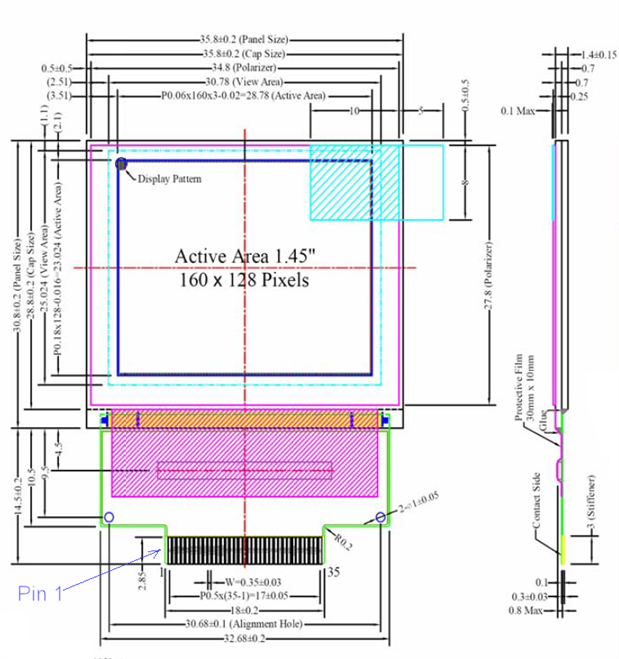
The display has a Densitron code DD-160128FC-1A. The screen has the label “UG-6028GDEAF01” on the rear. A connector by Omron (Omron code XF2M35151A  Farnell code 1112561) should fit.

Shown below is a diagram from the datasheet. The screen is very thin (about 1.5mm). There is an in-built controller (Syncoam SEPS525) located in the hatched purple area. The display is organized such that memory address 0 is top-left (where the round blob is shown) like most displays. Personally I prefer to have the origin at bottom-left, so the code uses that reference point as (0,0) instead of top-left.
image


Example Images

These photos were taken in a brightly lit room. The screen appears bright, sharp and has a more rich/saturated quality than LCD displays:

image


This animated character is drawn at position (0,0), since co-ordinates are taken from bottom-left in the attached code:

image


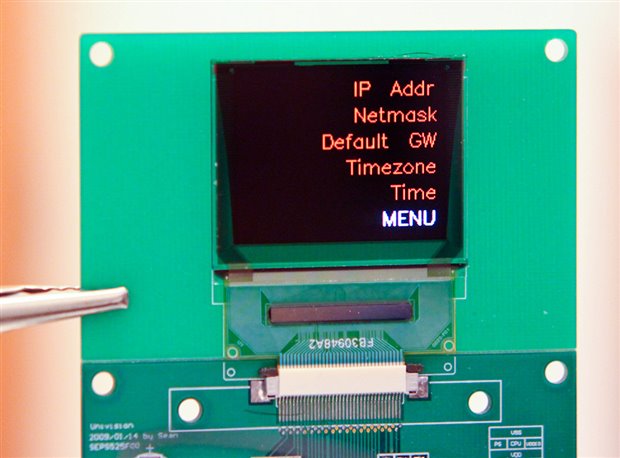
An example menu. A circuit board could have buttons to the side:
image


Video

Note - The photographs are more representative of what the display looks like in action. The image quality appears extremely bright and sharp when viewed in person – about the same as a mobile phone

The video clip here is only really useful to show the update speeds for the current code. The pulsing/flickering and horizontal banding visible in the video is not apparent in real life.

Click here for the video- having real trouble with it, it is from a camera I don't normally use and the quality is pretty bad - sorry. The final animation is actually quite smooth in real life.


Circuit

There is an optional demo board available, but it is quite basic; it has no active components, it is almost just a breakout board. The demo board was intended to speed development up, but the datasheet slowed things right back down again - the datasheet from Densitron is poor and has many errors (they have taken absolutely no care to review it).

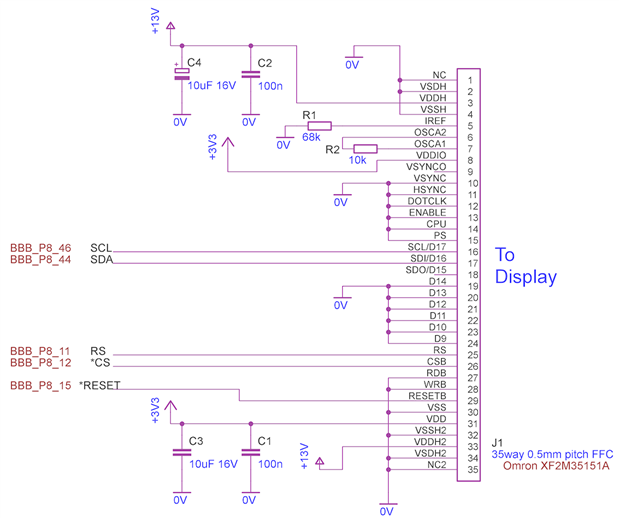
This is the required circuit to get the display working in a serial mode:
image


An appropriate connector shown here (Farnell code 1112561) should be compatible (35 way, 0.5mm pitch) but was not tested.


The display requires a low voltage supply (3.3V max) which matches what the BBB offers. A higher voltage (13V) supply is also required. I didn’t have any appropriate IC over the holiday period, so a Maxim MAX734 was used, with some resistors used to adjust the voltage to 13V. This is not recommended since it is outside the specification of the MAX734, but the circuit is shown below since it worked for the prototype. It is recommended to use a different circuit.

image

Once assembled, the circuit was connected to the BBB as indicated in the schematic. The 0V, +3.3V and +5V supply rails were powered directly from the BeagleBone, using the BBB header P9 pins 1, 3 and 5 respectively.


Software

The code is attached to this post. It is written in C. Refer to the file ‘oled.c’ to see the functions available. The main function currently also resides in that file. It runs five demonstrations when executed.


To use it, create a folder off the home directory (/home/root in my case):

mkdir –p development/oled
cd development/oled

The path will now be /home/root/development/oled

Copy the files into this location, then type the following to compile the code:

make install

The demo can now be run by typing:

./oled


Summary

It would be worthwhile creating a board for this display, and using it for small projects with the BBB where a high quality image is needed. A good amount of information can be represented on this display. It is easy to use with the example C code library, but will require a 13V supply (a small circuit can be used to generate this from the BBB’s 5V supply rail).

For larger displays, the 4.3” and 7” BB-View displays are available.


The revision 1 code is attached below for reference, but is also available here so that changes can be tracked.

Attachments:
oled-SEPS525-rev1.zip
  • Sign in to reply

Top Comments

  • Kilohercas
    Kilohercas over 12 years ago +1
    I have all code for htc desire AMOLED screen. If you want try to connect to LCDC at 800x480 resolution, that would be greait
  • Kilohercas
    Kilohercas over 12 years ago in reply to shabaz +1
    you can get from ebay, cost only 20$. For HTC Desire A8181 G7 LCD Display Screen Samsung AMOLED Repalcement | eBay but you will need pair of connectors from mouser.com, since i was unable to find exact…
  • DAB
    DAB over 12 years ago +1
    Good post, I especially like your sharing the pinouts and interface issues. DAB
  • koolkat204
    koolkat204 over 11 years ago in reply to shabaz

    Hey shabaz,


    None of the signals correspond to any startup / initialization. Do you know what version of Angstrom you were using back when you made this write up? I do not believe the software is assigning the pins correctly : (

    • Cancel
    • Vote Up 0 Vote Down
    • Sign in to reply
    • More
    • Cancel
  • Problemchild
    Problemchild over 11 years ago in reply to mcb1

    They are following one another completely lockstep and the Data line is doing all sorts of stuff so I think that's the case . Unlikely that you have two lines doing the same thing all the time like that unless you have joined them electrically or by software

    • Cancel
    • Vote Up 0 Vote Down
    • Sign in to reply
    • More
    • Cancel
  • mcb1
    mcb1 over 11 years ago in reply to shabaz

    It almost seemed that the two lines were shorted together.


    Mark

    • Cancel
    • Vote Up 0 Vote Down
    • Sign in to reply
    • More
    • Cancel
  • shabaz
    shabaz over 11 years ago in reply to Problemchild

    I see what you mean. Hard to know, without knowing what kind of sampling rate is on the Rigol in this logic analyzer mode : ( Also, it might be worth just going into normal oscilloscope mode with normal probes briefly, to confirm that nothing odd is happening with the logic levels that the logic analyzer would not reveal.

    I did look in the source code but I can't identify if the displayed signals correspond to any startup or initialization sequence, it didn't seem to match anything I could recognize. Paul, can you confirm exactly what the logic signals look like (i.e. is there any detail that is missing from the traces above, if you zoom in and pan around?

    Given the code worked on the OLED I tried, I suspect it's just a case of modifying the code to set the initialization parameters to match your particular OLED (the parameters are different according to the datasheet for your OLED), but the quicker solution may be to just use the same OLED model.

    • Cancel
    • Vote Up 0 Vote Down
    • Sign in to reply
    • More
    • Cancel
  • Problemchild
    Problemchild over 11 years ago in reply to shabaz

    I think that Mark may be right since those CS &RS lines are a word wide then I would be expecting that clk line to be doing more in the scale we are zoomed in at. Worth a check at any rate and a zoom in of the detail for Shabaz's blessing image

    • Cancel
    • Vote Up 0 Vote Down
    • Sign in to reply
    • More
    • Cancel
<>
element14 Community

element14 is the first online community specifically for engineers. Connect with your peers and get expert answers to your questions.

  • Members
  • Learn
  • Technologies
  • Challenges & Projects
  • Products
  • Store
  • About Us
  • Feedback & Support
  • FAQs
  • Terms of Use
  • Privacy Policy
  • Legal and Copyright Notices
  • Sitemap
  • Cookies

An Avnet Company © 2026 Premier Farnell Limited. All Rights Reserved.

Premier Farnell Ltd, registered in England and Wales (no 00876412), registered office: Farnell House, Forge Lane, Leeds LS12 2NE.

ICP 备案号 10220084.

Follow element14

  • X
  • Facebook
  • linkedin
  • YouTube