element14 Community
element14 Community
    Register Log In
  • Site
  • Search
  • Log In Register
  • Community Hub
    Community Hub
    • What's New on element14
    • Feedback and Support
    • Benefits of Membership
    • Personal Blogs
    • Members Area
    • Achievement Levels
  • Learn
    Learn
    • Ask an Expert
    • eBooks
    • element14 presents
    • Learning Center
    • Tech Spotlight
    • STEM Academy
    • Webinars, Training and Events
    • Learning Groups
  • Technologies
    Technologies
    • 3D Printing
    • FPGA
    • Industrial Automation
    • Internet of Things
    • Power & Energy
    • Sensors
    • Technology Groups
  • Challenges & Projects
    Challenges & Projects
    • Design Challenges
    • element14 presents Projects
    • Project14
    • Arduino Projects
    • Raspberry Pi Projects
    • Project Groups
  • Products
    Products
    • Arduino
    • Avnet & Tria Boards Community
    • Dev Tools
    • Manufacturers
    • Multicomp Pro
    • Product Groups
    • Raspberry Pi
    • RoadTests & Reviews
  • About Us
    About the element14 Community
  • Store
    Store
    • Visit Your Store
    • Choose another store...
      • Europe
      •  Austria (German)
      •  Belgium (Dutch, French)
      •  Bulgaria (Bulgarian)
      •  Czech Republic (Czech)
      •  Denmark (Danish)
      •  Estonia (Estonian)
      •  Finland (Finnish)
      •  France (French)
      •  Germany (German)
      •  Hungary (Hungarian)
      •  Ireland
      •  Israel
      •  Italy (Italian)
      •  Latvia (Latvian)
      •  
      •  Lithuania (Lithuanian)
      •  Netherlands (Dutch)
      •  Norway (Norwegian)
      •  Poland (Polish)
      •  Portugal (Portuguese)
      •  Romania (Romanian)
      •  Russia (Russian)
      •  Slovakia (Slovak)
      •  Slovenia (Slovenian)
      •  Spain (Spanish)
      •  Sweden (Swedish)
      •  Switzerland(German, French)
      •  Turkey (Turkish)
      •  United Kingdom
      • Asia Pacific
      •  Australia
      •  China
      •  Hong Kong
      •  India
      •  Japan
      •  Korea (Korean)
      •  Malaysia
      •  New Zealand
      •  Philippines
      •  Singapore
      •  Taiwan
      •  Thailand (Thai)
      •  Vietnam
      • Americas
      •  Brazil (Portuguese)
      •  Canada
      •  Mexico (Spanish)
      •  United States
      Can't find the country/region you're looking for? Visit our export site or find a local distributor.
  • Translate
  • Profile
  • Settings
Autodesk EAGLE
  • Products
  • More
Autodesk EAGLE
EAGLE User Support (English) Compact Address selection method
  • Blog
  • Forum
  • Documents
  • Events
  • Polls
  • Files
  • Members
  • Mentions
  • Sub-Groups
  • Tags
  • More
  • Cancel
  • New
Join Autodesk EAGLE to participate - click to join for free!
Actions
  • Share
  • More
  • Cancel
Forum Thread Details
  • State Verified Answer
  • Replies 8 replies
  • Subscribers 189 subscribers
  • Views 1289 views
  • Users 0 members are here
Related

Compact Address selection method

e14 Contributor
e14 Contributor over 10 years ago

Hi,


I have a couple of I2C devices which have address selection inputs A0,A1,A2. These can happily be connected to Ground = 0 or VDD = 1. I need both chips to be on the same address (they have different I2C base addresses).


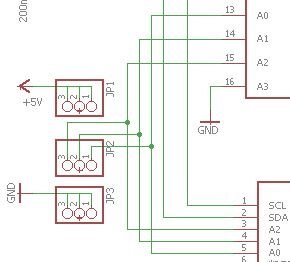
All very simple stuff - I can connect the address lines of the two chips in parallel and use jumpers to select the address by connecting the pins to Ground or VDD like this:
 

image


Now, my question is this: What is the most compact way of achieving this?


I am very pressed for space, and two rows of standard 2.54mm-spaced jumper headers look simply enormous on a compact board.


One option is to use a Resistor Network to pull the lines up to VDD, and double row of jumpers (or DIP switches) to pull them individually to ground though that, if anything, takes up more space than a triple row of jumpers. Ditto an 8-way rotary address selector and a Resistor Network.


I could just terminate on pads, make sure there's no solder mask, and bridge the appropriate pads with blobs of solder, but then that's not very nice if I want to change the address in the future (which the user might though not often).


Anybody got a neat space-saving way of doing this?


Richard

  • Sign in to reply
  • Cancel
  • e14 Contributor
    0 e14 Contributor over 10 years ago in reply to geralds

    Gerald: Yes, sensible idea - another good reason to go with jumpers rather than solder pads!


    Richard

    • Cancel
    • Vote Up 0 Vote Down
    • Sign in to reply
    • Verify Answer
    • Cancel
  • e14 Contributor
    0 e14 Contributor over 10 years ago in reply to e14candies

    Norm: that'd be a very sensible idea, however this is Raspberry Pi peripheral and, believe it or not, I have a use for every one of the useable GPIO pins so I'd have to add a GPIO expander, which sort-of defeats the object!


    I think I'll go with the 1.27mm jumper idea.


    Richard

    • Cancel
    • Vote Up 0 Vote Down
    • Sign in to reply
    • Verify Answer
    • Cancel
  • geralds
    0 geralds over 10 years ago in reply to e14 Contributor

    Hi Richard,

    i would suggest you inserting a security resistor to + 5V; so> 1k.

    Because if you makes solder bridges you can make a short circuit.

    Regards

    Gerald

    ---

    • Cancel
    • Vote Up 0 Vote Down
    • Sign in to reply
    • Verify Answer
    • Cancel
  • e14candies
    0 e14candies over 10 years ago

    If you are using I2C, could you use software controlled pins on your micro

    & a terminal to set them?  I don't have a pic of your system. Just store

    the settings in internal EEPROM or flash, if you have some avail.


    Here are some more of the 1.27mm shunts:


    http://www.isipkg.com/images/products/connectors/standard/Jumpers-shunts/Jumpers%201mm/92B-1.pdf


    --

    Web access to CadSoft support forums at www.eaglecentral.ca.  Where the CadSoft EAGLE community meets.


    • Cancel
    • Vote Up 0 Vote Down
    • Sign in to reply
    • Verify Answer
    • Cancel
  • e14 Contributor
    0 e14 Contributor over 10 years ago in reply to autodeskguest

    That's probably the best idea, so I've given you the 'Correct Answer'. I've not been able to find 1.27mm pitch jumpers in the standard library but it'd be easy enough to draw something on a 1.27mm pitch.


    I think it's going to either be those, or these solder bridge jumpers, which are 1.27mm horizontal and 2.54mm vertical pitch (total 5.08 x 7.62mm).


    image


    Thank you for your input, people.


    Richard

    • Cancel
    • Vote Up 0 Vote Down
    • Sign in to reply
    • Verify Answer
    • Cancel
  • e14 Contributor
    0 e14 Contributor over 10 years ago in reply to autodeskguest

    Thank you.


    The switches themselves are quite compact (1.27mm pitch), though it looks like they are all SPST, and only come in multiples of 2 (so I'd need a 4-way) plus i'd still need pull-up resistors in order to implement a logic-level switch? My I2C chips don't have internal pull-up resistors, so they need to be biased externally.


    Richard

    • Cancel
    • Vote Up 0 Vote Down
    • Sign in to reply
    • Verify Answer
    • Cancel
  • autodeskguest
    0 autodeskguest over 10 years ago

    On 15/07/2016 8:51 p.m., Richard Goodwin wrote:


    I am very pressed for space, and two rows of standard 2.54mm-spaced jumper headers look simply enormous on a compact board.


    There are jumpers and headers with 1.27mm pitch


    HTH Warren


    • Cancel
    • Vote Up 0 Vote Down
    • Sign in to reply
    • Reject Answer
    • Cancel
  • autodeskguest
    0 autodeskguest over 10 years ago

    Richard Goodwin wrote:

    I am very pressed for space, and two rows of standard 2.54mm-spaced

    jumper headers look simply enormous on a compact board.


    perhaps something like the GDH(L) switches from tyco?

    --


    Lorenz


    • Cancel
    • Vote Up 0 Vote Down
    • Sign in to reply
    • Verify Answer
    • Cancel
element14 Community

element14 is the first online community specifically for engineers. Connect with your peers and get expert answers to your questions.

  • Members
  • Learn
  • Technologies
  • Challenges & Projects
  • Products
  • Store
  • About Us
  • Feedback & Support
  • FAQs
  • Terms of Use
  • Privacy Policy
  • Legal and Copyright Notices
  • Sitemap
  • Cookies

An Avnet Company © 2026 Premier Farnell Limited. All Rights Reserved.

Premier Farnell Ltd, registered in England and Wales (no 00876412), registered office: Farnell House, Forge Lane, Leeds LS12 2NE.

Follow element14

  • X
  • Facebook
  • linkedin
  • YouTube