element14 Community
element14 Community
    Register Log In
  • Site
  • Search
  • Log In Register
  • Community Hub
    Community Hub
    • What's New on element14
    • Feedback and Support
    • Benefits of Membership
    • Personal Blogs
    • Members Area
    • Achievement Levels
  • Learn
    Learn
    • Ask an Expert
    • eBooks
    • element14 presents
    • Learning Center
    • Tech Spotlight
    • STEM Academy
    • Webinars, Training and Events
    • Learning Groups
  • Technologies
    Technologies
    • 3D Printing
    • FPGA
    • Industrial Automation
    • Internet of Things
    • Power & Energy
    • Sensors
    • Technology Groups
  • Challenges & Projects
    Challenges & Projects
    • Design Challenges
    • element14 presents Projects
    • Project14
    • Arduino Projects
    • Raspberry Pi Projects
    • Project Groups
  • Products
    Products
    • Arduino
    • Avnet & Tria Boards Community
    • Dev Tools
    • Manufacturers
    • Multicomp Pro
    • Product Groups
    • Raspberry Pi
    • RoadTests & Reviews
  • About Us
    About the element14 Community
  • Store
    Store
    • Visit Your Store
    • Choose another store...
      • Europe
      •  Austria (German)
      •  Belgium (Dutch, French)
      •  Bulgaria (Bulgarian)
      •  Czech Republic (Czech)
      •  Denmark (Danish)
      •  Estonia (Estonian)
      •  Finland (Finnish)
      •  France (French)
      •  Germany (German)
      •  Hungary (Hungarian)
      •  Ireland
      •  Israel
      •  Italy (Italian)
      •  Latvia (Latvian)
      •  
      •  Lithuania (Lithuanian)
      •  Netherlands (Dutch)
      •  Norway (Norwegian)
      •  Poland (Polish)
      •  Portugal (Portuguese)
      •  Romania (Romanian)
      •  Russia (Russian)
      •  Slovakia (Slovak)
      •  Slovenia (Slovenian)
      •  Spain (Spanish)
      •  Sweden (Swedish)
      •  Switzerland(German, French)
      •  Turkey (Turkish)
      •  United Kingdom
      • Asia Pacific
      •  Australia
      •  China
      •  Hong Kong
      •  India
      •  Japan
      •  Korea (Korean)
      •  Malaysia
      •  New Zealand
      •  Philippines
      •  Singapore
      •  Taiwan
      •  Thailand (Thai)
      •  Vietnam
      • Americas
      •  Brazil (Portuguese)
      •  Canada
      •  Mexico (Spanish)
      •  United States
      Can't find the country/region you're looking for? Visit our export site or find a local distributor.
  • Translate
  • Profile
  • Settings
Autodesk EAGLE
  • Products
  • More
Autodesk EAGLE
EAGLE User Support (English) [SOLVED] Ratsnets desition make based on different layer
  • Blog
  • Forum
  • Documents
  • Events
  • Polls
  • Files
  • Members
  • Mentions
  • Sub-Groups
  • Tags
  • More
  • Cancel
  • New
Join Autodesk EAGLE to participate - click to join for free!
Actions
  • Share
  • More
  • Cancel
Forum Thread Details
  • Replies 10 replies
  • Subscribers 189 subscribers
  • Views 1697 views
  • Users 0 members are here
  • eagle 8
  • ratsnest
  • eagle 7.7
Related

[SOLVED] Ratsnets desition make based on different layer

truhlik_fredy
truhlik_fredy over 9 years ago

Hello everybody,


I'm wondering if following is possible. I need to have a ratsnets being made based on top layer, but the polygon itself needs to be stored in a different layer. I need to automate process with cam and I need to have it stored under different layer to apply different settings to the job. But the ratsnets needs to be decided on the top layer.


Thanks in advance for any hints or ideas.


PS: if it's possible in any specific version I don't mind upgrading/downgrading.

  • Sign in to reply
  • Cancel
Parents
  • autodeskguest
    autodeskguest over 8 years ago

    Anton Krug wrote:

    I'm wondering if following is possible. I need to have a ratsnets

    being made based on top layer, but the polygon itself needs to be

    stored in a different layer. I need to automate process with cam and I

    need to have it stored under different layer to apply different

    settings to the job. But the ratsnets needs to be decided on the top

    layer.


    you could use an ulp to copy the polygons, redraw them in the target

    layer.


    Something like the following:


    |  board(BRD) {

    |    string s, cmd = "change layer 100;";

    |    BRD.signals(SIG) {

    |      if (SIG.name == "TEST") {

    |        SIG.polygons(POL) {

    |          if (POL.layer == 1) {

    |            sprintf(s, "change width %fmic;", u2mic(POL.width));

    |            cmd += s;

    | 

    |            POL.contours(FIL) {

    |              sprintf(s, "wire (%fmic %fmic) (%fmic %fmic);", u2mic(FIL.x1), u2mic(FIL.y1), u2mic(FIL.x2), u2mic(FIL.y2));

    |              cmd += s;

    |            }

    |            POL.fillings(FIL) {

    |              sprintf(s, "wire (%fmic %fmic) (%fmic %fmic);", u2mic(FIL.x1), u2mic(FIL.y1), u2mic(FIL.x2), u2mic(FIL.y2));

    |              cmd += s;

    |            }

    |          }

    |        }

    |      }

    |    }

    |    exit(cmd);

    |  }


    it redraws the polygons of signal "TEST" in the top layer into layer

    100 using wires.


    Thats quick and dirty 8-)  but seems to do the job

    --


    Lorenz


    • Cancel
    • Vote Up +3 Vote Down
    • Sign in to reply
    • Cancel
Reply
  • autodeskguest
    autodeskguest over 8 years ago

    Anton Krug wrote:

    I'm wondering if following is possible. I need to have a ratsnets

    being made based on top layer, but the polygon itself needs to be

    stored in a different layer. I need to automate process with cam and I

    need to have it stored under different layer to apply different

    settings to the job. But the ratsnets needs to be decided on the top

    layer.


    you could use an ulp to copy the polygons, redraw them in the target

    layer.


    Something like the following:


    |  board(BRD) {

    |    string s, cmd = "change layer 100;";

    |    BRD.signals(SIG) {

    |      if (SIG.name == "TEST") {

    |        SIG.polygons(POL) {

    |          if (POL.layer == 1) {

    |            sprintf(s, "change width %fmic;", u2mic(POL.width));

    |            cmd += s;

    | 

    |            POL.contours(FIL) {

    |              sprintf(s, "wire (%fmic %fmic) (%fmic %fmic);", u2mic(FIL.x1), u2mic(FIL.y1), u2mic(FIL.x2), u2mic(FIL.y2));

    |              cmd += s;

    |            }

    |            POL.fillings(FIL) {

    |              sprintf(s, "wire (%fmic %fmic) (%fmic %fmic);", u2mic(FIL.x1), u2mic(FIL.y1), u2mic(FIL.x2), u2mic(FIL.y2));

    |              cmd += s;

    |            }

    |          }

    |        }

    |      }

    |    }

    |    exit(cmd);

    |  }


    it redraws the polygons of signal "TEST" in the top layer into layer

    100 using wires.


    Thats quick and dirty 8-)  but seems to do the job

    --


    Lorenz


    • Cancel
    • Vote Up +3 Vote Down
    • Sign in to reply
    • Cancel
Children
  • rachaelp
    rachaelp over 8 years ago in reply to autodeskguest

    Nice solution Lorenz! I've learned something, I did not know about the contour() and fillings() loop members in polygons. Thank you!


    Anton, if you set the line width of your polygon in your design thinner this should translate to a thinner line in your new polygons.


    If you see this line:


    sprintf(s, "change width %fmic;", u2mic(POL.width));


    This sets the line width based on the width specified for the polygon (which it needs to do). So you should just be able to reduce the polygon line width down and hopefully that will solve some of your remaining issues.


    Best Regards,


    Rachael

    • Cancel
    • Vote Up +2 Vote Down
    • Sign in to reply
    • Cancel
  • truhlik_fredy
    truhlik_fredy over 8 years ago in reply to autodeskguest

    Hi Lorenz, Thank you very much,  it's almost doing it perfectly.


    It's bit rough around the edges, which probably I could live with, or maybe is there a way to make the line much thiner?

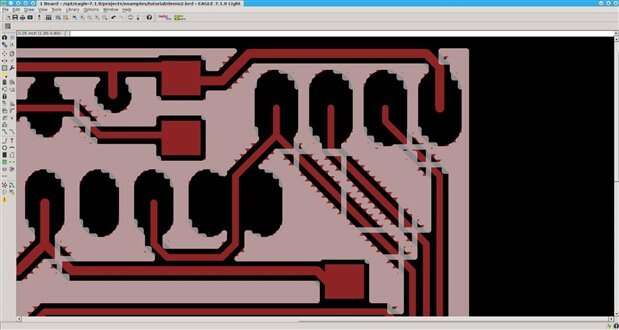
    But there is an issue and it's creating some artifacts where it is crossing traces (see attached picture), this layer will be fed into cam job to do isolation routing on a CNC so the artifacts would damage traces, while I need to remove only copper around the traces. The isolation routing is heavily time consuming, while there is an easier way to do it on the whole PCB, with a polygon fill / ratsnest I would have the freedom to select only desired parts where I really need to do it.


    When I was doing chemical process, everything worked fine I worked with output which described the traces which need to stay.

    While with mechanical CNC routing process I do the oposite, I concentrate not on traces, but on their outlines, because that needs to be removed, So the result looks like I would have polyfil on whole board enable. Which is problem if there is for example USB connector on a PCB or something where polyfill is undesired. And the polygon fill can be done in flatcam but it needs to know all the places to avoid already in the polygon, if I would leave the polygon there without conflict avoidance then the router would mill away whole polygon. So this way it will turn into an outline which then can be safely filled in flatcam into gcode which will mill away all the copper safely without damaging the traces.

    With chemical process the polyfill added more copper on the result, while now with the polyfil I want to remove copper in the mechanical process, because without anything the results look like this:

    https://i.ytimg.com/vi/g7A0pnUetRY/maxresdefault.jpg

    It just mills around the outlines of traces so it isolates the traces from each other and leaving large chunks of copper present.


    Here is the artifact of the script:


    image


    You think it could be fixed?  Thank you very much again, with this I could have the process automated, while now I waste lot of time doing it by hand on every single export image


    Best regards,

    Anton

    • Cancel
    • Vote Up +2 Vote Down
    • Sign in to reply
    • Cancel
element14 Community

element14 is the first online community specifically for engineers. Connect with your peers and get expert answers to your questions.

  • Members
  • Learn
  • Technologies
  • Challenges & Projects
  • Products
  • Store
  • About Us
  • Feedback & Support
  • FAQs
  • Terms of Use
  • Privacy Policy
  • Legal and Copyright Notices
  • Sitemap
  • Cookies

An Avnet Company © 2026 Premier Farnell Limited. All Rights Reserved.

Premier Farnell Ltd, registered in England and Wales (no 00876412), registered office: Farnell House, Forge Lane, Leeds LS12 2NE.

Follow element14

  • X
  • Facebook
  • linkedin
  • YouTube