







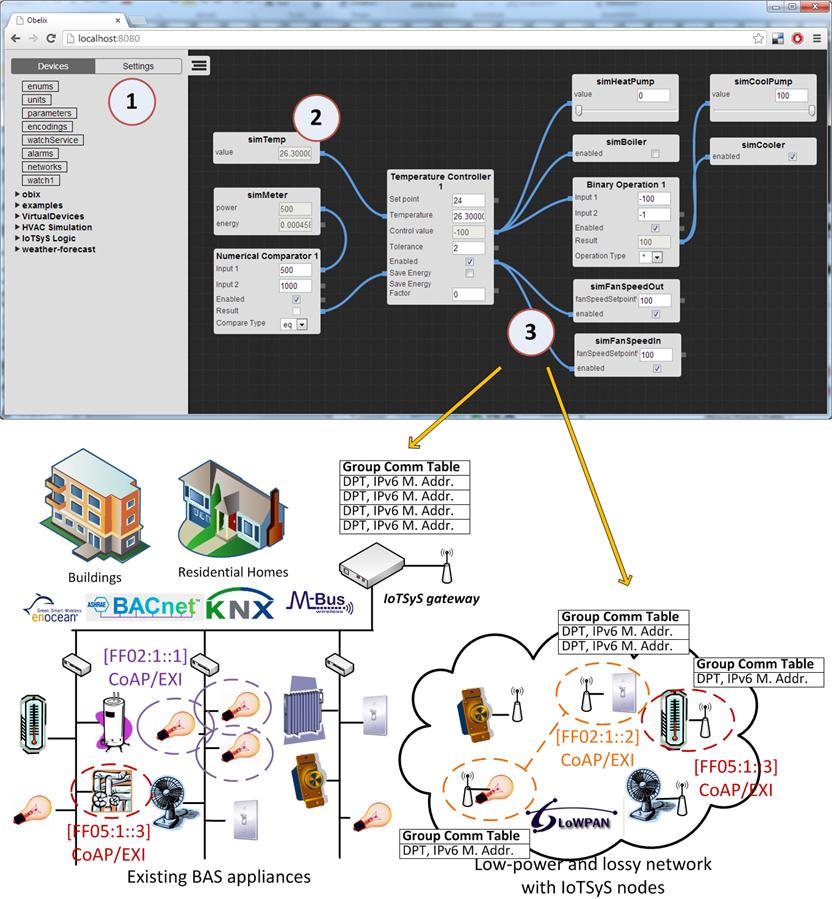
IoTSys makes it easy to communicate with IoT devices using a simple interface (via IoTSys)
At Sensor Expo 2014 in Chicago this year, the Raspberry Pi powered IoTSys project vied for the IPSO Challenge grand prize. Although it didn’t win, I feel it’s a triumph of Pi usage.
The IoT (Internet of Things) is gradually being implemented into our homes, businesses and warehouses and allows us to control or garner information from objects and systems in an online environment. We have mobile smart devices, wearable computing, smart home technologies and even industrial systems that all take advantage of the IoT. While those devices and systems are great in their functions and what they can provide, they do not always play well together in terms of communications.
Sure, there are appliances, for instance, that use the same communications protocols to connect them together and there are even home automation kits that can be integrated to work with ‘dumb’ devices but there really hasn’t been an open-source software stack ‘middleman’ of sorts that allows users to customize their IoT-enabled world until now. IoTSys has designed an IoT software system stack that takes advantage of the IPv6 protocol standard for non-IP home and business automation systems.
Meaning users can turn their homes or other buildings into smart abodes using the software stack and devices that take advantage of different communication protocols, such as BACnet, ZigBee, Enocean and KNX.
The greatest thing about the software is that it merges all of those hubs into one easy to use interface that can be modified to the user’s needs. This is where it gets interesting, while IoTSys uses the IPv6 protocol, Web services and oBIX (Open Building Information Exchange) for smart-device and system interoperability (already IP equipped), it uses a gateway solution based on the Raspberry Pi along with technology connectors (wireless boards, etc.) brings a IPv6 protocol end-point to non-IP related objects and systems.
This essentially gives non-internet connected devices the ability to be connected to an internet environment. Most modern buildings and homes are outfitted with systems that are non-IP and are typically implemented using local-control methods with their own software stacks, such as HVAC systems, alarm control and PC networks. This can become an interoperability conflict if newer updated systems are introduced. This is where oBIX comes in to play, as more companies and businesses are adopting the standard, which features XML and URIs to send and receive data over a network specifically designed for home and building automation systems.
IoTSys uses those oBIX interfaces for representation of certain device types and implements them with their own IPv6 multicast addresses on every ‘data-point’ (device) and groups similar devices together, such as sensors, actuators and other logic components. IoTSys has been optimized to run on SBCs like the Raspberry Pi, BeagleBone and PandaBoard (among a host of others) and protocol bundles are available that take advantage of communications modules, such as Zigbee, KNX and BACnet, which can be found on the IoTSys website.
C
See more news at:
http://twitter.com/Cabe_Atwell
