







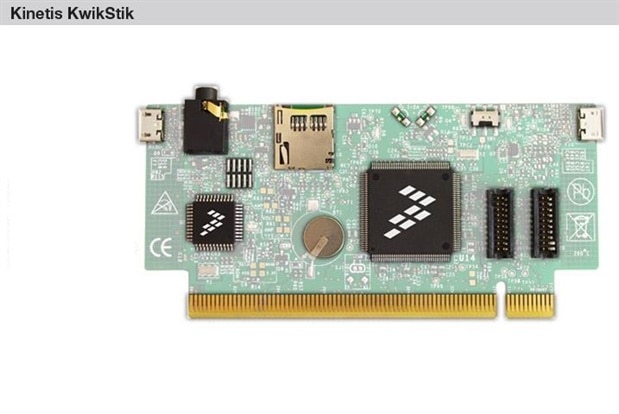
Freescale’s KWIKSTIK-K40 can be combined with other boards or used as a debugging tool.
Some have probably heard of Google’s plan to design a revolutionary smartphone that’s modular. Users can tailor their phones with the components they want and connect them together for increased functionality. What some people don’t know is, some companies are doing the same with development/evaluation boards, allowing users to combine the boards they need for the project at hand.
Freescale’s KWIKSTIK-K40 is a prime example of those modular boards. The board is an excellent tool for development and evaluation in conjunction with the company’s Kinetis MCU platforms. Alternatively, it can be used as a stand-alone debugging drop-in tool as well. It’s outfitted with an ARM Cortex-M4 core, large-segment LCD display, touch-sensing inputs as well as a myriad of connection ports, including two micro USB 2.0 and general-purpose tower plugins. As an extra-added bonus, the board comes preloaded with demonstration software, including FreeMASTER 1.4 and ARM-Keil MDK. The board is incredibly popular in the maker crowd and has been used in some interesting ways, including functioning as an MP3 player, a 4-wheel drive robotic car and even used to run Conway’s Game of Life.
Freescale provides everything needed to get the KWIKSTIK-K40 running, including all necessary connection cables, software DVD and even a plastic enclosure (ghastly orange) all for the low price of $35. Not bad for a dual-purpose evaluation and development board.
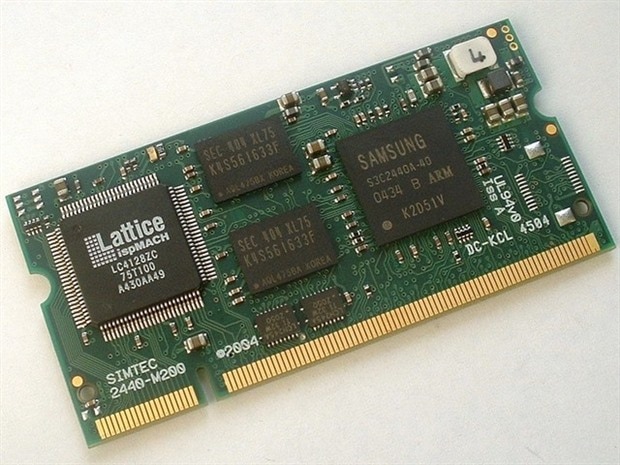
The Samsung 2440 Integrated Module is outfitted with everything needed for a complete system.
Samsung’s Integrated Modules (2410 and 2440 respectively) are another popular all-in-one solution for modular development/evaluation systems. When I was at EELive! 2014, I was introduced to ST’s and Samsung’s Integrated Module Systems. It’s a microcontroller and support hardware, in its simple form, which can be plugged into a daughterboard to expand its functionality.
The big push, I was told by a sales rep at EELive, is allowing the end user to decide what features they want to use with the base microcontroller. Unlike traditional project designs centered on monolithic development boards, the modulistic approach allows designers to change requirements on-the-fly. For example, users select the module they need, such as Samsung’s 2440, and pair with any number of baseboards (such as the BBD20EUROA) to suit their IO needs.
They can then develop their projects in the traditional manner and switch out the modules in case mistakes were made or the project requirements changed. Obviously, those changes can’t be made using a stand-alone board, however the 2440 is similar to those boards, albeit without the IO connections. The modular board features an ARM 920T processor, up to 512MB of NAND Flash for storage and up to 256MB of SDRAM. If that wasn’t enough, it can also be upgraded with some interesting options, including a programmable Li-Ion battery charger, RTC, temp sensor and even a CMOS digital camera. Samsung’s 2440 comes in three flavors (Bronze, Silver or Gold) with the fully outfitted Gold option topping out at around $195.
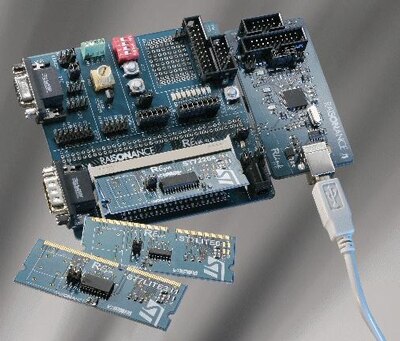
Raisonance’s STM8-SK/RAIS kit for development and evaluation with microcontrollers.
If your interests lie with developing microcontrollers, especially Raisonance’s STM8X microcontrollers then look no further than the company’s REva STM8-SK/RAIS starter kit. Unlike the other boards posted above, the STM8-SK comes with everything users need to begin developing their projects from the get-go, including all the motherboard and software.
The motherboard features one SO-DIMM connector for a variety of daughterboards, including the STM8 and ST7 MCUs. It also comes outfitted with digital/analog IO connections as well as a temperature sensor and potentiometer. The ST7 and STM8 series daughterboards provides the brains and processing power of the kit and feature up to 128KB of Flash memory, up to a 24MHz CPU and up to 2KB of true EEPROM memory. It also features an embedded RLink in-circuit debugging/programming tool (with JTAG protocol) to help with those annoying bugs that are sure to arise when programming comes into play.
Raisonance throws in their Ride7 and RFlasher software suites that include an editor, simulator and compiler as well as a programming interface for the device being used. Unfortunately, the starter kit doesn’t come cheap and costs around $227, however that includes the motherboard, daughterboards and USB cable to power the system.
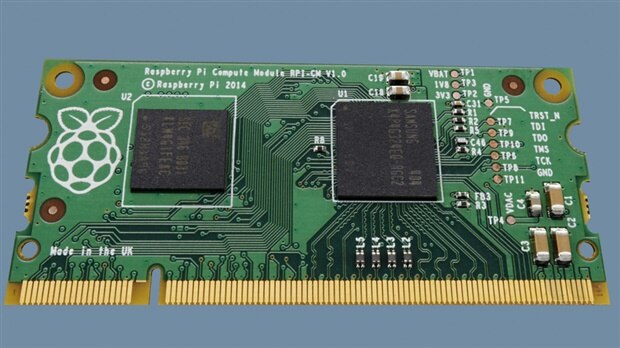

The printed graphic gives this Raspberry Pi Compute Module away. On the right is the initial IO board releasing with the Compute Module. LOOK AT ALL THAT IO!!!!!!!!!
We all know how popular the Raspberry Pi SBC has become since its major release back in 2012 and it only makes sense that the RPi Foundation would embrace the increasing popularity of modular platforms, which is why they are releasing a modular development kit of their own.
The Raspberry Pi Compute Module is essentially a Pi cut down to size and packed onto a SO-DIMM card. That’s right, it’s a Pi the same size as a laptop memory DIMM, however don’t expect to cram it in one as it won’t give the laptop extra Pi power. The Compute Module features the same Broadcom BCM2835 SoC, 512MB of RAM and 4GB eMMC Flash memory as its big brother. The Flash memory in this case, has been connected directly to the CPU on the board, however this leaves the remaining processor interfaces open to the user through the board’s connector pins.
This means you get more GPIOs and interfaces than what the full size Pi can offer. Of course, what’s a modular Pi without a motherboard to slap it in to? Not to worry, as the Foundation has designed an open-source IO breakout board to accommodate the Compute Module. The breakout board supplies the Module with power and a program interface to program the Module’s Flash memory, however the features don’t end there as the motherboard is outfitted with HDMI and USB ports just like its monolithic cousin.
The Pi Foundation designed the Compute Module for those who are looking to design their own PCBs, however with the introduction of the motherboard, everyone can use it for their projects. The Compute Module is expected to be available in kit form sometime this month (June 2014), however the components will be available separately a short time afterwards at a slightly higher cost ($30 for the Compute Module alone). It is unknown at this time what the entire kit will go for but we can be rest assured that it will not break the bank.
C
See more news at:
http://twitter.com/Cabe_Atwell
