



element14 Community
element14 Community
    Register Log In
  • Site
  • Search
  • Log In Register
  • Community Hub
    Community Hub
    • What's New on element14
    • Feedback and Support
    • Benefits of Membership
    • Personal Blogs
    • Members Area
    • Achievement Levels
  • Learn
    Learn
    • Ask an Expert
    • eBooks
    • element14 presents
    • Learning Center
    • Tech Spotlight
    • STEM Academy
    • Webinars, Training and Events
    • Learning Groups
  • Technologies
    Technologies
    • 3D Printing
    • FPGA
    • Industrial Automation
    • Internet of Things
    • Power & Energy
    • Sensors
    • Technology Groups
  • Challenges & Projects
    Challenges & Projects
    • Design Challenges
    • element14 presents Projects
    • Project14
    • Arduino Projects
    • Raspberry Pi Projects
    • Project Groups
  • Products
    Products
    • Arduino
    • Avnet & Tria Boards Community
    • Dev Tools
    • Manufacturers
    • Multicomp Pro
    • Product Groups
    • Raspberry Pi
    • RoadTests & Reviews
  • About Us
    About the element14 Community
  • Store
    Store
    • Visit Your Store
    • Choose another store...
      • Europe
      •  Austria (German)
      •  Belgium (Dutch, French)
      •  Bulgaria (Bulgarian)
      •  Czech Republic (Czech)
      •  Denmark (Danish)
      •  Estonia (Estonian)
      •  Finland (Finnish)
      •  France (French)
      •  Germany (German)
      •  Hungary (Hungarian)
      •  Ireland
      •  Israel
      •  Italy (Italian)
      •  Latvia (Latvian)
      •  
      •  Lithuania (Lithuanian)
      •  Netherlands (Dutch)
      •  Norway (Norwegian)
      •  Poland (Polish)
      •  Portugal (Portuguese)
      •  Romania (Romanian)
      •  Russia (Russian)
      •  Slovakia (Slovak)
      •  Slovenia (Slovenian)
      •  Spain (Spanish)
      •  Sweden (Swedish)
      •  Switzerland(German, French)
      •  Turkey (Turkish)
      •  United Kingdom
      • Asia Pacific
      •  Australia
      •  China
      •  Hong Kong
      •  India
      •  Japan
      •  Korea (Korean)
      •  Malaysia
      •  New Zealand
      •  Philippines
      •  Singapore
      •  Taiwan
      •  Thailand (Thai)
      •  Vietnam
      • Americas
      •  Brazil (Portuguese)
      •  Canada
      •  Mexico (Spanish)
      •  United States
      Can't find the country/region you're looking for? Visit our export site or find a local distributor.
  • Translate
  • Profile
  • Settings
Raspberry Pi
  • Products
  • More
Raspberry Pi
Blog Raspberry Pi 2 ADS-B Receiver
  • Blog
  • Forum
  • Documents
  • Quiz
  • Events
  • Polls
  • Files
  • Members
  • Mentions
  • Sub-Groups
  • Tags
  • More
  • Cancel
  • New
Join Raspberry Pi to participate - click to join for free!
Featured Articles
Announcing Pi
Technical Specifications
Raspberry Pi FAQs
Win a Pi
GPIO Pinout
Raspberry Pi Wishlist
Comparison Chart
Quiz
  • Share
  • More
  • Cancel
Group Actions
  • Group RSS
  • More
  • Cancel
Engagement
  • Author Author: Former Member
  • Date Created: 4 May 2015 3:59 PM Date Created
  • Views 5012 views
  • Likes 20 likes
  • Comments 22 comments
Related
Recommended
  • raspberry
  • pi
  • defined
  • software_defined_radio
  • raspberry_pi
  • radio
  • radar
  • raspberry_pi_2
  • raspberry_pi_space
  • sdr
  • rtl2832u
  • model_b
  • adsb
  • rtl-sdr
  • rtl2832
  • software

Raspberry Pi 2 ADS-B Receiver

Former Member
Former Member
4 May 2015

Why build a radar?

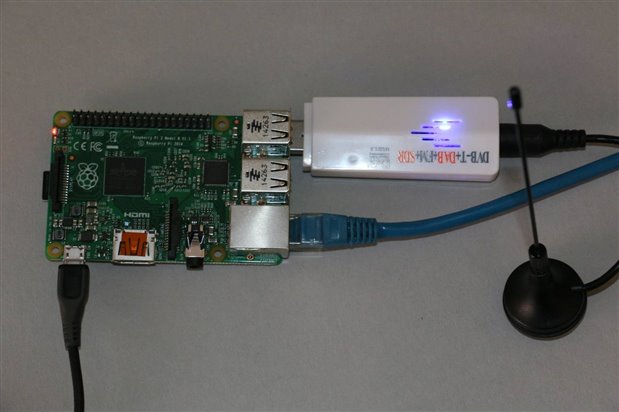
If you have an interest in aircraft then a cheap and easy way to receive details of aircraft near to you is using a cheap USB TV tuner as a software defined radio to decode aircraft radar transponder transmissions. Modern transponders can transmit more than just a squawk code and altitude allowing you to see their identity, position, speed and direction, and a Raspberry Pi is cheap enough to dedicate to the task. Tuners can be had from eBay for less than £10. Here's the hardware I'm using to test:
image

Software setup

Starting with the latest raspbian image apply the latest updates, then we can install a few extra packages and compile the software we need:

sudo apt-get install libusb-1.0.0-dev libmysqlclient-dev cmake

git clone git://git.osmocom.org/rtl-sdr.git

cd rtl-sdr

cmake .

make -j4 (because we have lots of cores to play with on a Pi2)

sudo make install

cd

wget http://lee.smallbone.com/blog/wp-content/uploads/2014/03/dump1090-1.08.1003.14-mysql.tar.gz

tar xvfz dump1090-1.08.1003.14-mysql.tar.gz

cd dump1090-mysql

PREFIX=/usr/local make -j4

cat <<EOF > /etc/modprobe.d/rtl-sdr-blacklist.conf

# This system has librtlsdr0 installed in order to

# use digital video broadcast receivers as generic

# software defined radios.

blacklist dvb_usb_rtl28xxu

blacklist e4000

blacklist rtl2832

EOF

cp dump1090 view1090 /usr/local/bin/

cp -av public_html /usr/local/share/dump1090


At this point you have the software built, but linux will have loaded the tv drivers not the sdr drivers. The simplest solution to this is a reboot.


Actually receiving data


Once things are up and running again you can fire up dump1090:

dump1090 --interactive --net --modeac --phase-enhance --aggressive --net-http-port 8080

You should see something like this in your terminal:
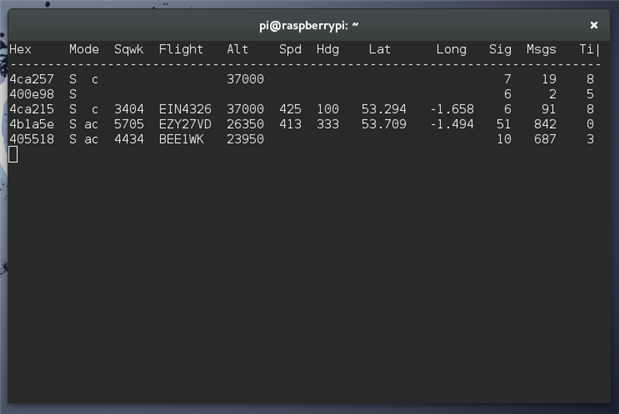
image

This shows you any aircraft being received. For a more interesting view point your browser to port 8080 on your Pi and you should see something like this:
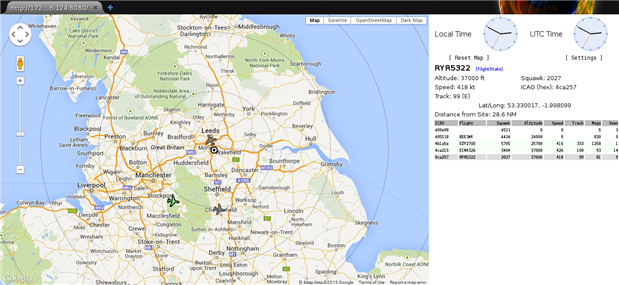
image

So now you have a list of the local aircraft, and a map showing their position. Selecting an aircraft will cause its track to be recorded and displayed. The centre of the map and the range rings can be configured for your location - you need to edit the config.js file in /usr/local/share/dump1090


Pi or Pi 2?

I've been running this setup on an original Pi Model B for a number of months logging to a database and also supplying data to Flightradar24. The load average on an original Pi is around 1.05 and this causes it to slowly grind to a halt and eventually become completely unresponsive. A reboot solves this but is annoying if you're trying to collect long term data. Running the same software on a Pi 2 results in a loadaverage of 0.43 - so you could probably get away with running multiple receivers on a single system.


So is it worth an upgrade?

If you're just running dump1090 to see whats around you then an original Pi will just about cope. Once you want to actually do something with the data then a Pi 2 will really make a difference to the performance and stability of the system.

  • Sign in to reply

Top Comments

  • Former Member
    Former Member over 10 years ago +1
    Very cool. I love rtl-sdr stuff. Another good platform is the odroid . Powerful enough to add a 2nd stick and maybe AIS or some voice.
  • Former Member
    Former Member over 10 years ago in reply to Former Member +1
    Starting it with this commandline will remove networking: dump1090 --interactive --modeac --phase-enhance --aggressive If you're really worried about performance you can remove the phase-enhance and aggressive…
  • Former Member
    Former Member over 10 years ago in reply to Former Member

    I'm afraid that chipset isn't supported. You need something based on the RTL2832U chipset.

    • Cancel
    • Vote Up 0 Vote Down
    • Sign in to reply
    • More
    • Cancel
  • Former Member
    Former Member over 10 years ago in reply to Former Member

    The receiver stick is just plugged directly into the Pi. Never had any power problems.

    • Cancel
    • Vote Up 0 Vote Down
    • Sign in to reply
    • More
    • Cancel
  • Former Member
    Former Member over 10 years ago

    Hi all,


    I am trying to setup this amazing tutorial on my raspberry 2.

    I have 2 different DVB-T USB sticks, one is using AF9015 firmware, the other the AF9035. I have followed the tutorial, but then after the reboot I try to launch the dump1090, but it say:

    -bash: dump1090: command not found

    Then I have tried to use the "rtl_test -t" command and I have:

    No supported devices found.


    Any idea of how to use one of those DVB-T stick?

    Thanks

    • Cancel
    • Vote Up 0 Vote Down
    • Sign in to reply
    • More
    • Cancel
  • clem57
    clem57 over 10 years ago in reply to Former Member

    I run mine on a separate hub.

    Clem

    • Cancel
    • Vote Up 0 Vote Down
    • Sign in to reply
    • More
    • Cancel
  • Former Member
    Former Member over 10 years ago

    Hi,


    A simple question. Are you running the RTL-SDR from the Raspberry Pi power supply or from a separate 5 Volt supply?


    Rein Smit

    • Cancel
    • Vote Up 0 Vote Down
    • Sign in to reply
    • More
    • Cancel
<>
element14 Community

element14 is the first online community specifically for engineers. Connect with your peers and get expert answers to your questions.

  • Members
  • Learn
  • Technologies
  • Challenges & Projects
  • Products
  • Store
  • About Us
  • Feedback & Support
  • FAQs
  • Terms of Use
  • Privacy Policy
  • Legal and Copyright Notices
  • Sitemap
  • Cookies

An Avnet Company © 2026 Premier Farnell Limited. All Rights Reserved.

Premier Farnell Ltd, registered in England and Wales (no 00876412), registered office: Farnell House, Forge Lane, Leeds LS12 2NE.

ICP 备案号 10220084.

Follow element14

  • X
  • Facebook
  • linkedin
  • YouTube