element14 Community
element14 Community
    Register Log In
  • Site
  • Search
  • Log In Register
  • Community Hub
    Community Hub
    • What's New on element14
    • Feedback and Support
    • Benefits of Membership
    • Personal Blogs
    • Members Area
    • Achievement Levels
  • Learn
    Learn
    • Ask an Expert
    • eBooks
    • element14 presents
    • Learning Center
    • Tech Spotlight
    • STEM Academy
    • Webinars, Training and Events
    • Learning Groups
  • Technologies
    Technologies
    • 3D Printing
    • FPGA
    • Industrial Automation
    • Internet of Things
    • Power & Energy
    • Sensors
    • Technology Groups
  • Challenges & Projects
    Challenges & Projects
    • Design Challenges
    • element14 presents Projects
    • Project14
    • Arduino Projects
    • Raspberry Pi Projects
    • Project Groups
  • Products
    Products
    • Arduino
    • Avnet & Tria Boards Community
    • Dev Tools
    • Manufacturers
    • Multicomp Pro
    • Product Groups
    • Raspberry Pi
    • RoadTests & Reviews
  • About Us
    About the element14 Community
  • Store
    Store
    • Visit Your Store
    • Choose another store...
      • Europe
      •  Austria (German)
      •  Belgium (Dutch, French)
      •  Bulgaria (Bulgarian)
      •  Czech Republic (Czech)
      •  Denmark (Danish)
      •  Estonia (Estonian)
      •  Finland (Finnish)
      •  France (French)
      •  Germany (German)
      •  Hungary (Hungarian)
      •  Ireland
      •  Israel
      •  Italy (Italian)
      •  Latvia (Latvian)
      •  
      •  Lithuania (Lithuanian)
      •  Netherlands (Dutch)
      •  Norway (Norwegian)
      •  Poland (Polish)
      •  Portugal (Portuguese)
      •  Romania (Romanian)
      •  Russia (Russian)
      •  Slovakia (Slovak)
      •  Slovenia (Slovenian)
      •  Spain (Spanish)
      •  Sweden (Swedish)
      •  Switzerland(German, French)
      •  Turkey (Turkish)
      •  United Kingdom
      • Asia Pacific
      •  Australia
      •  China
      •  Hong Kong
      •  India
      •  Japan
      •  Korea (Korean)
      •  Malaysia
      •  New Zealand
      •  Philippines
      •  Singapore
      •  Taiwan
      •  Thailand (Thai)
      •  Vietnam
      • Americas
      •  Brazil (Portuguese)
      •  Canada
      •  Mexico (Spanish)
      •  United States
      Can't find the country/region you're looking for? Visit our export site or find a local distributor.
  • Translate
  • Profile
  • Settings
Raspberry Pi
  • Products
  • More
Raspberry Pi
Raspberry Pi Forum Lowest cost ARM + Arduino headers expansion for Pi
  • Blog
  • Forum
  • Documents
  • Quiz
  • Events
  • Polls
  • Files
  • Members
  • Mentions
  • Sub-Groups
  • Tags
  • More
  • Cancel
  • New
Join Raspberry Pi to participate - click to join for free!
Featured Articles
Announcing Pi
Technical Specifications
Raspberry Pi FAQs
Win a Pi
Raspberry Pi Wishlist
Actions
  • Share
  • More
  • Cancel
Forum Thread Details
  • Replies 31 replies
  • Subscribers 687 subscribers
  • Views 4037 views
  • Users 0 members are here
  • raspberry_pi
Related

Lowest cost ARM + Arduino headers expansion for Pi

morgaine
morgaine over 13 years ago

As Eben Upton has often said, Arduino and Raspberry Pi don't really compete significantly because they're so different (maybe just 10% overlap).  They should instead be regarded as complementary.  When the rather meagre hardware interfacing of the Pi is not enough for your project, combining an Arduino with your Pi will often provide a very effective mix of extensive low-level interfacing and high-level programmability.


However,  traditional Arduino boards are based on 8-bit microcontrollers, and although these are perfect for a huge range of applications, there are times when it is desireable to use an ARM microcontroller when interfacing with the Pi's ARM1176, and not only for ARM symmetry.  Some things are simply easier to do with a 32-bit processor, and if processing speed matters in your application then an ARM microcontroller will almost always leave the 8-bit micro way behind.


Unfortunately your options become somewhat limited if you want to use an ARM microcontroller board yet still want to enjoy the ability to use Arduino "shields", the many hundreds of daughterboards that can plug into an Arduino board's headers and which make Arduino such a singularly impressive ecosystem.  Although the Arduino organization will soon be releasing their own ARM-based Arduino Due using an Atmel SAM3X8E device (a Cortex-M3), it's not officially out yet (despite having been sighted on flickr), and not many third parties have tackled this empty spot in the market.


The best known are probably the Maple from LeafLabs http://leaflabs.com/devices/maple/ , and the Olimexino-STM32 from Olimex http://www.olimex.com/dev/olimexino-stm32.html which offers quite a lot more and yet is cheaper (£16.96 from Farnell).  Both are based on an ARM Cortex-M3 from ST, and offer a degree of Arduino header compatibility.


Well, this area is about to be given an interesting shakeup, courtesy of yet another ARM licensee, Freescale.  Their Kinetis KL25Z Freedom Board is now on pre-order at Element 14:


  • http://www.element14.com/community/community/knode/dev_platforms_kits/element14_dev_kits/kinetis_kl2_freedom_board
  • http://uk.farnell.com/freescale-semiconductor/kl25z128vlk/board-kinetis-l-series-kl25z/dp/2115294?COM=freedompage_knode ,


and you really can't go wrong at its board price of £8.10 + Arduino header form factor . image


Admittedly the Kinetis KL25Z's KL2 microcontroller is a Cortex-M0 which is the little brother of the Cortex-M3, but for hardware interfacing that will often be more than ample and is still a huge step up from the 8-bit AVR.  What's more, it's highly likely to undercut the price of Arduino's about-to-be-released Arduino Due, so things may get quite interesting in this market niche.


[Added note:  the Kinetis KL25Z board uses  uses a Cortex-M0+, not M0  -- see post 16, http://www.element14.com/community/message/54650#54650 ]


For expanding the Pi (and the BeagleBone too) into the Arduino niche, the Kinetis KL25Z looks extremely good to me. Admittedly, it won't provide anything like the power of an STM32F4-Discovery board which uses a Cortex-M4  http://uk.farnell.com/stmicroelectronics/stm32f4discovery/board-eval-stm32f4-discovery/dp/2009276?Ntt=STM32F4-Discovery , and at £9.96 from Farnell this Discovery is the very clear price-performance leader.  However, the Kinetis KL25Z has the Arduino form factor, and that may make all the difference.  YMMV !!


Very interesting times ahead! image


And just in case that isn't tempting enough, ST's Discovery range has a Cortex-M0 version, the STM32F0-Discovery http://uk.farnell.com/stmicroelectronics/stm32f0discovery/eval-board-cortex-m0-stm32f0/dp/2096251?Ntt=STM32F0-Discovery which is even cheaper at £5.88.  If Arduino headers aren't essential but you want the cheapest possible Cortex-M0 board to expand your Pi, beating £5.88 on sheer price will be very hard.  It's fairly safe to predict that the Cortex-M0[+] range is going to have a colossal impact.


Morgaine.

  • Sign in to reply
  • Cancel
Parents
  • morgaine
    morgaine over 13 years ago

    Apparerently the illustration for the Kinetis KL25Z Freedom Board shown at the Farnell ordering link I gave is wrong,  Element 14's knode page shows it more accurately ---


    • http://www.element14.com/community/community/knode/dev_platforms_kits/element14_dev_kits/kinetis_kl2_freedom_board


    You can read "Freedom KL25Z" there on expanded images of the board, which inspires confidence that it's the right picture.


    Still no sign of a proper board document though, nor a real datasheet for the KL25Z128VLK4 processor on it, just general KL24/KL25 product briefs.


    I take the hard engineering line on this:  no datasheet == vapourware. image

    • Cancel
    • Vote Up 0 Vote Down
    • Sign in to reply
    • Cancel
  • GregC
    GregC over 13 years ago in reply to morgaine

    Morgaine Dinova wrote:


    Apparerently the illustration for the Kinetis KL25Z Freedom Board shown at the Farnell ordering link I gave is wrong,  Element 14's knode page shows it more accurately ---


    • http://www.element14.com/community/community/knode/dev_platforms_kits/element14_dev_kits/kinetis_kl2_freedom_board


    You can read "Freedom KL25Z" there on expanded images of the board, which inspires confidence that it's the right picture.


    Still no sign of a proper board document though, nor a real datasheet for the KL25Z128VLK4 processor on it, just general KL24/KL25 product briefs.


    I take the hard engineering line on this:  no datasheet == vapourware. image


    Documentation (Reference Manual or Datasheet) from Freedom board should be available in max 2 weeks as it is still in examination.


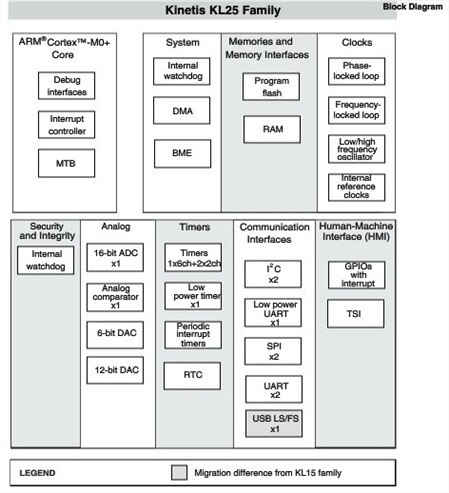
    I would like just highlight some interesting features from KL25 silicon illustrated with the bloc diagram found in its product brief

    - Analog to Digital Converter with a resolution up to 16-bit

    - Touch Sensor Interface

    - RTC

    image

    • Cancel
    • Vote Up +1 Vote Down
    • Sign in to reply
    • Cancel
  • morgaine
    morgaine over 13 years ago in reply to GregC

    Expanding on my first post, after being prompted by Greg -- thanks! image


    It's worth pointing out that the ARM on the Freescale KL25Z128VLK4 device is correctly termed a Cortex-M0+ and not a Cortex-M0 at all.  And no, this is not just Marketting inventing a new term for a brochure (as one might cynically expect), but an official redesigned ARM core.  This caught me out initially, as I hadn't realized that ARM had officially released a new M0+ core as an improvement over their M0, but they have.  The info from ARM is here --- http://www.arm.com/products/processors/cortex-m/cortex-m0plus.php


    This seems like a very nice little device, and I'm really looking forward to using it, both with Pi and standalone. image


    Morgaine.

    • Cancel
    • Vote Up 0 Vote Down
    • Sign in to reply
    • Cancel
Reply
  • morgaine
    morgaine over 13 years ago in reply to GregC

    Expanding on my first post, after being prompted by Greg -- thanks! image


    It's worth pointing out that the ARM on the Freescale KL25Z128VLK4 device is correctly termed a Cortex-M0+ and not a Cortex-M0 at all.  And no, this is not just Marketting inventing a new term for a brochure (as one might cynically expect), but an official redesigned ARM core.  This caught me out initially, as I hadn't realized that ARM had officially released a new M0+ core as an improvement over their M0, but they have.  The info from ARM is here --- http://www.arm.com/products/processors/cortex-m/cortex-m0plus.php


    This seems like a very nice little device, and I'm really looking forward to using it, both with Pi and standalone. image


    Morgaine.

    • Cancel
    • Vote Up 0 Vote Down
    • Sign in to reply
    • Cancel
Children
No Data
element14 Community

element14 is the first online community specifically for engineers. Connect with your peers and get expert answers to your questions.

  • Members
  • Learn
  • Technologies
  • Challenges & Projects
  • Products
  • Store
  • About Us
  • Feedback & Support
  • FAQs
  • Terms of Use
  • Privacy Policy
  • Legal and Copyright Notices
  • Sitemap
  • Cookies

An Avnet Company © 2026 Premier Farnell Limited. All Rights Reserved.

Premier Farnell Ltd, registered in England and Wales (no 00876412), registered office: Farnell House, Forge Lane, Leeds LS12 2NE.

ICP 备案号 10220084.

Follow element14

  • X
  • Facebook
  • linkedin
  • YouTube