element14 Community
element14 Community
    Register Log In
  • Site
  • Search
  • Log In Register
  • Community Hub
    Community Hub
    • What's New on element14
    • Feedback and Support
    • Benefits of Membership
    • Personal Blogs
    • Members Area
    • Achievement Levels
  • Learn
    Learn
    • Ask an Expert
    • eBooks
    • element14 presents
    • Learning Center
    • Tech Spotlight
    • STEM Academy
    • Webinars, Training and Events
    • Learning Groups
  • Technologies
    Technologies
    • 3D Printing
    • FPGA
    • Industrial Automation
    • Internet of Things
    • Power & Energy
    • Sensors
    • Technology Groups
  • Challenges & Projects
    Challenges & Projects
    • Design Challenges
    • element14 presents Projects
    • Project14
    • Arduino Projects
    • Raspberry Pi Projects
    • Project Groups
  • Products
    Products
    • Arduino
    • Avnet & Tria Boards Community
    • Dev Tools
    • Manufacturers
    • Multicomp Pro
    • Product Groups
    • Raspberry Pi
    • RoadTests & Reviews
  • About Us
  • Store
    Store
    • Visit Your Store
    • Choose another store...
      • Europe
      •  Austria (German)
      •  Belgium (Dutch, French)
      •  Bulgaria (Bulgarian)
      •  Czech Republic (Czech)
      •  Denmark (Danish)
      •  Estonia (Estonian)
      •  Finland (Finnish)
      •  France (French)
      •  Germany (German)
      •  Hungary (Hungarian)
      •  Ireland
      •  Israel
      •  Italy (Italian)
      •  Latvia (Latvian)
      •  
      •  Lithuania (Lithuanian)
      •  Netherlands (Dutch)
      •  Norway (Norwegian)
      •  Poland (Polish)
      •  Portugal (Portuguese)
      •  Romania (Romanian)
      •  Russia (Russian)
      •  Slovakia (Slovak)
      •  Slovenia (Slovenian)
      •  Spain (Spanish)
      •  Sweden (Swedish)
      •  Switzerland(German, French)
      •  Turkey (Turkish)
      •  United Kingdom
      • Asia Pacific
      •  Australia
      •  China
      •  Hong Kong
      •  India
      • Japan
      •  Korea (Korean)
      •  Malaysia
      •  New Zealand
      •  Philippines
      •  Singapore
      •  Taiwan
      •  Thailand (Thai)
      • Vietnam
      • Americas
      •  Brazil (Portuguese)
      •  Canada
      •  Mexico (Spanish)
      •  United States
      Can't find the country/region you're looking for? Visit our export site or find a local distributor.
  • Translate
  • Profile
  • Settings
Raspberry Pi
  • Products
  • More
Raspberry Pi
Raspberry Pi Forum More power/heat related problems ...
  • Blog
  • Forum
  • Documents
  • Quiz
  • Events
  • Polls
  • Files
  • Members
  • Mentions
  • Sub-Groups
  • Tags
  • More
  • Cancel
  • New
Join Raspberry Pi to participate - click to join for free!
Featured Articles
Announcing Pi
Technical Specifications
Raspberry Pi FAQs
Win a Pi
Raspberry Pi Wishlist
Actions
  • Share
  • More
  • Cancel
Forum Thread Details
  • Replies 15 replies
  • Subscribers 679 subscribers
  • Views 2488 views
  • Users 0 members are here
  • raspberry
  • heat
  • issues
  • raspberry_pi
  • raspberrypi
  • thermal
  • power
Related

More power/heat related problems ...

jamodio
jamodio over 13 years ago

I think I found another problem I didn't notice before.


I have the R-pi hooked up in the prototyping gig I described on another thread (http://www.element14.com/community/thread/18981?tstart=0),

currently no keyboard, HDMI monitor, just network and access to console via the serial port.


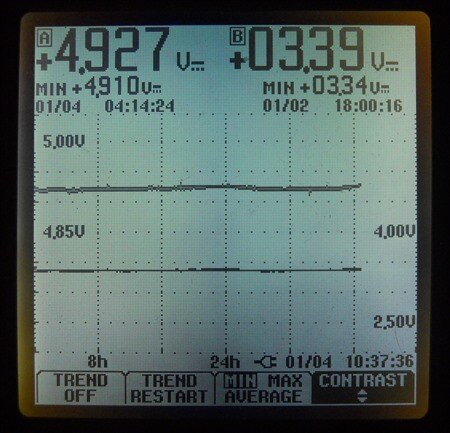
I've been running a trend plot monitoring the +5V feed to the R-pi and the output of the 3.3V on board regulator. I noticed that gradually

the voltage out of the regulator has increased from 3.30V to almost 3.39V, it is actually not doing much, just responding to ping packtes

(flood mode) I'm sending from another machine and serving the serial console I use once in a while to run procinfo and network stats.


I guess the voltage increase is probably not noticeable when there is more load and current draw, the only thing I can think of is self

heating of the LDO. I just placed one of the little heatsinks I've got for the LAN9512 on the LDO and seems that output voltage is starting

to slowly drop. I'll keep this configuration to see if with the heatsink the voltage keeps droping.
 

image


-J

  • Sign in to reply
  • Cancel
  • morgaine
    morgaine over 13 years ago

    Interesting.  My RG2 output has been rock steady on 3.322-3.323V since the beginning, and the board is permanently playing music from an NFS server while I'm awake.  TP1 to ground doesn't vary either, totally pegged at 4.89V.  Temperature-wise, RG1 is at "1 second finger-test" temperature, so not blisteringly hot like the LAN9512.

    • Cancel
    • Vote Up 0 Vote Down
    • Sign in to reply
    • Cancel
  • Former Member
    Former Member over 13 years ago

    Looking at a data sheet the top end spec for a LDO1117 type device should be 3.333V and reduces with increased temperature. Heatsinking isn't going to hurt though. I take it that there is nothing connected across from your external psu that would influence things?

    • Cancel
    • Vote Up 0 Vote Down
    • Sign in to reply
    • Cancel
  • jamodio
    jamodio over 13 years ago in reply to Former Member

    Nope, nothing from the external supply, I'm not using a USB psu, it is a direct 5V fee to P1 from a DC-DC converter powered by a bench ps.


    I removed the heatsink and stuck a temperature probe on the tab of RG2, and restarted the trend plot. The output of RG2 is showing now about 3.36V

    and temperature is about 40C (ambient is about 27C).


    It is not a big deal because we are still within spec, and it could have been a measurement anomaly, particularly with LDOs you can have some

    variance when the rest of the circuit draws more or less current. I noticed that with the keyboard and HDMI connected the output of RG1 is

    slighlty lower, I have no means how to measure the current draw out of it.


    Another test I'm thinking of is to remove RG2 and feed the 3.3V with an external ps to P1 via and ampmeter and get some baseline current draw

    profile with the R-pi doing different things and stuff like the HDMI monitor connected or not.


    I've no clue if anybody at RPF did this kind of tests or not. Is there any record or discussions when the board was on the early design phase ?


    -J

    • Cancel
    • Vote Up 0 Vote Down
    • Sign in to reply
    • Cancel
  • jamodio
    jamodio over 13 years ago

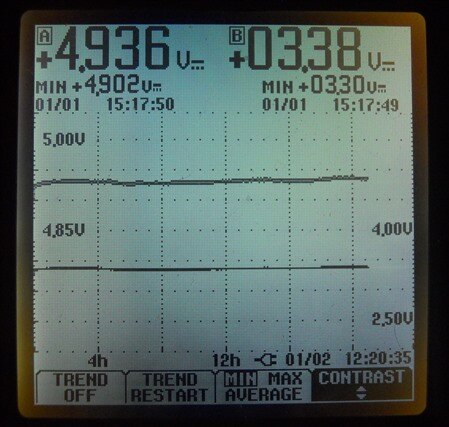
    Still can't explain it but something is going on, over a period of 40 hours the output of RG2 has been increasing from 3.34V to 3.39V,

    temperature shows now 44.2C and trending up. This is without the heatsink.


    image


    I'm tempted to replace the part and see what happens.


    -J

    • Cancel
    • Vote Up 0 Vote Down
    • Sign in to reply
    • Cancel
  • Former Member
    Former Member over 13 years ago in reply to jamodio

    You have looked for instability (HF oscillations) with your scope? These issues can be down to (input /) output capacitors. Maybe reflow the solder on these components as well as the regulator. Looking at the trace your 5V line seems to be trending upwards as well?


    I assume that you have double checked your readings against another measuring device? Or against another piece of kit with a similar regulator. Its just that the 3.34V start value is out of spec to start with.


    For the cost of these things if you are comfortable doing the job then what's to lose. Looks as though its easy to get at as well.

    • Cancel
    • Vote Up 0 Vote Down
    • Sign in to reply
    • Cancel
  • jamodio
    jamodio over 13 years ago in reply to Former Member

    Still not a definitive explanation but I believe the issue is ambient temperature, I'm cranking up the air conditioner to reduce my office temperature from about 27C to 25C and now the output of RG2 shows 3.36V.


    I think that since there are several components generating heat and it gets conducted through the power planes, it may generate sort of a cascading event where the internal temperature of some parts start to trigger side effects.


    I'll hookup the rework station at some moment to replace the part and test with other regulators I've believe have in stock with the same package.


    While the part number on the schematics is shown as NCP1117, the part installed on at least the two boards I've is numbered SE8117T33, which is not from any well known major semiconductor company but a chinese cheap knock off, it could also be a counterfit part, not uncommon when sourcing some parts from China.


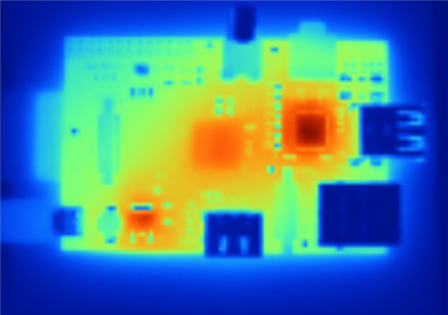
    This thermal image taken by "Remy" from Spain shows really where the heat is, if you follow the orange haze you can see how heat is being conducted by the board and not just staying around the hot components.


    image


    I wonder how many Raspberry Pi's will get "cooked" when people start to put them in cases.


    -J

    • Cancel
    • Vote Up +1 Vote Down
    • Sign in to reply
    • Cancel
  • morgaine
    morgaine over 13 years ago in reply to jamodio

    Interesting image, where was that posted?  Any more info, like the temperature of the LAN9512 at the time?

    • Cancel
    • Vote Up 0 Vote Down
    • Sign in to reply
    • Cancel
  • jamodio
    jamodio over 13 years ago in reply to morgaine

    The original post is in spanish. Here is the link ...

    http://www.geektopia.es/es/technology/2012/06/22/articulos/se-calienta-el-ordenador-raspberry-pi-estudio-de-sus-temperaturas-en-funcionamiento.html


    -J

    • Cancel
    • Vote Up +1 Vote Down
    • Sign in to reply
    • Cancel
  • johnbeetem
    johnbeetem over 13 years ago in reply to jamodio

    Interesting images.  I notice that 1.8V regulator RG1 (near GPIO connector) isn't the slightest bit warm.  That would tend to confirm your theory that the LAN9512 may be supplying 1.8V to the SoC and DRAM, adding to the LAN9512's power problems.

    • Cancel
    • Vote Up 0 Vote Down
    • Sign in to reply
    • Cancel
  • jamodio
    jamodio over 13 years ago in reply to johnbeetem

    That's a very interesting observation John, on all the thermal images RG1 looks cold. Unfortunatelly we don't have ANY electrical specs of the SoC, not even for the GPIO pins, to have at least a reference on what current draw to expect from the device and how the internal architecture looks is.


    There are other pins from the schematics that would be interesting to know what are they and how they are supposed to be connected, for example SLDO_1V8_1 and SLDO_1V8_2 on the BCM2835 which seems to have some internal power supply block that generates several voltages, I'm pretty sure there is an internal switched power supply for VDD_OUT given the existance of L5 and a feedback loop.


    Then is SLDO_1V8 an internal LDO to feed 1.8V to the PoP SDRAM ? if so why it is connected to the +1V8 plane ?

    (Notice the comment on the sch "Used to be called SDRAM_1V8 on previous issues".)


    Another question is, why all VDD_BATx pins are connected directly to +5V0, or why the VDDIO1_x pins are fed from what looks as an internal VDDIO power supply and VDDIO2_x and the other peripheral blocks like HDMI are fed from the +3V3 plane.


    I'll put out a warning out there to be carefull on what you put on the GPIO ports and if you use the +3V3 line to supply power to any external circuitry.


    IMHO the entire power architecture on this design is a big mistery and after reading Pete's May 8th article in newselectronics now is pretty clear that the Raspberry Pi has not been a design from scratch but started as "a proof of concept" (the "alpha" board) from Broadcom which Pete canibalized for cost and size.


    Hard to say from just looking at the picture of the "alpha" board, besides having a decent DC power jack and a polarity protection diode, the circuitry around U1 and U3 look to me like a switching DC-DC converters and there is an ON Semiconductor 1.8V LDO (bigger package than RG1.)


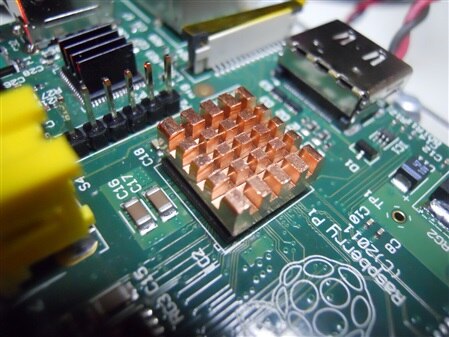
    Anyway, yesterday arrived the little heatsink that I ordered via eBay for the SoC:

    image


    Next week I'll replace RG2 by an original part from ON Semi, and since I'll fire up the rework station also replace the polyfuses on the USB lines by 0 ohm resistors.


    -J

    • Cancel
    • Vote Up 0 Vote Down
    • Sign in to reply
    • Cancel
>
element14 Community

element14 is the first online community specifically for engineers. Connect with your peers and get expert answers to your questions.

  • Members
  • Learn
  • Technologies
  • Challenges & Projects
  • Products
  • Store
  • About Us
  • Feedback & Support
  • FAQs
  • Terms of Use
  • Privacy Policy
  • Legal and Copyright Notices
  • Sitemap
  • Cookies

An Avnet Company © 2025 Premier Farnell Limited. All Rights Reserved.

Premier Farnell Ltd, registered in England and Wales (no 00876412), registered office: Farnell House, Forge Lane, Leeds LS12 2NE.

ICP 备案号 10220084.

Follow element14

  • X
  • Facebook
  • linkedin
  • YouTube