Yet another ARM Cortex board ... The pcDuino com ... getting one to see how compares with the Rpi ...
Atr least I didn't have to wake up in wee hours like a year ago to get one.
Cheers
Jorge

Yet another ARM Cortex board ... The pcDuino com ... getting one to see how compares with the Rpi ...
Atr least I didn't have to wake up in wee hours like a year ago to get one.
Cheers
Jorge

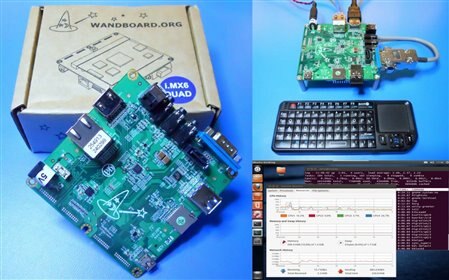
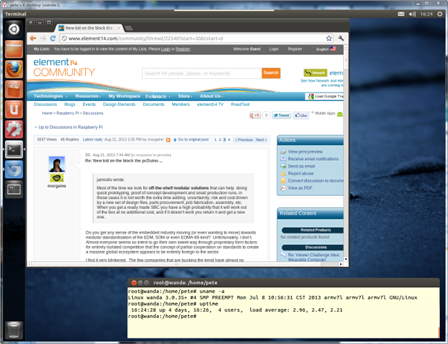
I've the Wandboard Quad on the bench, worked out of the box !
Added the WiFi antenna, few minutes configuration via the ubuntu system settings, and joined my WiFi network without a glitch.
Very, very impressed with the quality of video, even playing videos through vnc. Nicely done. Blog article coming soon ...
Cheers
Jorge
You are welcome Drew.
I do embedded system development and R&D on Internet of Things, so I'm always looking for modular solutions where an RTOS is not enough or needs to be complemented with something that can support eLinux, so yes I've a large collection of sbc's and trying to make some time to start writing some blog articles about them.
Cheers
Jorge
Drew Fustini wrote:
Off-topic... when I advocate OSHW, one of the points I makes is that it enables a professional engineer to modify a devkit or SBC to optimize for their use case. Do you ever do this? It would be interesting to have some examples to back up this theory.
Yes it is a lot of fun, never took a job that I didn't have fun doing it 
About your question, it depends on the application and the volume. Most of the time we look for off-the-shelf modular solutions that can help doing quick prototyping, proof of concept development and small production runs, in those cases it is not worth the extra time adding uncertainity, risk and cost driven by a new set of design files, parts procurement, pcb fabrication, assembly, etc. When you get a ready made SBC you have a high probability that it will work out of the box at no additional cost, and if it doesn't work you return it and get a new one.
Now if the application requires a lot of customization, the volume justifies the extra design and production costs or you are trying also to increase reliability, having an OSHW design gives you a better starting point than starting from scratch, but again it has a lot to do with the application and the costs.
One of the great benefits of OSHW besides that you can modify an existing design, is that you can learn a lot by looking at the deteails on the design files, for example on dense pcb layouts a bga fan out and scape routing strategy that you know it worked, or placement of decoupling caps, parts used on the design like a PMIC that you can consider using in your designs, etc.
Also having full access to design files helps to perform a more educated analysis of a particular SBC, most of the time in serious engineering you can't keep folks happy with the taste of the sausage, we really want to know what is on it and how it is made.
My .02
Jorge
jamodio wrote:
Most of the time we look for off-the-shelf modular solutions that can help doing quick prototyping, proof of concept development and small production runs, in those cases it is not worth the extra time adding uncertainity, risk and cost driven by a new set of design files, parts procurement, pcb fabrication, assembly, etc. When you get a ready made SBC you have a high probability that it will work out of the box at no additional cost, and if it doesn't work you return it and get a new one.
Do you get any sense of the embedded industry moving (or even wanting to move) towards modular standardisation of the EDM, SOM or even EOMA-68 kind? Unfortunately, I don't. Almost everyone seems so intent to go their own sweet way through proprietary form factors for entirely isolated competition that the concept of partial cooperation on standards to create a massive global ecosystem appears to be entirely foreign to the sector.
I find it very blinkered. The few companies that are bucking the trend have almost no mindshare and so the few modular systems remain niche and expensive. As a result, there isn't even a cost carrot to break the vicious cycle.
Morgaine Dinova wrote:
Do you get any sense of the embedded industry moving (or even wanting to move) towards modular standardisation of the EDM, SOM or even EOMA-68 kind? Unfortunately, I don't.
EDM seems to have some mindshare, but the wandboard seems to be the cheapest and most powerful example. I know some folks here like EOMA, but I'm skeptical. EDM clearly isn't gaining acceptance, so what killer feature would EOMA have that EDM doesn't in already existing products ?
Nope, I don't see any clear signs of any coordinated effort to generate an industry standard for modular SBCs, also I don't know how feasible that could be with such a diverse universe of SoC or application processors.
What I see as modular is something that can be taken as a "module" and integrated into another board for a specific application, good solutions are those where most of the interesting signals/interface/power are brought to some sort of expansion connector.
The Raspberry Pi for example is not good at all, I'd say that the Beagle Bone [Black] is one of the best given that strikes a good balance on type and quantity of signals in a pair of standard and cheap header connectors.
The Wandboard is on the other side of the spectrum, almost all signals are on the connector to the motherboard but it is not as cheap or standard to be integrated.
Olimex is very good on this front for simple applications.
The Cubie board is an interesting option but documentation is very scarce.
I still have the pcDuino on my list of things to test, but this is another Allwinner board so documentation is not good either, and not that many IO and as easy to integrate like the BBB.
You also have to give some points for quality of design and production, and very very important what development tools and support community you have around.
Adding everything up if I have today to pick a winner it will be the Beagle Bone Black.
My. 02
Jorge
You're both confirming the impression I'd gained of the state of play in modular boards. That's a pity.
Although we have no power to influence the direction of industry in any significant way, perhaps there is room for enthusiast-level design (or promotion) of OSHW modular systems independent of industry, if only one major barrier could be overcome.
BGA is the big elephant in the room, a nearly impossible hurdle placed between SoC manufacturers and enthusiasts (yes I know that a few enthusiasts can handle BGA, but that doesn't change the statistics much). There is however a way of cutting the elephant down to size, and that is to choose a cheap intermediate adapter form that is easier to handle, and then getting the BGA-on-adapters mass produced for not a lot more than the SoCs themselves. Based on these pre-mounted BGAs, enthusiasts could then take module design in directions where the embedded industry has not found a reason to go. Coupled with 3D printing, modular enthusiast OSHW computers would then be not too far-fetched an idea.
The current direction in which every board is different and requires its own case design and mandates almost wholesale reinvestment when you change manufacturers is really bad. The OSHW community could chose to do better than this, even if industry doesn't want to help.
Addendum: I've just realized that this is the Pi group, singularly the wrong place to be having a discussion about OSHW modules. The chances of getting a BCM2835 on a bare BGA-adapter boardlet are not very good. 
jamodio wrote:
The Wandboard is on the other side of the spectrum, almost all signals are on the connector to the motherboard but it is not as cheap or standard to be integrated.
As I understand it, the wandboard follows the EDM 'standard'. I'd been kind of hoping it might help drive some more adoption.
jamodio wrote:
The Wandboard is on the other side of the spectrum, almost all signals are on the connector to the motherboard but it is not as cheap or standard to be integrated.
As I understand it, the wandboard follows the EDM 'standard'. I'd been kind of hoping it might help drive some more adoption.
selsinork wrote:
As I understand it, the wandboard follows the EDM 'standard'. I'd been kind of hoping it might help drive some more adoption.
An OSHW kickstarter campaign to put one (or all) of TI, Allwinner, Samsung and ST applications processors on the same EDM form factor as was used by Wandboard for Freescale's i.MX6 aren't beyond the bounds of possibility. Kickstarters have been successful with far stupider goals.
selsinork wrote:
jamodio wrote:
The Wandboard is on the other side of the spectrum, almost all signals are on the connector to the motherboard but it is not as cheap or standard to be integrated.
As I understand it, the wandboard follows the EDM 'standard'. I'd been kind of hoping it might help drive some more adoption.
There is no such thing as an "EDM standard".
The wandboard and the "EDM standard" are creations of the same company.
It may look confusing and misleading but behind all of them is TechNexion LTD of Taiwan. The only company to use EDM is them so there is no "standard" as you can see from this detailed list of products that support it http://www.edm-standard.org/index.php/product-list or the exensive list of companies that adhere to the standard http://www.edm-standard.org/index.php/members
Those guys may succeed tyring to fool some newbie but not an old dog 
-J
One more bit of information to share, the Wandboard afaik has not a single certification, I didn't do a detailed analysis but I'd venture to bet that if they try, it won't pass FCC Class B, not even close.
On the other hand, the BBB is both CE and FCC certified (class B). You can even download the certificate of compliance https://github.com/CircuitCo/-BeagleBone-Black/blob/master/10238105EUS1.pdf?raw=true
-J
jamodio wrote:
There is no such thing as an "EDM standard".
there was a reason I put 'standard' in quotes
anything called a standard is only of use if you can convince others to follow it, and short of being a government and being able to pass a law forcing people to use your 'standard' none are any better than others, they're mostly cooked up by some company anyway. but does that matter ? as long as it's free to use and you can build a consensus that it's a good idea. I'd venture to think that any 'standards' that come with patent claims, licensing fees etc. are a bad thing, but the world has no shortage of those.
The only company to use EDM is them
Doing some research a few months ago I did come across both TechNexion and a couple of places in Germany using the same non-standard while the wandboard appears to be a barely disguised version of the EDM2-CF-iMX6, the german company was using older SoC's like the imx233 clearly aimed at industrial use with price tags to match. Simple searches for 'EDM' aren't bringing me back to their page, so I fully understand you're not likely to believe me 
I did however turn up a couple of competing 'standards', SMARC from Kontron http://uk.kontron.com/about-kontron/news-events/ulpcom+is+now+smarc.6720.html and Qseven, both sponsored by "Standardization Group for Embedded Technologies" http://www.sget.org/ who do seem to have some members and Qseven has a bunch of products form several manufacturers.
Interestingly SMARC uses the same connector as the EDM one.
To add to the amusement, there's the AMD version of the Minnow http://www.gizmosphere.org/
And it seems likely we should get used to angstrom like setups or be prepared to roll our own:
http://linuxgizmos.com/gumstix-adopts-yocto-for-overo-modules/
Morgaine Dinova wrote:
An OSHW kickstarter campaign to put one (or all) of TI, Allwinner, Samsung and ST applications processors on the same EDM form factor as was used by Wandboard for Freescale's i.MX6 aren't beyond the bounds of possibility.
As jamodio points out, TechNexion the company behind EDM has some of those covered already http://www.cnx-software.com/2012/06/10/technexion-edm-modules-open-software-and-somewhat-open-hardware-arm-x86-cpu-modules/
jamodio wrote:
On the other hand, the BBB is both CE and FCC certified (class B). You can even download the certificate of compliance https://github.com/CircuitCo/-BeagleBone-Black/blob/master/10238105EUS1.pdf?raw=true
There's an interesting chunk of documentation available in that github repo, quite unusual for that to be made quite so open. My memory is hazy, but did the RPF ever publish quite so much detail for the Pi ?
selsinork wrote:
As jamodio points out, TechNexion the company behind EDM has some of those covered already http://www.cnx-software.com/2012/06/10/technexion-edm-modules-open-software-and-somewhat-open-hardware-arm-x86-cpu-modules/
That's an interesting article, referring to various nice goodies coming our way from TI:
Arrow Europe also leaked TI Sitara Roadmap until 2014, which shows AM437x being available in 2013, and AM2x single and dual Cortex A7 as AM5x Cortex 15 planned for 2014.
And about TechNexion specifically, cnxsoft writes:
they appear to have some interesting solutions, and because I’ve heard him say “all the software code can be found on our home page, we don’t believe in NDAs, everything needs to be open source” and later “the baseboard schematics are available”. This is extremely unusual for companies that make CPU modules or SoMs to open most of their design.
It seems like a company worth supporting, although it's hard to offer our support when their market presence is so low here. Their position on openness does however made their EDM format a candidate for adoption by the OSHW community.
selsinork wrote:
jamodio wrote:
On the other hand, the BBB is both CE and FCC certified (class B). You can even download the certificate of compliance https://github.com/CircuitCo/-BeagleBone-Black/blob/master/10238105EUS1.pdf?raw=true
There's an interesting chunk of documentation available in that github repo, quite unusual for that to be made quite so open. My memory is hazy, but did the RPF ever publish quite so much detail for the Pi ?
Yes, they posted the recipe in Food Network ...
BTW I'd love to see the same document from the FCC certification for both the Raspberry Pi Model A and B.
-J
BTW, I really like the Wandboard, it's good quality, has a ton of features and stuff, and has been working glitch free since I turned it on.
Just only one clock config issue after boot but so far I'm impressed about how it is performing even doing video playing via VNC.
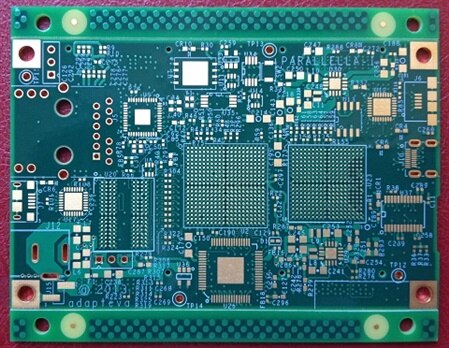
And talking about BGA, Adapteva just posted a picture of the parallela board "naked" .... how sexy
-J
jamodio wrote:
One more bit of information to share, the Wandboard afaik has not a single certification, I didn't do a detailed analysis but I'd venture to bet that if they try, it won't pass FCC Class B, not even close.
On the other hand, the BBB is both CE and FCC certified (class B). You can even download the certificate of compliance https://github.com/CircuitCo/-BeagleBone-Black/blob/master/10238105EUS1.pdf?raw=true
Interestingly the Cubieboard A10 appears to have recently passed FCC Class B, the certificate ant test report are available from their download page http://cubieboard.org/download/
so it does seem that a proportion of the people building these dev boards do actually care about getting them compliance tested