Yet another ARM Cortex board ... The pcDuino com ... getting one to see how compares with the Rpi ...
Atr least I didn't have to wake up in wee hours like a year ago to get one.
Cheers
Jorge

Yet another ARM Cortex board ... The pcDuino com ... getting one to see how compares with the Rpi ...
Atr least I didn't have to wake up in wee hours like a year ago to get one.
Cheers
Jorge

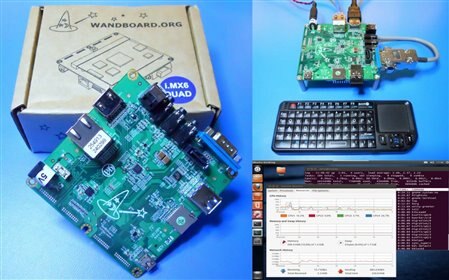
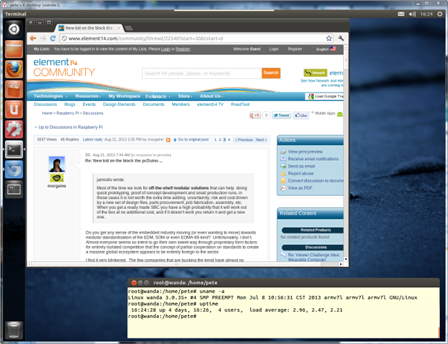
I've the Wandboard Quad on the bench, worked out of the box !
Added the WiFi antenna, few minutes configuration via the ubuntu system settings, and joined my WiFi network without a glitch.
Very, very impressed with the quality of video, even playing videos through vnc. Nicely done. Blog article coming soon ...
Cheers
Jorge
One more bit of information to share, the Wandboard afaik has not a single certification, I didn't do a detailed analysis but I'd venture to bet that if they try, it won't pass FCC Class B, not even close.
On the other hand, the BBB is both CE and FCC certified (class B). You can even download the certificate of compliance https://github.com/CircuitCo/-BeagleBone-Black/blob/master/10238105EUS1.pdf?raw=true
-J
I think we can have an interesting discussion somewhere else in the forum about BGA vs ???, there are pros and cons, and as I always say it depends on the application and the target "customer."
If you are in this just for a hobby, a DYI project or some basic integration, don't mess with what you don't know how to do or have the tools to do it, you will waste more time and money, just buy a ready made BBB and have fun with it.
My .02
-J
jamodio wrote:
There is no such thing as an "EDM standard".
there was a reason I put 'standard' in quotes
anything called a standard is only of use if you can convince others to follow it, and short of being a government and being able to pass a law forcing people to use your 'standard' none are any better than others, they're mostly cooked up by some company anyway. but does that matter ? as long as it's free to use and you can build a consensus that it's a good idea. I'd venture to think that any 'standards' that come with patent claims, licensing fees etc. are a bad thing, but the world has no shortage of those.
The only company to use EDM is them
Doing some research a few months ago I did come across both TechNexion and a couple of places in Germany using the same non-standard while the wandboard appears to be a barely disguised version of the EDM2-CF-iMX6, the german company was using older SoC's like the imx233 clearly aimed at industrial use with price tags to match. Simple searches for 'EDM' aren't bringing me back to their page, so I fully understand you're not likely to believe me 
I did however turn up a couple of competing 'standards', SMARC from Kontron http://uk.kontron.com/about-kontron/news-events/ulpcom+is+now+smarc.6720.html and Qseven, both sponsored by "Standardization Group for Embedded Technologies" http://www.sget.org/ who do seem to have some members and Qseven has a bunch of products form several manufacturers.
Interestingly SMARC uses the same connector as the EDM one.
To add to the amusement, there's the AMD version of the Minnow http://www.gizmosphere.org/
And it seems likely we should get used to angstrom like setups or be prepared to roll our own:
http://linuxgizmos.com/gumstix-adopts-yocto-for-overo-modules/
Morgaine Dinova wrote:
An OSHW kickstarter campaign to put one (or all) of TI, Allwinner, Samsung and ST applications processors on the same EDM form factor as was used by Wandboard for Freescale's i.MX6 aren't beyond the bounds of possibility.
As jamodio points out, TechNexion the company behind EDM has some of those covered already http://www.cnx-software.com/2012/06/10/technexion-edm-modules-open-software-and-somewhat-open-hardware-arm-x86-cpu-modules/
jamodio wrote:
On the other hand, the BBB is both CE and FCC certified (class B). You can even download the certificate of compliance https://github.com/CircuitCo/-BeagleBone-Black/blob/master/10238105EUS1.pdf?raw=true
There's an interesting chunk of documentation available in that github repo, quite unusual for that to be made quite so open. My memory is hazy, but did the RPF ever publish quite so much detail for the Pi ?
selsinork wrote:
As jamodio points out, TechNexion the company behind EDM has some of those covered already http://www.cnx-software.com/2012/06/10/technexion-edm-modules-open-software-and-somewhat-open-hardware-arm-x86-cpu-modules/
That's an interesting article, referring to various nice goodies coming our way from TI:
Arrow Europe also leaked TI Sitara Roadmap until 2014, which shows AM437x being available in 2013, and AM2x single and dual Cortex A7 as AM5x Cortex 15 planned for 2014.
And about TechNexion specifically, cnxsoft writes:
they appear to have some interesting solutions, and because I’ve heard him say “all the software code can be found on our home page, we don’t believe in NDAs, everything needs to be open source” and later “the baseboard schematics are available”. This is extremely unusual for companies that make CPU modules or SoMs to open most of their design.
It seems like a company worth supporting, although it's hard to offer our support when their market presence is so low here. Their position on openness does however made their EDM format a candidate for adoption by the OSHW community.
jamodio wrote:
I think we can have an interesting discussion somewhere else in the forum about BGA vs ???, there are pros and cons, and as I always say it depends on the application and the target "customer."
If you are in this just for a hobby, a DYI project or some basic integration, don't mess with what you don't know how to do or have the tools to do it, you will waste more time and money, just buy a ready made BBB and have fun with it.
Although I agree that BBB is well in the lead for embedded OSHW capability up to Cortex-A8 level, I was looking beyond that. It's not like there is a Beagle roadmap catering for all our needs into the distant future, and even if there was, we still wouldn't want to be dependent on a single manufacturer.
The community of OSHW enthusiasts would be stronger if it took control of its own destiny than by being mere consumers of OSHW designs that commercial companies feel like providing. It's just like what happened when 3D printing enthusiasts discovered that they could build their own printers and that this independence from commercial 3D printing gave them immense power and control over their own destinies.
Exactly the same would happen if we took computer design and construction into our own hands.
selsinork wrote:
jamodio wrote:
On the other hand, the BBB is both CE and FCC certified (class B). You can even download the certificate of compliance https://github.com/CircuitCo/-BeagleBone-Black/blob/master/10238105EUS1.pdf?raw=true
There's an interesting chunk of documentation available in that github repo, quite unusual for that to be made quite so open. My memory is hazy, but did the RPF ever publish quite so much detail for the Pi ?
Yes, they posted the recipe in Food Network ...
BTW I'd love to see the same document from the FCC certification for both the Raspberry Pi Model A and B.
-J
BTW, I really like the Wandboard, it's good quality, has a ton of features and stuff, and has been working glitch free since I turned it on.
Just only one clock config issue after boot but so far I'm impressed about how it is performing even doing video playing via VNC.
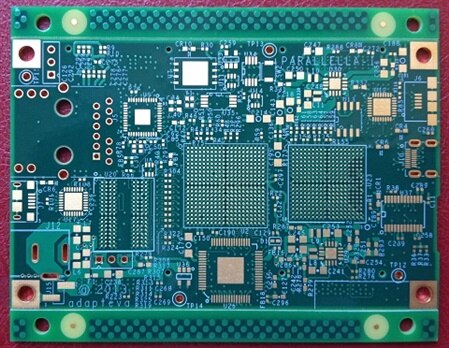
And talking about BGA, Adapteva just posted a picture of the parallela board "naked" .... how sexy
-J
jamodio wrote:
One more bit of information to share, the Wandboard afaik has not a single certification, I didn't do a detailed analysis but I'd venture to bet that if they try, it won't pass FCC Class B, not even close.
On the other hand, the BBB is both CE and FCC certified (class B). You can even download the certificate of compliance https://github.com/CircuitCo/-BeagleBone-Black/blob/master/10238105EUS1.pdf?raw=true
Interestingly the Cubieboard A10 appears to have recently passed FCC Class B, the certificate ant test report are available from their download page http://cubieboard.org/download/
so it does seem that a proportion of the people building these dev boards do actually care about getting them compliance tested
jamodio wrote:
One more bit of information to share, the Wandboard afaik has not a single certification, I didn't do a detailed analysis but I'd venture to bet that if they try, it won't pass FCC Class B, not even close.
On the other hand, the BBB is both CE and FCC certified (class B). You can even download the certificate of compliance https://github.com/CircuitCo/-BeagleBone-Black/blob/master/10238105EUS1.pdf?raw=true
Interestingly the Cubieboard A10 appears to have recently passed FCC Class B, the certificate ant test report are available from their download page http://cubieboard.org/download/
so it does seem that a proportion of the people building these dev boards do actually care about getting them compliance tested
I've the Cuibieboard 1 and 2 (A20) on the queue to be tested, also purchased a pair of the breadboards. The also have now a new very interesting baseboard for both, thinking about adding it to Santa's list :-)
Regards
Jorge
The only problem with the breadboard is that the VGA connector makes it a little difficult to change the uSD card. It's just slightly too close.