element14 Community
element14 Community
    Register Log In
  • Site
  • Search
  • Log In Register
  • Community Hub
    Community Hub
    • What's New on element14
    • Feedback and Support
    • Benefits of Membership
    • Personal Blogs
    • Members Area
    • Achievement Levels
  • Learn
    Learn
    • Ask an Expert
    • eBooks
    • element14 presents
    • Learning Center
    • Tech Spotlight
    • STEM Academy
    • Webinars, Training and Events
    • Learning Groups
  • Technologies
    Technologies
    • 3D Printing
    • FPGA
    • Industrial Automation
    • Internet of Things
    • Power & Energy
    • Sensors
    • Technology Groups
  • Challenges & Projects
    Challenges & Projects
    • Design Challenges
    • element14 presents Projects
    • Project14
    • Arduino Projects
    • Raspberry Pi Projects
    • Project Groups
  • Products
    Products
    • Arduino
    • Avnet & Tria Boards Community
    • Dev Tools
    • Manufacturers
    • Multicomp Pro
    • Product Groups
    • Raspberry Pi
    • RoadTests & Reviews
  • About Us
  • Store
    Store
    • Visit Your Store
    • Choose another store...
      • Europe
      •  Austria (German)
      •  Belgium (Dutch, French)
      •  Bulgaria (Bulgarian)
      •  Czech Republic (Czech)
      •  Denmark (Danish)
      •  Estonia (Estonian)
      •  Finland (Finnish)
      •  France (French)
      •  Germany (German)
      •  Hungary (Hungarian)
      •  Ireland
      •  Israel
      •  Italy (Italian)
      •  Latvia (Latvian)
      •  
      •  Lithuania (Lithuanian)
      •  Netherlands (Dutch)
      •  Norway (Norwegian)
      •  Poland (Polish)
      •  Portugal (Portuguese)
      •  Romania (Romanian)
      •  Russia (Russian)
      •  Slovakia (Slovak)
      •  Slovenia (Slovenian)
      •  Spain (Spanish)
      •  Sweden (Swedish)
      •  Switzerland(German, French)
      •  Turkey (Turkish)
      •  United Kingdom
      • Asia Pacific
      •  Australia
      •  China
      •  Hong Kong
      •  India
      • Japan
      •  Korea (Korean)
      •  Malaysia
      •  New Zealand
      •  Philippines
      •  Singapore
      •  Taiwan
      •  Thailand (Thai)
      • Vietnam
      • Americas
      •  Brazil (Portuguese)
      •  Canada
      •  Mexico (Spanish)
      •  United States
      Can't find the country/region you're looking for? Visit our export site or find a local distributor.
  • Translate
  • Profile
  • Settings
Raspberry Pi
  • Products
  • More
Raspberry Pi
Raspberry Pi Forum RPi Compute module high temperature operation
  • Blog
  • Forum
  • Documents
  • Quiz
  • Events
  • Polls
  • Files
  • Members
  • Mentions
  • Sub-Groups
  • Tags
  • More
  • Cancel
  • New
Join Raspberry Pi to participate - click to join for free!
Featured Articles
Announcing Pi
Technical Specifications
Raspberry Pi FAQs
Win a Pi
Raspberry Pi Wishlist
Actions
  • Share
  • More
  • Cancel
Forum Thread Details
  • State Suggested Answer
  • Replies 9 replies
  • Answers 2 answers
  • Subscribers 676 subscribers
  • Views 2461 views
  • Users 0 members are here
  • environment
  • temperature
  • operating conditions
  • compute module
Related

RPi Compute module high temperature operation

Former Member
Former Member over 9 years ago

Hello,

Hi, I am working in a prestudy project where we are looking at using the Raspberry Pi Compute Module in a building automation application.

We have difficulties finding info about temperature behavior.


Is there an absolute maximum rating specified for the Broadcom chip or the module as such?


What happens to the functionality of the chip when it reaches high temperatures? Are certain functions disabled? Does it shut down?


Any input appreciated.


BR Pål Dahle


  • Sign in to reply
  • Cancel
  • clem57
    0 clem57 over 9 years ago

    Cannot say what will happen, but check out this.

    • Cancel
    • Vote Up 0 Vote Down
    • Sign in to reply
    • Verify Answer
    • Reject Answer
    • Cancel
  • shabaz
    0 shabaz over 9 years ago

    There are some numbers here, https://www.raspberrypi.org/forums/viewtopic.php?f=98&t=74908

    looks like 80 degrees C is the limit.

    Approaching such a temperature, the Pi 3 reduces the speed of one of its clocks in an attempt to reduce heat.

    I don't know how intelligent the throttling is, whether it examines the CPU load before performing this.

    The compute module may do something similar. I'd strongly suggest you try it, and not just rely on

    information that is out there, because things can change from release to release. A change in speed can

    be severe for an embedded app, so you don't really want to be at the 80 degrees C point.

    Anyone want to put hot air onto their Pi, see what it does w.r.t. throttling? Could be interesting..

    • Cancel
    • Vote Up 0 Vote Down
    • Sign in to reply
    • Verify Answer
    • Cancel
  • rew
    0 rew over 9 years ago in reply to shabaz

    I don't  think the throttling depends on anything but temperature.


    The main question to Pal (I have tried copy-pasting into this window to spell that correctly, but some fancy Farnell-stuff blocks that... sorry) is: what is "high temperature".


    If you want it to run at 100 degrees ambient... 100% certain: you can forget that.

    If you want to run it at 40 degrees ambient... 100% certain: sure you can! But the throttling may happen earlier than you might expect, and it would be good to keep in mind that the CPU might start to throttle when it hits a heat-limit. If the throttling is bad for your application, you may need cooling measures. If you require maximum performance, you'll further heat up the CPU by having it DO stuff, and the throttling may happen at an inopportune moment....

    • Cancel
    • Vote Up 0 Vote Down
    • Sign in to reply
    • Verify Answer
    • Reject Answer
    • Cancel
  • shabaz
    0 shabaz over 9 years ago in reply to rew

    Yeah I suspected as much : (

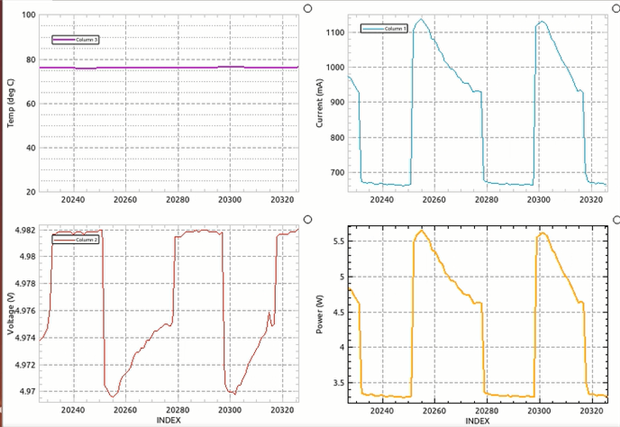
    It was interesting to see the Pi 3's behaviour where it seemed to toggle between a few (seemed like 2 or 3)

    values under certain conditions to try to and cool off (see graphs below). Whereas some Intel chips drop and then ramp up. Probably there are patents in some of these implemented strategies I guess.

    Some article (anandtech, usually has more information but not this time) suggested that some mobile processors by Intel

    can have different strategies depending on additional information like orientation, and seems to use a power sensor too.

    Anyway, for compute module Pål, (rew I had to go into HTML mode to do that with å, couldn't find another way ),  make sure your software engineers are aware that throttling could occur if you determine that the temperature and amount of processing could result in this. They will need to test the application under such speed conditions (more relevant for the compute module than an app for a PC or tablet/mobile phone).

    image

    • Cancel
    • Vote Up 0 Vote Down
    • Sign in to reply
    • Verify Answer
    • Cancel
  • Former Member
    0 Former Member over 9 years ago in reply to shabaz

    I'm amazed over the lengths you go to spell my name correctly! Appreciate it image


    The CM will sit in an enclosed box on an application specific I/O board. The box will sit in some sort of chamber that in itself can be exposed to sunlight, India is a potential market (they recently had a temperture record of 51 degC...). This hw spec says +60 degC ambient right now (and I currently work with our customer to get more accurate data, I suspect it was set ad-hoc with some margin, to maybe get it down to 50-55 degC). I have myself been running the RPi A-version for long periods in a very lightweight application and it seems self-heat about 25-30 degrees, (as expected rather independent in a 5 degC - 30 degC ambient temperature span).


    So in essence we are on the limit for "high temperature" :-)


    The application (as it is defined today) require very little from the SW, wouldn't be suprised if we were below 10% CPU load on average. Throttling is not a problem the way I see it. I'm not fully clear whether the CPU will switch off at high temps (did I read that somewhere here?).


    We will be running some tests for sure, to check the behavior, both on hw-level and on system level (if we ever get that far... :-)

    • Cancel
    • Vote Up +1 Vote Down
    • Sign in to reply
    • Verify Answer
    • Cancel
  • clem57
    0 clem57 over 9 years ago

    You can use code like this to get the Temps internal to the chip:

    vcgencmd measure_temp

    Shows core temperature of BCM2835 SoC.

    root@raspberrypi:~# vcgencmd measure_temp 
    temp=42.8'C

    From: RPI vcgencmd usage - eLinux.org


    Clem

    • Cancel
    • Vote Up 0 Vote Down
    • Sign in to reply
    • Verify Answer
    • Cancel
  • rive
    0 rive over 9 years ago in reply to rew

    Pi will also throttle for voltage

    • Cancel
    • Vote Up 0 Vote Down
    • Sign in to reply
    • Verify Answer
    • Cancel
  • rive
    0 rive over 9 years ago in reply to clem57

    This is better, not only shows thermals, but also the  freq (so you can see if you are throttling for either heat or voltage):


    2 sec readouts:


    Scrolling:

    while true; do vcgencmd measure_clock arm; vcgencmd measure_temp; sleep 2; done


    Non-scrolling:

    watch '(vcgencmd measure_temp; vcgencmd measure_clock arm)'


    @ Pål Dahle


    The module cannot have temps exceed 80C.


    However, this range is the maximum for the silicon die; therefore developers should take into account the heat generated when in use and make sure this does not cause the device temperature to exceed 80°C.


    At 80C the pi 3 throttles, at 85C all voltage and freq revert back to minimum defaults (for example, at 85C the Pi 3 reverts to 600 MHz). For under voltage, regardless of thermals, Pi 3 thottles/reverts to minimum voltage and freq.


    When the Pi throttles/reverts to minimum freq and voltages, performance of the Pi is reduced/degraded as a result.


    Here are some stock pi 3 benchmarks (A pi that overheats or is undervolted, will perform beneath the benchmarks, e.g., an undervolting/throttling Pi 3 may only pass at 3 Gflops on the linpack benchmark, indicating a computational performance degradation/loss of approx. 50%):


    Sysbench (CPU prime number test) -validated run (passes if completed in 119 seconds or less)

    Cpuburn-a53 (thermals and voltage test using neon Instructions) (passes if no throttling occurs, and can maintain thermals at 79C or lower)

    Linpack Bench (CPU floating point computing power test, thermals and voltage test using neon Instructions) ( passes if results are 'PASSED'  at 6 GFLOPS (6 billion operations per second) or higher)


    https://youtu.be/KuEZV0WsRLg?t=7m20s


    Test your Pi/Pi 3, and resolve any voltage/thermal issues as needed:


    ............................................................

    ...........................................................


    /////Sysbench///// 


    Install:

    sudo apt-get install sysbench


    run:
    sysbench --num-threads=4 --test=cpu --cpu-max-prime=20000 --validate run


    ............................................................

    ............................................................


    /////Cpuburn-a53/////


    Install:

    wget https://raw.githubusercontent.com/ssvb/cpuburn-arm/master/cpuburn-a53.S
    gcc -o cpuburn-a53 cpuburn-a53.S


    run:
    while true; do vcgencmd measure_clock arm; vcgencmd measure_temp; sleep 2; done& ./cpuburn-a53


    ..............................................................

    ..............................................................


    /////Linpack Bench://///  Be sure to reboot after Install


    Install:

    sudo apt-get install libmpich-dev
    wget http://web.eece.maine.edu/~vweaver/junk/pi3_hpl.tar.gz
    tar -xvzf pi3_hpl.tar.gz
    chmod +x xhpl


    run:
    ./xhpl


    ...............................................................

    ................................................................

    • Cancel
    • Vote Up 0 Vote Down
    • Sign in to reply
    • Verify Answer
    • Cancel
  • rew
    0 rew over 9 years ago in reply to Former Member

    Pål, (Hey, I can do that too! :-) )


    If your application is not speed-critical, I'd configure it for "minimum performance" from the beginning. That would mean: no surprises later on.


    For testing on a budget, get a PID temperature module from ebay, a 12V power supply, a 220V relay (SSR?)  (or 115 wherever you are), and a cheap pizza oven.  That should get you a DIY "hot climate testing environment" for around EUR 100. The professional solution with a temperature controlled climate room will probably set you back at least 10 times more.

    • Cancel
    • Vote Up 0 Vote Down
    • Sign in to reply
    • Verify Answer
    • Cancel
element14 Community

element14 is the first online community specifically for engineers. Connect with your peers and get expert answers to your questions.

  • Members
  • Learn
  • Technologies
  • Challenges & Projects
  • Products
  • Store
  • About Us
  • Feedback & Support
  • FAQs
  • Terms of Use
  • Privacy Policy
  • Legal and Copyright Notices
  • Sitemap
  • Cookies

An Avnet Company © 2025 Premier Farnell Limited. All Rights Reserved.

Premier Farnell Ltd, registered in England and Wales (no 00876412), registered office: Farnell House, Forge Lane, Leeds LS12 2NE.

ICP 备案号 10220084.

Follow element14

  • X
  • Facebook
  • linkedin
  • YouTube