element14 Community
element14 Community
    Register Log In
  • Site
  • Search
  • Log In Register
  • Community Hub
    Community Hub
    • What's New on element14
    • Feedback and Support
    • Benefits of Membership
    • Personal Blogs
    • Members Area
    • Achievement Levels
  • Learn
    Learn
    • Ask an Expert
    • eBooks
    • element14 presents
    • Learning Center
    • Tech Spotlight
    • STEM Academy
    • Webinars, Training and Events
    • Learning Groups
  • Technologies
    Technologies
    • 3D Printing
    • FPGA
    • Industrial Automation
    • Internet of Things
    • Power & Energy
    • Sensors
    • Technology Groups
  • Challenges & Projects
    Challenges & Projects
    • Design Challenges
    • element14 presents Projects
    • Project14
    • Arduino Projects
    • Raspberry Pi Projects
    • Project Groups
  • Products
    Products
    • Arduino
    • Avnet & Tria Boards Community
    • Dev Tools
    • Manufacturers
    • Multicomp Pro
    • Product Groups
    • Raspberry Pi
    • RoadTests & Reviews
  • About Us
  • Store
    Store
    • Visit Your Store
    • Choose another store...
      • Europe
      •  Austria (German)
      •  Belgium (Dutch, French)
      •  Bulgaria (Bulgarian)
      •  Czech Republic (Czech)
      •  Denmark (Danish)
      •  Estonia (Estonian)
      •  Finland (Finnish)
      •  France (French)
      •  Germany (German)
      •  Hungary (Hungarian)
      •  Ireland
      •  Israel
      •  Italy (Italian)
      •  Latvia (Latvian)
      •  
      •  Lithuania (Lithuanian)
      •  Netherlands (Dutch)
      •  Norway (Norwegian)
      •  Poland (Polish)
      •  Portugal (Portuguese)
      •  Romania (Romanian)
      •  Russia (Russian)
      •  Slovakia (Slovak)
      •  Slovenia (Slovenian)
      •  Spain (Spanish)
      •  Sweden (Swedish)
      •  Switzerland(German, French)
      •  Turkey (Turkish)
      •  United Kingdom
      • Asia Pacific
      •  Australia
      •  China
      •  Hong Kong
      •  India
      • Japan
      •  Korea (Korean)
      •  Malaysia
      •  New Zealand
      •  Philippines
      •  Singapore
      •  Taiwan
      •  Thailand (Thai)
      • Vietnam
      • Americas
      •  Brazil (Portuguese)
      •  Canada
      •  Mexico (Spanish)
      •  United States
      Can't find the country/region you're looking for? Visit our export site or find a local distributor.
  • Translate
  • Profile
  • Settings
Raspberry Pi
  • Products
  • More
Raspberry Pi
Raspberry Pi Forum Rpi2 cooling
  • Blog
  • Forum
  • Documents
  • Quiz
  • Events
  • Polls
  • Files
  • Members
  • Mentions
  • Sub-Groups
  • Tags
  • More
  • Cancel
  • New
Join Raspberry Pi to participate - click to join for free!
Featured Articles
Announcing Pi
Technical Specifications
Raspberry Pi FAQs
Win a Pi
Raspberry Pi Wishlist
Actions
  • Share
  • More
  • Cancel
Forum Thread Details
  • State Verified Answer
  • Replies 14 replies
  • Answers 3 answers
  • Subscribers 679 subscribers
  • Views 2109 views
  • Users 0 members are here
  • ram
  • raspi
  • 2
  • temperature
  • overcharge
  • cooler
  • raspberry_pi_2
  • raspberry_pi_space
  • raspberrypi
  • rpi
  • cpu
  • overclocking
  • raspberrypi2
  • cooling
Related

Rpi2 cooling

Former Member
Former Member over 10 years ago

Hello everybody (and sorry for my bad english),

I'm currently working on cooling system for Rpi2 to overclock it a bit. I'm already owner of older model (just B) where are 3 "chips" I'm cooling (CPU/GPU/RAM, ethernet and input voltage regulator) all on front side. On this new B2 model, front side only contains CPU/GPU and ethernet controler and RAM is from bottom side... The question is, if the RAM temperature will increase too, if CPU will be overclocked (i guess yes...)... so is it necessary to cool RAM too? (if there will be a cooler on the bottom of rpi, I would have to mod whole box to fit it in...)


Thank you for your help and suggestions.

  • Sign in to reply
  • Cancel
Parents
  • sthibaud
    0 sthibaud over 10 years ago

    Hi,


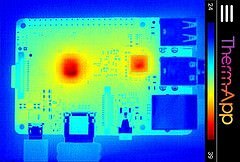
    It seems also that network chip (usb, ethernet), can heat too.

    Give a look on the thermal pic below. Maybe i will plan to use a second heatsink on it.

    image

    • Cancel
    • Vote Up +1 Vote Down
    • Sign in to reply
    • Verify Answer
    • Reject Answer
    • Cancel
  • clem57
    0 clem57 over 10 years ago in reply to sthibaud

    That is the USB/phys link controller chip.

    Clem

    • Cancel
    • Vote Up 0 Vote Down
    • Sign in to reply
    • Verify Answer
    • Cancel
  • gdstew
    0 gdstew over 10 years ago in reply to clem57

    @ Clem

    It is also the Ethernet controller which uses the USB bus to communicate with the Broadcom SoC.


    On the overall subject:


    All IC's are designed to run fairly hot. The lowest temperature grade for most ICs is commercial with a maximum die temperature of 70 deg. C (158 deg. F). For

    industrial grade ICs it is 85 deg. C (175 deg. F), and for military grade it is 125 deg. C (250 deg. F, OUCH). Note that even the lowest of these temperatures will

    feel uncomfortably hot on bare skin. I believe that the Broadcom SoCs are industrial grade, if the software is enabled it will throttle the clock when the die reaches

    85 deg. C. If you are overclocking or running it in high ambient temperatures extra cooling is a good idea because it allows the IC package to dissipate the heat of

    the die more efficiently. Otherwise it should be fine as is.

    • Cancel
    • Vote Up 0 Vote Down
    • Sign in to reply
    • Verify Answer
    • Reject Answer
    • Cancel
Reply
  • gdstew
    0 gdstew over 10 years ago in reply to clem57

    @ Clem

    It is also the Ethernet controller which uses the USB bus to communicate with the Broadcom SoC.


    On the overall subject:


    All IC's are designed to run fairly hot. The lowest temperature grade for most ICs is commercial with a maximum die temperature of 70 deg. C (158 deg. F). For

    industrial grade ICs it is 85 deg. C (175 deg. F), and for military grade it is 125 deg. C (250 deg. F, OUCH). Note that even the lowest of these temperatures will

    feel uncomfortably hot on bare skin. I believe that the Broadcom SoCs are industrial grade, if the software is enabled it will throttle the clock when the die reaches

    85 deg. C. If you are overclocking or running it in high ambient temperatures extra cooling is a good idea because it allows the IC package to dissipate the heat of

    the die more efficiently. Otherwise it should be fine as is.

    • Cancel
    • Vote Up 0 Vote Down
    • Sign in to reply
    • Verify Answer
    • Reject Answer
    • Cancel
Children
  • johnbeetem
    0 johnbeetem over 10 years ago in reply to gdstew

    Gary Stewart wrote:


    All IC's are designed to run fairly hot. The lowest temperature grade for most ICs is commercial with a maximum die temperature of 70 deg. C (158 deg. F). For industrial grade ICs it is 85 deg. C (175 deg. F), and for military grade it is 125 deg. C (250 deg. F, OUCH). Note that even the lowest of these temperatures will feel uncomfortably hot on bare skin.

    I am a "run it cool" fanatic.


    While I realize that the chips can run quite hot safely, high temperature is the enemy of long-term PC board reliability especially if you turn products on and off.  When I got started in this biz, it was mostly through-hole parts or else gull-wing flat packages.  When the board heated up or cooled down, thermal mis-match stresses would be handled by IC package leads.


    Modern PC boards have BGAs and QFPs QFNs [*], where contact is made by solder balls [or similar].  If you stress solder, it doesn't bend -- it cracks.  Eventually the cracks cause intermittent problems, followed by total failure.


    Of course, you can leave the product turned on all the time, but then your electrolytic capacitors boil away and voltage ripple causes intermittent problems, followed by total failure.


    In both cases you need to worry about tin whiskers, thanks to ROHS.


    Or you can run everything cool using good thermal design and avoid these worries.


    JMO/YMMV


    [*] Edit:  I had meant to write QFN (Quad Flat No-leads), not QFP.  As Gary points out below, QFPs are indeed leaded packages and handle thermal stresses nicely.  RasPi uses a QFN for the USB/LAN chip.

    • Cancel
    • Vote Up +1 Vote Down
    • Sign in to reply
    • Verify Answer
    • Cancel
  • gdstew
    0 gdstew over 10 years ago in reply to johnbeetem

    "Modern PC boards have BGAs and QFPs, where contact is made by solder balls.  If you stress solder, it doesn't bend -- it cracks.  Eventually the cracks cause intermittent problems, followed by total failure."


    Actually QFPs and indeed most "flat" packages do not use solder balls they use leads and even through hole solder connections have been known to crack due to thermal stress and coefficient of

    expansion mismatches. Modern engineers are very aware of these potential problems with BGA and other packages and do their best to prevent it by using the thermal design techniques you speak

    of with impressive results. The only major case of BGA solder ball failure due to thermal stress that I know of was due to a coefficient of expansion problem with a package Nvidia chose for its GPUs,

    clearly without proper thermal design checks. I lost two video cards because of it. There are also other causes for solder balls (and just about every other type of solder joint) failing but these are usually

    manufacturing process problems.


    "In both cases you need to worry about tin whiskers, thanks to ROHS."


    Before ROHS there were tiny solder balls to worry about and before tiny solder balls there were solder bridges. While it has caused quite a few problems, getting rid of lead is a very good thing

    considering the serious disposal and contamination problem it became in our do not repair just replace it and throw the bad one away world.


    "Or you can run everything cool using good thermal design and avoid these worries."


    Yes that is how most boards are designed in the first place and why extra cooling is not needed under normal circumstances..

    • Cancel
    • Vote Up 0 Vote Down
    • Sign in to reply
    • Verify Answer
    • Cancel
  • johnbeetem
    0 johnbeetem over 10 years ago in reply to gdstew

    Gary Stewart wrote:


    While [ROHS] has caused quite a few problems, getting rid of lead is a very good thing considering the serious disposal and contamination problem it became in our do not repair just replace it and throw the bad one away world.

    IMO the "throw away" mentality is a serious problem.  When I was a kid we were sold the idea that when transistors replaced vacuum tubes we would have "solid-state products that lasted forever".  Nowadays you're supposed to throw away your "smart phone" every 2 years and fill landfills with the old ones.  I would rather have reliable lead connections and have electronics that lasts decades and is worth recycling at the end of a long life.  Manufacturers, of course, would like to have you throw away products every two years and they influence governments towards that goal.


    JMO/YMMV


    P.S. You're right about QFPs.  I had mean to write QFN, the package used by RasPi's USB/LAN chip.

    • Cancel
    • Vote Up 0 Vote Down
    • Sign in to reply
    • Verify Answer
    • Cancel
  • johnbeetem
    0 johnbeetem over 10 years ago in reply to gdstew

    Gary Stewart wrote:


    The only major case of BGA solder ball failure due to thermal stress that I know of was due to a coefficient of expansion problem with a package Nvidia chose for its GPUs, clearly without proper thermal design checks. I lost two video cards because of it.


    ...


    "Or you can run everything cool using good thermal design and avoid these worries."


    Yes that is how most boards are designed in the first place and why extra cooling is not needed under normal circumstances..

    I believe the Xbox 360 had a lot of reliability problems Xbox 360 technical problems - Wikipedia, the free encyclopedia which some have attributed to thermal causes.  According to the Wikipedia link, Microsoft never came clean about the root cause(s).


    I've found that a lot of boards, particularly the wonderful cheap little boards we talk about so much here at element14 often have thermal issues.  The original RasPi Model B 1.0 PCB had a design defect which caused some boards' USB/LAN chips to overheat.  This was corrected in the 2.0 PCB, which also has a much better thermal design in general for the USB/LAN.  The Parallella board had a serious overheating problem -- I don't know if they ever really fixed it.  With general-purpose FPGA boards it can be very hard to predict how much power they're going to use.  If you design FPGA logic carefully so that it doesn't do more work than necessary, they can run very cool.  If you design the logic poorly or your application simply requires a lot of signal transitions it can run very hot.


    Until very recently Intel has approached chips by making them perform as fast as possible: who cares how much power they use, that's what chip fans are for.  ARM's history was always fan-less, so low power has been a constraint and philosophy from the beginning.  Now that their territories are starting to overlap, Intel is playing catch-up in low power design (Atoms keep getting better) and ARM is learning how to make chips that consume a lot more power to get a little more performance.

    • Cancel
    • Vote Up +1 Vote Down
    • Sign in to reply
    • Verify Answer
    • Cancel
element14 Community

element14 is the first online community specifically for engineers. Connect with your peers and get expert answers to your questions.

  • Members
  • Learn
  • Technologies
  • Challenges & Projects
  • Products
  • Store
  • About Us
  • Feedback & Support
  • FAQs
  • Terms of Use
  • Privacy Policy
  • Legal and Copyright Notices
  • Sitemap
  • Cookies

An Avnet Company © 2025 Premier Farnell Limited. All Rights Reserved.

Premier Farnell Ltd, registered in England and Wales (no 00876412), registered office: Farnell House, Forge Lane, Leeds LS12 2NE.

ICP 备案号 10220084.

Follow element14

  • X
  • Facebook
  • linkedin
  • YouTube