
element14 Community
element14 Community
    Register Log In
  • Site
  • Search
  • Log In Register
  • Community Hub
    Community Hub
    • What's New on element14
    • Feedback and Support
    • Benefits of Membership
    • Personal Blogs
    • Members Area
    • Achievement Levels
  • Learn
    Learn
    • Ask an Expert
    • eBooks
    • element14 presents
    • Learning Center
    • Tech Spotlight
    • STEM Academy
    • Webinars, Training and Events
    • Learning Groups
  • Technologies
    Technologies
    • 3D Printing
    • FPGA
    • Industrial Automation
    • Internet of Things
    • Power & Energy
    • Sensors
    • Technology Groups
  • Challenges & Projects
    Challenges & Projects
    • Design Challenges
    • element14 presents Projects
    • Project14
    • Arduino Projects
    • Raspberry Pi Projects
    • Project Groups
  • Products
    Products
    • Arduino
    • Avnet & Tria Boards Community
    • Dev Tools
    • Manufacturers
    • Multicomp Pro
    • Product Groups
    • Raspberry Pi
    • RoadTests & Reviews
  • About Us
    About the element14 Community
  • Store
    Store
    • Visit Your Store
    • Choose another store...
      • Europe
      •  Austria (German)
      •  Belgium (Dutch, French)
      •  Bulgaria (Bulgarian)
      •  Czech Republic (Czech)
      •  Denmark (Danish)
      •  Estonia (Estonian)
      •  Finland (Finnish)
      •  France (French)
      •  Germany (German)
      •  Hungary (Hungarian)
      •  Ireland
      •  Israel
      •  Italy (Italian)
      •  Latvia (Latvian)
      •  
      •  Lithuania (Lithuanian)
      •  Netherlands (Dutch)
      •  Norway (Norwegian)
      •  Poland (Polish)
      •  Portugal (Portuguese)
      •  Romania (Romanian)
      •  Russia (Russian)
      •  Slovakia (Slovak)
      •  Slovenia (Slovenian)
      •  Spain (Spanish)
      •  Sweden (Swedish)
      •  Switzerland(German, French)
      •  Turkey (Turkish)
      •  United Kingdom
      • Asia Pacific
      •  Australia
      •  China
      •  Hong Kong
      •  India
      •  Japan
      •  Korea (Korean)
      •  Malaysia
      •  New Zealand
      •  Philippines
      •  Singapore
      •  Taiwan
      •  Thailand (Thai)
      •  Vietnam
      • Americas
      •  Brazil (Portuguese)
      •  Canada
      •  Mexico (Spanish)
      •  United States
      Can't find the country/region you're looking for? Visit our export site or find a local distributor.
  • Translate
  • Profile
  • Settings
Raspberry Pi
  • Products
  • More
Raspberry Pi
Raspberry Pi Forum Trying the Pi Pico RX SDR Project
  • Blog
  • Forum
  • Documents
  • Quiz
  • Events
  • Polls
  • Files
  • Members
  • Mentions
  • Sub-Groups
  • Tags
  • More
  • Cancel
  • New
Join Raspberry Pi to participate - click to join for free!
Featured Articles
Announcing Pi
Technical Specifications
Raspberry Pi FAQs
Win a Pi
Raspberry Pi Wishlist
Actions
  • Share
  • More
  • Cancel
Forum Thread Details
  • Replies 4 replies
  • Subscribers 685 subscribers
  • Views 432 views
  • Users 0 members are here
Related

Trying the Pi Pico RX SDR Project

scottiebabe
scottiebabe 1 month ago

The element14 community (shabaz) pointed me to a very neat SDR project using a RPI Pico.

I have a RPI Pico and lots of generic and jellybean electronic components.

So, I will have a go at building a copy of the open source project.

All of the projects schematics and documentation are available here:

https://101-things.readthedocs.io/en/latest/radio_receiver.html

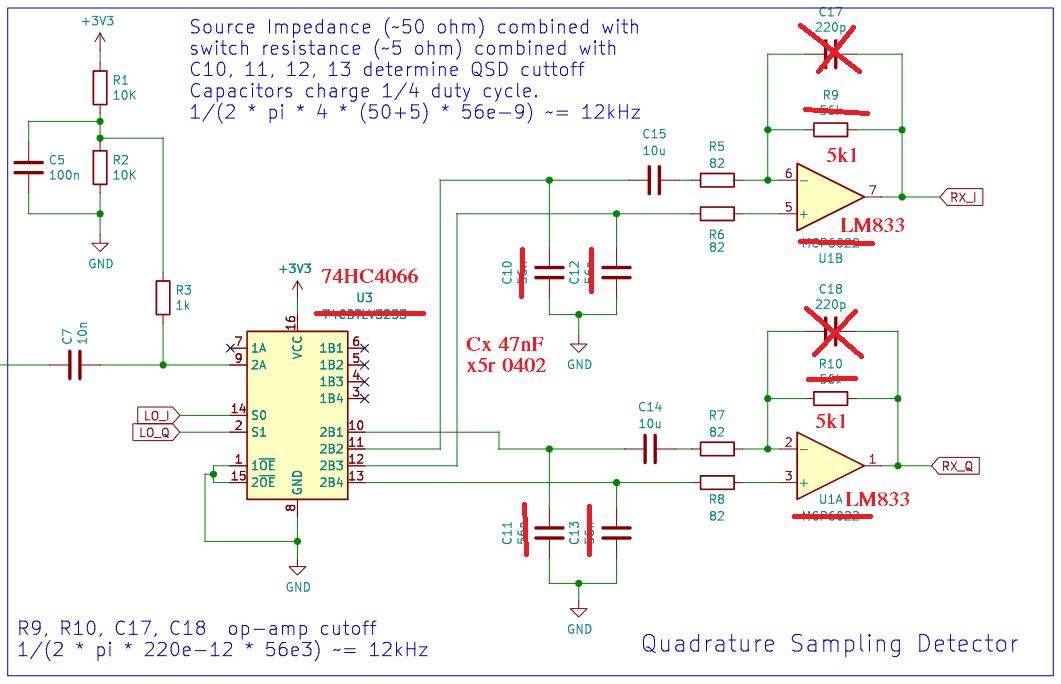
I don’t have all the exact components used in the project.

I made the following substitutions with similar components I had on hand
image

The frontend low rdson analog multiplexer was replaced with a 74HC066 quad analog switch (plus a one hot decoder).

I also lowered the gain of the op-amp difference amplifiers.

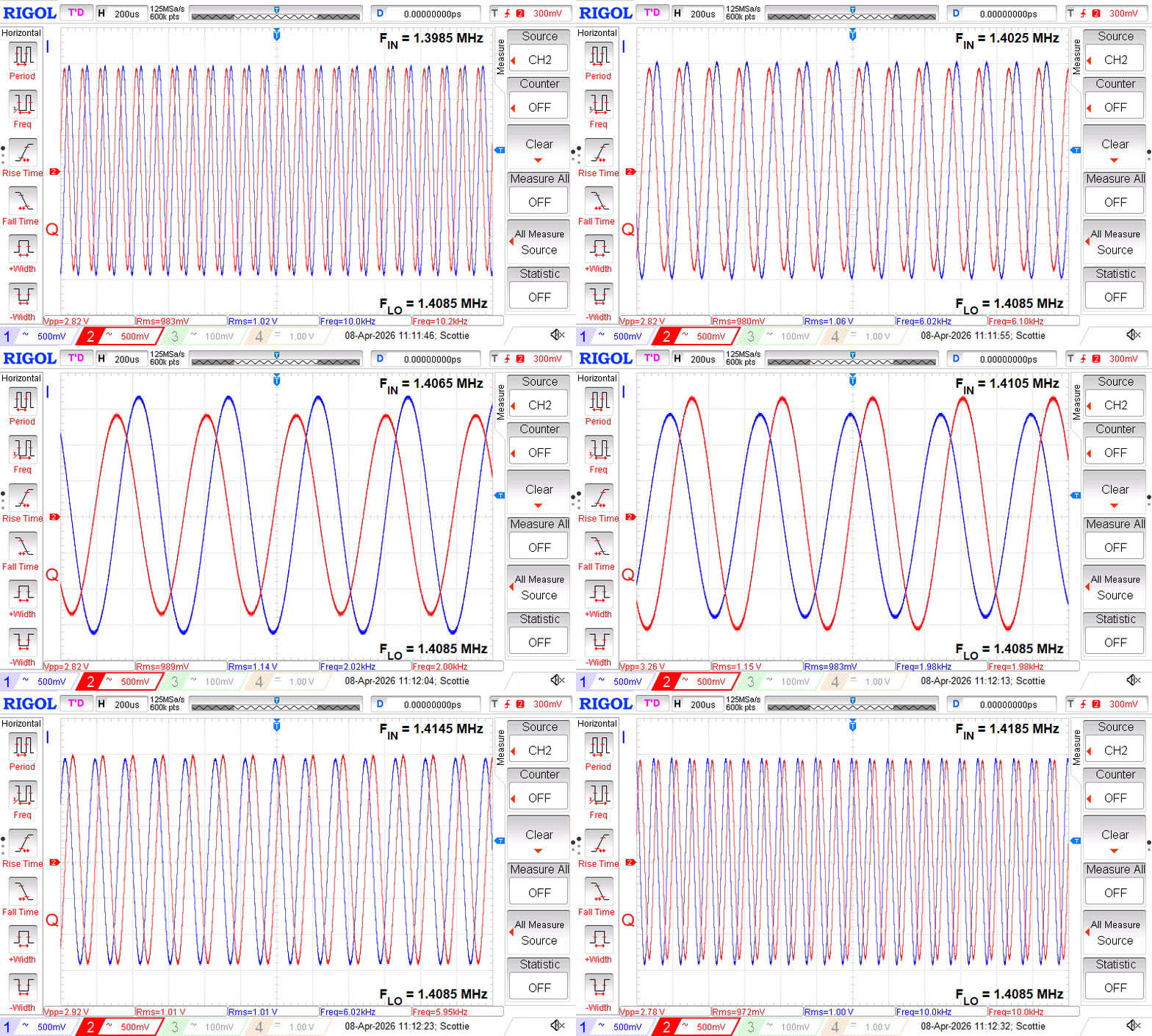
On power up, the picorx software defaults to an LO frequency of 1.4085 MHz.

I used my signal generator to apply a 150 mVpp carrier with a frequency that sweeps from 10 kHz below the pico’s LO to 10 kHz above the pico’s LO.

I get wonderful sinewaves on the output I/Q channels:
image

The quadrature detector has significantly more bandwidth than I expected.

You will notice that for frequencies above the local oscillator the Q signal leads the I signal (and vice versa for frequencies below the LO).

The QSD’s response within 1 kHz of the LO is being partially rejected by the AC-coupled difference amplifiers.

The amplitude response of the I/Q channels is not very well matched (I will have to think about that for a bit)

More to experiment with, but impressive results for the simplicity of the project.

  • Sign in to reply
  • Cancel
Parents
  • scottiebabe
    scottiebabe 27 days ago

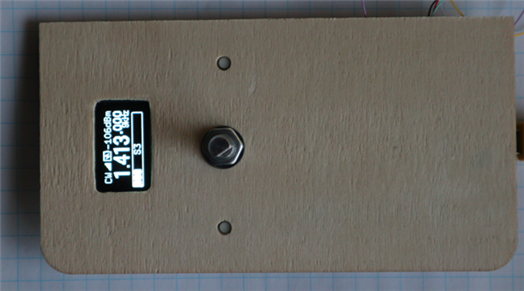
    Spent some time putting the UI bits on a front panel. Most of the configuration options are only available via the physical UI, not the usb serial interface.

    image

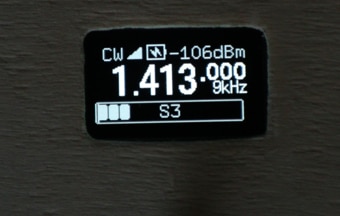
    The author did a nice job on the UI, it looks sharp.

    image

    • Cancel
    • Vote Up +3 Vote Down
    • Sign in to reply
    • Cancel
Reply
  • scottiebabe
    scottiebabe 27 days ago

    Spent some time putting the UI bits on a front panel. Most of the configuration options are only available via the physical UI, not the usb serial interface.

    image

    The author did a nice job on the UI, it looks sharp.

    image

    • Cancel
    • Vote Up +3 Vote Down
    • Sign in to reply
    • Cancel
Children
No Data
element14 Community

element14 is the first online community specifically for engineers. Connect with your peers and get expert answers to your questions.

  • Members
  • Learn
  • Technologies
  • Challenges & Projects
  • Products
  • Store
  • About Us
  • Feedback & Support
  • FAQs
  • Terms of Use
  • Privacy Policy
  • Legal and Copyright Notices
  • Sitemap
  • Cookies

An Avnet Company © 2026 Premier Farnell Limited. All Rights Reserved.

Premier Farnell Ltd, registered in England and Wales (no 00876412), registered office: Farnell House, Forge Lane, Leeds LS12 2NE.

ICP 备案号 10220084.

Follow element14

  • X
  • Facebook
  • linkedin
  • YouTube