

element14 Community
element14 Community
    Register Log In
  • Site
  • Search
  • Log In Register
  • Community Hub
    Community Hub
    • What's New on element14
    • Feedback and Support
    • Benefits of Membership
    • Personal Blogs
    • Members Area
    • Achievement Levels
  • Learn
    Learn
    • Ask an Expert
    • eBooks
    • element14 presents
    • Learning Center
    • Tech Spotlight
    • STEM Academy
    • Webinars, Training and Events
    • Learning Groups
  • Technologies
    Technologies
    • 3D Printing
    • FPGA
    • Industrial Automation
    • Internet of Things
    • Power & Energy
    • Sensors
    • Technology Groups
  • Challenges & Projects
    Challenges & Projects
    • Design Challenges
    • element14 presents Projects
    • Project14
    • Arduino Projects
    • Raspberry Pi Projects
    • Project Groups
  • Products
    Products
    • Arduino
    • Avnet & Tria Boards Community
    • Dev Tools
    • Manufacturers
    • Multicomp Pro
    • Product Groups
    • Raspberry Pi
    • RoadTests & Reviews
  • About Us
  • Store
    Store
    • Visit Your Store
    • Choose another store...
      • Europe
      •  Austria (German)
      •  Belgium (Dutch, French)
      •  Bulgaria (Bulgarian)
      •  Czech Republic (Czech)
      •  Denmark (Danish)
      •  Estonia (Estonian)
      •  Finland (Finnish)
      •  France (French)
      •  Germany (German)
      •  Hungary (Hungarian)
      •  Ireland
      •  Israel
      •  Italy (Italian)
      •  Latvia (Latvian)
      •  
      •  Lithuania (Lithuanian)
      •  Netherlands (Dutch)
      •  Norway (Norwegian)
      •  Poland (Polish)
      •  Portugal (Portuguese)
      •  Romania (Romanian)
      •  Russia (Russian)
      •  Slovakia (Slovak)
      •  Slovenia (Slovenian)
      •  Spain (Spanish)
      •  Sweden (Swedish)
      •  Switzerland(German, French)
      •  Turkey (Turkish)
      •  United Kingdom
      • Asia Pacific
      •  Australia
      •  China
      •  Hong Kong
      •  India
      • Japan
      •  Korea (Korean)
      •  Malaysia
      •  New Zealand
      •  Philippines
      •  Singapore
      •  Taiwan
      •  Thailand (Thai)
      • Vietnam
      • Americas
      •  Brazil (Portuguese)
      •  Canada
      •  Mexico (Spanish)
      •  United States
      Can't find the country/region you're looking for? Visit our export site or find a local distributor.
  • Translate
  • Profile
  • Settings
Raspberry Pi
  • Products
  • More
Raspberry Pi
Raspberry Pi Forum New reworked driver for Wolfson/Cirrus Logic audio card
  • Blog
  • Forum
  • Documents
  • Quiz
  • Events
  • Polls
  • Files
  • Members
  • Mentions
  • Sub-Groups
  • Tags
  • More
  • Cancel
  • New
Join Raspberry Pi to participate - click to join for free!
Featured Articles
Announcing Pi
Technical Specifications
Raspberry Pi FAQs
Win a Pi
Raspberry Pi Wishlist
Actions
  • Share
  • More
  • Cancel
Forum Thread Details
  • Replies 390 replies
  • Subscribers 744 subscribers
  • Views 43181 views
  • Users 0 members are here
  • raspberry_pi
  • raspeberry_pi_accessories
Related

New reworked driver for Wolfson/Cirrus Logic audio card

hiassoft
hiassoft over 9 years ago

I've been working on a driver rework, mainly to get rid of the requirement to carry around a bunch of patches to upstream driver code, and also to fix some outstanding issues and introduce some new features.


Most issues have been ironed out so here's the first public release.


Edit: the driver has been included in official RPi kernels. Just run sudo rpi-update to install it.

You still have to install the mixer scripts and add the /etc/modprobe.d file. See my website for details

RPi Linux driver for Wolfson / Cirrus Logic Audio Card


Source: https://github.com/HiassofT/rpi-linux/tree/cirrus-ng-4.9.0

Precompiled kernel: http://www.horus.com/~hias/tmp/cirrus/cirrus-ng-linux-4.9.0.tgz

New mixer scripts: http://www.horus.com/~hias/tmp/cirrus/cirrus-ng-scripts.tgz


Important notes:

  • The new driver bases on the rather fresh kernel 4.9.0 which means there's some risk of (yet unknown) issues. Use it at your own risk and please run "rpi-update" to get the latest firmware before installing the new driver.
  • The soundcard name has been changed from "snd_rpi_wsp" to "RPi-Cirrus", also several ALSA controls have been removed and new ones were added. This means the old usecase scripts and any custom-made scripts will no longer work. Use the new mixer scripts instead of the old usecase/listen scripts.
  • The new driver supports setting (and receiving) of the S/PDIF channel status bits (aka AES bits). If you add an ALSA card configuration file this means applications like Kodi can do proper AC3/DTS passthrough. A sample card configuration file (plus the mixer scripts) can be found here: https://github.com/HiassofT/rpi-cirrus-config
  • I haven't fully updated the documentation on my website RPi Linux driver for Wolfson / Cirrus Logic Audio Card  yet, will do that during the next weeks/months. But except for the things noted above most stuff should still work as in previous driver versions.


Please report back if you tested the driver (either successfully or unsuccessfully), any feedback will help me!


so long,


Hias

  • Sign in to reply
  • Cancel
Parents
  • timg73
    timg73 over 8 years ago

    Hias,

    A huge thank-you for all the work you've put into supporting the Cirrus Audio card.  Until now I've been using your kernel packages, and have just got round to trying the latest official 4.9 kernel which is also working very nicely.  It's a real shame that the Cirrus card has (or appears to have) gone out of production just when the software support became so good.  The older Wolfson cards are still available, so perhaps I'll get a couple and try modifying them to fit a 40-pin header.  Anyway, thanks again for everything you've done.  I really do appreciate it.

    Tim

    • Cancel
    • Vote Up 0 Vote Down
    • Sign in to reply
    • Cancel
  • hystrix
    hystrix over 8 years ago in reply to timg73

    The Cirrus Card does seem to be out of stock everywhere - what a shame.  I just started working on an alternative ultrasound sensistive microphone, since the electret type I was using has been out of production for years and is now virtually impossible to get hold of.


    What other options are there for recording audio at 192kHz with the Raspberry Pi?


    • Cancel
    • Vote Up 0 Vote Down
    • Sign in to reply
    • Cancel
  • psyj
    psyj over 8 years ago in reply to marcelheijkoop

    Those on  chip D class amplifiers are remarkable for what they do, but personally I would not use them.  You could arrange to use that amplifier for just the high frequency components where less power is needed (above 1kHz). That would still lead to you needing a stereo amp for the LF though.  I am fairly sure that some Lenevo tablets use the 5102 power amp to drive their speakers, so that gives an idea of where they do well.


    I am not sure whether you picked up on my observation that both the line out and headphone out are capable of driving 15 ohm loads (though I repeat I would not do it).  So conceptually you could have Left channel feeding two filters (one high pass, one low pass) and these two signals feeding the headphones out.  The Right channel could follow the same logic except it could feed the line out socket.


    However I presume you are using speaker out to drive your speaker, which is capable of driving 3 ohm loads. And there you have just two channels ...


      There are so rediculously cheap small class d amps out there eg


    PAM8403 Ultra Miniature Digital Power Amplifier Board Class D 2channels x 3W 8′′ | eBay


    at 0,30 euros.


    I would use a couple of those and protect my precious Wolfson!


    As to connecting two Wolfsons/Pi together, I wouldnt.  unifying the two I2S clocks represents a huge effort

    • Cancel
    • Vote Up 0 Vote Down
    • Sign in to reply
    • Cancel
  • marcelheijkoop
    marcelheijkoop over 8 years ago in reply to psyj

    Thanks John,


    Indeed I did not notice enough the line out  AND  headphones out both can carry the same signals with their own individual filters.

    Combined with external amps one could indeed build a setup for bi-amped speakers.

    I definitely want to experiment with that in combination with a multi channel amp I already own, it would just need 4 analogue  inputs to be active to 4 amp outputs.


    If combined with speakers out one could do a how-mid-high separation but that is fun in theory only I presume.


    On the D-amps indeed they do perform much better than people do credit them for.

    My experiments with the PAM 8403 boards are positive, but I prefer the on-board amp in the cirrus logic audio card.

    I really do recommend you test them once. Depending on the the effectiveness of your speakers it does create enough signal to enjoy your music.

    Combined with the digital silence of the card , it is ideal for a bed side audioset to wake you up in the morning , without the sound of the sea during the night.


    In need to do more reading on the amp used in the card....

    Edit :.As the 5102 you mentioned is rated at 2*20 Watt max and should not be fed with less than 8 volts.....

    Edit : confused the wolfson 5102 chip with an other popular chipmakers 5102.

    Edit :  2 watt D-amps according to chip datasheet


    Regards Marcel.

    • Cancel
    • Vote Up 0 Vote Down
    • Sign in to reply
    • Cancel
  • analysis
    analysis over 8 years ago in reply to psyj

    Hi John 

    I hope that this finds you well!! I see the revised PCB could you send me the file for PCB fab  requirements like dimension length X Width (mm), Layers, thickness,

    you have any picture to take a look the PCB assembly


    Thanks in advance  

    • Cancel
    • Vote Up 0 Vote Down
    • Sign in to reply
    • Cancel
  • psyj
    psyj over 8 years ago in reply to analysis

    Hi,


    Here is the KiCAD file that I used.  You may want to add to it,  feel free!  And if you are going to get some made with gold plated pads for the pogo connector, please let me know  ..... I would like to buy a couple if possible


    Regards


    John

    • Cancel
    • Vote Up 0 Vote Down
    • Sign in to reply
    • Cancel
  • psyj
    psyj over 8 years ago in reply to analysis

    Hi,


    Here is the KiCAD file that I used.  You may want to add to it,  feel free!  And if you are going to get some made with gold plated pads for the pogo connector, please let me know  ..... I would like to buy a couple if possible


    Regards


    John


    Postscript:-  I cannot post the file directly, forum rules.  If you pass a private message with an email address, I will send it straight to you

    • Cancel
    • Vote Up 0 Vote Down
    • Sign in to reply
    • Cancel
  • analysis
    analysis over 8 years ago in reply to psyj

    Hi John   I can't  send you a  private message ...we must be  connected first 


    Best Regards 

    • Cancel
    • Vote Up 0 Vote Down
    • Sign in to reply
    • Cancel
  • analysis
    analysis over 8 years ago in reply to psyj

    John , follow also me 

    • Cancel
    • Vote Up 0 Vote Down
    • Sign in to reply
    • Cancel
  • psyj
    psyj over 8 years ago in reply to analysis

    Hello Athanasios (and others)


    Producing printed circuit boards is certainly possible (and I have spoken to the fabricators), but I will need to add to the design I published some time ago.  I am putting this message out to the community in order to see what I should add to the design.  Hias has already suggested that the board should be larger so that it can support the wolfson.  But are there other useful things I should try and incorporate? I guarantee nothing, but suggestions are welcome!

    • Cancel
    • Vote Up 0 Vote Down
    • Sign in to reply
    • Cancel
  • analysis
    analysis over 8 years ago in reply to psyj

    Hi John

    At first, I would like to thank you for your help

    Your prototype board meets Hias, hardware modifications, I have tested it also and works perfectly. 

    So why not to move forward with some printed circuit boards for test

    Remain the problem with the CAD layout to generate the Gerber


    All the best


    • Cancel
    • Vote Up 0 Vote Down
    • Sign in to reply
    • Cancel
  • spambake
    spambake over 8 years ago in reply to psyj

    Some basic things to add to the pcb would be a .1" pin header with any available GPIO pins (not being used by the Wolfson card), the I2C bus, and the UART.  Also a parallel row of ground pins and several 3.3V  and 5V pins.


    I use something like added onto the Cirrus card for indicator LEDs, a temperature sensor, a shutdown button,  RTC via I2C and GPS via UART.  A low noise LDO to convert the 5V to a clean 3.3V (or whatever voltage) for a preamp or something might come in handy for some uses.

    • Cancel
    • Vote Up 0 Vote Down
    • Sign in to reply
    • Cancel
Reply
  • spambake
    spambake over 8 years ago in reply to psyj

    Some basic things to add to the pcb would be a .1" pin header with any available GPIO pins (not being used by the Wolfson card), the I2C bus, and the UART.  Also a parallel row of ground pins and several 3.3V  and 5V pins.


    I use something like added onto the Cirrus card for indicator LEDs, a temperature sensor, a shutdown button,  RTC via I2C and GPS via UART.  A low noise LDO to convert the 5V to a clean 3.3V (or whatever voltage) for a preamp or something might come in handy for some uses.

    • Cancel
    • Vote Up 0 Vote Down
    • Sign in to reply
    • Cancel
Children
  • psyj
    psyj over 8 years ago in reply to spambake

    Hi Spambake,


    Very reasonable suggestions, many thanks.  The biggest problem with a 0.1 header would be that the board will need to be larger than the wolfson (which sits above it) in order to give access to the pins.  This would mean that the overall "footprint" will be greater than the raspberry beneath ..... not a problem in some instances. But when space is limited?  What do you (and others) think?


    The obvious thing to do would be to reproduce almost all of the 40 way header (including the gpio used by the wolfson) outwards  (giving access, eg, to I2C...... leaving the covered space of the PCB (beneath the Wolfson) unused.  A low noise LDO? maybe?  But in my limited experience getting a really low noise power supply it would be best to source from other than the raspberry.


    I had thought of an uncommited array of 0.1" pitch holes for prototyping,  but that rather shows my age!  Or some useful I2C device  .... but what?


    Athanasios


    How do you feel about adding a 40 way header to allow other connections? (Sadly that would not allow  stacking of further cards).  I am in two minds about whether to complicate the design (with extra risk),  but when the boards cost around 12 euros each (in small quantities) , plus VAT and delivery, it seems a shame to waste the board space?

    • Cancel
    • Vote Up 0 Vote Down
    • Sign in to reply
    • Cancel
  • analysis
    analysis over 8 years ago in reply to psyj

    Hi John

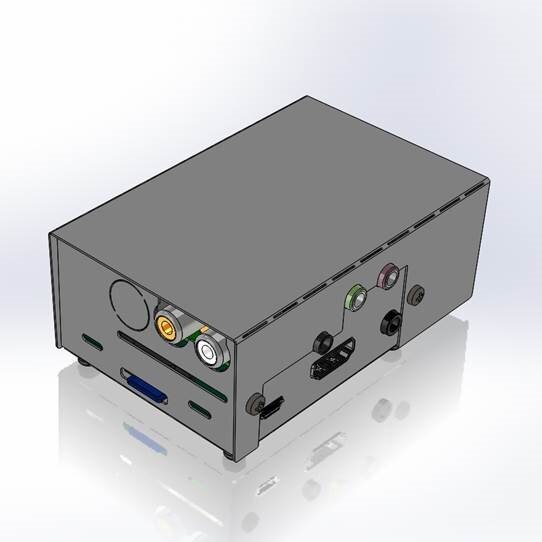
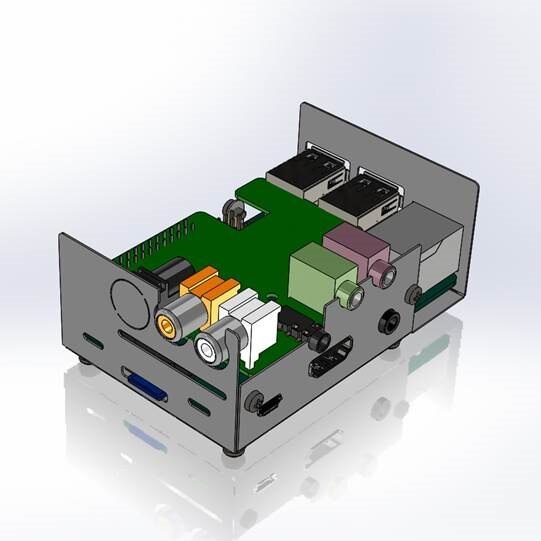
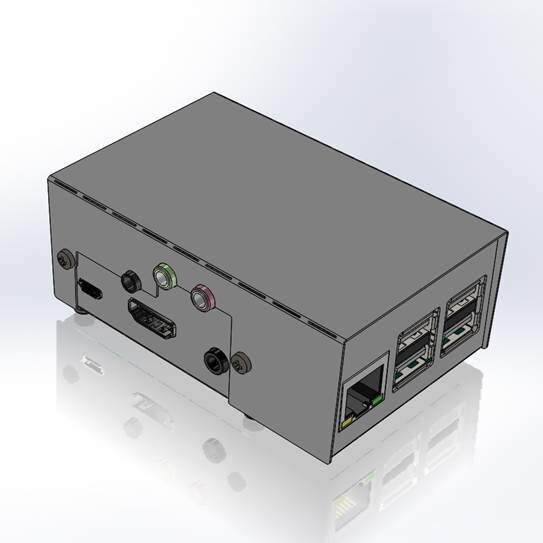
    Sorry for the late response  I was busy lately with the case  

    with 40-way header and board, we have to make the case longer  .. I'm ok, let's make this project happen


    Sincerely 


    .image


    imageimage

    • Cancel
    • Vote Up +2 Vote Down
    • Sign in to reply
    • Cancel
  • psyj
    psyj over 8 years ago in reply to analysis

    Nice case design  .... how will you fabricate? 3 d printer?


    Have started work on a proper pcb design.  Trouble is my Kicad skills are limited.  Anybody more gifted out there ?? Please!.  There seems no point in making the daughter board anything other than a Pi hat shape, that way it gets support from the pi itself.  Two problems


    1) The wolfson card will overhang one side of the hat card.  The pink /green jack sockets will overhang the edge of both the hat and the pi by (probably) 5.08mm. Nothing I can do to avoid that because the 40 pin headers have to be offset from one another.


    2) That will impact your case design I guess.


    At the moment, I am thinking of putting an eeprom on the board (which if memory serves me well is on the cirrus version of this audio card).  And some i2c / power holes for flying leads.


    I would suggest that the board, whilst having the overall shape of a hat, does not have the slot for the camera flex, and that display flex cutout is left to the end user to cut out, otherwise production costs will rise.

    • Cancel
    • Vote Up 0 Vote Down
    • Sign in to reply
    • Cancel
  • analysis
    analysis over 8 years ago in reply to psyj

    Hi John 


    CNC router  : )   Thanks for all your hard work it is much appreciated

    • Cancel
    • Vote Up 0 Vote Down
    • Sign in to reply
    • Cancel
  • psyj
    psyj over 8 years ago in reply to analysis

    Hi Athanasios (and others)


    Had some family problems here, so apologies for the delay.  The design is finally moving ahead ..... here is the alpha artwork (eg I have still to wire in the eeprom and change some pads around)  ... It gives some idea of what board space is still open


    image

    • Cancel
    • Vote Up 0 Vote Down
    • Sign in to reply
    • Cancel
  • analysis
    analysis over 8 years ago in reply to psyj

    Hi John


    I hope that everything is well now, with you and yours 

    Well done for the Great work!

    Will be in touch 


    My best

    • Cancel
    • Vote Up 0 Vote Down
    • Sign in to reply
    • Cancel
  • psyj
    psyj over 8 years ago in reply to psyj

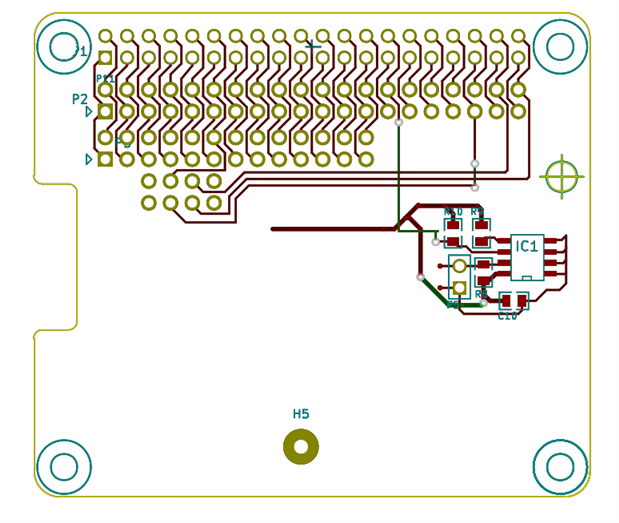
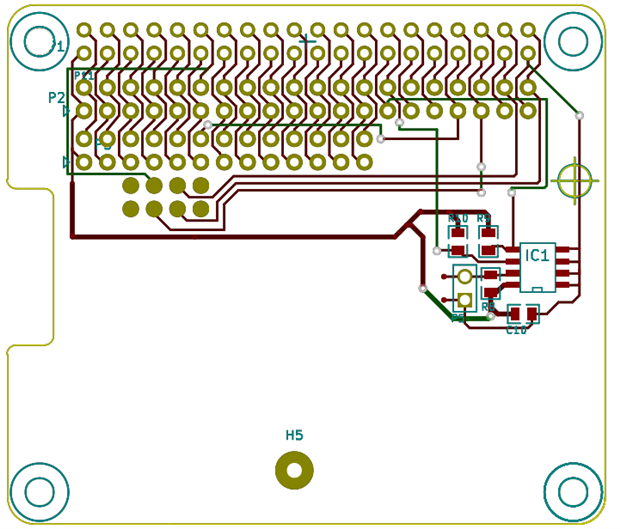
    Here is version 2 of the PCB  .... anybody see anything wrong?


    image


    The wolfson card overhangs this lower edge by 0.45 inches, this is the edge with the jack sockets.  The left hand edge of the wolfson (with the spidfs) sits directly over the left hand edge indent shown above, so the two cards are, in general, offset in this sense too. It would be nicer if the left and right edges aligned between hat card and wolfson card, but that is not possible since it would involve offsetting the 26 way connector and there is not enough space to route the tracks

    • Cancel
    • Vote Up 0 Vote Down
    • Sign in to reply
    • Cancel
  • psyj
    psyj over 8 years ago in reply to psyj

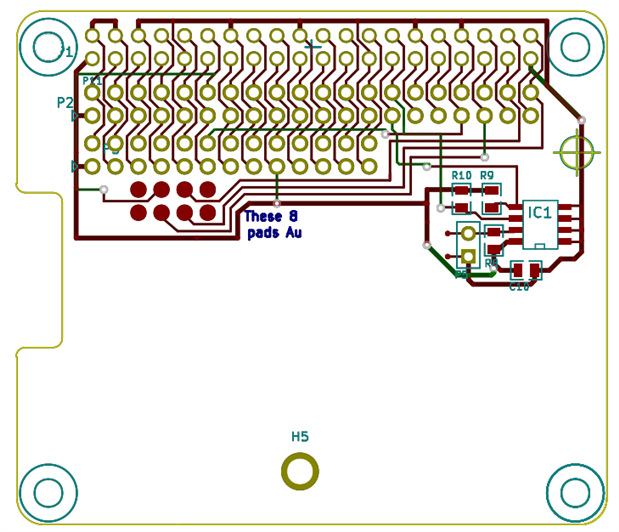
    Here is the last version, the Gerber files are generated, ready to go.  It is the first time I have sent artwork away for PCB production (rather than making the boards myself).


    image

    • Cancel
    • Vote Up 0 Vote Down
    • Sign in to reply
    • Cancel
  • soundhound
    soundhound over 8 years ago in reply to psyj

    hi John


    can you confirm the hardware mods needed to connect the wolfson to an RPi 2/3?


    I have:


    pin 40 rx to 5

    pin 38 tx to 6

    pin 35 frame to 4

    pin 12 (on wolfson) to 3


    remove resistor  r39 .... can I do this by scraping it out with a scalpel/stanley knife? has anyone posted a picture elsewhere showing its location? (my eyes aren't good)


    thanks,


    chris

    • Cancel
    • Vote Up 0 Vote Down
    • Sign in to reply
    • Cancel
  • psyj
    psyj over 8 years ago in reply to soundhound

    Chris,


    I hope those are the connections,  they are the ones on the artwork above !  (note that the 8 pogo pins are mirror numbered because of their spatial inversion)


    Pages 6 & 7 (and indeed later) of this thread give some further details on the original modification made by Hias (and me).  We differed in our approaches but the two solutions are electrically equivalent.  Like you, I didnt fancy removing the pogo pins and r39.  Instead I opted for a daughter board, which has become the pi hat shown above  ...... this requires zero modification of either the pi or the wolfson card.  However it does demand additional space  ..... and additional money!


    If you want to plug the wolfson directly onto the pi then you will need to remove the 8 pogo pins, or shield their tips from making contact with the "mother" board (both these approaches have been documented in this thread).  You will also need either to remove r39 OR cut off pin 12 on the pi 40 way header.  Of the two I would prefer to cut off pin 12 because it avoids me putting a soldering iron near the Wolfson  .... but of course if you ever re-use the pi AND you need pin 12 then you will have a problem.


    If you follow the unsolder solution, I must urge you to find a good magnifying glass and check out your board. As Hias has (I think) said, it is less difficult than it looks  ...  the heat from a normal soldering iron direct onto the component will melt both pads (and the component) and it should lift off by capillary action   .... but lift off the wrong component, or surface tension breaks down, or get a solder smear between this and adjacent pads ........ and unsoldering the pogo pins will demand lots of heat .........  Hias has nerves of steel, at least by my standards.


    But then that pi hat daughter board I am designing/building is going to cost 25 euros or there about   ...... more than Farnell currently charge for the  Wolfson card!


    Where is R39 on the Wolfson card?  Offhand I cannot say, I will need to look at the card when I get back


    A quick (and not too dirty) solution that nobody has yet tried is a 40 way idc plug and ribbon (as used on old ATA HDD) and connecting the appropriate wires to a 26 pin header plus the pogo pins.  Not all of the connections need to be made, but Hias will need to say which GPIO the driver uses .... or simply wire them all (switching pin 12 as previously noted)  ..... and remembering the mirror inversion !!!!

    • Cancel
    • Vote Up 0 Vote Down
    • Sign in to reply
    • Cancel
element14 Community

element14 is the first online community specifically for engineers. Connect with your peers and get expert answers to your questions.

  • Members
  • Learn
  • Technologies
  • Challenges & Projects
  • Products
  • Store
  • About Us
  • Feedback & Support
  • FAQs
  • Terms of Use
  • Privacy Policy
  • Legal and Copyright Notices
  • Sitemap
  • Cookies

An Avnet Company © 2026 Premier Farnell Limited. All Rights Reserved.

Premier Farnell Ltd, registered in England and Wales (no 00876412), registered office: Farnell House, Forge Lane, Leeds LS12 2NE.

ICP 备案号 10220084.

Follow element14

  • X
  • Facebook
  • linkedin
  • YouTube