RoadTest: RoadTest Open Call
Author: skruglewicz
Creation date:
Evaluation Type: Development Boards & Tools
Did you receive all parts the manufacturer stated would be included in the package?: True
What other parts do you consider comparable to this product?: 03030215 CAN-BUS Shield Board, MCP2515, MCP2551, Controller and Transceiver, Arduino Board (SEEED STUDIO) SHIELDBTS70021EPPTOBO1 ARDUINO SHIELD, HIGH-SIDE SW, 12V, 21A ROHS COMPLIANT: YES (INFINEON)
What were the biggest problems encountered?: todo
Detailed Review:

Title Banner: “Evaluating Modulino Nodes and Shield Integration on the Arduino UNO Q” featuring the Arduino UNO Q flanked by the Plug and Make Kit, Infineon BLDC Shield, and MIKROE-1581 Click Shield
This RoadTest Open Call turns the traditional RoadTest concept around by letting members choose the exact product they want to test and review. Applicants can choose any product under $175 (such as single-board computers, development kits, or bench equipment) available on the Newark / Farnell / element14 online stores. Selected RoadTesters were announced and received their requested products for free in exchange for writing a comprehensive review. I was fortunate to be chosen to write a review based on products I selected from the online store.
I will be using the Arduino UNO Q board currently in my possession as the core processing engine for this evaluation. Rather than functioning as a standard micro-controller board, the UNO Q introduces a transformative shift to the traditional Arduino workflow, marking an impressive milestone for embedded hardware design.
I road tested the Arduino UNO Q here: Test out Arduino's Uno Q - The new Single-Board Computer and was incredibly impressed by its hybrid MPU/MCU architecture. While I pushed the board's internal capabilities to its limits, I was highly motivated to evaluate its physical expandability. I wanted to test Arduino's claim of seamless compatibility with the wider ecosystem—specifically how it handles classic arduino shields, Qwiic connectors, and Modulino nodes—to see if it can truly serve as the ultimate industrial/hobbyist bridge.
I might also mention that I have connected a Grove base shield to a UNO Q with great success. Feel free to view my project, which earned 3rd Place in the element14 On The Line Design Challenge at this link: Industrial Line Sentinel (ILS).
The type of review I am doing is an out-of-the-box experience with the expansion products supplied to me by the Roadtest team. I will do an unboxing, power the product up, check any pre-programmed options or features, and follow the user guides and review them for each product.
These are the devices that I will be reviewing. I proposed these products to possibly test the ecosystem, and was given them to review:


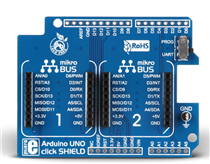
The scope of my evaluation focuses on an out-of-the-box review for these three expansion products detailed below. Each product will undergo individual testing, covering unboxing, initial power-up, assessing stock configurations, and executing the official user guides to review the full experience.
As a retired Senior Software Engineer holding a Bachelor of Science in Computer Science from Boston University, my embedded systems work focuses on system architecture, inter-processor communication (IPC), and hardware-in-the-loop validation. Over years of participating in element14 Design Challenges and RoadTests, I have evaluated dozens of development ecosystems across Renesas, NXP, Infineon, Nordic, and STMicroelectronics.
Building on my previous RoadTest of the UNO Q and my work in the element14 Summer of Sensors Design Challenge—where I published a technical series (e.g., Under Pressure - BLOG 1 - BPM Uno - INTRODUCTION) evaluating the MIKROE-1581 Click Shield with optical biosensors—this review dives deeper into multi-bus hardware integration.
Traditional 8-bit and 32-bit microcontrollers easily manage hardware shields because they interact with a single, dedicated execution loop. In contrast, modern single-board computers often sacrifice pin-level deterministic timing to support an operating system. The Arduino UNO Q claims to solve this dilemma through its dual-brain design.
My hypothesis asserts that:
To provide thorough, rigorous testing without forcing multiple unrelated technologies into a single sprawling review, I have structured this Open Call evaluation into three dedicated child RoadTests, anchored by this master introduction:
[LINK] UNDER CONSTRUCTION
[LINK] UNDER CONSTRUCTION
[LINK] UNDER CONSTRUCTION
The architectural breakthrough of the Arduino UNO Q lies in its asymmetric multiprocessing (AMP) design. Embedded developers have historically been forced to choose between the high compute capacity of a single-board computer and the deterministic low-latency responsiveness of a microcontroller. The UNO Q provides both simultaneously:

The internal Router Bridge links the two processors over an ultra-low-latency inter-processor communication channel. Firmware running on the STM32 formats polled telemetry into lightweight JSON packets sent over the bridge. A background Python service on the Qualcomm Linux MPU ingests this stream, performs higher-level processing, and publishes metrics to the web dashboard. Conversely, operator commands issued from the web interface pass across the bridge to trigger immediate hardware actuation on the MCU.
To provide consistency across all three dedicated product reviews, each evaluation follows a standardized 7-point testing framework:
With hardware officially received at my lab in West Boylston, Massachusetts, the evaluation roadmap is scheduled across the standard 60-day element14 review cycle:
The element14 RoadTest Open Call offers an ideal platform to explore how well the Arduino UNO Q bridges modern modular sensor nodes, classic high-power shields, and standardized socket adapters. By splitting this evaluation into dedicated child reviews anchored by this introduction, each expansion architecture receives the rigorous testing it deserves.
Stay tuned for the publication of RoadTest 1: Modulino Integration with the AKX00069 Plug and Make Kit, followed shortly by the Infineon BLDC Motor Shield and MIKROE-1581 Click Shield evaluations!


