element14 Community
element14 Community
    Register Log In
  • Site
  • Search
  • Log In Register
  • Community Hub
    Community Hub
    • What's New on element14
    • Feedback and Support
    • Benefits of Membership
    • Personal Blogs
    • Members Area
    • Achievement Levels
  • Learn
    Learn
    • Ask an Expert
    • eBooks
    • element14 presents
    • Learning Center
    • Tech Spotlight
    • STEM Academy
    • Webinars, Training and Events
    • Learning Groups
  • Technologies
    Technologies
    • 3D Printing
    • FPGA
    • Industrial Automation
    • Internet of Things
    • Power & Energy
    • Sensors
    • Technology Groups
  • Challenges & Projects
    Challenges & Projects
    • Design Challenges
    • element14 presents Projects
    • Project14
    • Arduino Projects
    • Raspberry Pi Projects
    • Project Groups
  • Products
    Products
    • Arduino
    • Avnet & Tria Boards Community
    • Dev Tools
    • Manufacturers
    • Multicomp Pro
    • Product Groups
    • Raspberry Pi
    • RoadTests & Reviews
  • About Us
    About the element14 Community
  • Store
    Store
    • Visit Your Store
    • Choose another store...
      • Europe
      •  Austria (German)
      •  Belgium (Dutch, French)
      •  Bulgaria (Bulgarian)
      •  Czech Republic (Czech)
      •  Denmark (Danish)
      •  Estonia (Estonian)
      •  Finland (Finnish)
      •  France (French)
      •  Germany (German)
      •  Hungary (Hungarian)
      •  Ireland
      •  Israel
      •  Italy (Italian)
      •  Latvia (Latvian)
      •  
      •  Lithuania (Lithuanian)
      •  Netherlands (Dutch)
      •  Norway (Norwegian)
      •  Poland (Polish)
      •  Portugal (Portuguese)
      •  Romania (Romanian)
      •  Russia (Russian)
      •  Slovakia (Slovak)
      •  Slovenia (Slovenian)
      •  Spain (Spanish)
      •  Sweden (Swedish)
      •  Switzerland(German, French)
      •  Turkey (Turkish)
      •  United Kingdom
      • Asia Pacific
      •  Australia
      •  China
      •  Hong Kong
      •  India
      •  Japan
      •  Korea (Korean)
      •  Malaysia
      •  New Zealand
      •  Philippines
      •  Singapore
      •  Taiwan
      •  Thailand (Thai)
      •  Vietnam
      • Americas
      •  Brazil (Portuguese)
      •  Canada
      •  Mexico (Spanish)
      •  United States
      Can't find the country/region you're looking for? Visit our export site or find a local distributor.
  • Translate
  • Profile
  • Settings
Experts, Learning and Guidance
  • Technologies
  • More
Experts, Learning and Guidance
Ask an Expert Forum Generally, how are capacitors picked? (Applies to radio, MCU's, digital, analog)
  • Blog
  • Forum
  • Documents
  • Leaderboard
  • Files
  • Members
  • Mentions
  • Sub-Groups
  • Tags
  • More
  • Cancel
  • New
Join Experts, Learning and Guidance to participate - click to join for free!
Actions
  • Share
  • More
  • Cancel
Forum Thread Details
  • Replies 3 replies
  • Subscribers 316 subscribers
  • Views 610 views
  • Users 0 members are here
Related
See a helpful answer?

Be sure to click 'more' and select 'suggest as answer'!

If you're the thread creator, be sure to click 'more' then 'Verify as Answer'!

Generally, how are capacitors picked? (Applies to radio, MCU's, digital, analog)

Former Member
Former Member over 12 years ago

Sorry if this post is out of line, I'm pretty new to Element14 and I'm not fully oriented with the site yet, meaning I also don't know how many times someone may have asked this same exact question. Please bear with me, though.


I have been trying to learn about capacitors, and I know that their function is to store energy, but what I don't understand is how this applies to electronic circuits. When it is used in digital circuits, what's the point of putting it where it is? What is the function of caps in radio circuits or small DC motor circuits? I understand a little bit of that, but what bugs me the most is how people know what farad, material and voltage to use!! I looked around all over the internet but I couldn't find an explanation that I could understand. Would someone care to point me toward where I can be enlightened about capacitors, their specific purposes and how to determine what kind?


Thank you,

-Tom

  • Sign in to reply
  • Cancel

Top Replies

  • shabaz
    shabaz over 12 years ago +1
    Hi Thomas, They store a certain amount of charge when you stick a voltage across them, but that is much like describing a glass window as "made of silicon dioxide", which while true at a high level, doesn…
  • johnbeetem
    johnbeetem over 12 years ago +1
    My expertise is digital, where capacitors are mostly used for bypass. The purpose of a bypass capacitor is to keep the supply voltage for an IC constant. The problem with most digital ICs is that the amount…
  • shabaz
    shabaz over 12 years ago

    Hi Thomas,


    They store a certain amount of charge when you stick a voltage across them, but that is much like describing a glass window as "made of silicon dioxide", which while true at a high level, doesn't explain glass nor windows in much detail.


    In electronics, there are certain fundamental circuits that can be created using capacitors; these fundamental building-blocks become parts of larger circuits like computers, radios, etc.


    Here are some building blocks which can all be created with capacitors and other components:


    1. Decoupling

    2. Filter

    3. DC blocking (related to filter)

    4. Tank circuit

    5. Timing (often used for resets)


    A computer will make extremely extensive use of the first block and #5, whereas a radio will make use of #1,2,4 and an amplifier will make use of #1,2,3.


    There are formulas which are used to calculate the preferred value for the above building blocks. The wikipedia pages for them will hopefully contain the formulae.


    Note that since electronics relies on the physics of materials, capacitors can behave in a non-ideal way limited by physics and therefore some designs will use certain types or even certain shapes of capacitors, and made of certain materials (cost-performance tradeoff). It can get very advanced; for example, here is a PDF document just dedicated to decoupling. (AVX is a manufacturer of capacitors, so expect them to have lots of useful information).


    Some of the other topics require using complex math, depending on how much detail you want to go into. At a high level, it is possible to state things like "a filter will allow certain frequencies to pass". One nice way to think of a capacitor (again, high level) is as a frequency-dependent resistance (actually impedance, but that requires complex math). Again, from that high level, you would not really try to convert that into the building blocks listed above; those building blocks are like well-known templates of designs, so you can directly use the appropriate formulae for calculating the component values.


    If you want to be enlightened without any deep math, and want practical guidance, a very good book is 'The Art of Electronics'. If you want the math too, then I can recommend some university-level books, but they are definitely not easy-going and I don't want to scare you ; ) Personally, I'd suggest The Art of Electronics, it is very easy to read.


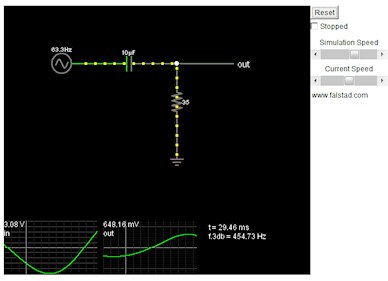
    If you want to experiment, you could try a simulator. Here is a simulation of a filter. You can alter the component values if desired. Notice when you run it, the input signal frequency slowly increases. You can observe the input signal, and the output graphs at the bottom, dynamically.

    image


    EDIT: here is a practical example of building block #2 (filter).

    • Cancel
    • Vote Up +1 Vote Down
    • Sign in to reply
    • Cancel
  • johnbeetem
    johnbeetem over 12 years ago

    My expertise is digital, where capacitors are mostly used for bypass.  The purpose of a bypass capacitor is to keep the supply voltage for an IC constant.  The problem with most digital ICs is that the amount of current they need can change very rapidly, especially if multiple inputs change at the same time.  For example, if 32 IC outputs all switch from 0V to 3.3V simultaneously, the IC needs to get a bunch of charge from somewhere quickly.  Now it could try to get the charge from the power supply, but it's far enough away that it will take a while to get the current to the IC.  Meanwhile, the IC will pull charge from whatever is near, which causes the supply voltage of the IC to dip.  If it dips too much, it will malfunction.


    So what the bypass capacitor does is provide a reservoir of charge right next to the IC power pin so that it provides the charge and minimizes the dip in supply voltage.  To calculate the amount of capacitance you need, you add up the amounts of charge needed to change the outputs.  Usually nobody bothers with the calculations and instead uses 0.1 uF or 0.01 uF capacitors everywhere.  Parts with lots of voltage supply pins (usually called Vcc or Vdd) often tell you in the data sheet what values are recommended, e.g., 0.1 uF ceramic cap for each Vdd plus an additional 10 uF bulk capacitor.  Also, many manufacturers provide a reference design board or schematic and encourage you to copy the capacitor values from that board.


    One thing you have to be careful about with capacitors is that they don't just have capacitance: they also have resistance and inductance.  Typically those little 0603 SMT 0.01 uF ceramic caps have very little inductance so they make the best bypass.  However, they can't store much charge so you add larger 10 uF multi-layer ceramic caps to provide a second reservoir.


    There are also large electrolytic capacitors.  They're slow, but can store a lot of charge... unless they get too warm and the electrolyte boils off making them useless.  This happens a lot with cheap PC motherboards.


    Capacitors also have a working voltage.  You usually want to have twice the highest voltage you expect to get good margin.  Higher voltage capacitors are physically larger, and may have more inductance.


    Analog capacitors are a huge subject which I know very little about.  If I need to do something analog, I try to copy the reference design exactly, including the same types and values of capacitors.  I leave the differences between polyester and mica and paper to others.

    • Cancel
    • Vote Up +1 Vote Down
    • Sign in to reply
    • Cancel
  • jvdberg@ieee.org
    jvdberg@ieee.org over 12 years ago in reply to johnbeetem

    In his explanation John Beeten wrote about changing the output Voltage of an integrated circuit. The inputs of the circuits connected  to those outputs are the real need for a decoupling capacitor. The output of a C-mos digital circuit acts as a switch, connecting the output pin to the supply pin or to ground. The load is mostly capacitive. With fast components,  the inductance of the trace to the supply cannot be neglected. A capacitor close to the supply pins of the driving IC will charge the load when the output goes from low ho high. Without this capacitor, the supply Voltage at the driving IC will drop when the polarity of the output changes. If this IC is a gate, this will cause a delay. If this IC is a counter or a memory, the drop in supply Voltage can cause loss of the content stored in the IC. The value of the decoupling capacitor must be more than 10 times the input capacity of the inputs, connected to the outputs of the IC. In general ceramic capacitors with a value of 0.1 μF are used for this purpose. Capacitors also have inductance.  Larger capacitors have larger inductance, as a result if their mechanical size and construction. Properties of a capacitor are not only value and maximum Voltage. Inductance, current rating, ESR(Equivalent Series Resistance), accuracy and stability are sometimes important. For critical decoupling over a wide frequency area, often several capacitors with different type and value are used in parallel. For example  a 0.1 μF ceramic capacitor, a 1 μF polyester capacitor and a 1000 μF electrolytic capacitor. For decoupling purposes, accuracy and stability are not important. In tuned circuits and timing systems they are. In switched mode power supplies some capacitors must handle high currents at the switching frequency. Here a low ESR is important. J. van den Berg

    • Cancel
    • Vote Up 0 Vote Down
    • Sign in to reply
    • Cancel
element14 Community

element14 is the first online community specifically for engineers. Connect with your peers and get expert answers to your questions.

  • Members
  • Learn
  • Technologies
  • Challenges & Projects
  • Products
  • Store
  • About Us
  • Feedback & Support
  • FAQs
  • Terms of Use
  • Privacy Policy
  • Legal and Copyright Notices
  • Sitemap
  • Cookies

An Avnet Company © 2026 Premier Farnell Limited. All Rights Reserved.

Premier Farnell Ltd, registered in England and Wales (no 00876412), registered office: Farnell House, Forge Lane, Leeds LS12 2NE.

ICP 备案号 10220084.

Follow element14

  • X
  • Facebook
  • linkedin
  • YouTube