element14 Community
element14 Community
    Register Log In
  • Site
  • Search
  • Log In Register
  • Community Hub
    Community Hub
    • What's New on element14
    • Feedback and Support
    • Benefits of Membership
    • Personal Blogs
    • Members Area
    • Achievement Levels
  • Learn
    Learn
    • Ask an Expert
    • eBooks
    • element14 presents
    • Learning Center
    • Tech Spotlight
    • STEM Academy
    • Webinars, Training and Events
    • Learning Groups
  • Technologies
    Technologies
    • 3D Printing
    • FPGA
    • Industrial Automation
    • Internet of Things
    • Power & Energy
    • Sensors
    • Technology Groups
  • Challenges & Projects
    Challenges & Projects
    • Design Challenges
    • element14 presents Projects
    • Project14
    • Arduino Projects
    • Raspberry Pi Projects
    • Project Groups
  • Products
    Products
    • Arduino
    • Avnet & Tria Boards Community
    • Dev Tools
    • Manufacturers
    • Multicomp Pro
    • Product Groups
    • Raspberry Pi
    • RoadTests & Reviews
  • About Us
  • Store
    Store
    • Visit Your Store
    • Choose another store...
      • Europe
      •  Austria (German)
      •  Belgium (Dutch, French)
      •  Bulgaria (Bulgarian)
      •  Czech Republic (Czech)
      •  Denmark (Danish)
      •  Estonia (Estonian)
      •  Finland (Finnish)
      •  France (French)
      •  Germany (German)
      •  Hungary (Hungarian)
      •  Ireland
      •  Israel
      •  Italy (Italian)
      •  Latvia (Latvian)
      •  
      •  Lithuania (Lithuanian)
      •  Netherlands (Dutch)
      •  Norway (Norwegian)
      •  Poland (Polish)
      •  Portugal (Portuguese)
      •  Romania (Romanian)
      •  Russia (Russian)
      •  Slovakia (Slovak)
      •  Slovenia (Slovenian)
      •  Spain (Spanish)
      •  Sweden (Swedish)
      •  Switzerland(German, French)
      •  Turkey (Turkish)
      •  United Kingdom
      • Asia Pacific
      •  Australia
      •  China
      •  Hong Kong
      •  India
      • Japan
      •  Korea (Korean)
      •  Malaysia
      •  New Zealand
      •  Philippines
      •  Singapore
      •  Taiwan
      •  Thailand (Thai)
      • Vietnam
      • Americas
      •  Brazil (Portuguese)
      •  Canada
      •  Mexico (Spanish)
      •  United States
      Can't find the country/region you're looking for? Visit our export site or find a local distributor.
  • Translate
  • Profile
  • Settings
Experts, Learning and Guidance
  • Technologies
  • More
Experts, Learning and Guidance
Ask an Expert Forum How could I install a new 12 volt backlight?
  • Blog
  • Forum
  • Documents
  • Leaderboard
  • Files
  • Members
  • Mentions
  • Sub-Groups
  • Tags
  • More
  • Cancel
  • New
Join Experts, Learning and Guidance to participate - click to join for free!
Actions
  • Share
  • More
  • Cancel
Forum Thread Details
  • State Verified Answer
  • Replies 51 replies
  • Answers 5 answers
  • Subscribers 307 subscribers
  • Views 7836 views
  • Users 0 members are here
  • monitor
  • power
  • backlighting
Related
See a helpful answer?

Be sure to click 'more' and select 'suggest as answer'!

If you're the thread creator, be sure to click 'more' then 'Verify as Answer'!

How could I install a new 12 volt backlight?

bwarren97
bwarren97 over 10 years ago

I have a 1080p monitor that I really really liked, until its backlight started being a butthead. So, I decided to take out the old backlight, and stick in an aftermarket one. I thought it would be nice and simple, until I realized that the LED driver ran on 12 volts and there was no 12 volt output anywhere on the monitor (the original LED was driven by 80 volts).
I have confirmed that the backlight works by jump-wiring it to a PC power supply, but I need a somewhat space-saving method of driving it within the monitor case using its own power supply so that it turns on and off with the monitor. I would like to just solder a 12 volt regulator directly onto the 80 volt output, but I don't know if there is a small chip capable of providing sufficient power or stepping down that much voltage. Any ideas?

  • Sign in to reply
  • Cancel

Top Replies

  • mcb1
    mcb1 over 9 years ago in reply to bwarren97 +2 suggested
    An optocoupler (as you discovered when you seardhed it) provides isolation between sides (LED) and the other (Transistor/Tirac/SCR). They come in various forms and some are much more sensitive than others…
  • shabaz
    shabaz over 10 years ago +1
    You can apply ohm's law and the power equation and see immediately you have a very high amount of power to dissipate as cmay77 mentions - heatsinks and fan time basically. So, theoretically possible with…
  • shabaz
    shabaz over 10 years ago in reply to bwarren97 +1
    By connecting to a 80V supply, even if your backlight draws just 0.3A (4W), your heatsink will need to dissipate more than 20W - that's a huge heatsink. Furthermore, the supply you measured is probably…
Parents
  • cmay77
    0 cmay77 over 10 years ago

    Okay, first of all you cannot just solder in a voltage regulator directly to your 80 volt output is just going to blow your new backlight. First things first we need to get some information about your new backlight, and your tv. Specifically what is the current rating of the light, and what is the current output of the TV power supply driver?

    While hooking up a voltage regulator will change the output voltage it will not limit the current. This will be just like hooking up and led up directly to a battery. Once you have the current output and the current rating we can design a circuit that will limit the current, and drop the voltage, the circuit will most likely integrate a voltage regulator. You also probably need a couple of half watt or 1 watt resistors dropping from 80 volts down to 12 volts will cause a high rate of power dissipation, and since your television will be running for extended periods of time, you will want to make the circuit as close to indestructible as possible. Also keep in mind that the voltage regulator dropping from 80 down to 12 volts is also going to be dissipating a great deal of heat, you're going to have to have a heat sink attached to it and that will take up a bit of space, and you don't want that touching any of the plastic parts of the television.


    Please post the following information:

    Backlight power dissipation, and current rating.

    Television monitor driver current output.


    You should be able to find all this in the data sheet for the light bar, might have to do some digging to get the information about the television driver output. If you can't find the information for the television we can still probably design the circuit by assuming that the television current source will attempt to supply infinite current, it would just be nice to have that information handy.

    • Cancel
    • Vote Up 0 Vote Down
    • Sign in to reply
    • Verify Answer
    • Cancel
  • bwarren97
    0 bwarren97 over 10 years ago in reply to cmay77

    Well, here's the problem. The backlight I purchased had literally no documentation attached. It's a cheap one from China. All I know is that the LED driver that it shipped with runs on 12 volts at least, and it needs an enable signal. I am very hesitant to attach my multimeter to read the current draw of it, as my multimeter has a 10 amp capacity and has no fuse (the milliamp setting is also unfused since the original fuse blew and I just decided to bypass it)


    What I meant about tying a regulator to the 80v output, I meant attaching the new driver to that with the 12v regulator or something. The LED driver would then limit the current if I am not mistaken, since it ran just fine from the PC power supply. If I can grab power from somewhere else on the power board that turns off when it goes into sleep mode, then that would be great. The enable line on the LED driver can take as little as 5v (based on what I used on the PC power supply) to turn on, so that can be separate.


    As for the calibration and whatnot, I don't really think that's necessary, because I ran the panel with the new backlight in there and I was very satisfied with the results. It works, but now I'm just looking for a way to run it as just the monitor, not a string of parts everywhere.


    I will do some research on the monitor. It is an ASUS VK248. What I do know is that the power going to the logic is just 5v.


    In my opinion, there appears to be plenty of space for a heat sink to fit within the metal shielding of the device. Here's some pictures to maybe give you guys a better idea. https://drive.google.com/folderview?id=0B5FOtrrp9MnYZDMwcHI1TUJxOUU&usp=sharing

    • Cancel
    • Vote Up 0 Vote Down
    • Sign in to reply
    • Verify Answer
    • Cancel
  • supper_slash
    0 supper_slash over 9 years ago in reply to mcb1

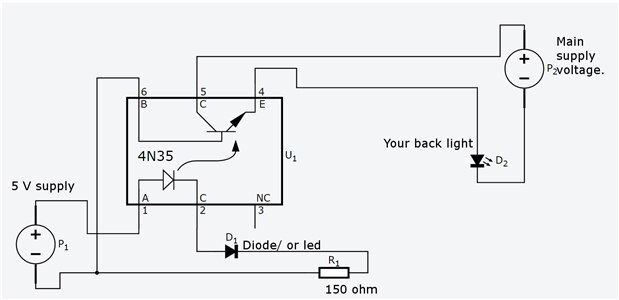
    Here is an idea of what you are doing. image


    Are you sure your led/diode is connected the correct way?

    Just a thought.

    P.S. I know the ground is connected, I just forgot to add that to the diagram.

    Also, Please take Voltage readings for ground, and each "LEG" of the circuit, This will be most helpful.

    I.E. reading at pin 2, than at pin3, resistor, then at diode/Led, both sides, etc.

    • Cancel
    • Vote Up 0 Vote Down
    • Sign in to reply
    • Verify Answer
    • Cancel
  • mudz
    0 mudz over 9 years ago in reply to bwarren97

    Your power supply is on? right? No short connections ? right? No wrong opto-coupler connections? No blown opcto-coupler?

    • Cancel
    • Vote Up 0 Vote Down
    • Sign in to reply
    • Verify Answer
    • Cancel
  • supper_slash
    0 supper_slash over 9 years ago in reply to mudz

    Good thinking, Hopefully If he posts the voltages on the circuit, this can be answered. image

    mudz wrote:


    Your power supply is on? right? No short connections ? right?

    • Cancel
    • Vote Up 0 Vote Down
    • Sign in to reply
    • Verify Answer
    • Cancel
  • mcb1
    0 mcb1 over 9 years ago in reply to supper_slash

    supper_slash

    Great circuit but the Base of the transistor remains unconnected.

    ie Pin 6 is either unconnected or in some case tied to Pin 4 via a 1Mohm resistor.


    Mark

    • Cancel
    • Vote Up 0 Vote Down
    • Sign in to reply
    • Verify Answer
    • Cancel
  • bwarren97
    0 bwarren97 over 9 years ago in reply to mcb1

    Yes, my power supply turns on, and yes, the LED turns on.


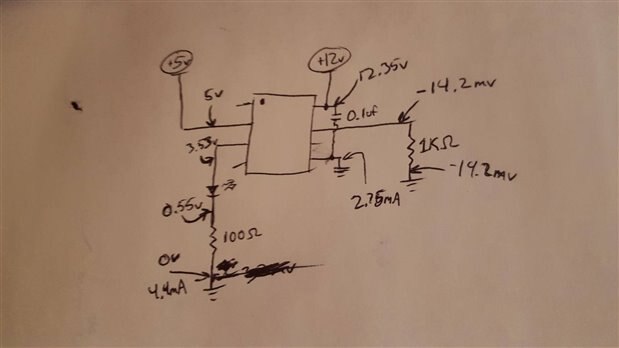
    I have jotted down a crude schematic of what I currently have connected. This is the FOD3184 chip. One interesting thing I noted here is that operating the LED generated slight negative voltage on the ground of one side, but not the other. There was no voltage being output by the sensor side of the coupler at all, as when I disconnected it, I got 0 on the output.


    Here's my schematic with my voltage and amperage readings, and the link to the full-resolution

    http://puu.sh/mMi2D/d4665b25e5.jpg

    image

    • Cancel
    • Vote Up 0 Vote Down
    • Sign in to reply
    • Verify Answer
    • Reject Answer
    • Cancel
  • mudz
    0 mudz over 9 years ago in reply to bwarren97

    supper_slash is right. Remove all the connections first and check if opto coupler is working fine by giving input and checking out on Vo using multi meter. Most of the times when the circuit is not working I found that a floating ground pin was the fault. so carefully connect all ground connections.
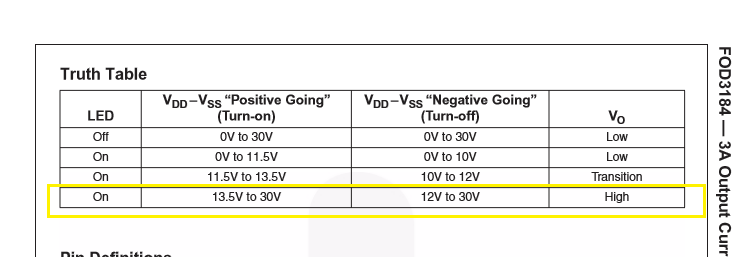
    On the second thought: Hey, look what I found:-
    image


    So you need to apply more voltage on VDD to turn the Vo pin high. Apply at least 13.5v-14v on VDD pin.
    Hope this helps.


    mudz

    • Cancel
    • Vote Up 0 Vote Down
    • Sign in to reply
    • Verify Answer
    • Cancel
  • mcb1
    0 mcb1 over 9 years ago in reply to bwarren97

    bwarren97

    Clearly some comments are missing the point.


    You have a 1.47v drop across the LED, which is within spec.

    image

    The second LED has a 2.98v drop across it (3.53-0.55 = 2.98).


    This is resulting in the forward current being 5.5mA

    (0.55v across 100ohms is .0055A).


    The specs show you need 10-16mA

    image


    I suggest either find a lower forward voltage led or remove it and increase the series resistor back up to 220 ohms.


    This optocoupler has a high output current and noise immunity, hence the fairly high input requirements.


    Mark

    • Cancel
    • Vote Up 0 Vote Down
    • Sign in to reply
    • Verify Answer
    • Cancel
  • mcb1
    0 mcb1 over 9 years ago in reply to mcb1

    bwarren97

    BTW you are looking for 1-1.6v acrss the 100 ohm resistor if you change the LED.

    Generally the higher output/brighter LED's require a higher forward voltage, so look for some lowly old red LED.


    Mark

    • Cancel
    • Vote Up 0 Vote Down
    • Sign in to reply
    • Verify Answer
    • Cancel
  • bwarren97
    0 bwarren97 over 9 years ago in reply to mcb1

    So, this was starting to make a lot more sense to me. However, I tried both switching the LED and removing it altogether. Still nothing


    I got a reading of just over 10mA using the lower power LED, and got a reading of about 14mA when I removed it and increased the resistor. The output on the optocoupler remained 0.

    • Cancel
    • Vote Up 0 Vote Down
    • Sign in to reply
    • Verify Answer
    • Cancel
  • mudz
    0 mudz over 9 years ago in reply to bwarren97

    Hi bwarren97
    If you move to post number 30 (i.e. first post in this page & leave first two lines), you'll know why you are not getting a high on output (Vo pin)
    It's because you are not applying enough voltage on the Vdd pin, use minimum of 13.5v.


    mudz

    • Cancel
    • Vote Up 0 Vote Down
    • Sign in to reply
    • Verify Answer
    • Cancel
Reply
  • mudz
    0 mudz over 9 years ago in reply to bwarren97

    Hi bwarren97
    If you move to post number 30 (i.e. first post in this page & leave first two lines), you'll know why you are not getting a high on output (Vo pin)
    It's because you are not applying enough voltage on the Vdd pin, use minimum of 13.5v.


    mudz

    • Cancel
    • Vote Up 0 Vote Down
    • Sign in to reply
    • Verify Answer
    • Cancel
Children
  • supper_slash
    0 supper_slash over 9 years ago in reply to mudz

    So @mudz Do you think @Blake Warren can power the circuit from the 14-volt rail of the power circuit?

    Or just replace the Opto to a lower level one?


    What are you thinking?

    I feel like a different Opto is in order.

    • Cancel
    • Vote Up 0 Vote Down
    • Sign in to reply
    • Verify Answer
    • Cancel
element14 Community

element14 is the first online community specifically for engineers. Connect with your peers and get expert answers to your questions.

  • Members
  • Learn
  • Technologies
  • Challenges & Projects
  • Products
  • Store
  • About Us
  • Feedback & Support
  • FAQs
  • Terms of Use
  • Privacy Policy
  • Legal and Copyright Notices
  • Sitemap
  • Cookies

An Avnet Company © 2025 Premier Farnell Limited. All Rights Reserved.

Premier Farnell Ltd, registered in England and Wales (no 00876412), registered office: Farnell House, Forge Lane, Leeds LS12 2NE.

ICP 备案号 10220084.

Follow element14

  • X
  • Facebook
  • linkedin
  • YouTube