element14 Community
element14 Community
    Register Log In
  • Site
  • Search
  • Log In Register
  • Community Hub
    Community Hub
    • What's New on element14
    • Feedback and Support
    • Benefits of Membership
    • Personal Blogs
    • Members Area
    • Achievement Levels
  • Learn
    Learn
    • Ask an Expert
    • eBooks
    • element14 presents
    • Learning Center
    • Tech Spotlight
    • STEM Academy
    • Webinars, Training and Events
    • Learning Groups
  • Technologies
    Technologies
    • 3D Printing
    • FPGA
    • Industrial Automation
    • Internet of Things
    • Power & Energy
    • Sensors
    • Technology Groups
  • Challenges & Projects
    Challenges & Projects
    • Design Challenges
    • element14 presents Projects
    • Project14
    • Arduino Projects
    • Raspberry Pi Projects
    • Project Groups
  • Products
    Products
    • Arduino
    • Avnet & Tria Boards Community
    • Dev Tools
    • Manufacturers
    • Multicomp Pro
    • Product Groups
    • Raspberry Pi
    • RoadTests & Reviews
  • About Us
  • Store
    Store
    • Visit Your Store
    • Choose another store...
      • Europe
      •  Austria (German)
      •  Belgium (Dutch, French)
      •  Bulgaria (Bulgarian)
      •  Czech Republic (Czech)
      •  Denmark (Danish)
      •  Estonia (Estonian)
      •  Finland (Finnish)
      •  France (French)
      •  Germany (German)
      •  Hungary (Hungarian)
      •  Ireland
      •  Israel
      •  Italy (Italian)
      •  Latvia (Latvian)
      •  
      •  Lithuania (Lithuanian)
      •  Netherlands (Dutch)
      •  Norway (Norwegian)
      •  Poland (Polish)
      •  Portugal (Portuguese)
      •  Romania (Romanian)
      •  Russia (Russian)
      •  Slovakia (Slovak)
      •  Slovenia (Slovenian)
      •  Spain (Spanish)
      •  Sweden (Swedish)
      •  Switzerland(German, French)
      •  Turkey (Turkish)
      •  United Kingdom
      • Asia Pacific
      •  Australia
      •  China
      •  Hong Kong
      •  India
      • Japan
      •  Korea (Korean)
      •  Malaysia
      •  New Zealand
      •  Philippines
      •  Singapore
      •  Taiwan
      •  Thailand (Thai)
      • Vietnam
      • Americas
      •  Brazil (Portuguese)
      •  Canada
      •  Mexico (Spanish)
      •  United States
      Can't find the country/region you're looking for? Visit our export site or find a local distributor.
  • Translate
  • Profile
  • Settings
Experts, Learning and Guidance
  • Technologies
  • More
Experts, Learning and Guidance
Ask an Expert Forum Low-level to High-level signal
  • Blog
  • Forum
  • Documents
  • Leaderboard
  • Files
  • Members
  • Mentions
  • Sub-Groups
  • Tags
  • More
  • Cancel
  • New
Join Experts, Learning and Guidance to participate - click to join for free!
Actions
  • Share
  • More
  • Cancel
Forum Thread Details
  • State Suggested Answer
  • Replies 6 replies
  • Answers 4 answers
  • Subscribers 304 subscribers
  • Views 1511 views
  • Users 0 members are here
Related
See a helpful answer?

Be sure to click 'more' and select 'suggest as answer'!

If you're the thread creator, be sure to click 'more' then 'Verify as Answer'!

Low-level to High-level signal

jimmyhu78
jimmyhu78 over 7 years ago

Hi all.


I tried to find the magic component on all famous retaillers but no way.

I'm looking for a solution which able to switching between a 28Vcc (state 1) and an open output (state 0), by a command signal of 200mV


When U>200mV is applied, that energize a relay which permit to supplied a 28V or let a 28V goes through itself.

When U<200mv is applied, relay is OFF, output is open.


I think it's possible to amplify the source signal before be able to command a relay.

But i'm completly lost in datasheets.


Does someone is able to help me for finfing an efficient solution?


Many thanks.


Jimmy

  • Sign in to reply
  • Cancel

Top Replies

  • dougw
    dougw over 7 years ago +3 suggested
    You could do this with a 30V rail-to-rail op-amp like an OPA171 or an LT1637. If the current needs to be higher than the op-amp can supply, you can use a FET on the output.
  • dougw
    dougw over 7 years ago in reply to jimmyhu78 +3 suggested
    Diagram:
  • jw0752
    jw0752 over 7 years ago +2 suggested
    Hi Jimmy, I think a comparator circuit like I just used in my recent Interface Build might work. You will have to use a better comparator than the LM 393 or you could use a rail to rail op amp. Don't forget…
  • dougw
    0 dougw over 7 years ago

    You could do this with a 30V rail-to-rail op-amp like an OPA171 or an LT1637.

    If the current needs to be higher than the op-amp can supply, you can use a FET on the output.

    • Cancel
    • Vote Up +3 Vote Down
    • Sign in to reply
    • Verify Answer
    • Reject Answer
    • Cancel
  • jw0752
    0 jw0752 over 7 years ago

    Hi Jimmy,


    I think a comparator circuit like I just used in my recent Interface Build might work. You will have to use a better comparator than the LM 393 or you could use a rail to rail op amp. Don't forget you will probably need some hysteresis or you will get chattering at or near the 200 mV level as the circuit tries to decide whether it should be high or low. This means that the circuit will go high at say 200 mV but will not go low again until the signal drops below 190 mV. Here is a link to my blog with the schematic. In my case the trigger point is set by the 2 10K resistors on the non-inverting + pin 3 of the comparator at 1/2 Vcc. You will have to use a resistor voltage divider to move the trigger voltage to 200 mV if that is the level you are looking to be the change over point from High to Low.


    https://www.element14.com/community/people/jw0752/blog/2018/11/27/back-up-battery-failure-inspires-new-test-tools


    If this isn't what you are looking for give the guys some more specifics and someone will come up with other ideas.


    John

    • Cancel
    • Vote Up +2 Vote Down
    • Sign in to reply
    • Verify Answer
    • Reject Answer
    • Cancel
  • jimmyhu78
    0 jimmyhu78 over 7 years ago

    Hi Douglas and John.


    Thanks for your answers.

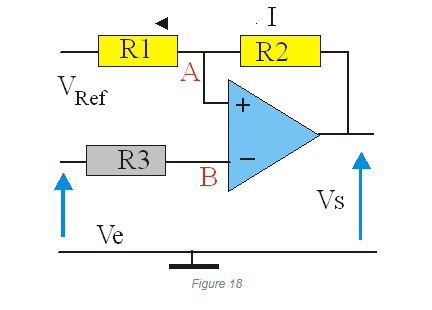
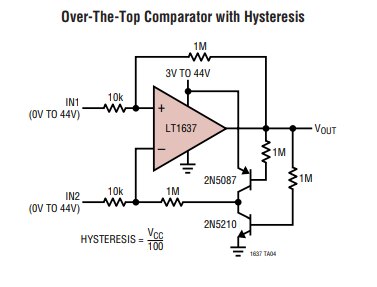
    If i understand well, i should use the component recommanded by Douglas, but could be safer with a Hysteresis application (as John mentionned).


    imageimage

    Do you think i can obtained good results with one of these kind of configurations?


    Thx

    • Cancel
    • Vote Up +2 Vote Down
    • Sign in to reply
    • Verify Answer
    • Cancel
  • dougw
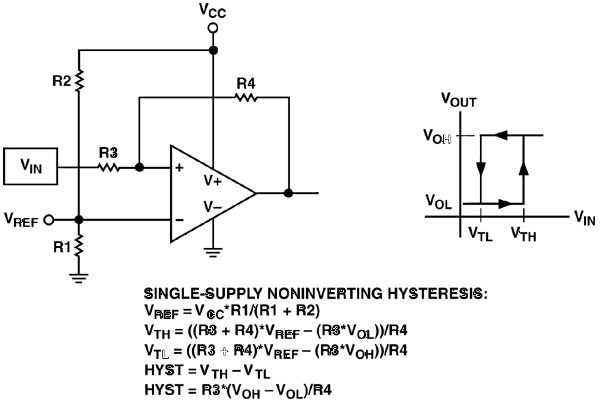
    0 dougw over 7 years ago in reply to jimmyhu78

    Diagram:

    image

    • Cancel
    • Vote Up +3 Vote Down
    • Sign in to reply
    • Verify Answer
    • Reject Answer
    • Cancel
  • geralds
    0 geralds over 7 years ago in reply to dougw

    High Douglas,


    may be it works down closed to 0,xxx V. But normally comparators like this are working down above 1V, or 1.2V with its hysteresis.

    Here a negative supply voltage may help a bit more, so the V- supply pin would get to -1.2V supply voltage for this comparator.

    We have do not to forget  too the GND noise.


    Gerald

    ---

    • Cancel
    • Vote Up +2 Vote Down
    • Sign in to reply
    • Verify Answer
    • Reject Answer
    • Cancel
  • geralds
    0 geralds over 7 years ago

    This command voltage, is this a 200mV in Respekt to GND, or on top of a threshold input voltage?

    • Cancel
    • Vote Up +1 Vote Down
    • Sign in to reply
    • Verify Answer
    • Cancel
element14 Community

element14 is the first online community specifically for engineers. Connect with your peers and get expert answers to your questions.

  • Members
  • Learn
  • Technologies
  • Challenges & Projects
  • Products
  • Store
  • About Us
  • Feedback & Support
  • FAQs
  • Terms of Use
  • Privacy Policy
  • Legal and Copyright Notices
  • Sitemap
  • Cookies

An Avnet Company © 2025 Premier Farnell Limited. All Rights Reserved.

Premier Farnell Ltd, registered in England and Wales (no 00876412), registered office: Farnell House, Forge Lane, Leeds LS12 2NE.

ICP 备案号 10220084.

Follow element14

  • X
  • Facebook
  • linkedin
  • YouTube