element14 Community
element14 Community
    Register Log In
  • Site
  • Search
  • Log In Register
  • Community Hub
    Community Hub
    • What's New on element14
    • Feedback and Support
    • Benefits of Membership
    • Personal Blogs
    • Members Area
    • Achievement Levels
  • Learn
    Learn
    • Ask an Expert
    • eBooks
    • element14 presents
    • Learning Center
    • Tech Spotlight
    • STEM Academy
    • Webinars, Training and Events
    • Learning Groups
  • Technologies
    Technologies
    • 3D Printing
    • FPGA
    • Industrial Automation
    • Internet of Things
    • Power & Energy
    • Sensors
    • Technology Groups
  • Challenges & Projects
    Challenges & Projects
    • Design Challenges
    • element14 presents Projects
    • Project14
    • Arduino Projects
    • Raspberry Pi Projects
    • Project Groups
  • Products
    Products
    • Arduino
    • Avnet & Tria Boards Community
    • Dev Tools
    • Manufacturers
    • Multicomp Pro
    • Product Groups
    • Raspberry Pi
    • RoadTests & Reviews
  • About Us
  • Store
    Store
    • Visit Your Store
    • Choose another store...
      • Europe
      •  Austria (German)
      •  Belgium (Dutch, French)
      •  Bulgaria (Bulgarian)
      •  Czech Republic (Czech)
      •  Denmark (Danish)
      •  Estonia (Estonian)
      •  Finland (Finnish)
      •  France (French)
      •  Germany (German)
      •  Hungary (Hungarian)
      •  Ireland
      •  Israel
      •  Italy (Italian)
      •  Latvia (Latvian)
      •  
      •  Lithuania (Lithuanian)
      •  Netherlands (Dutch)
      •  Norway (Norwegian)
      •  Poland (Polish)
      •  Portugal (Portuguese)
      •  Romania (Romanian)
      •  Russia (Russian)
      •  Slovakia (Slovak)
      •  Slovenia (Slovenian)
      •  Spain (Spanish)
      •  Sweden (Swedish)
      •  Switzerland(German, French)
      •  Turkey (Turkish)
      •  United Kingdom
      • Asia Pacific
      •  Australia
      •  China
      •  Hong Kong
      •  India
      • Japan
      •  Korea (Korean)
      •  Malaysia
      •  New Zealand
      •  Philippines
      •  Singapore
      •  Taiwan
      •  Thailand (Thai)
      • Vietnam
      • Americas
      •  Brazil (Portuguese)
      •  Canada
      •  Mexico (Spanish)
      •  United States
      Can't find the country/region you're looking for? Visit our export site or find a local distributor.
  • Translate
  • Profile
  • Settings
Experts, Learning and Guidance
  • Technologies
  • More
Experts, Learning and Guidance
Ask an Expert Forum power LED's
  • Blog
  • Forum
  • Documents
  • Leaderboard
  • Files
  • Members
  • Mentions
  • Sub-Groups
  • Tags
  • More
  • Cancel
  • New
Join Experts, Learning and Guidance to participate - click to join for free!
Actions
  • Share
  • More
  • Cancel
Forum Thread Details
  • State Verified Answer
  • Replies 18 replies
  • Subscribers 306 subscribers
  • Views 2338 views
  • Users 0 members are here
Related
See a helpful answer?

Be sure to click 'more' and select 'suggest as answer'!

If you're the thread creator, be sure to click 'more' then 'Verify as Answer'!

power LED's

greenwald1818
greenwald1818 over 12 years ago

hi,

     I was wondering, im building a raspberry pi laptop, and I need a way to tell if the battery is low. so, what part would I need to get if I get 2 LED'S, and I want the blue one to be on if the battery is full and the amber one to be on if it gets below 4.5 volts (with a 7.5 volt battery) OR if I have a multi-colored one how would I do it if the same thing applies except with a multi colored one. thx in advanced.

  • Sign in to reply
  • Cancel

Top Replies

  • saurocksall
    saurocksall over 12 years ago +1 verified
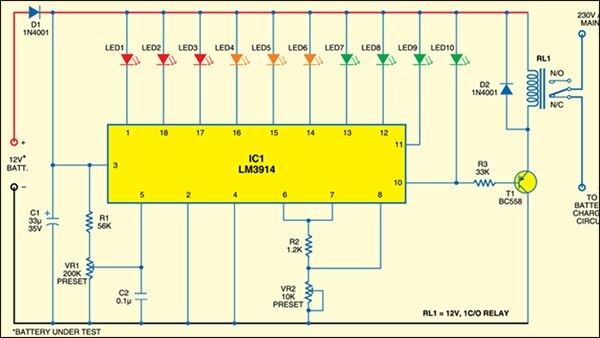
    Hi Alex, I have found the circuit that will help you , it uses The LM 3914 it has ten comparators, which are internally assembled in the voltage divider network based on the current-division rule. So it…
  • greenwald1818
    greenwald1818 over 11 years ago in reply to saurocksall +1
    what is the ic1 LM3914
  • shabaz
    0 shabaz over 12 years ago

    Hi Alex,


    This type of thing is possible to implement using comparator ICs and a voltage reference. For example, see the datasheet for LM3915 which has a block diagram of the type of circuitry that would do what you need. Another alternative - if you're using something like an Arduino as part of your build - would be to use one of the ADC channels to monitor a fraction of the supply voltage and control the LEDs.

    • Cancel
    • Vote Up 0 Vote Down
    • Sign in to reply
    • Verify Answer
    • Cancel
  • greenwald1818
    0 greenwald1818 over 12 years ago

    can you give me links to all that stuff?

    • Cancel
    • Vote Up 0 Vote Down
    • Sign in to reply
    • Verify Answer
    • Cancel
  • shabaz
    0 shabaz over 12 years ago in reply to greenwald1818

    Hi Alex,


    I don't know of any links to do exactly what you wish to achieve, but the LM3915 datasheet has a block diagram to give you an idea of how to achieve it with a comparator. You'd still have to design the circuit. Similarly for an ADC method, you could search for potential divider to see how to divide the input voltage to a range suitable for the Arduino ADC (assuming this is what you choose - just a suggestion in case you were already using it as part of your design). Code to read the ADC can be found by searching for 'arduino adc' - it is an AnalogRead function. To make an LED turn on, the DigitalWrite function can be used I believe (I'm not knowledgeable on Arduino, but I know it can be done with it - the arduino.cc website has example code).

    • Cancel
    • Vote Up 0 Vote Down
    • Sign in to reply
    • Verify Answer
    • Cancel
  • saurocksall
    0 saurocksall over 12 years ago

    Hi Alex,


    I have found the circuit that will help you , it uses The LM 3914 it has ten comparators, which are internally assembled in the voltage divider network based on the current-division rule. So it divides the battery level into ten parts !!

    image

    you can read more about this circuit at http://www.electronicsforu.com/electronicsforu/circuitarchives/view_article.asp?sno=137&article_type=1&id=433&tt=unhot&b_type=new

    • Cancel
    • Vote Up +1 Vote Down
    • Sign in to reply
    • Reject Answer
    • Cancel
  • greenwald1818
    0 greenwald1818 over 11 years ago in reply to saurocksall

    what is the ic1 LM3914

    • Cancel
    • Vote Up +1 Vote Down
    • Sign in to reply
    • Verify Answer
    • Cancel
  • saurocksall
    0 saurocksall over 11 years ago in reply to greenwald1818

    The LM3914 is basically a Dot/Bar Display Driver used for indication of voltage levels, You can read more about it HERE...

    • Cancel
    • Vote Up 0 Vote Down
    • Sign in to reply
    • Verify Answer
    • Cancel
  • D_Hersey
    0 D_Hersey over 11 years ago

    One can (okay, I am showing my age) build a comparator or schmidt trigger from discretes.  If one want's high Zin, one constructs an inverter w/ a fet (or mosfet) and follows it with a bipolar inverter.  Schmidt action is cast by using a very large positive feedback resistor from the output to the input, just sayin', these things are mighty fast, not that we need fast here.  If one want's low Zin, one can start with the bipolar inverter and finish with the FET inverter.  Use switching Qs, if poss.  You could probably just hook up a (backwards, of course) Zener to the front end of this version, as it is current-sensitive.  Alternately, get a potential (voltage for the illiterate community) comparator chip.  I'd get an OC (open collector) version, if using a single led, hook it up and it's ballast to the output.  Else, if you insist upon two LEDs, use a non OC comparator or one with a PU (pull up) resistor, appropriately scaled from the (data-sheet) DS.  Feed this into a CMOS gate, in order to get push-pull action.  Hook this output to the middle of an led (plus ballasts) string.  Choose resistors to balance subjective output.  At the front end of the comparator are two inputs, one is fed by your battery, the other by a reference, I would use a cheap, tiny voltage-regulator here, preferably.  You can use a string of a backward Zener plus forward diode(s) to balance the tempcos, again, showing my age.  Interchange of the inputs complements the sense, equiv, presuming equal ballasts, of swapping LED position.  Using a R-string from the supply would be obviously problematic.  Similarly, in many situations using the processor itself would be undesirable. 

    • Cancel
    • Vote Up 0 Vote Down
    • Sign in to reply
    • Verify Answer
    • Cancel
  • D_Hersey
    0 D_Hersey over 11 years ago

    Nowadays they have comparators w/ complementary-symmetry outputs.  I know what I am doing, but I was born awhile ago!

    • Cancel
    • Vote Up 0 Vote Down
    • Sign in to reply
    • Verify Answer
    • Cancel
  • D_Hersey
    0 D_Hersey over 11 years ago

    It's all about what is in your drawer for a one-off.  Another way to get the two LEDs thingy going would be to spring for a dual OC (open collector, open drain) type comparator.  One comparator energizes LED-and-ballast A, on the basis of battery level, the other comparator senses the absence of drop across load A and, in response, energizes LED-and-ballast (load) B.  Also if your design has an unused CMOS gate locally, you might want to go with the earlier solution.  EEs are an adventitious lot.

    • Cancel
    • Vote Up 0 Vote Down
    • Sign in to reply
    • Verify Answer
    • Cancel
  • Former Member
    0 Former Member over 11 years ago

    There is an episode of the Ben Heck show where he builds an alert system for a mailbox that is set up to warn him inside the house when the batteries are starting to get low.  Would probably be a good episode to watch.

    • Cancel
    • Vote Up 0 Vote Down
    • Sign in to reply
    • Verify Answer
    • Cancel
>
element14 Community

element14 is the first online community specifically for engineers. Connect with your peers and get expert answers to your questions.

  • Members
  • Learn
  • Technologies
  • Challenges & Projects
  • Products
  • Store
  • About Us
  • Feedback & Support
  • FAQs
  • Terms of Use
  • Privacy Policy
  • Legal and Copyright Notices
  • Sitemap
  • Cookies

An Avnet Company © 2025 Premier Farnell Limited. All Rights Reserved.

Premier Farnell Ltd, registered in England and Wales (no 00876412), registered office: Farnell House, Forge Lane, Leeds LS12 2NE.

ICP 备案号 10220084.

Follow element14

  • X
  • Facebook
  • linkedin
  • YouTube