Hi!
Do enyone know how i can make a led turn on that uses 3 volts, when a voltage has reached 330volts?
I am trying to make a indicator turn on when a capasitor is full..
Be sure to click 'more' and select 'suggest as answer'!
If you're the thread creator, be sure to click 'more' then 'Verify as Answer'!
Hi!
Do enyone know how i can make a led turn on that uses 3 volts, when a voltage has reached 330volts?
I am trying to make a indicator turn on when a capasitor is full..
Typically, LEDs are actuated by a current rather than a potential, but, lets presume that you want to derive a 3-volt signal to drive a ballasted LED. The problem you mention, otherwise, is rather canonical. You can use an op-amp in the inverting configuration followed by a comparator. Your input resistor should be about 100x larger in value than the feedback resistor, this configuration allows for fractional (and negative) gain. Don't forget the current-balancing resistor, from gnd to the non-inverting terminal whose value is Rin//Rf for best results. You can protect the inverting node with a Zener or something, SVP. You might want to opto-isolate this output. You could directly deploy a current comparator, outfitted with input resistors. You could go old-school and feed the input led of an opto-isolator thru a ballast resistor and a string of Zener diodes. If you need precision from this topology, you need to include forward Si diodes to balance the tempcos of the Zeners.
However you do it, this is HV land, be careful.
You can also use a resistive attenuator to bring your signal potential into the realm of your circuit. They have names like 'L' and 'Pi,' you can look them up on the internet. If you want simple, you can use a resistive string and a comparator. Let's say I was possessed of a 2.5V voltage reference. I would want to hook it up to one input of a voltage comparator. Probably the inverting node, I can switch sense with another comparator, duals are as cheap as singles. Rather than directly connect the reference, I probably want to use a resistor to balance the input stage and to allow for positive feedback if I figure that I want add Schmidt action. (330 + 2.5)/2.5 = 133. So you could use a 3/4 K resistor pulling down and a 100K resistor as your input. Note that Power = V * V / R, so at the moment of truth your input resistor is dissipating 11W! To see if we could use a smaller (in terms of power rather than value) resistor, we would have to look at your duty-cycles and probably perform some definite integrations. Because the ratio of these resistors is so extreme, we can just use another 3/4 K resistor as our current-balancer, as a large resistance in parallel with a small resistance is just a little less than the small resistance. For a small error penalty, you could rescale your resistors by an order of decimal magnitude, and use a 1W input resistor, I suppose.
An interesting side-note about Ohm's law: Material scientists remind us than less than half of all materials are Ohmic!
Probably the gold-standard circuit here, and just as probably beyond your requirements, is to PWM or FM a signal according to the HV level, send it through an opto-coupler or other isolation boundary, and detect the HV on the other side, this allows both precision and isolation while operating our coupler in saturation mode so that we don't have to be concerned with the non-linearities of the isolator, as we are only operating it at two points along the curve.
Integrated Soln: TL431 http://www.ti.com/lit/ds/symlink/tl431.pdf example 22 crowbar circuit, replace TRIAC w/ P-FET or optoisolator.
No, but you don't need one, I got a little business to attend to, then I can drop by my office where I can draw pictures for you, that will probably make things clear. Wait a couple of hours.
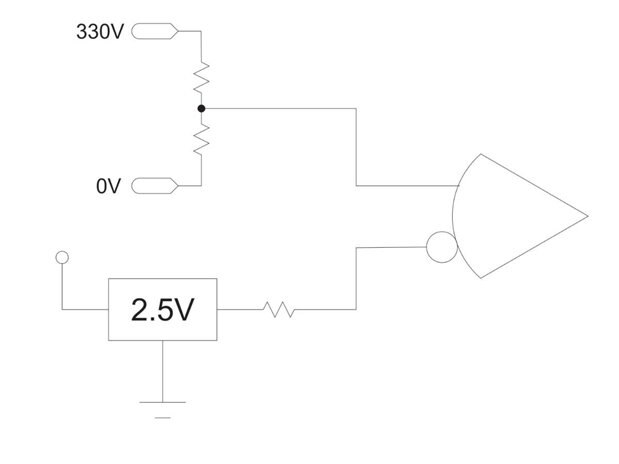
Hi, I'm back. Let me say that you are brave for starting off in HV, something I've avoided for years. An LED is not a good electrical match for 330 V. You should either establish an LV, or use an incandescent or neon bulb to establish a visual indicator. Let's suppose we are going to use a resistor to ballast an imaginary indicator LED. Let's say that our current through the LED should be 30mA and its drop is 1.2V, consistent with a red LED. The amount of power our LED is using is the product, 36mW.* The drop across the ballast is 330 - 1.2V, 328.8V. 328.8 / 1.2 = 274. That's how much more power the ballast is using as regards the LED. The ballast uses almost 10W! There are other reasons to go to an auxiliary LV as well. I will presume a 5V LV, as a design point of departure.
Can you make sense of this circuit as I have drawn it so far? Assume 0V and gnd are connected.
----------
*Per definition, all two-terminal elements strung together in series have the same current running through them. P(W) = Potential(V) * Current(I). Hence, the proportionality is the ratio of the drops.
Hi Magnus,
Just some additional information that may be of help. In the old days I used to work on battery powered camera flashes. They would run off 3V or 6V battery power. An oscillator would charge a capacitor with upwards of 300 volts. When the capacitor was fully charged a small neon light would come on to indicate that the flash was ready to fire. Don had some good advice reference playing with 300 plus volts. Even for experienced technicians this level of voltage is scary and dangerous. Even if you are working with lower voltage you will need a circuit to turn your LED on at the desired full charge point. I would recommend a voltage divider like Don drew but I would use the voltage at the point between the two resistor to turn on a Schmitt trigger. In this way your LED will turn on fully at the desired point. If you hook the LED up to the voltage divider directly it will begin to glow dimly at one point and brighten as the voltage in the capacitor rises. By putting a variable resistor in the voltage divider network you should be able to adjust the trigger point of the Schmitt Trigger and hence the LED's point of turn on. Even if this sounds complicated take some time to investigate resistor voltage dividers and Schmitt Triggers as they are indispensable tools for designing electronic circuits.
John
P.S. When I need to look up help with some of the basics I like this site: Basic Electronics Tutorials and Revision
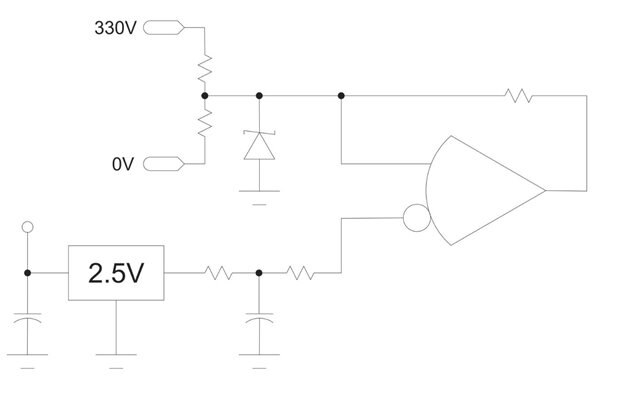
The feedback resistor should be >> than rA || rB. The point of the Schmidt Trigger is to bias the switching points away from each other. The motive is to avoid chattering. The thermostat on your air-conditioner probably has such a faculty. They are typically used when we have a bang/bang device trying to stabilize a continuous quantity. Presuming RRIO, the points can be computed by analyzing with the feedback resistor in shunt with rA then rB. If we were interfacing to an A/D convertor, rather than a banger, we would use negative feedback for stability. Remember, all other factors being equal, Negative feedback tends toward stability. Positive feedback tends toward saturation or oscillation.
The Japanese have a charming, illustrative term for the behavior of an ill-tempered comparator, they use the word 'hunting.'
There is another form of the Schmidt trigger circuit that allows for independent setting of the cross-points, it uses two comparators and an S/R flip-flop. Note: the gates for the flop can be constructed out of the remaining comparators of a quad, if no spare gates are laying about.
Actually, the shunt trick won't work in this case because of the supervoltage. Gotta whip out Norton's theorem and reckon the currents.
Hi Don,
Sorry I jumped into your tutorial to Magnus but I always learn something when I do. Your first drawing didn't come through clearly to my computer and perhaps not to Magnus's either. Your second drawing is all there and makes more sense. I liked your reference to "hunting" as I learned this term years ago in reference to a gasoline engine that doesn't run steady but pulses its RPMs. It would relate to an unstable oscillator. Back to your circuit why wouldn't a person just use a segment of a 74HC14 and use an input voltage of the resistive voltage divider to trigger the Schmitt Trigger. The hysteresis of the 74HC14 would eliminate LED chatter. Obviously we would need a stable 5 volt power supply to power the 74HC14 and the LED. Perhaps we would also need a zenner diode to provide some protection to the input of the IC in case of transients from whatever circuit he is using to charge the capacitor. I submit these ideas humbly as I can tell from your post that you are way ahead of me in electronics competence. Please continue your tutorial as I am interested in this question. It seems like something that could be useful to me in the future.
John