element14 Community
element14 Community
    Register Log In
  • Site
  • Search
  • Log In Register
  • Community Hub
    Community Hub
    • What's New on element14
    • Feedback and Support
    • Benefits of Membership
    • Personal Blogs
    • Members Area
    • Achievement Levels
  • Learn
    Learn
    • Ask an Expert
    • eBooks
    • element14 presents
    • Learning Center
    • Tech Spotlight
    • STEM Academy
    • Webinars, Training and Events
    • Learning Groups
  • Technologies
    Technologies
    • 3D Printing
    • FPGA
    • Industrial Automation
    • Internet of Things
    • Power & Energy
    • Sensors
    • Technology Groups
  • Challenges & Projects
    Challenges & Projects
    • Design Challenges
    • element14 presents Projects
    • Project14
    • Arduino Projects
    • Raspberry Pi Projects
    • Project Groups
  • Products
    Products
    • Arduino
    • Avnet & Tria Boards Community
    • Dev Tools
    • Manufacturers
    • Multicomp Pro
    • Product Groups
    • Raspberry Pi
    • RoadTests & Reviews
  • About Us
  • Store
    Store
    • Visit Your Store
    • Choose another store...
      • Europe
      •  Austria (German)
      •  Belgium (Dutch, French)
      •  Bulgaria (Bulgarian)
      •  Czech Republic (Czech)
      •  Denmark (Danish)
      •  Estonia (Estonian)
      •  Finland (Finnish)
      •  France (French)
      •  Germany (German)
      •  Hungary (Hungarian)
      •  Ireland
      •  Israel
      •  Italy (Italian)
      •  Latvia (Latvian)
      •  
      •  Lithuania (Lithuanian)
      •  Netherlands (Dutch)
      •  Norway (Norwegian)
      •  Poland (Polish)
      •  Portugal (Portuguese)
      •  Romania (Romanian)
      •  Russia (Russian)
      •  Slovakia (Slovak)
      •  Slovenia (Slovenian)
      •  Spain (Spanish)
      •  Sweden (Swedish)
      •  Switzerland(German, French)
      •  Turkey (Turkish)
      •  United Kingdom
      • Asia Pacific
      •  Australia
      •  China
      •  Hong Kong
      •  India
      • Japan
      •  Korea (Korean)
      •  Malaysia
      •  New Zealand
      •  Philippines
      •  Singapore
      •  Taiwan
      •  Thailand (Thai)
      • Vietnam
      • Americas
      •  Brazil (Portuguese)
      •  Canada
      •  Mexico (Spanish)
      •  United States
      Can't find the country/region you're looking for? Visit our export site or find a local distributor.
  • Translate
  • Profile
  • Settings
Experts, Learning and Guidance
  • Technologies
  • More
Experts, Learning and Guidance
Ask an Expert Forum Start a led on a sertent voltage
  • Blog
  • Forum
  • Documents
  • Leaderboard
  • Files
  • Members
  • Mentions
  • Sub-Groups
  • Tags
  • More
  • Cancel
  • New
Join Experts, Learning and Guidance to participate - click to join for free!
Actions
  • Share
  • More
  • Cancel
Forum Thread Details
  • State Suggested Answer
  • Replies 30 replies
  • Answers 2 answers
  • Subscribers 305 subscribers
  • Views 3557 views
  • Users 0 members are here
  • led
  • voltage
  • high
Related
See a helpful answer?

Be sure to click 'more' and select 'suggest as answer'!

If you're the thread creator, be sure to click 'more' then 'Verify as Answer'!

Start a led on a sertent voltage

magnus2112
magnus2112 over 11 years ago

Hi!

Do enyone know how i can make a led turn on that uses 3 volts, when a voltage has reached 330volts?

I am trying to make a indicator turn on when a capasitor is full..

Thanks for eny help! image

  • Sign in to reply
  • Cancel

Top Replies

  • jw0752
    jw0752 over 11 years ago +1
    Hi Magnus, Just some additional information that may be of help. In the old days I used to work on battery powered camera flashes. They would run off 3V or 6V battery power. An oscillator would charge…
Parents
  • magnus2112
    0 magnus2112 over 11 years ago

    Thanks Don! But your explanation was way to advanced for me..image

    Eny way you can explane it in a "noob friendly" way?

    Does it exist a mosfet with a gate that has to to be 330v or higer?

    • Cancel
    • Vote Up 0 Vote Down
    • Sign in to reply
    • Verify Answer
    • Cancel
  • D_Hersey
    0 D_Hersey over 11 years ago in reply to magnus2112

    No, but you don't need one, I got a little business to attend to, then I can drop by my office where I can draw pictures for you, that will probably make things clear.  Wait a couple of hours.

    • Cancel
    • Vote Up 0 Vote Down
    • Sign in to reply
    • Verify Answer
    • Cancel
  • D_Hersey
    0 D_Hersey over 11 years ago in reply to D_Hersey

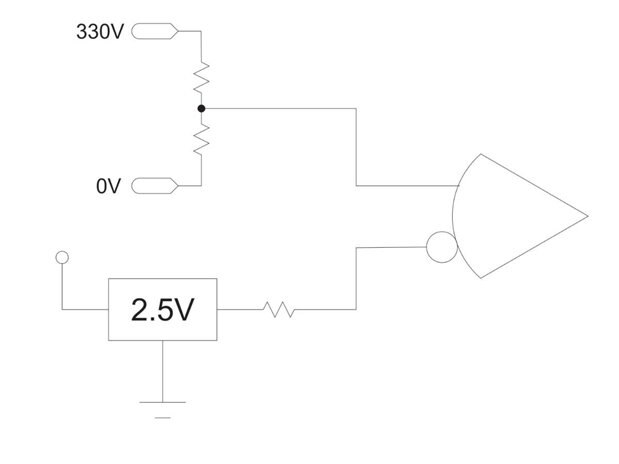
    Hi, I'm back.  Let me say that you are brave for starting off in HV, something I've avoided for years.  An LED is not a good electrical match for 330 V.  You should either establish an LV, or use an incandescent or neon bulb to establish a visual indicator.  Let's suppose we are going to use a resistor to ballast an imaginary indicator LED.  Let's say that our current through the LED should be 30mA and its drop is 1.2V, consistent with a red LED.  The amount of power our LED is using is the product, 36mW.*  The drop across the ballast is 330 - 1.2V, 328.8V.  328.8 / 1.2 = 274.  That's how much more power the ballast is using as regards the LED.  The ballast uses almost 10W!  There are other reasons to go to an auxiliary LV as well.  I will presume a 5V LV, as a design point of departure.

    image

    Can you make sense of this circuit as I have drawn it so far?  Assume 0V and gnd are connected.

    ----------

    *Per definition, all two-terminal elements strung together in series have the same current running through them.  P(W) = Potential(V) * Current(I).  Hence, the proportionality is the ratio of the drops.

    • Cancel
    • Vote Up 0 Vote Down
    • Sign in to reply
    • Verify Answer
    • Cancel
Reply
  • D_Hersey
    0 D_Hersey over 11 years ago in reply to D_Hersey

    Hi, I'm back.  Let me say that you are brave for starting off in HV, something I've avoided for years.  An LED is not a good electrical match for 330 V.  You should either establish an LV, or use an incandescent or neon bulb to establish a visual indicator.  Let's suppose we are going to use a resistor to ballast an imaginary indicator LED.  Let's say that our current through the LED should be 30mA and its drop is 1.2V, consistent with a red LED.  The amount of power our LED is using is the product, 36mW.*  The drop across the ballast is 330 - 1.2V, 328.8V.  328.8 / 1.2 = 274.  That's how much more power the ballast is using as regards the LED.  The ballast uses almost 10W!  There are other reasons to go to an auxiliary LV as well.  I will presume a 5V LV, as a design point of departure.

    image

    Can you make sense of this circuit as I have drawn it so far?  Assume 0V and gnd are connected.

    ----------

    *Per definition, all two-terminal elements strung together in series have the same current running through them.  P(W) = Potential(V) * Current(I).  Hence, the proportionality is the ratio of the drops.

    • Cancel
    • Vote Up 0 Vote Down
    • Sign in to reply
    • Verify Answer
    • Cancel
Children
No Data
element14 Community

element14 is the first online community specifically for engineers. Connect with your peers and get expert answers to your questions.

  • Members
  • Learn
  • Technologies
  • Challenges & Projects
  • Products
  • Store
  • About Us
  • Feedback & Support
  • FAQs
  • Terms of Use
  • Privacy Policy
  • Legal and Copyright Notices
  • Sitemap
  • Cookies

An Avnet Company © 2025 Premier Farnell Limited. All Rights Reserved.

Premier Farnell Ltd, registered in England and Wales (no 00876412), registered office: Farnell House, Forge Lane, Leeds LS12 2NE.

ICP 备案号 10220084.

Follow element14

  • X
  • Facebook
  • linkedin
  • YouTube