element14 Community
element14 Community
    Register Log In
  • Site
  • Search
  • Log In Register
  • Community Hub
    Community Hub
    • What's New on element14
    • Feedback and Support
    • Benefits of Membership
    • Personal Blogs
    • Members Area
    • Achievement Levels
  • Learn
    Learn
    • Ask an Expert
    • eBooks
    • element14 presents
    • Learning Center
    • Tech Spotlight
    • STEM Academy
    • Webinars, Training and Events
    • Learning Groups
  • Technologies
    Technologies
    • 3D Printing
    • FPGA
    • Industrial Automation
    • Internet of Things
    • Power & Energy
    • Sensors
    • Technology Groups
  • Challenges & Projects
    Challenges & Projects
    • Design Challenges
    • element14 presents Projects
    • Project14
    • Arduino Projects
    • Raspberry Pi Projects
    • Project Groups
  • Products
    Products
    • Arduino
    • Avnet & Tria Boards Community
    • Dev Tools
    • Manufacturers
    • Multicomp Pro
    • Product Groups
    • Raspberry Pi
    • RoadTests & Reviews
  • About Us
  • Store
    Store
    • Visit Your Store
    • Choose another store...
      • Europe
      •  Austria (German)
      •  Belgium (Dutch, French)
      •  Bulgaria (Bulgarian)
      •  Czech Republic (Czech)
      •  Denmark (Danish)
      •  Estonia (Estonian)
      •  Finland (Finnish)
      •  France (French)
      •  Germany (German)
      •  Hungary (Hungarian)
      •  Ireland
      •  Israel
      •  Italy (Italian)
      •  Latvia (Latvian)
      •  
      •  Lithuania (Lithuanian)
      •  Netherlands (Dutch)
      •  Norway (Norwegian)
      •  Poland (Polish)
      •  Portugal (Portuguese)
      •  Romania (Romanian)
      •  Russia (Russian)
      •  Slovakia (Slovak)
      •  Slovenia (Slovenian)
      •  Spain (Spanish)
      •  Sweden (Swedish)
      •  Switzerland(German, French)
      •  Turkey (Turkish)
      •  United Kingdom
      • Asia Pacific
      •  Australia
      •  China
      •  Hong Kong
      •  India
      • Japan
      •  Korea (Korean)
      •  Malaysia
      •  New Zealand
      •  Philippines
      •  Singapore
      •  Taiwan
      •  Thailand (Thai)
      • Vietnam
      • Americas
      •  Brazil (Portuguese)
      •  Canada
      •  Mexico (Spanish)
      •  United States
      Can't find the country/region you're looking for? Visit our export site or find a local distributor.
  • Translate
  • Profile
  • Settings
Experts, Learning and Guidance
  • Technologies
  • More
Experts, Learning and Guidance
Ask an Expert Forum Help with Making a RPM tacho Shift Light circuit open a 12v Relay
  • Blog
  • Forum
  • Documents
  • Leaderboard
  • Files
  • Members
  • Mentions
  • Sub-Groups
  • Tags
  • More
  • Cancel
  • New
Join Experts, Learning and Guidance to participate - click to join for free!
Actions
  • Share
  • More
  • Cancel
Forum Thread Details
  • State Not Answered
  • Replies 19 replies
  • Subscribers 305 subscribers
  • Views 4428 views
  • Users 0 members are here
  • ask_an_expert
  • led
  • rpm
Related
See a helpful answer?

Be sure to click 'more' and select 'suggest as answer'!

If you're the thread creator, be sure to click 'more' then 'Verify as Answer'!

Help with Making a RPM tacho Shift Light circuit open a 12v Relay

Former Member
Former Member over 11 years ago

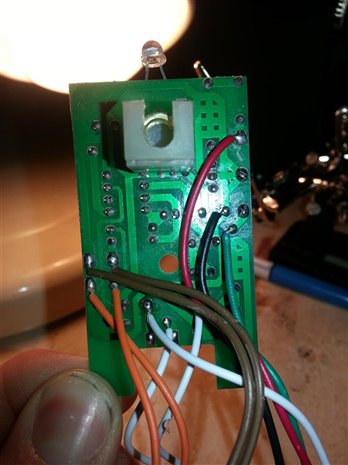
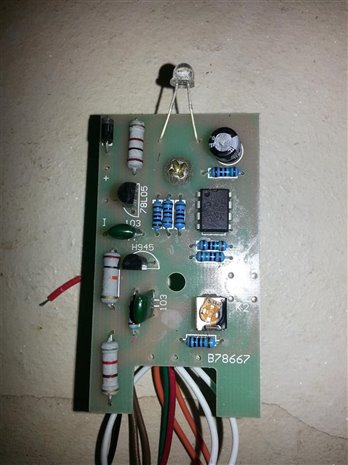
Hi everyone, i have a few adjustable Tachometer Shift light Circuits that i want to use to turn on a relay when the led turns on.

The way they are set up now:
You can adjust the desired rpm Shift light value with a pot then when that rpm is reached the led turns on.


My problem is tracing it back to the IC or to the nearest transistor.
I'm trying to turn on a 12v relay when the desired rpm is reached.


So there are 2 ways i am thinking of doing this...


1: is to use a transistor to allow a higher current to run through the relay's solenoid to then allow me to run a separate 12v circuit to turn on more than 1 led light. i cant find where to run the transistor off or which pin on the ic is actually the "remote wire" for the led.


2: If i can't use a transistor is it possible to use a phototransistor and just use the built in led to then turn on a second circuit with a phototransitor linked to the relay's solenoid>


Any help would be greatly appreciated please find some pictures attached of the circuitimage


image

  • Sign in to reply
  • Cancel
Parents
  • supper_slash
    0 supper_slash over 11 years ago

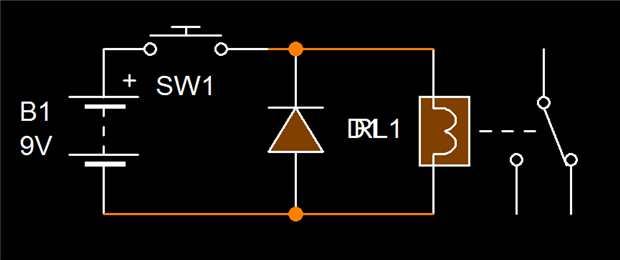
    Here is the setup for the circuit.

    The positive, and negative orientation of the diode is the key.

    image

    • Cancel
    • Vote Up 0 Vote Down
    • Sign in to reply
    • Verify Answer
    • Cancel
  • Former Member
    0 Former Member over 11 years ago in reply to supper_slash

    Ah yes so where i have the +ve leg on the led coming off the relay i need to put the cathode on the diode and bridge it straight across the relay solenoid in parallel if that makes sense?

    • Cancel
    • Vote Up 0 Vote Down
    • Sign in to reply
    • Verify Answer
    • Cancel
  • supper_slash
    0 supper_slash over 11 years ago in reply to Former Member

    you got it.

    • Cancel
    • Vote Up 0 Vote Down
    • Sign in to reply
    • Verify Answer
    • Cancel
Reply
  • supper_slash
    0 supper_slash over 11 years ago in reply to Former Member

    you got it.

    • Cancel
    • Vote Up 0 Vote Down
    • Sign in to reply
    • Verify Answer
    • Cancel
Children
  • Former Member
    0 Former Member over 11 years ago in reply to supper_slash

    Although i cant remember if i have the relay coming off the negative pin on the led or the positive... i have a feeling it may be switched negative and constant pos.... cant remember in that case would i flip the diode around?

    • Cancel
    • Vote Up 0 Vote Down
    • Sign in to reply
    • Verify Answer
    • Cancel
  • supper_slash
    0 supper_slash over 11 years ago in reply to Former Member

    nope. here is what happens in a relay, that requires the diode.:


    Since an inductor (the relay coil) cannot change it's current instantly, the fly-back diode provides a path for the current when the coil is switched off. Otherwise, a voltage spike will occur causing arcing on switch contacts or possibly destroying switching transistors.


    But, if you place the diode the wrong way, it will act like a short, and there will not be enough voltage to the relay to activate it.


    Done properly, When the current through a coil is switched off, the coil (being an inductor) will try to maintain the current. When there is no path for this current the voltage across the coil will increase rapidly, and the current will find a path, right through the isolation of a chip or transistor, destroying that component. The diode provides a path for this current, so the energy stored in the coil can be dissipated safely.


    • Cancel
    • Vote Up 0 Vote Down
    • Sign in to reply
    • Verify Answer
    • Cancel
  • Former Member
    0 Former Member over 11 years ago in reply to supper_slash

    Yes i understand that but what i mean is that the switch (SW1) in your diagram is actually negative on mine from memory (will clarify later) so in that case my positive lead is constant so then if i didnt switch the diode around wouldnt it just short and create high current to run and not activate the relay?

    • Cancel
    • Vote Up 0 Vote Down
    • Sign in to reply
    • Verify Answer
    • Cancel
  • Robert Peter Oakes
    0 Robert Peter Oakes over 11 years ago in reply to Former Member

    DIODE will always point to the positive supply side, no matter where you place the switch, it is to protect against back EMF when the switch opens as stated


    the switch does not dictate the current flow or the polarity of the supply, thats all about how the battery is wired up in the circuit


    Peter

    • Cancel
    • Vote Up 0 Vote Down
    • Sign in to reply
    • Verify Answer
    • Cancel
  • Former Member
    0 Former Member over 11 years ago in reply to Robert Peter Oakes

    Yeah thats what i thought so If mine is a switched negative then i need to face the diode in the opposing way to the diagram. I will draw up a bit of a circuit later to confirm and also see if mine is switched negative like i think cheers

    • Cancel
    • Vote Up 0 Vote Down
    • Sign in to reply
    • Verify Answer
    • Cancel
element14 Community

element14 is the first online community specifically for engineers. Connect with your peers and get expert answers to your questions.

  • Members
  • Learn
  • Technologies
  • Challenges & Projects
  • Products
  • Store
  • About Us
  • Feedback & Support
  • FAQs
  • Terms of Use
  • Privacy Policy
  • Legal and Copyright Notices
  • Sitemap
  • Cookies

An Avnet Company © 2026 Premier Farnell Limited. All Rights Reserved.

Premier Farnell Ltd, registered in England and Wales (no 00876412), registered office: Farnell House, Forge Lane, Leeds LS12 2NE.

ICP 备案号 10220084.

Follow element14

  • X
  • Facebook
  • linkedin
  • YouTube