element14 Community
element14 Community
    Register Log In
  • Site
  • Search
  • Log In Register
  • Community Hub
    Community Hub
    • What's New on element14
    • Feedback and Support
    • Benefits of Membership
    • Personal Blogs
    • Members Area
    • Achievement Levels
  • Learn
    Learn
    • Ask an Expert
    • eBooks
    • element14 presents
    • Learning Center
    • Tech Spotlight
    • STEM Academy
    • Webinars, Training and Events
    • Learning Groups
  • Technologies
    Technologies
    • 3D Printing
    • FPGA
    • Industrial Automation
    • Internet of Things
    • Power & Energy
    • Sensors
    • Technology Groups
  • Challenges & Projects
    Challenges & Projects
    • Design Challenges
    • element14 presents Projects
    • Project14
    • Arduino Projects
    • Raspberry Pi Projects
    • Project Groups
  • Products
    Products
    • Arduino
    • Avnet & Tria Boards Community
    • Dev Tools
    • Manufacturers
    • Multicomp Pro
    • Product Groups
    • Raspberry Pi
    • RoadTests & Reviews
  • About Us
  • Store
    Store
    • Visit Your Store
    • Choose another store...
      • Europe
      •  Austria (German)
      •  Belgium (Dutch, French)
      •  Bulgaria (Bulgarian)
      •  Czech Republic (Czech)
      •  Denmark (Danish)
      •  Estonia (Estonian)
      •  Finland (Finnish)
      •  France (French)
      •  Germany (German)
      •  Hungary (Hungarian)
      •  Ireland
      •  Israel
      •  Italy (Italian)
      •  Latvia (Latvian)
      •  
      •  Lithuania (Lithuanian)
      •  Netherlands (Dutch)
      •  Norway (Norwegian)
      •  Poland (Polish)
      •  Portugal (Portuguese)
      •  Romania (Romanian)
      •  Russia (Russian)
      •  Slovakia (Slovak)
      •  Slovenia (Slovenian)
      •  Spain (Spanish)
      •  Sweden (Swedish)
      •  Switzerland(German, French)
      •  Turkey (Turkish)
      •  United Kingdom
      • Asia Pacific
      •  Australia
      •  China
      •  Hong Kong
      •  India
      •  Korea (Korean)
      •  Malaysia
      •  New Zealand
      •  Philippines
      •  Singapore
      •  Taiwan
      •  Thailand (Thai)
      • Americas
      •  Brazil (Portuguese)
      •  Canada
      •  Mexico (Spanish)
      •  United States
      Can't find the country/region you're looking for? Visit our export site or find a local distributor.
  • Translate
  • Profile
  • Settings
Experts, Learning and Guidance
  • Technologies
  • More
Experts, Learning and Guidance
Ask an Expert Forum Transistor
  • Blog
  • Forum
  • Documents
  • Leaderboard
  • Files
  • Members
  • Mentions
  • Sub-Groups
  • Tags
  • More
  • Cancel
  • New
Join Experts, Learning and Guidance to participate - click to join for free!
Actions
  • Share
  • More
  • Cancel
Forum Thread Details
  • State Not Answered
  • Replies 8 replies
  • Subscribers 301 subscribers
  • Views 2200 views
  • Users 0 members are here
Related
See a helpful answer?

Be sure to click 'more' and select 'suggest as answer'!

If you're the thread creator, be sure to click 'more' then 'Verify as Answer'!

Transistor

Pironi6
Pironi6 over 3 years ago

How to determine the type of resistor to be used when connecting a transistor

  • Sign in to reply
  • Cancel

Top Replies

  • michaelkellett
    michaelkellett over 3 years ago in reply to Pironi6 +6
    1 Decide the current you want in the LED (check the data sheet) call it Iled 2 Choose the power supply voltage V1 3 Choose the control voltage to switch the transistor on, V2 4 If the transistor is suitable…
  • Jan Cumps
    Jan Cumps over 3 years ago +3
    putting the answers and complexity in context: In my electronics studies, this was year 2 material. Year one's theory was fully dedicated to linear components (resistor, capacitor, inductor) + resolving…
  • Jan Cumps
    Jan Cumps over 3 years ago in reply to Pironi6 +2
    There will be a few variables. I am assuming an NPN setup where there is a resistor in series with LED between V+ and collector. Emitter to ground. And the base used to switch (edit: michaelkellett 's…
Parents
  • michaelkellett
    0 michaelkellett over 3 years ago

    You will need to provide a lot more information to get a sensible answer.

    What are you trying to do ?

    • Cancel
    • Vote Up 0 Vote Down
    • Sign in to reply
    • Verify Answer
    • Cancel
  • Pironi6
    0 Pironi6 over 3 years ago in reply to michaelkellett

    To know the actual value of resistor for construction of a transistor as to prevent it from burning out by a high current or voltage

    • Cancel
    • Vote Up 0 Vote Down
    • Sign in to reply
    • Verify Answer
    • Cancel
Reply
  • Pironi6
    0 Pironi6 over 3 years ago in reply to michaelkellett

    To know the actual value of resistor for construction of a transistor as to prevent it from burning out by a high current or voltage

    • Cancel
    • Vote Up 0 Vote Down
    • Sign in to reply
    • Verify Answer
    • Cancel
Children
  • michaelkellett
    0 michaelkellett over 3 years ago in reply to Pironi6

    That would depend on the transistor, the load, the application and  a whole load more things.

    When I said explain what you are trying to do I meant like:

    turning an LED on and off

    controling a room heater

    Transistors come in thousands of different types , capable of handling currents from a few nA to a few thousand amps - to calculate the compoents in a circuit then first you need to knwo what it supposed to do.

    MK

    • Cancel
    • Vote Up 0 Vote Down
    • Sign in to reply
    • Verify Answer
    • Cancel
  • Pironi6
    0 Pironi6 over 3 years ago in reply to michaelkellett

    Turning on and off an LED 

    The transistor am using is NPN 

    I need the formula of getting it right, how to know for instance that either 1 kilo ohm resistor is to be used

    • Cancel
    • Vote Up 0 Vote Down
    • Sign in to reply
    • Verify Answer
    • Cancel
  • michaelkellett
    0 michaelkellett over 3 years ago in reply to Pironi6

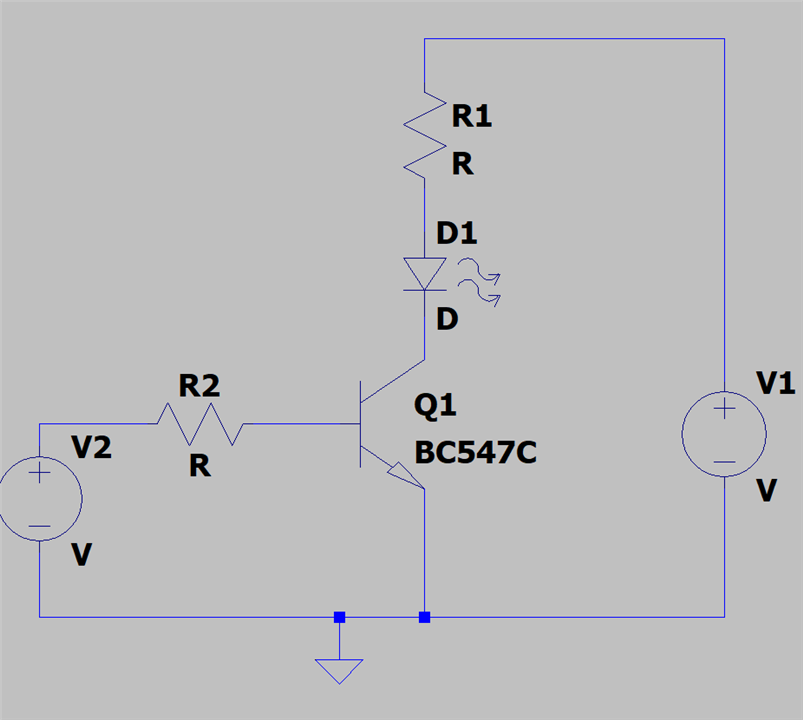
    image

    1 Decide the current you want in the LED (check the data sheet) call it Iled
    2 Choose the power supply voltage V1
    3 Choose the control voltage to switch the transistor on, V2
    4 If the transistor is suitable and switched on the voltage on its collector will be low so the voltage across R1 and D1 will be V1
    5 Look up the forward voltage of the LED (Vled) in the data sheet
    6 The current through R1 will be (V1 - Vled)/R1, so Iled = (V1 - Vled)/R1
    7 R1 = (V1 - Vled)/Iled
    8 if V1 = 5V, Iled = 10mA, Vled = 1.2V then R1 = (5 - 1.1)/0.01 = 390R
    10 For the transistor to be really well turned on the base current should be at least collector current/25
    11 In our example base current = 10mA/25 = 0.4mA
    12 So R2 = (V2 -0.6)/0.4mA
    13 if V2 = 5V then R2 = 11k

    When you build this, please send a picture so we can see it working, it's no fun answering questions if you don't get feedback !

    MK

    • Cancel
    • Vote Up +6 Vote Down
    • Sign in to reply
    • Verify Answer
    • Cancel
  • Jan Cumps
    0 Jan Cumps over 3 years ago in reply to Pironi6

    There will be a few variables. I am assuming an NPN setup where there is a resistor in series with LED between V+ and collector. Emitter to ground. And the base used to switch (edit: michaelkellett's schematic above).

    Step 1: output side
    you need to know

    • the led current, from the LED datasheet.
    • the voltage over the LED for that current
    • VCE for your transistor, at saturation, for the LED current
    • you need to know V+

    Then you can calculate the resistor:

    • V+ may be 5V. Your source.
    • The voltage over the LED and resistor will be (V+) - (VCEsat). Maybe 90 mV for a BC547 in saturation
    • The desired current for a good LED light. Maybe 12 mA for a red led?
    • The voltage over the led, VLED, is the one from the datasheet. Maybe 2V for a red led?

    Now you know how to dimension the resistor, because:

    • you want 12 mA = 0 .012 A
    • you want the resistor to drop: (V+) - (VCEsat) - VLED) =  5V - 0.09V - 2V = 2.91V
    • you use Ohms law: R = U / I = 2.91 V / 0.012 A = 242 Ohm.

    Don't look for a resistor with the exact value. This isn't high precision electronics. Look for the cheapest one that's close to this.
    If you're at the upper range of the LED current, then use a resistor greater than the calculated value. To avoid exceeding the LEDs limits.

    Then, you can calculate how hard you need to drive the basis to get the transistor saturated at 12 mA ...

    edit : that is step 10 in michaelkellett's reply above

    • Cancel
    • Vote Up +2 Vote Down
    • Sign in to reply
    • Verify Answer
    • Cancel
  • Pironi6
    0 Pironi6 over 3 years ago in reply to michaelkellett

    Thank u.

    I will send a picture of the work

    • Cancel
    • Vote Up 0 Vote Down
    • Sign in to reply
    • Verify Answer
    • Cancel
element14 Community

element14 is the first online community specifically for engineers. Connect with your peers and get expert answers to your questions.

  • Members
  • Learn
  • Technologies
  • Challenges & Projects
  • Products
  • Store
  • About Us
  • Feedback & Support
  • FAQs
  • Terms of Use
  • Privacy Policy
  • Legal and Copyright Notices
  • Sitemap
  • Cookies

An Avnet Company © 2025 Premier Farnell Limited. All Rights Reserved.

Premier Farnell Ltd, registered in England and Wales (no 00876412), registered office: Farnell House, Forge Lane, Leeds LS12 2NE.

ICP 备案号 10220084.

Follow element14

  • X
  • Facebook
  • linkedin
  • YouTube