element14 Community
element14 Community
    Register Log In
  • Site
  • Search
  • Log In Register
  • Community Hub
    Community Hub
    • What's New on element14
    • Feedback and Support
    • Benefits of Membership
    • Personal Blogs
    • Members Area
    • Achievement Levels
  • Learn
    Learn
    • Ask an Expert
    • eBooks
    • element14 presents
    • Learning Center
    • Tech Spotlight
    • STEM Academy
    • Webinars, Training and Events
    • Learning Groups
  • Technologies
    Technologies
    • 3D Printing
    • FPGA
    • Industrial Automation
    • Internet of Things
    • Power & Energy
    • Sensors
    • Technology Groups
  • Challenges & Projects
    Challenges & Projects
    • Design Challenges
    • element14 presents Projects
    • Project14
    • Arduino Projects
    • Raspberry Pi Projects
    • Project Groups
  • Products
    Products
    • Arduino
    • Avnet & Tria Boards Community
    • Dev Tools
    • Manufacturers
    • Multicomp Pro
    • Product Groups
    • Raspberry Pi
    • RoadTests & Reviews
  • About Us
  • Store
    Store
    • Visit Your Store
    • Choose another store...
      • Europe
      •  Austria (German)
      •  Belgium (Dutch, French)
      •  Bulgaria (Bulgarian)
      •  Czech Republic (Czech)
      •  Denmark (Danish)
      •  Estonia (Estonian)
      •  Finland (Finnish)
      •  France (French)
      •  Germany (German)
      •  Hungary (Hungarian)
      •  Ireland
      •  Israel
      •  Italy (Italian)
      •  Latvia (Latvian)
      •  
      •  Lithuania (Lithuanian)
      •  Netherlands (Dutch)
      •  Norway (Norwegian)
      •  Poland (Polish)
      •  Portugal (Portuguese)
      •  Romania (Romanian)
      •  Russia (Russian)
      •  Slovakia (Slovak)
      •  Slovenia (Slovenian)
      •  Spain (Spanish)
      •  Sweden (Swedish)
      •  Switzerland(German, French)
      •  Turkey (Turkish)
      •  United Kingdom
      • Asia Pacific
      •  Australia
      •  China
      •  Hong Kong
      •  India
      •  Korea (Korean)
      •  Malaysia
      •  New Zealand
      •  Philippines
      •  Singapore
      •  Taiwan
      •  Thailand (Thai)
      • Americas
      •  Brazil (Portuguese)
      •  Canada
      •  Mexico (Spanish)
      •  United States
      Can't find the country/region you're looking for? Visit our export site or find a local distributor.
  • Translate
  • Profile
  • Settings
Experts, Learning and Guidance
  • Technologies
  • More
Experts, Learning and Guidance
Ask an Expert Forum Transistor
  • Blog
  • Forum
  • Documents
  • Leaderboard
  • Files
  • Members
  • Mentions
  • Sub-Groups
  • Tags
  • More
  • Cancel
  • New
Join Experts, Learning and Guidance to participate - click to join for free!
Actions
  • Share
  • More
  • Cancel
Forum Thread Details
  • State Not Answered
  • Replies 8 replies
  • Subscribers 301 subscribers
  • Views 2197 views
  • Users 0 members are here
Related
See a helpful answer?

Be sure to click 'more' and select 'suggest as answer'!

If you're the thread creator, be sure to click 'more' then 'Verify as Answer'!

Transistor

Pironi6
Pironi6 over 3 years ago

How to determine the type of resistor to be used when connecting a transistor

  • Sign in to reply
  • Cancel

Top Replies

  • michaelkellett
    michaelkellett over 3 years ago in reply to Pironi6 +6
    1 Decide the current you want in the LED (check the data sheet) call it Iled 2 Choose the power supply voltage V1 3 Choose the control voltage to switch the transistor on, V2 4 If the transistor is suitable…
  • Jan Cumps
    Jan Cumps over 3 years ago +3
    putting the answers and complexity in context: In my electronics studies, this was year 2 material. Year one's theory was fully dedicated to linear components (resistor, capacitor, inductor) + resolving…
  • Jan Cumps
    Jan Cumps over 3 years ago in reply to Pironi6 +2
    There will be a few variables. I am assuming an NPN setup where there is a resistor in series with LED between V+ and collector. Emitter to ground. And the base used to switch (edit: michaelkellett 's…
Parents
  • michaelkellett
    0 michaelkellett over 3 years ago

    You will need to provide a lot more information to get a sensible answer.

    What are you trying to do ?

    • Cancel
    • Vote Up 0 Vote Down
    • Sign in to reply
    • Verify Answer
    • Cancel
  • Pironi6
    0 Pironi6 over 3 years ago in reply to michaelkellett

    To know the actual value of resistor for construction of a transistor as to prevent it from burning out by a high current or voltage

    • Cancel
    • Vote Up 0 Vote Down
    • Sign in to reply
    • Verify Answer
    • Cancel
  • michaelkellett
    0 michaelkellett over 3 years ago in reply to Pironi6

    That would depend on the transistor, the load, the application and  a whole load more things.

    When I said explain what you are trying to do I meant like:

    turning an LED on and off

    controling a room heater

    Transistors come in thousands of different types , capable of handling currents from a few nA to a few thousand amps - to calculate the compoents in a circuit then first you need to knwo what it supposed to do.

    MK

    • Cancel
    • Vote Up 0 Vote Down
    • Sign in to reply
    • Verify Answer
    • Cancel
  • Pironi6
    0 Pironi6 over 3 years ago in reply to michaelkellett

    Turning on and off an LED 

    The transistor am using is NPN 

    I need the formula of getting it right, how to know for instance that either 1 kilo ohm resistor is to be used

    • Cancel
    • Vote Up 0 Vote Down
    • Sign in to reply
    • Verify Answer
    • Cancel
  • michaelkellett
    0 michaelkellett over 3 years ago in reply to Pironi6

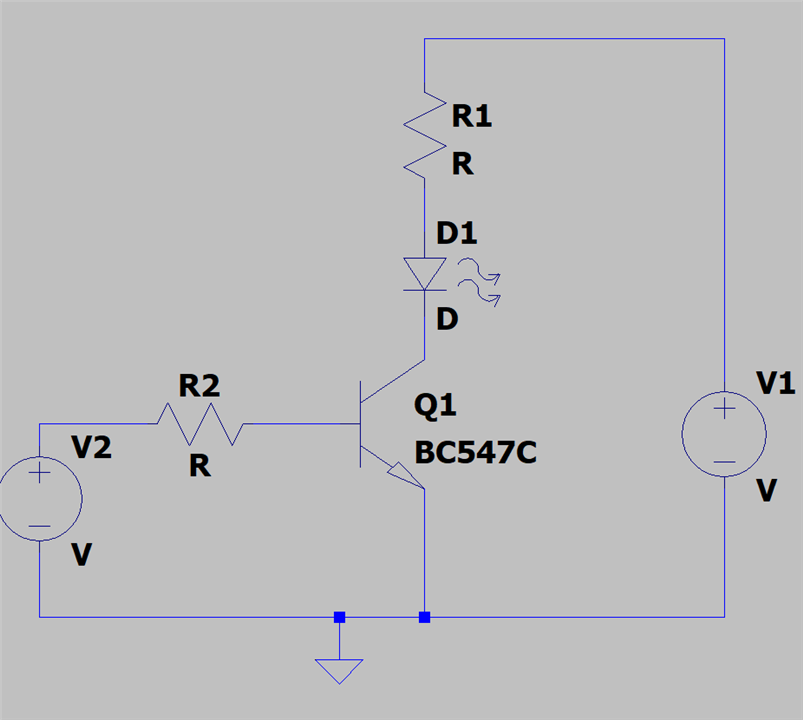
    image

    1 Decide the current you want in the LED (check the data sheet) call it Iled
    2 Choose the power supply voltage V1
    3 Choose the control voltage to switch the transistor on, V2
    4 If the transistor is suitable and switched on the voltage on its collector will be low so the voltage across R1 and D1 will be V1
    5 Look up the forward voltage of the LED (Vled) in the data sheet
    6 The current through R1 will be (V1 - Vled)/R1, so Iled = (V1 - Vled)/R1
    7 R1 = (V1 - Vled)/Iled
    8 if V1 = 5V, Iled = 10mA, Vled = 1.2V then R1 = (5 - 1.1)/0.01 = 390R
    10 For the transistor to be really well turned on the base current should be at least collector current/25
    11 In our example base current = 10mA/25 = 0.4mA
    12 So R2 = (V2 -0.6)/0.4mA
    13 if V2 = 5V then R2 = 11k

    When you build this, please send a picture so we can see it working, it's no fun answering questions if you don't get feedback !

    MK

    • Cancel
    • Vote Up +6 Vote Down
    • Sign in to reply
    • Verify Answer
    • Cancel
Reply
  • michaelkellett
    0 michaelkellett over 3 years ago in reply to Pironi6

    image

    1 Decide the current you want in the LED (check the data sheet) call it Iled
    2 Choose the power supply voltage V1
    3 Choose the control voltage to switch the transistor on, V2
    4 If the transistor is suitable and switched on the voltage on its collector will be low so the voltage across R1 and D1 will be V1
    5 Look up the forward voltage of the LED (Vled) in the data sheet
    6 The current through R1 will be (V1 - Vled)/R1, so Iled = (V1 - Vled)/R1
    7 R1 = (V1 - Vled)/Iled
    8 if V1 = 5V, Iled = 10mA, Vled = 1.2V then R1 = (5 - 1.1)/0.01 = 390R
    10 For the transistor to be really well turned on the base current should be at least collector current/25
    11 In our example base current = 10mA/25 = 0.4mA
    12 So R2 = (V2 -0.6)/0.4mA
    13 if V2 = 5V then R2 = 11k

    When you build this, please send a picture so we can see it working, it's no fun answering questions if you don't get feedback !

    MK

    • Cancel
    • Vote Up +6 Vote Down
    • Sign in to reply
    • Verify Answer
    • Cancel
Children
  • Pironi6
    0 Pironi6 over 3 years ago in reply to michaelkellett

    Thank u.

    I will send a picture of the work

    • Cancel
    • Vote Up 0 Vote Down
    • Sign in to reply
    • Verify Answer
    • Cancel
element14 Community

element14 is the first online community specifically for engineers. Connect with your peers and get expert answers to your questions.

  • Members
  • Learn
  • Technologies
  • Challenges & Projects
  • Products
  • Store
  • About Us
  • Feedback & Support
  • FAQs
  • Terms of Use
  • Privacy Policy
  • Legal and Copyright Notices
  • Sitemap
  • Cookies

An Avnet Company © 2025 Premier Farnell Limited. All Rights Reserved.

Premier Farnell Ltd, registered in England and Wales (no 00876412), registered office: Farnell House, Forge Lane, Leeds LS12 2NE.

ICP 备案号 10220084.

Follow element14

  • X
  • Facebook
  • linkedin
  • YouTube