element14 Community
element14 Community
    Register Log In
  • Site
  • Search
  • Log In Register
  • Community Hub
    Community Hub
    • What's New on element14
    • Feedback and Support
    • Benefits of Membership
    • Personal Blogs
    • Members Area
    • Achievement Levels
  • Learn
    Learn
    • Ask an Expert
    • eBooks
    • element14 presents
    • Learning Center
    • Tech Spotlight
    • STEM Academy
    • Webinars, Training and Events
    • Learning Groups
  • Technologies
    Technologies
    • 3D Printing
    • FPGA
    • Industrial Automation
    • Internet of Things
    • Power & Energy
    • Sensors
    • Technology Groups
  • Challenges & Projects
    Challenges & Projects
    • Design Challenges
    • element14 presents Projects
    • Project14
    • Arduino Projects
    • Raspberry Pi Projects
    • Project Groups
  • Products
    Products
    • Arduino
    • Avnet & Tria Boards Community
    • Dev Tools
    • Manufacturers
    • Multicomp Pro
    • Product Groups
    • Raspberry Pi
    • RoadTests & Reviews
  • About Us
  • Store
    Store
    • Visit Your Store
    • Choose another store...
      • Europe
      •  Austria (German)
      •  Belgium (Dutch, French)
      •  Bulgaria (Bulgarian)
      •  Czech Republic (Czech)
      •  Denmark (Danish)
      •  Estonia (Estonian)
      •  Finland (Finnish)
      •  France (French)
      •  Germany (German)
      •  Hungary (Hungarian)
      •  Ireland
      •  Israel
      •  Italy (Italian)
      •  Latvia (Latvian)
      •  
      •  Lithuania (Lithuanian)
      •  Netherlands (Dutch)
      •  Norway (Norwegian)
      •  Poland (Polish)
      •  Portugal (Portuguese)
      •  Romania (Romanian)
      •  Russia (Russian)
      •  Slovakia (Slovak)
      •  Slovenia (Slovenian)
      •  Spain (Spanish)
      •  Sweden (Swedish)
      •  Switzerland(German, French)
      •  Turkey (Turkish)
      •  United Kingdom
      • Asia Pacific
      •  Australia
      •  China
      •  Hong Kong
      •  India
      • Japan
      •  Korea (Korean)
      •  Malaysia
      •  New Zealand
      •  Philippines
      •  Singapore
      •  Taiwan
      •  Thailand (Thai)
      • Vietnam
      • Americas
      •  Brazil (Portuguese)
      •  Canada
      •  Mexico (Spanish)
      •  United States
      Can't find the country/region you're looking for? Visit our export site or find a local distributor.
  • Translate
  • Profile
  • Settings
Experts, Learning and Guidance
  • Technologies
  • More
Experts, Learning and Guidance
Ask an Expert Forum LT1712: Need help understanding and modifying this oscillator
  • Blog
  • Forum
  • Documents
  • Leaderboard
  • Files
  • Members
  • Mentions
  • Sub-Groups
  • Tags
  • More
  • Cancel
  • New
Join Experts, Learning and Guidance to participate - click to join for free!
Actions
  • Share
  • More
  • Cancel
Forum Thread Details
  • State Verified Answer
  • Replies 11 replies
  • Answers 3 answers
  • Subscribers 306 subscribers
  • Views 295 views
  • Users 0 members are here
  • opamp
  • oscillator
Related
See a helpful answer?

Be sure to click 'more' and select 'suggest as answer'!

If you're the thread creator, be sure to click 'more' then 'Verify as Answer'!

LT1712: Need help understanding and modifying this oscillator

rsjawale24
rsjawale24 4 days ago

I'm in need of an analog circuit that can generate a square wave output of 20MHz. My first thought was to use a schmitt trigger inverter with a crystal, but then I thought of using a fast opamp to make it more challenging and a fun to work on project. 

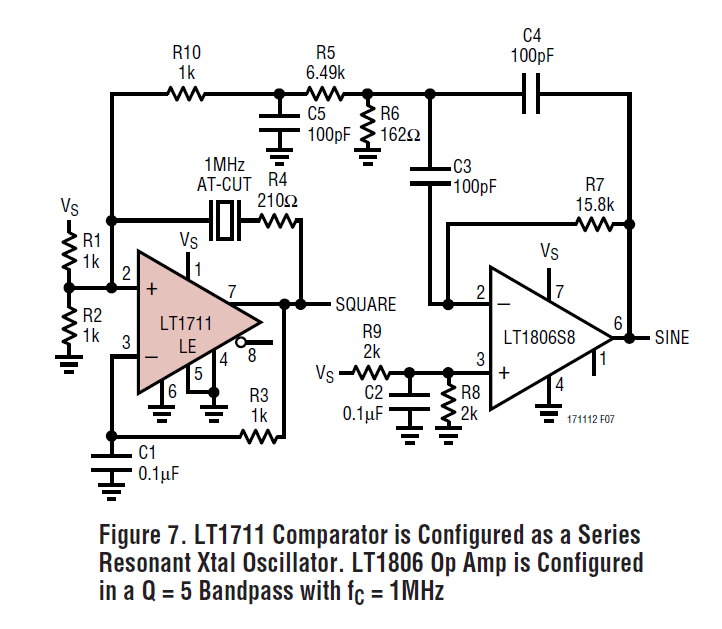
I came across this circuit made using LT1712 4.5ns comparator from Linear Technologies (now ADI). The circuit below generates a square wave output with a freq. of 1MHz which is filtered to obtain a sine wave of 1MHz. It uses a series resonant crystal to generate a stable 1MHz signal as shown in Fig.1 

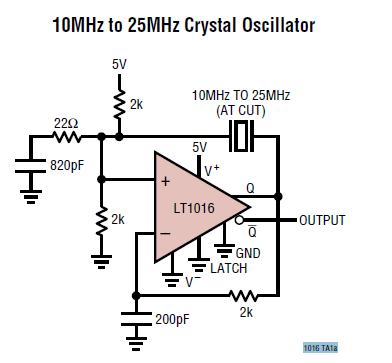
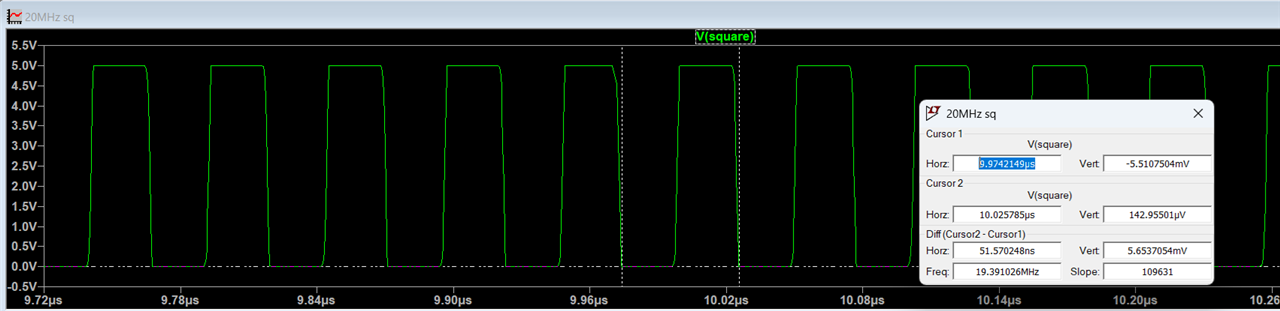
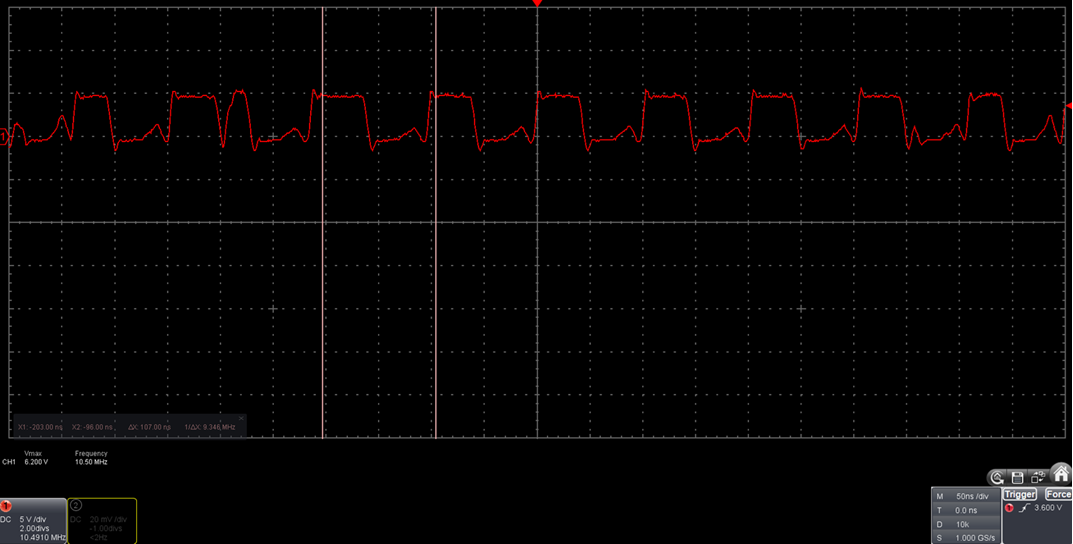
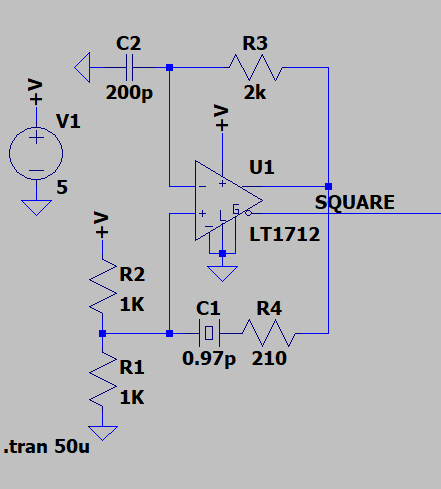
I modified the circuit, by replacing the crystal with a  20MHz one and R3, C1 by using another circuit given in the datasheet of LT1016 for 10MHz to 25MHz signal as shown in Fig. 2. I made a PCB to test the chip. However, my output frequency is around 10MHz with a distorted square wave output. I have tried the circuit in LTspice where it gives proper 20MHz output. 

Hence, I need help in understanding how the series resonant crystal circuit is working, why the 210 ohm resistor? and how the R3 and C1affect the output freq? As the values are both different in the two circuit diagrams. I have also posted the LTspice circuit simulation and output as well as the measured output of my PCB. 
image

Fig. 1: LT1017 1MHz square wave gen

image

Fig.2: LT1016 10MHz to 25 MHz generator
image

image

image

DSO output

  • Sign in to reply
  • Cancel

Top Replies

  • dougw
    dougw 3 days ago +3 suggested
    I am not an expert on this at all. If you remove the crystal, this circuit will oscillate based on R3 and C2. If these component values are adjusted until the frequency is approximately correct, reinserting…
  • dang74
    dang74 4 days ago +2
    It looks like you have a second, lower frequency crawling through your oscilloscope trace. Do you have 0.1uF capacitors bypassing the power pins of your active devices? Datasheets don't mention this and…
  • jc2048
    jc2048 3 days ago +2 suggested
    Another non-expert here :) "why the 210 ohm resistor" Series resistor is to reduce the power that the crystal is having to deal with. It may be a small piece of hard rock (quartz), but it will crack…
Parents
  • shabaz
    0 shabaz 3 days ago

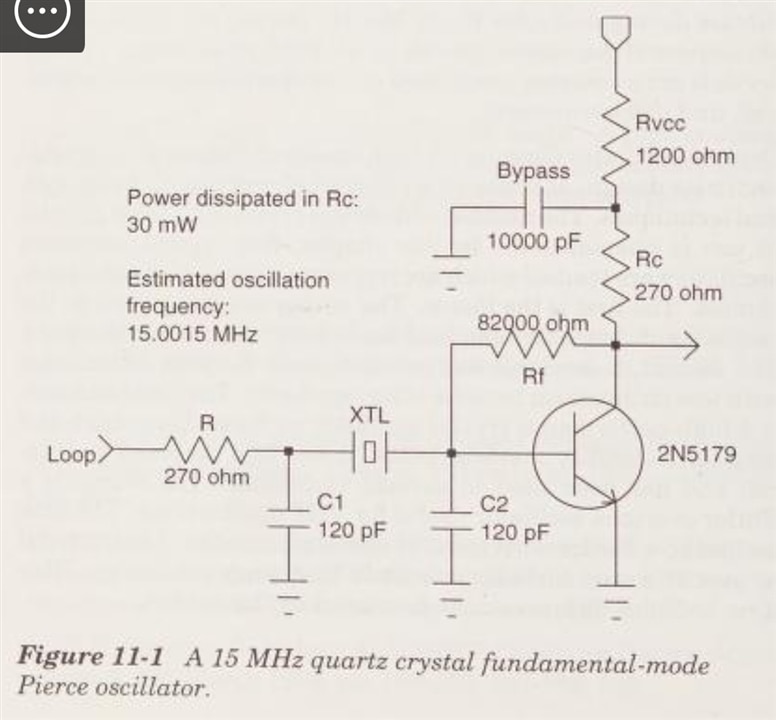
    Hi, it's unusual to use such a circuit (especially that very expensive part). Personally I would have gone for maybe a CMOS logic IC. There are a few (I am mobile, not easy to check the specific part number) logic ICs that also contain built-in dividers, they provide a great quality square wave output. Otherwise, for more fun/challenge, check out Oscillator Design and Computer Simulation by Rhea (It's possible to read it for free by virtually borrowing it on Internet Archive), one particular chapter has various example circuits, the one here would provide a signal, then you'd need to square it using (depending on output level) say a logic IC or another transistor, you'd take the output from the arrow, using a capacitor). The left and right side of this circuit is supposed to be connected together, I.e. connect that arrow to the wire labeled 'loop'.

    image

    • Cancel
    • Vote Up +2 Vote Down
    • Sign in to reply
    • Verify Answer
    • Reject Answer
    • Cancel
Reply
  • shabaz
    0 shabaz 3 days ago

    Hi, it's unusual to use such a circuit (especially that very expensive part). Personally I would have gone for maybe a CMOS logic IC. There are a few (I am mobile, not easy to check the specific part number) logic ICs that also contain built-in dividers, they provide a great quality square wave output. Otherwise, for more fun/challenge, check out Oscillator Design and Computer Simulation by Rhea (It's possible to read it for free by virtually borrowing it on Internet Archive), one particular chapter has various example circuits, the one here would provide a signal, then you'd need to square it using (depending on output level) say a logic IC or another transistor, you'd take the output from the arrow, using a capacitor). The left and right side of this circuit is supposed to be connected together, I.e. connect that arrow to the wire labeled 'loop'.

    image

    • Cancel
    • Vote Up +2 Vote Down
    • Sign in to reply
    • Verify Answer
    • Reject Answer
    • Cancel
Children
  • rsjawale24
    0 rsjawale24 3 days ago in reply to shabaz

    Thanks! But I needed a square wave o/p with fast pulse edges. I will check the mentioned book for more circuits!

    • Cancel
    • Vote Up 0 Vote Down
    • Sign in to reply
    • Verify Answer
    • Cancel
  • shabaz
    0 shabaz 3 days ago in reply to rsjawale24

    I see.. the choice of oscillator doesn't affect that, it's how you square it (i.e. buffer it). There's a complete circuit that could be set to (not xtal oscillator level of stability) 20MHz by changing one resistor value:  Building a Fast Edge Square Wave Generator 

    Or you could just use a buffer stage perhaps like described there, with a crystal oscillator of your choice provided there's sufficient drive for the logic input. All depends how fast you want the edges, that one achieved 500ps rise time which is pretty fast, but you may have a need for even higher, in which case a different circuit would be needed. What's the use-case and desired rise and fall times?

    • Cancel
    • Vote Up +1 Vote Down
    • Sign in to reply
    • Verify Answer
    • Cancel
  • rsjawale24
    0 rsjawale24 3 days ago in reply to shabaz

    Ah got it. I thought the device being used for the oscillator is important for the rise time. 500ps is more than enough for my application. I'm working on a TDR project, 500ps would suffice as I'm only detecting open circuit (distant to fault measurement) of a not so long coax cable. 

    • Cancel
    • Vote Up +1 Vote Down
    • Sign in to reply
    • Verify Answer
    • Cancel
  • dougw
    0 dougw 3 days ago in reply to rsjawale24

    Any oscillator could be "squared up" when followed by a fast comparator.

    • Cancel
    • Vote Up +1 Vote Down
    • Sign in to reply
    • Verify Answer
    • Cancel
element14 Community

element14 is the first online community specifically for engineers. Connect with your peers and get expert answers to your questions.

  • Members
  • Learn
  • Technologies
  • Challenges & Projects
  • Products
  • Store
  • About Us
  • Feedback & Support
  • FAQs
  • Terms of Use
  • Privacy Policy
  • Legal and Copyright Notices
  • Sitemap
  • Cookies

An Avnet Company © 2026 Premier Farnell Limited. All Rights Reserved.

Premier Farnell Ltd, registered in England and Wales (no 00876412), registered office: Farnell House, Forge Lane, Leeds LS12 2NE.

ICP 备案号 10220084.

Follow element14

  • X
  • Facebook
  • linkedin
  • YouTube