element14 Community
element14 Community
    Register Log In
  • Site
  • Search
  • Log In Register
  • Community Hub
    Community Hub
    • What's New on element14
    • Feedback and Support
    • Benefits of Membership
    • Personal Blogs
    • Members Area
    • Achievement Levels
  • Learn
    Learn
    • Ask an Expert
    • eBooks
    • element14 presents
    • Learning Center
    • Tech Spotlight
    • STEM Academy
    • Webinars, Training and Events
    • Learning Groups
  • Technologies
    Technologies
    • 3D Printing
    • FPGA
    • Industrial Automation
    • Internet of Things
    • Power & Energy
    • Sensors
    • Technology Groups
  • Challenges & Projects
    Challenges & Projects
    • Design Challenges
    • element14 presents Projects
    • Project14
    • Arduino Projects
    • Raspberry Pi Projects
    • Project Groups
  • Products
    Products
    • Arduino
    • Avnet & Tria Boards Community
    • Dev Tools
    • Manufacturers
    • Multicomp Pro
    • Product Groups
    • Raspberry Pi
    • RoadTests & Reviews
  • About Us
    About the element14 Community
  • Store
    Store
    • Visit Your Store
    • Choose another store...
      • Europe
      •  Austria (German)
      •  Belgium (Dutch, French)
      •  Bulgaria (Bulgarian)
      •  Czech Republic (Czech)
      •  Denmark (Danish)
      •  Estonia (Estonian)
      •  Finland (Finnish)
      •  France (French)
      •  Germany (German)
      •  Hungary (Hungarian)
      •  Ireland
      •  Israel
      •  Italy (Italian)
      •  Latvia (Latvian)
      •  
      •  Lithuania (Lithuanian)
      •  Netherlands (Dutch)
      •  Norway (Norwegian)
      •  Poland (Polish)
      •  Portugal (Portuguese)
      •  Romania (Romanian)
      •  Russia (Russian)
      •  Slovakia (Slovak)
      •  Slovenia (Slovenian)
      •  Spain (Spanish)
      •  Sweden (Swedish)
      •  Switzerland(German, French)
      •  Turkey (Turkish)
      •  United Kingdom
      • Asia Pacific
      •  Australia
      •  China
      •  Hong Kong
      •  India
      •  Japan
      •  Korea (Korean)
      •  Malaysia
      •  New Zealand
      •  Philippines
      •  Singapore
      •  Taiwan
      •  Thailand (Thai)
      •  Vietnam
      • Americas
      •  Brazil (Portuguese)
      •  Canada
      •  Mexico (Spanish)
      •  United States
      Can't find the country/region you're looking for? Visit our export site or find a local distributor.
  • Translate
  • Profile
  • Settings
Experts, Learning and Guidance
  • Technologies
  • More
Experts, Learning and Guidance
Ask an Expert Forum Why is the Schottky diode being used in control circuit?
  • Blog
  • Forum
  • Documents
  • Leaderboard
  • Files
  • Members
  • Mentions
  • Sub-Groups
  • Tags
  • More
  • Cancel
  • New
Join Experts, Learning and Guidance to participate - click to join for free!
Actions
  • Share
  • More
  • Cancel
Forum Thread Details
  • Replies 26 replies
  • Subscribers 313 subscribers
  • Views 669 views
  • Users 0 members are here
Related
See a helpful answer?

Be sure to click 'more' and select 'suggest as answer'!

If you're the thread creator, be sure to click 'more' then 'Verify as Answer'!

Why is the Schottky diode being used in control circuit?

Humaninsane
Humaninsane 6 days ago

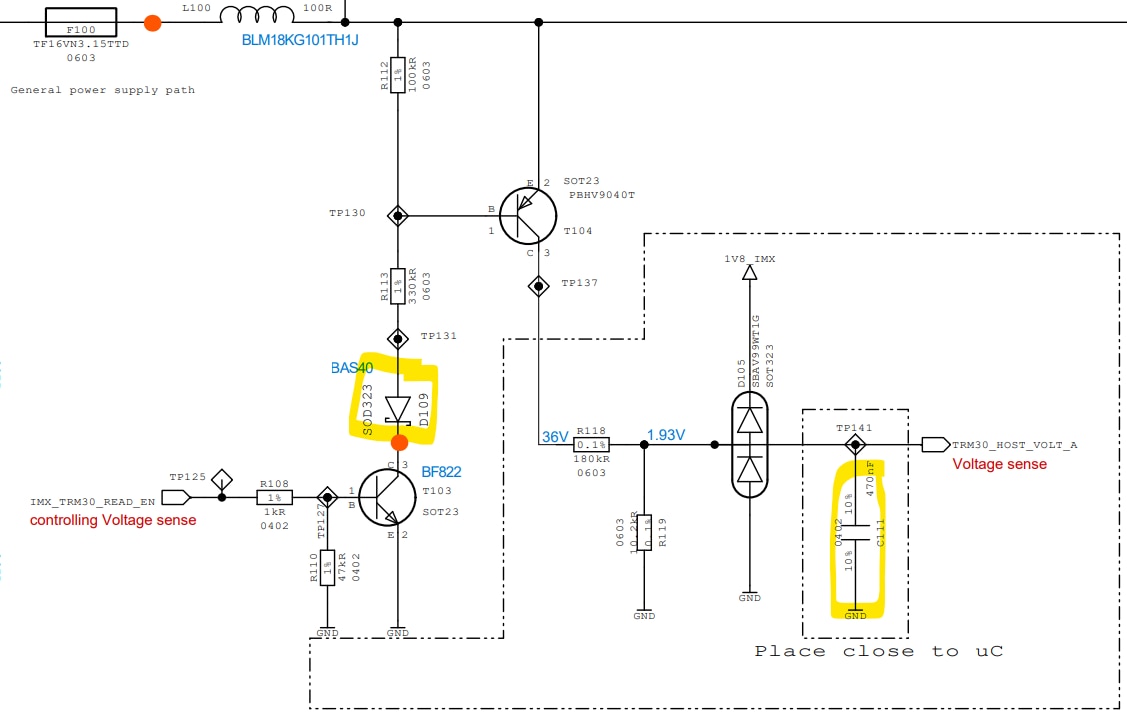
imageWhy is the Schottky diode being used in control circuit? and why is the 470nF cap is added at that voltage divider output? how is the Cap value 470nF calculated?

  • Sign in to reply
  • Cancel

Top Replies

  • michaelkellett
    michaelkellett 6 days ago in reply to Humaninsane +2
    I think I can see what the ciruit is attempting: T103 switches T104 on and T104 connects R108 to the supply rail. R108 and R119 attenuate the signal by a factor of (180 + 10.2)/10.2. C111 makes a…
  • geralds
    geralds 4 days ago in reply to michaelkellett +2
    Hi simulation with Schottky diode: simulation without Schottky diode: The Schottky diode is important during switching off the transistors. Without Schottky it can produce very high…
  • geralds
    geralds 6 days ago in reply to Humaninsane +1
    Hi, I would say that the T103 is a simple switching transistor in a higher voltage-rated circuit. A BC846 would be too small at 60V. The microcontroller's output switches it on to measure the voltage…
Parents
  • michaelkellett
    michaelkellett 6 days ago

    I would need to know more about the function of the circuit to make an informed comment.

    The two transistors are high voltage parts (250V and 500V).

    What are the inductor connections and what is the working voltage on emitter of T104 ?

    D108 is only rated for 40V reverse voltage.

    I suspect that the diode is to protect T103 from negative voltages at TP131 - but without more information its only a guess. 

    MK

    • Cancel
    • Vote Up 0 Vote Down
    • Sign in to reply
    • Cancel
  • Humaninsane
    Humaninsane 6 days ago in reply to michaelkellett

    The two transistors are high voltage parts (250V and 500V)- fuse & inductor path is max60V from Lead-acid battery. This a random selection. 100V part cab used.

    What are the inductor connections and what is the working voltage on emitter of T104 ? -  ferrite bead used for High Impedance at high frequency (EMI/EMC) 

    D108 is only rated for 40V reverse voltage. - D109, after 100k and 300k, 60V will drop...so they have used 40V schottky

    I suspect that the diode is to protect T103 from negative voltages at TP131 - do we get -ve voltage in between?not sure, I thought it's only at product out (Connector/GND...).

    • Cancel
    • Vote Up 0 Vote Down
    • Sign in to reply
    • Cancel
  • michaelkellett
    michaelkellett 6 days ago in reply to Humaninsane

    I think I can see what the ciruit is attempting:

    T103 switches T104 on and T104 connects R108 to the supply rail.

    R108 and R119 attenuate the signal by a factor of  (180 + 10.2)/10.2.

    C111 makes a low pass filter with the source resistance of R108 and R109 in parallel (1/(1/R108 + 1/R109)) about 9.6k.

    The -3dB point of the filter will be at 36Hz.

    The two diodes are there to limit the maximum voltage range on the output to -0.6V -> +2.4V (roughly).

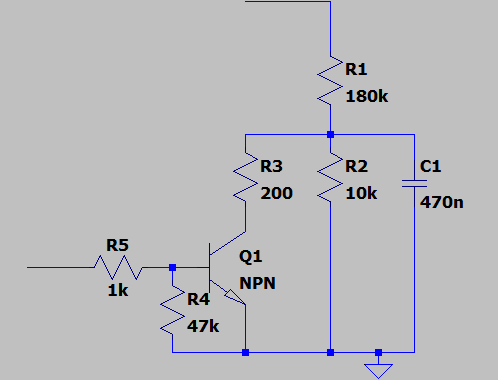
    The whole circuit is a bit odd - it could be much simpler:

    image

    One low voltage transistor - the logic sense of the input is different. You could use a second low voltage transistor to fix this it you wanted.

    There is no need for any of the diodes unless it is expected that the power supply may go very wildly out of range.

    If you apply 60V on the power supply the output will be about 3.2V (the diodes in the original would have limited this to 2.4V)

    MK

    • Cancel
    • Vote Up +2 Vote Down
    • Sign in to reply
    • Cancel
Reply
  • michaelkellett
    michaelkellett 6 days ago in reply to Humaninsane

    I think I can see what the ciruit is attempting:

    T103 switches T104 on and T104 connects R108 to the supply rail.

    R108 and R119 attenuate the signal by a factor of  (180 + 10.2)/10.2.

    C111 makes a low pass filter with the source resistance of R108 and R109 in parallel (1/(1/R108 + 1/R109)) about 9.6k.

    The -3dB point of the filter will be at 36Hz.

    The two diodes are there to limit the maximum voltage range on the output to -0.6V -> +2.4V (roughly).

    The whole circuit is a bit odd - it could be much simpler:

    image

    One low voltage transistor - the logic sense of the input is different. You could use a second low voltage transistor to fix this it you wanted.

    There is no need for any of the diodes unless it is expected that the power supply may go very wildly out of range.

    If you apply 60V on the power supply the output will be about 3.2V (the diodes in the original would have limited this to 2.4V)

    MK

    • Cancel
    • Vote Up +2 Vote Down
    • Sign in to reply
    • Cancel
Children
  • dang74
    dang74 6 days ago in reply to michaelkellett

    Yeah, sounds like you got it.  If the frequency is only 60Hz  I think a larger cap than 470nF should be used to lower the corner frequency below 36Hz.

    • Cancel
    • Vote Up 0 Vote Down
    • Sign in to reply
    • Cancel
element14 Community

element14 is the first online community specifically for engineers. Connect with your peers and get expert answers to your questions.

  • Members
  • Learn
  • Technologies
  • Challenges & Projects
  • Products
  • Store
  • About Us
  • Feedback & Support
  • FAQs
  • Terms of Use
  • Privacy Policy
  • Legal and Copyright Notices
  • Sitemap
  • Cookies

An Avnet Company © 2026 Premier Farnell Limited. All Rights Reserved.

Premier Farnell Ltd, registered in England and Wales (no 00876412), registered office: Farnell House, Forge Lane, Leeds LS12 2NE.

ICP 备案号 10220084.

Follow element14

  • X
  • Facebook
  • linkedin
  • YouTube