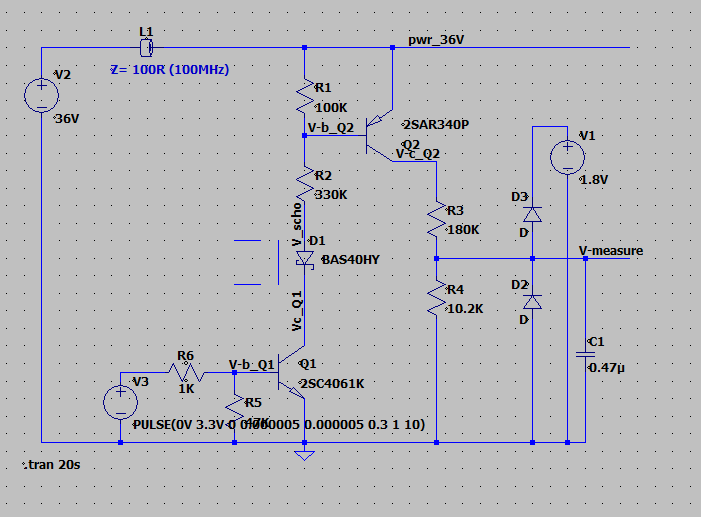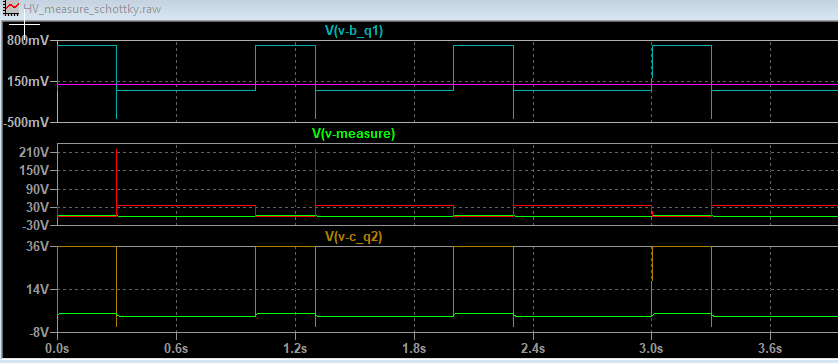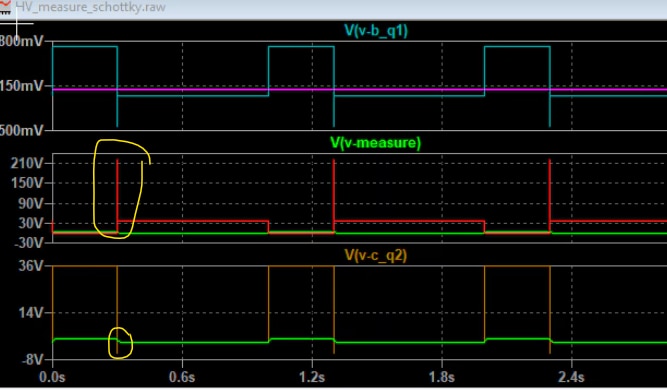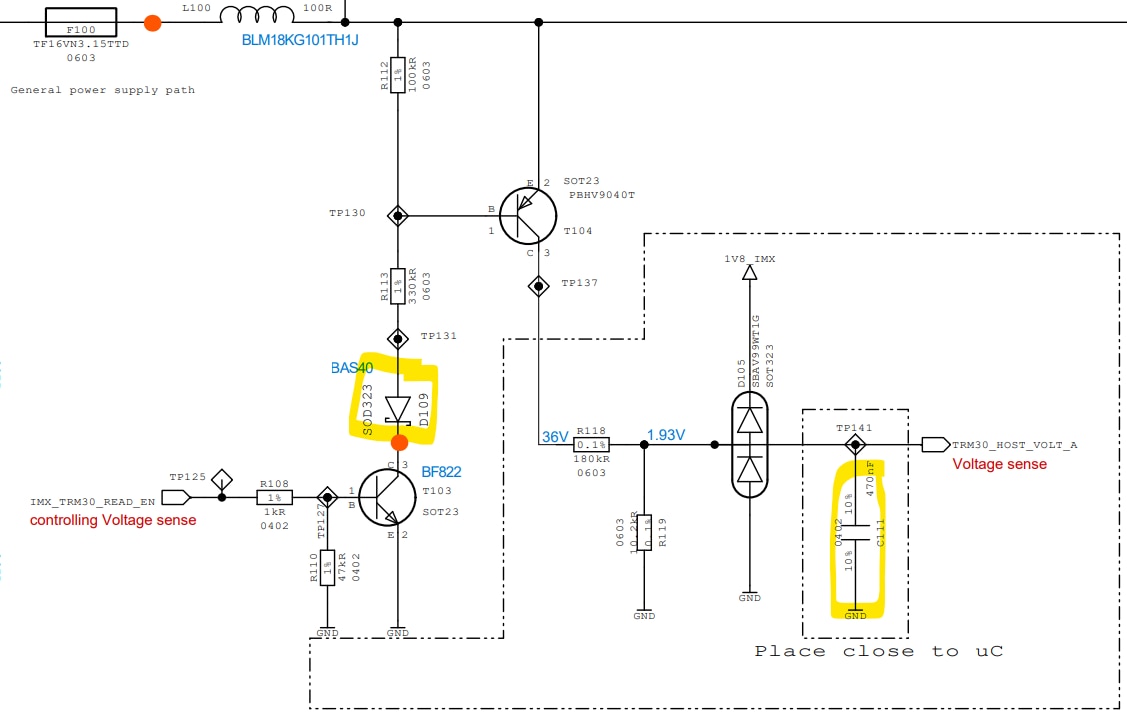
Why is the Schottky diode being used in control circuit? and why is the 470nF cap is added at that voltage divider output? how is the Cap value 470nF calculated?
Be sure to click 'more' and select 'suggest as answer'!
If you're the thread creator, be sure to click 'more' then 'Verify as Answer'!
Why is the Schottky diode being used in control circuit? and why is the 470nF cap is added at that voltage divider output? how is the Cap value 470nF calculated?
I would need to know more about the function of the circuit to make an informed comment.
The two transistors are high voltage parts (250V and 500V).
What are the inductor connections and what is the working voltage on emitter of T104 ?
D108 is only rated for 40V reverse voltage.
I suspect that the diode is to protect T103 from negative voltages at TP131 - but without more information its only a guess.
MK
The two transistors are high voltage parts (250V and 500V)- fuse & inductor path is max60V from Lead-acid battery. This a random selection. 100V part cab used.
What are the inductor connections and what is the working voltage on emitter of T104 ? - ferrite bead used for High Impedance at high frequency (EMI/EMC)
D108 is only rated for 40V reverse voltage. - D109, after 100k and 300k, 60V will drop...so they have used 40V schottky
I suspect that the diode is to protect T103 from negative voltages at TP131 - do we get -ve voltage in between?not sure, I thought it's only at product out (Connector/GND...).
I think I can see what the ciruit is attempting:
T103 switches T104 on and T104 connects R108 to the supply rail.
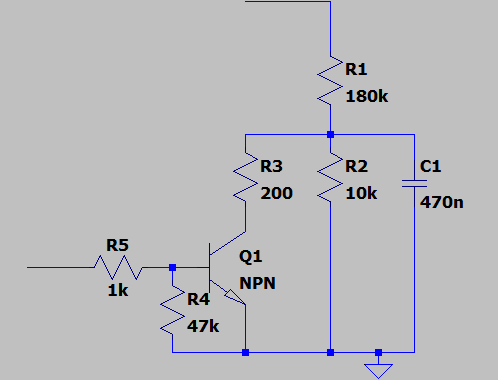
R108 and R119 attenuate the signal by a factor of (180 + 10.2)/10.2.
C111 makes a low pass filter with the source resistance of R108 and R109 in parallel (1/(1/R108 + 1/R109)) about 9.6k.
The -3dB point of the filter will be at 36Hz.
The two diodes are there to limit the maximum voltage range on the output to -0.6V -> +2.4V (roughly).
The whole circuit is a bit odd - it could be much simpler:

One low voltage transistor - the logic sense of the input is different. You could use a second low voltage transistor to fix this it you wanted.
There is no need for any of the diodes unless it is expected that the power supply may go very wildly out of range.
If you apply 60V on the power supply the output will be about 3.2V (the diodes in the original would have limited this to 2.4V)
MK
Yeah, sounds like you got it. If the frequency is only 60Hz I think a larger cap than 470nF should be used to lower the corner frequency below 36Hz.
Hi,
I would say that the T103 is a simple switching transistor in a higher voltage-rated circuit. A BC846 would be too small at 60V.
The microcontroller's output switches it on to measure the voltage at the output of the "voltage sense" module.
The T103 then switches on the T104, which applies a voltage source to the voltage divider. The two diodes D105 are freewheeling, protection diodes, diodes that eliminate both positive and negative over voltages and dissipate voltage spikes against the 1.8V supply voltage (the voltage of the controller board).
The Schottky diode acts as a voltage barrier; it helps transistor T104 switch off very quickly (T103), much faster, because T103 is somewhat slower.
The capacitor at the output of the voltage source is simply a storage capacitor that temporarily stores the switched-on voltage, approximately 2V according to the RC propagation delay.
Furthermore, it helps to eliminate and smooth out some spikes present on this measuring line.
The choke above is a low-pass filter that suppresses RF interference when power is switched. It also limits inrush current.
The voltage divider R118/R119 has a ratio of approximately 17.6470; therefore, with a 36V power supply, the output voltage is approximately 2V (1.93V depends on the actual conditions).
There is no AC voltage at a battery (normally; however, superimposed voltage can unfortunately occur).
Best Regards
Gerald
---
The
The choke above is a low-pass filter that suppresses RF interference when power is switched. It also limits inrush current.
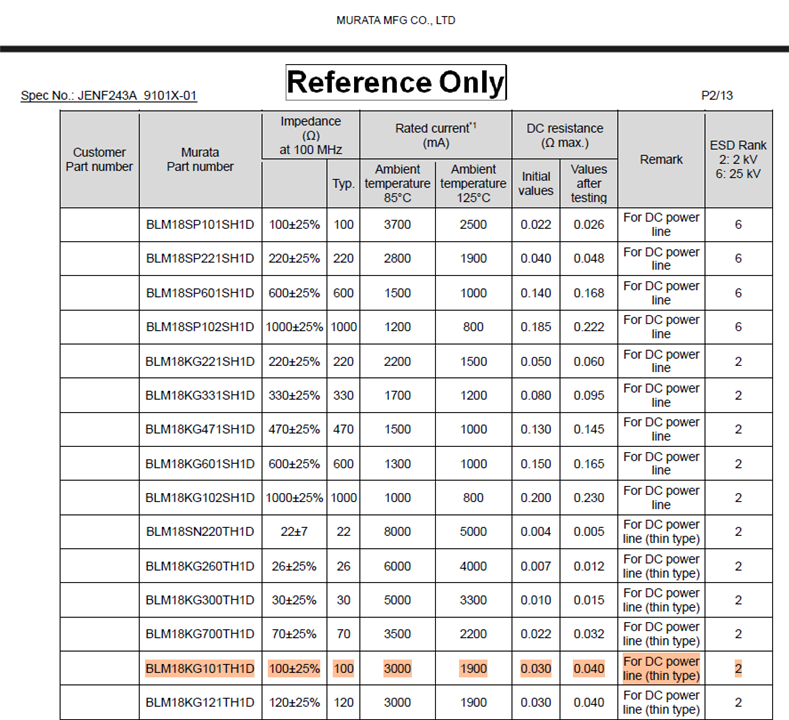
It's an 0603 ferrite bead with an impedance of 120R at 300MHz and a resistance of approx 0.03ohms, it won't do much to limit inrush current. And it wont need to since the only path for inrush current is through R113 or R118 (300k and 180k respectively).
The Schottky diode acts as a voltage barrier; it helps transistor T104 switch off very quickly (T103), much faster, because T103 is somewhat slower.
Could you explain this - and maybe illustrate with simulation because I can't see how a diode of any kind in series with 300k will help T104 switch off quickly.
The two diodes D105 are freewheeling, protection diodes, diodes that eliminate both positive and negative over voltages and dissipate voltage spikes against the 1.8V supply voltage (the voltage of the controller board).
The diodes in the ciruit are not freewheeling diodes according to the generally accepted use of the term.
https://en.wikipedia.org/wiki/Flyback_diode
And the action of the diodes is to clamp the signal at between -0.6V and +2.4V - one clamps to the ground rail and the other to the 1.8V source.
MK
The
The choke above is a low-pass filter that suppresses RF interference when power is switched. It also limits inrush current.
It's an 0603 ferrite bead with an impedance of 120R at 300MHz and a resistance of approx 0.03ohms, it won't do much to limit inrush current. And it wont need to since the only path for inrush current is through R113 or R118 (300k and 180k respectively).
The Schottky diode acts as a voltage barrier; it helps transistor T104 switch off very quickly (T103), much faster, because T103 is somewhat slower.
Could you explain this - and maybe illustrate with simulation because I can't see how a diode of any kind in series with 300k will help T104 switch off quickly.
The two diodes D105 are freewheeling, protection diodes, diodes that eliminate both positive and negative over voltages and dissipate voltage spikes against the 1.8V supply voltage (the voltage of the controller board).
The diodes in the ciruit are not freewheeling diodes according to the generally accepted use of the term.
https://en.wikipedia.org/wiki/Flyback_diode
And the action of the diodes is to clamp the signal at between -0.6V and +2.4V - one clamps to the ground rail and the other to the 1.8V source.
MK
Hi
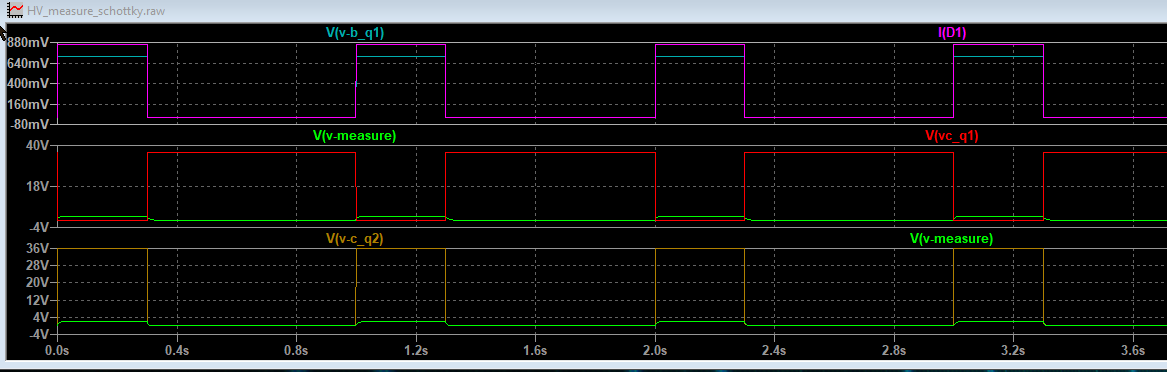
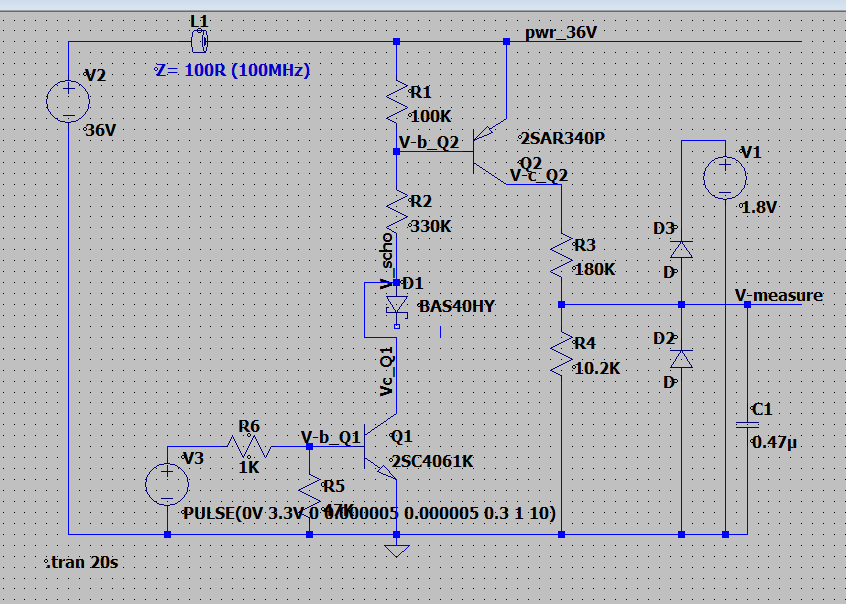
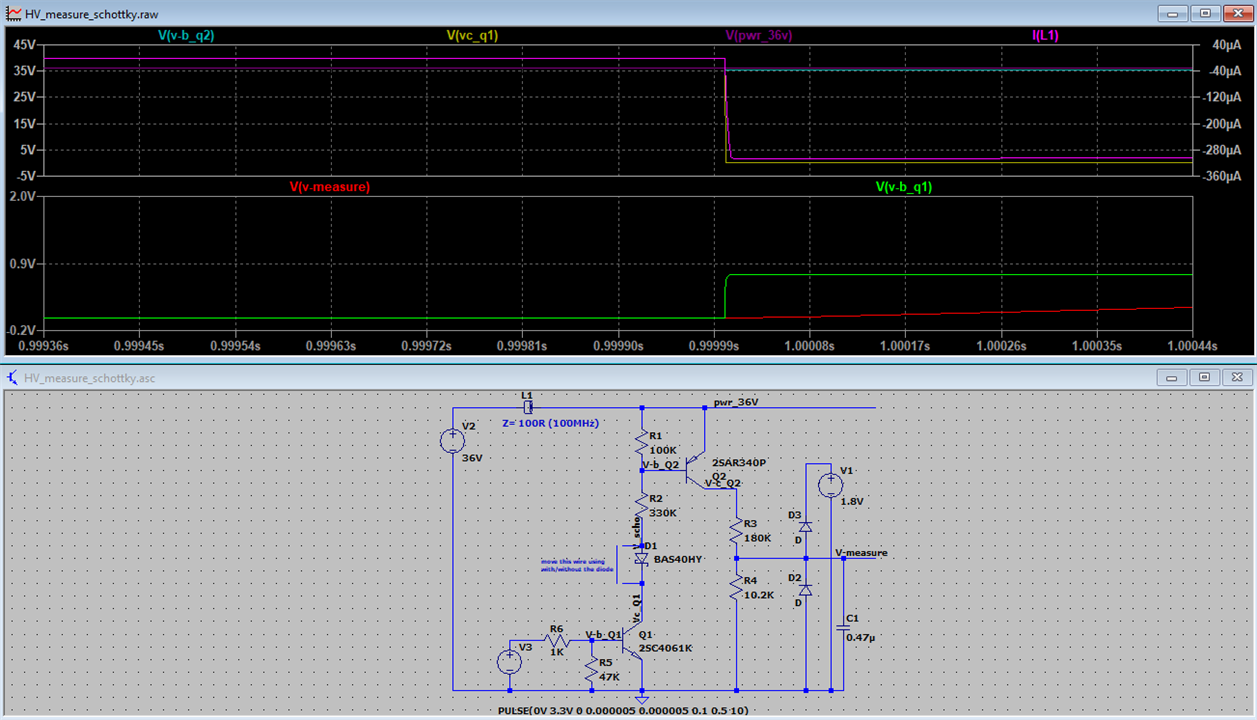
simulation with Schottky diode:


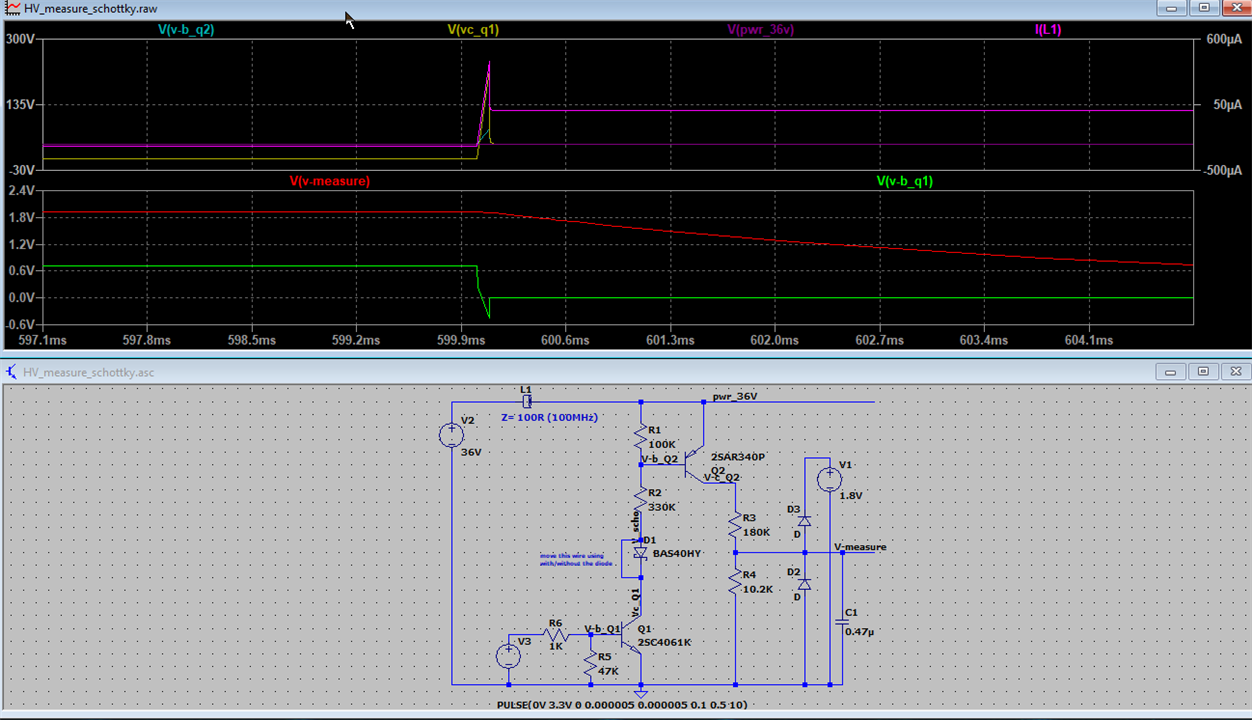
simulation without Schottky diode:


The Schottky diode is important during switching off the transistors.
Without Schottky it can produce very high voltage spikes during switching off.
Yes, the two diodes on the measure line are clamping diodes. sorry, it's my English is not very well. I translate it all from German to English. I forgot the word clamping.... "..to you know Mr. Alzheimer? - no, I forgot him." In the 70's I learned about them, telecommunication - telephones.
Thanks for the efforts️.
Without Schottky it can produce very high voltage spikes during switching off. - you are refereing T103(npn)?.
as we can see in the 2nd waveform (VC-Q1 - red) there is high voltage spike...in-turn leading Vc-q2 (orange) -ve spike....
But any how this -ve spike will be suppressed by clamping diode right? so can we remove schottky?...
And can you please share the Simulation settings. If you can share the .asc file that would be great.
Hi,


With Schottky - the current through the ferrite bead is minimal few micro ampere.
Without Schottky - the current is much more - it produce a current spike, that produce a spike voltage on the Q1 transistor during switching off.
This diode blocks the back current, which will stored in the induction during switching off, it separates Q1 from Q2.
refer what michaelkellet told - flyback diode
-->>> see also switched power supplies, such circuits looking similar.
copy this .docx file to your folder and rename the extension docx to .asc.
Best Regards
Gerald
--
Ok now its clear. Once again thanks for the support
Thank for the efforts and discussions️.
Hello Gerald,
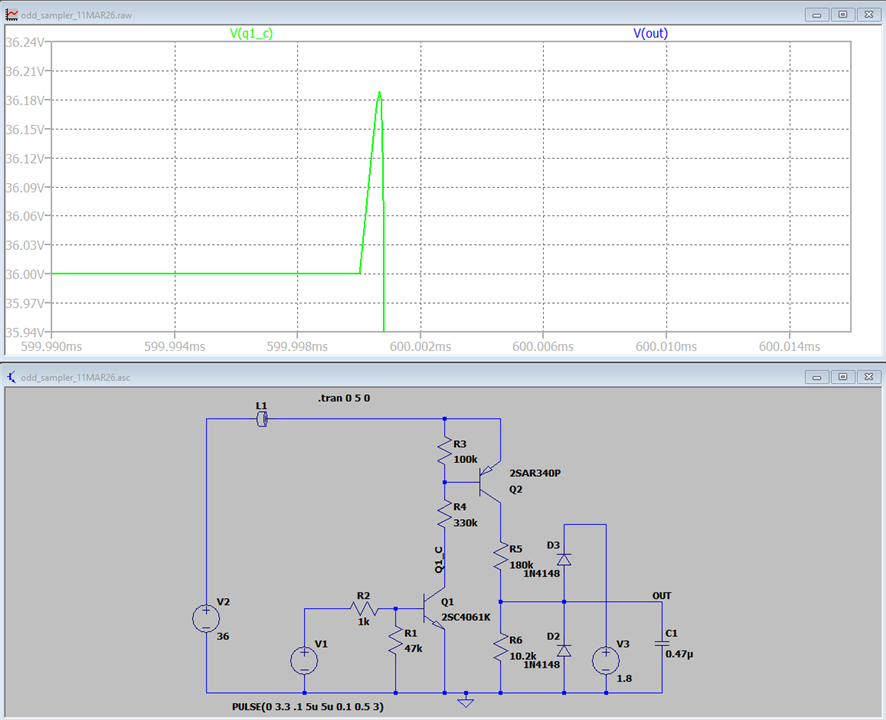
I have replicated your model quite closely in LTSpice and it shows no sign of the huge spikes.

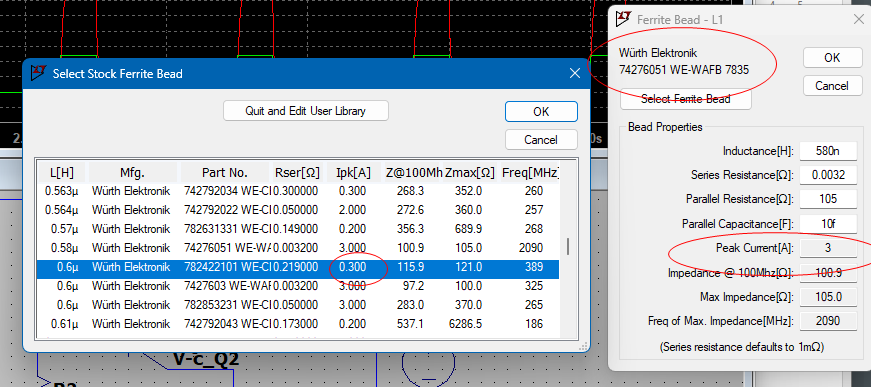
I used a Wurth ferrite bead:

MK
original ferrite bead in the original circuit, Murata BLM18KG101TH1D:

I've selected the Würth ferrite bead 74276051:

Well, may be your simulation have other setting in the software.
I just installed the software and worked with default settings, in the simulation settings.
Just drag and drop, I selected components that have "real" parameters, I did not use ideal components.
In the fused wire draws < 3A at 36V, not mA. This is the power rail.
The measurement circuit is just a small part of a bigger circuit.
You can ask the developers who inserted the Schottky.
Could you post your .asc file for the simulation an I can try running it here. (I can't copy it as text the way you've posted it above.)
Here is mine:
Version 4.1
SHEET 1 880 692
WIRE -256 -208 -352 -208
WIRE 192 -208 -192 -208
WIRE 320 -208 192 -208
WIRE 192 -176 192 -208
WIRE 320 -112 320 -208
WIRE 192 -64 192 -96
WIRE 256 -64 192 -64
WIRE 192 -32 192 -64
WIRE 560 32 464 32
WIRE 320 64 320 -16
WIRE 464 80 464 32
WIRE 192 112 192 48
WIRE 192 176 192 112
WIRE -352 208 -352 -208
WIRE 320 208 320 144
WIRE 464 208 464 144
WIRE 464 208 320 208
WIRE 688 208 464 208
WIRE -32 224 -128 224
WIRE 80 224 48 224
WIRE 128 224 80 224
WIRE 80 256 80 224
WIRE 320 272 320 208
WIRE 688 272 688 208
WIRE 464 288 464 208
WIRE -128 304 -128 224
WIRE 560 304 560 32
WIRE -352 416 -352 288
WIRE -128 416 -128 384
WIRE -128 416 -352 416
WIRE 80 416 80 336
WIRE 80 416 -128 416
WIRE 192 416 192 272
WIRE 192 416 80 416
WIRE 240 416 192 416
WIRE 320 416 320 352
WIRE 320 416 240 416
WIRE 464 416 464 352
WIRE 464 416 320 416
WIRE 560 416 560 384
WIRE 560 416 464 416
WIRE 688 416 688 336
WIRE 688 416 560 416
WIRE 240 432 240 416
FLAG 240 432 0
FLAG 192 112 Q1_C
FLAG 688 208 OUT
SYMBOL npn 128 176 R0
SYMATTR InstName Q1
SYMATTR Value 2SC4061K
SYMBOL res 64 240 R0
SYMATTR InstName R1
SYMATTR Value 47k
SYMBOL res 64 208 R90
WINDOW 0 0 56 VBottom 2
WINDOW 3 32 56 VTop 2
SYMATTR InstName R2
SYMATTR Value 1k
SYMBOL voltage -128 288 R0
WINDOW 3 -165 160 Left 2
WINDOW 123 0 0 Left 0
WINDOW 39 0 0 Left 0
SYMATTR Value PULSE(0 3.3 .1 5u 5u 0.1 0.5 3)
SYMATTR InstName V1
SYMBOL voltage -352 192 R0
WINDOW 123 0 0 Left 0
WINDOW 39 0 0 Left 0
SYMATTR InstName V2
SYMATTR Value 36
SYMBOL pnp 256 -16 M180
SYMATTR InstName Q2
SYMATTR Value 2SAR340P
SYMBOL res 176 -192 R0
SYMATTR InstName R3
SYMATTR Value 100k
SYMBOL res 176 -48 R0
SYMATTR InstName R4
SYMATTR Value 330k
SYMBOL res 304 48 R0
SYMATTR InstName R5
SYMATTR Value 180k
SYMBOL res 304 256 R0
SYMATTR InstName R6
SYMATTR Value 10.2k
SYMBOL diode 480 352 R180
WINDOW 0 24 64 Left 2
WINDOW 3 24 0 Left 2
SYMATTR InstName D2
SYMATTR Value 1N4148
SYMBOL diode 480 144 R180
WINDOW 0 24 64 Left 2
WINDOW 3 24 0 Left 2
SYMATTR InstName D3
SYMATTR Value 1N4148
SYMBOL voltage 560 288 R0
WINDOW 123 0 0 Left 0
WINDOW 39 0 0 Left 0
SYMATTR InstName V3
SYMATTR Value 1.8
SYMBOL cap 672 272 R0
SYMATTR InstName C1
SYMATTR Value 0.47µ
SYMBOL FerriteBead -224 -208 R90
WINDOW 0 -16 0 VBottom 2
SYMATTR InstName L1
SYMATTR Value 600n
SYMATTR SpiceLine Ipk=0.3 Rser=0.219 Rpar=121 Cpar=279f mfg="Würth Elektronik" pn="782422101 WE-CBA 0402"
TEXT -96 -256 Left 2 !.tran 0 5 0
MK
sorry, uploading the .asc file is not allowed.
I uploaded above the .docx file to Humaninsane postings.
Please download this docx file and rename the extension from .docx to asc.
I use the newest version of LTSpice. Please update it or download it.
I uploaded above the .docx file to Humaninsane postings.
I know that's what you tried to do but the rendering of that upload is incomplete and if it is downloaded MS Word can't decode it. The easy way to this is to just paste the text into a post.
Thanks.
MK