element14 Community
element14 Community
    Register Log In
  • Site
  • Search
  • Log In Register
  • Community Hub
    Community Hub
    • What's New on element14
    • Feedback and Support
    • Benefits of Membership
    • Personal Blogs
    • Members Area
    • Achievement Levels
  • Learn
    Learn
    • Ask an Expert
    • eBooks
    • element14 presents
    • Learning Center
    • Tech Spotlight
    • STEM Academy
    • Webinars, Training and Events
    • Learning Groups
  • Technologies
    Technologies
    • 3D Printing
    • FPGA
    • Industrial Automation
    • Internet of Things
    • Power & Energy
    • Sensors
    • Technology Groups
  • Challenges & Projects
    Challenges & Projects
    • Design Challenges
    • element14 presents Projects
    • Project14
    • Arduino Projects
    • Raspberry Pi Projects
    • Project Groups
  • Products
    Products
    • Arduino
    • Avnet & Tria Boards Community
    • Dev Tools
    • Manufacturers
    • Multicomp Pro
    • Product Groups
    • Raspberry Pi
    • RoadTests & Reviews
  • About Us
  • Store
    Store
    • Visit Your Store
    • Choose another store...
      • Europe
      •  Austria (German)
      •  Belgium (Dutch, French)
      •  Bulgaria (Bulgarian)
      •  Czech Republic (Czech)
      •  Denmark (Danish)
      •  Estonia (Estonian)
      •  Finland (Finnish)
      •  France (French)
      •  Germany (German)
      •  Hungary (Hungarian)
      •  Ireland
      •  Israel
      •  Italy (Italian)
      •  Latvia (Latvian)
      •  
      •  Lithuania (Lithuanian)
      •  Netherlands (Dutch)
      •  Norway (Norwegian)
      •  Poland (Polish)
      •  Portugal (Portuguese)
      •  Romania (Romanian)
      •  Russia (Russian)
      •  Slovakia (Slovak)
      •  Slovenia (Slovenian)
      •  Spain (Spanish)
      •  Sweden (Swedish)
      •  Switzerland(German, French)
      •  Turkey (Turkish)
      •  United Kingdom
      • Asia Pacific
      •  Australia
      •  China
      •  Hong Kong
      •  India
      • Japan
      •  Korea (Korean)
      •  Malaysia
      •  New Zealand
      •  Philippines
      •  Singapore
      •  Taiwan
      •  Thailand (Thai)
      • Vietnam
      • Americas
      •  Brazil (Portuguese)
      •  Canada
      •  Mexico (Spanish)
      •  United States
      Can't find the country/region you're looking for? Visit our export site or find a local distributor.
  • Translate
  • Profile
  • Settings
Internet of Things
  • Technologies
  • More
Internet of Things
Blog Frequency Shift Keying (FSK) - Texas Instruments CC11xL Wireless Connectivity Solution
  • Blog
  • Forum
  • Documents
  • Quiz
  • Events
  • Polls
  • Members
  • Mentions
  • Sub-Groups
  • Tags
  • More
  • Cancel
  • New
Join Internet of Things to participate - click to join for free!
  • Share
  • More
  • Cancel
Group Actions
  • Group RSS
  • More
  • Cancel
Engagement
  • Author Author: shabaz
  • Date Created: 1 Sep 2014 2:17 AM Date Created
  • Views 1923 views
  • Likes 2 likes
  • Comments 12 comments
  • cc110l
  • texas-instruments
  • keysight
  • n9322c
  • ioe
  • internet_of_everything
  • 430boost-cc110l
  • internet_of_things
  • modulation
  • cc11xldk-868-915
  • msp-exp430g2
  • cc11xl
  • iot
  • msp430
  • wireless
  • rf
  • fsk
  • ti
  • agilent
Related
Recommended

Frequency Shift Keying (FSK) - Texas Instruments CC11xL Wireless Connectivity Solution

shabaz
shabaz
1 Sep 2014

This blog post is part of a collection, click here for links to the entire set, and a review of the products.

Introduction

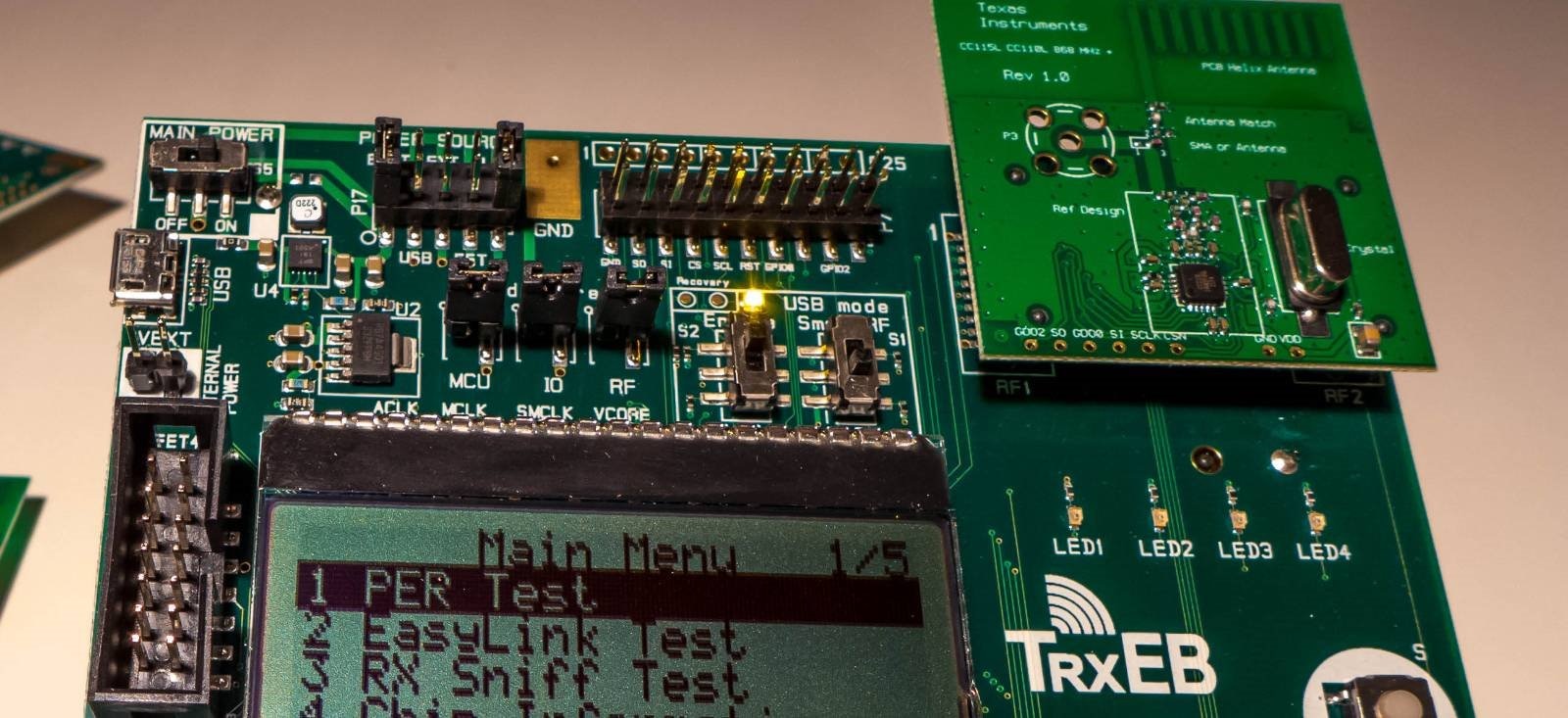
The Texas Instruments CC11xL devices are very low cost sub-1GHz ISM band transceiver/receiver/transmitter integrated circuits. These devices are good for IoT applications and are available as individual chips, or on a small board ready for integrationsmall board ready for integration or on a BoosterPack  BoosterPack  (Arduino-like shield board) or as part of a full development kitfull development kit. See here for an introduction to the development kit for these chips.


This post investigates the RF output from the TI devices using an Agilent/Keysight spectrum analyzer.
image


Replacing the Antenna

The radio evaluation modules that are supplied as part of the development kit have an on-board PCB trace antenna with exceptional performance in real-world experiments; I was able to maintain a reliable packet transmission from my home to the next street.


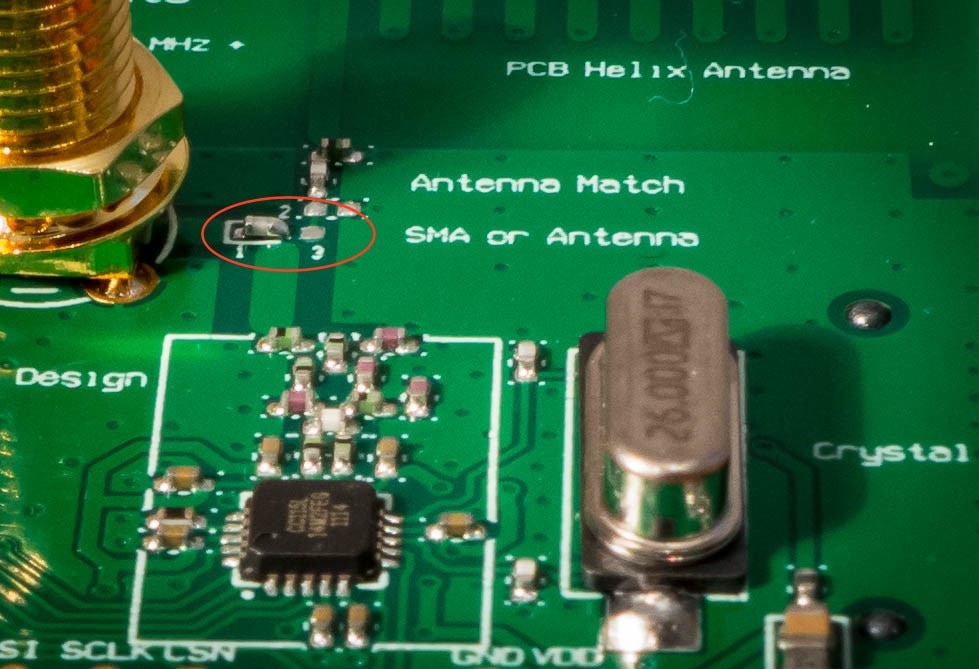
I decided to move the small 100pF capacitor from position 2-3 and move it to position 1-2 (see the circled area in the photo below) in order to disable the on-board PCB antenna, and direct the transmission into an RF connector. This would allow me to be able to connect up a spectrum analyzer and view the transmitted signal.
image


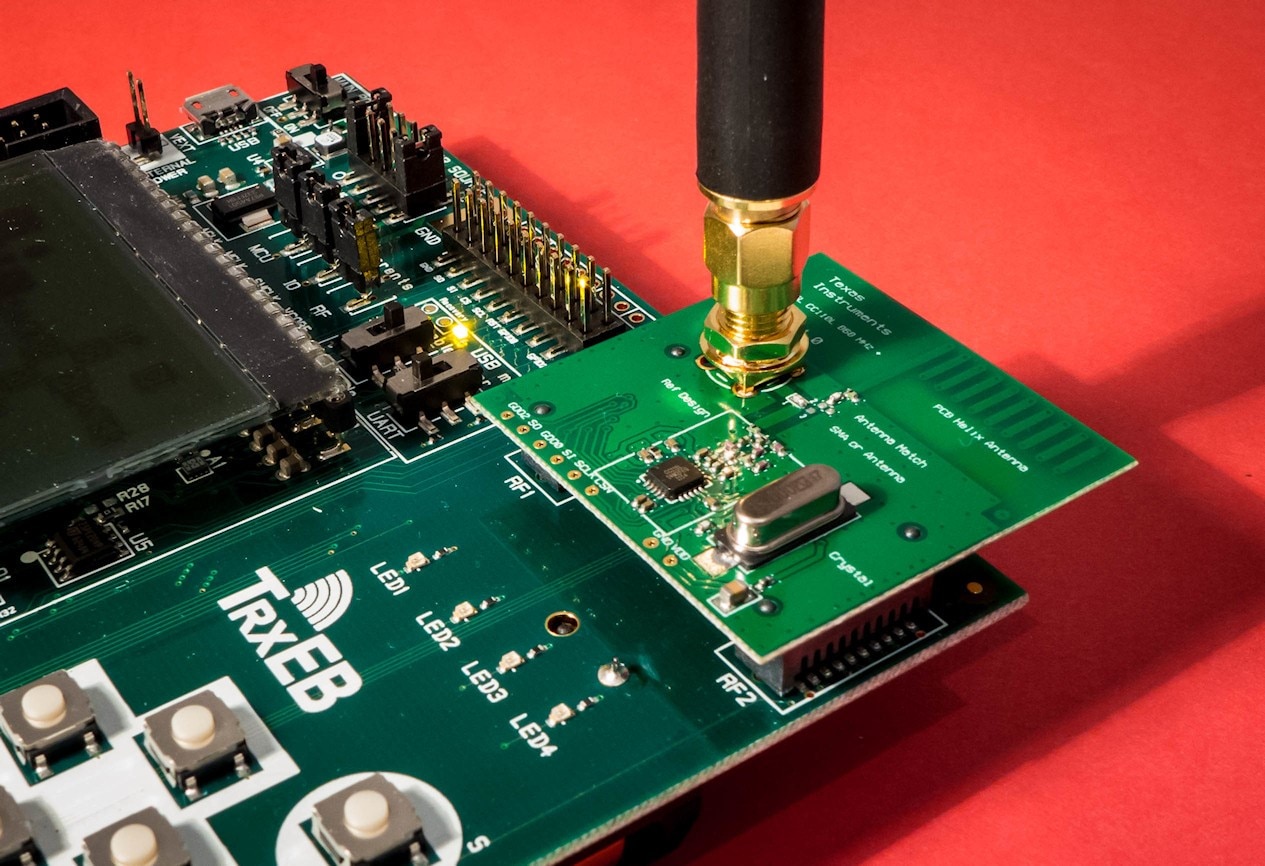
It also provides the opportunity to be able to test other antennas too, as shown in this photo:
image


The N9322C spectrum analyser provides modulation analysis capabilities, and FM modulation analysis and occupied bandwidth measurements were explored earlier however this time Frequency-Shift Keying (FSK) was explored since the Texas Instruments chips provide this capability.


Observing the Output

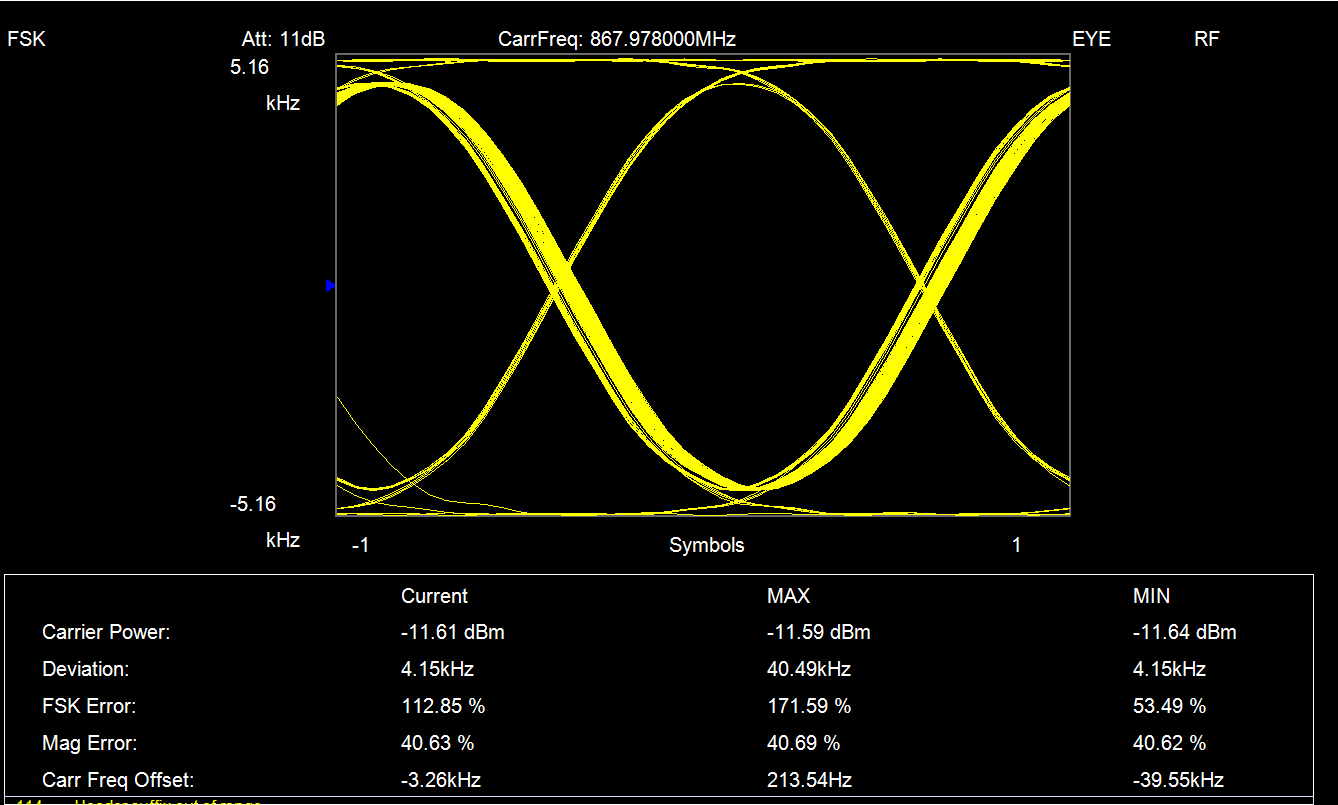
It proved possible to generate an eye diagram, nicely showing the frequency deviation and the clean output. As you may expect from the clean image, this is from a very high output (-10dBm).
image


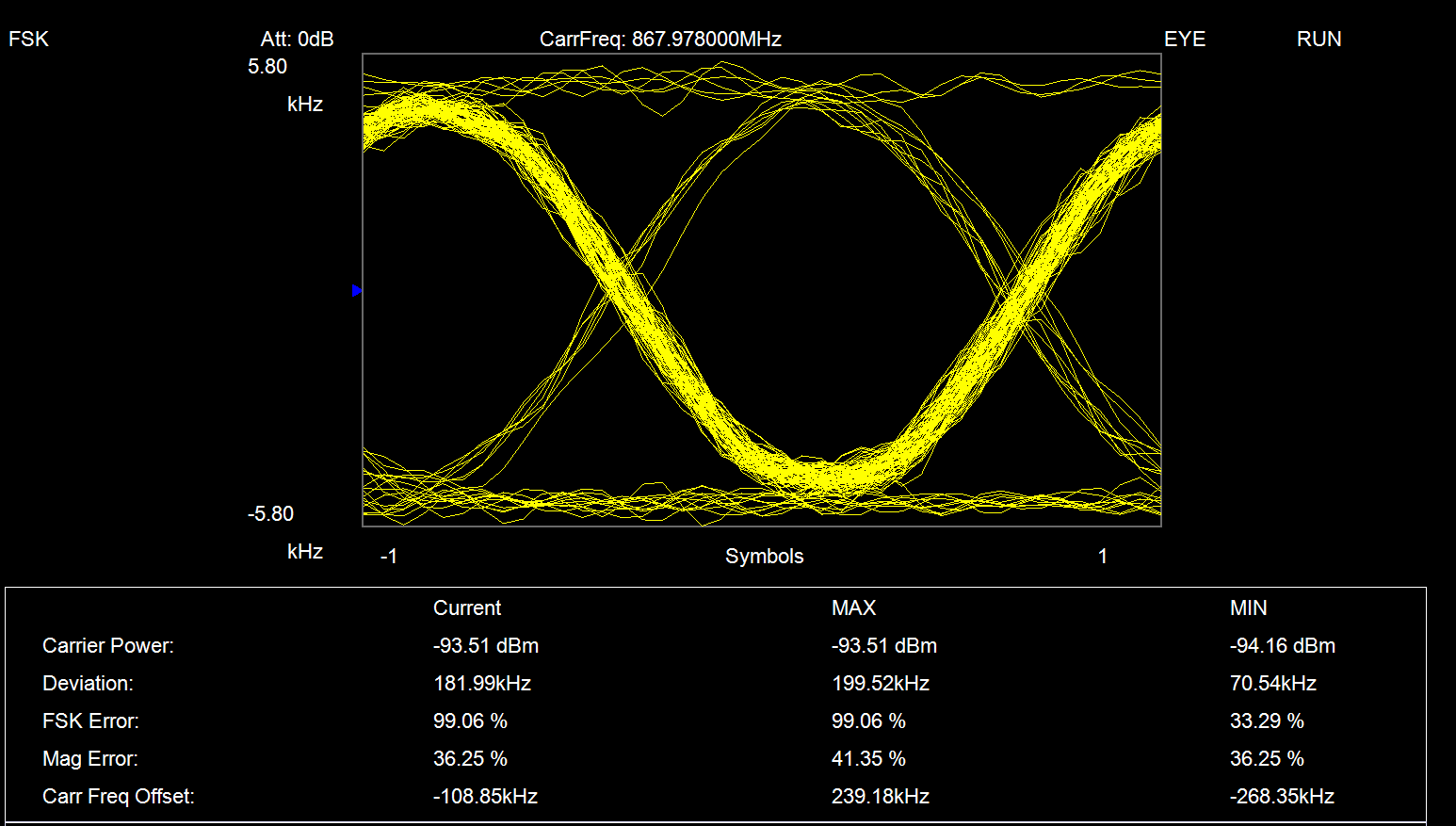
It is more interesting to progressively drop the input to a more realistic signal:
image


To perform the attenuation, see here for information. If you’re wondering why the eye diagram is eye-shaped across a radio transmission, it is because the TI CC11xL chips perform frequency transitions in-between the FSK frequencies. This is an option on the TI chips. If it is disabled, this is the result:

image


It’s also interesting to see the comparison in the spectrum view as shown below. Here you can see the raw FSK signal in blue, and the smoothed transition (also known as Gaussian FSK or GFSK) in yellow. GFSK clearly has far less spread than the usual frequency-shift keying.

image


Summary

This was just a quick look at the interesting spectrum shaping capabilities of the Texas Instruments chips. I’m extremely excited to have the opportunity to examine these devices in detail. I can see them easily being put to hundreds of uses, and so some time spent learning about them will prove extremely valuable for me and hopefully for others too. I know many people have already gained experience with these devices, and I hope others investigate them too. To do that, the full development kitfull development kit is the best way in my opinion (and is cost-effective for what you get – we have purchased many of them), but the BoosterPack  BoosterPack  / LaunchPad  LaunchPad  ensemble would be useful too, so you may want both.

  • Sign in to reply

Top Comments

  • DAB
    DAB over 11 years ago +1
    Very good post. I like the scope shots and detailed explanations. DAB
  • mcb1
    mcb1 over 11 years ago +1
    Nice work. I've added some of these to the shopping basket for the next order. Mark
  • ipv1
    ipv1 over 11 years ago +1
    Nicely written. I was wondering if there is any comparison with the el-cheapo 433MHz ask modules available everywhere. They are cheap and just work as modules. Any reason to prefer these? Thanks IP
Parents
  • ipv1
    ipv1 over 11 years ago

    Nicely written. I was wondering if there is any comparison with the el-cheapo 433MHz ask modules available everywhere. They are cheap and just work as modules. Any reason to prefer these?

    Thanks

    IP

    • Cancel
    • Vote Up +1 Vote Down
    • Sign in to reply
    • More
    • Cancel
  • shabaz
    shabaz over 11 years ago in reply to ipv1

    Hi Inderpreet,


    Thanks!!

    It's a good question. It varies from country to country, but in the UK not much spectrum is available at 433MHz, although you can transmit at 100% duty cycle (i.e. you can on average transmit for 100% of the time without pausing to receive). Also, the power output is limited. At 868MHz, there is more spectrum available, and you can transmit at much higher power, but the duty cycle has to be much lower.

    Users in the United States are lucky, they have an approx. 900MHz band too, and have a lot more spectrum there than in the 868MHz range for the UK.

    I found a doc from TI called Low Power RF guide which has a good overview, and frequency list on page 31 for some regions. It is just an overview, individual countries will still have their own legislation.

    As another advantage, the TI modules use an interesting technology called 'low IF' which as I understand was traditionally difficult to get good results with, but it appears to have improved dramatically over the years. It allows virtually the entire high-performing solution to be integrated in a single piece of silicon, whereas (I'm guessing here) a lot of the 433MHz modules are likely using more traditional architectures (maybe as simple as tuned radio frequency), with the superhet versions being physically larger due to less integration, and costing more as a result of more parts.

    TI's Chipcon acquisition provided them with a lot of cool technology basically.

    • Cancel
    • Vote Up 0 Vote Down
    • Sign in to reply
    • More
    • Cancel
  • mcb1
    mcb1 over 11 years ago in reply to shabaz

    Shabaz

    As an additional question, are they FSK (Frequency Shift Keying) or ASK (Amplitude Shift Keying).


    Most of the 433MHz are ASK meaning they are subject to interference.


    Mark

    • Cancel
    • Vote Up +1 Vote Down
    • Sign in to reply
    • More
    • Cancel
  • shabaz
    shabaz over 11 years ago in reply to mcb1

    Hey Mark,


    You're right, the modulation scheme should be considered too depending on requirements. With the CC11xL series,ASK is an option or FSK schemes can be selected.

    The transceivers are extremely configurable and feature rich due to having them almost entirely in silicon.

    • Cancel
    • Vote Up 0 Vote Down
    • Sign in to reply
    • More
    • Cancel
Comment
  • shabaz
    shabaz over 11 years ago in reply to mcb1

    Hey Mark,


    You're right, the modulation scheme should be considered too depending on requirements. With the CC11xL series,ASK is an option or FSK schemes can be selected.

    The transceivers are extremely configurable and feature rich due to having them almost entirely in silicon.

    • Cancel
    • Vote Up 0 Vote Down
    • Sign in to reply
    • More
    • Cancel
Children
No Data
element14 Community

element14 is the first online community specifically for engineers. Connect with your peers and get expert answers to your questions.

  • Members
  • Learn
  • Technologies
  • Challenges & Projects
  • Products
  • Store
  • About Us
  • Feedback & Support
  • FAQs
  • Terms of Use
  • Privacy Policy
  • Legal and Copyright Notices
  • Sitemap
  • Cookies

An Avnet Company © 2026 Premier Farnell Limited. All Rights Reserved.

Premier Farnell Ltd, registered in England and Wales (no 00876412), registered office: Farnell House, Forge Lane, Leeds LS12 2NE.

ICP 备案号 10220084.

Follow element14

  • X
  • Facebook
  • linkedin
  • YouTube