element14 Community
element14 Community
    Register Log In
  • Site
  • Search
  • Log In Register
  • Community Hub
    Community Hub
    • What's New on element14
    • Feedback and Support
    • Benefits of Membership
    • Personal Blogs
    • Members Area
    • Achievement Levels
  • Learn
    Learn
    • Ask an Expert
    • eBooks
    • element14 presents
    • Learning Center
    • Tech Spotlight
    • STEM Academy
    • Webinars, Training and Events
    • Learning Groups
  • Technologies
    Technologies
    • 3D Printing
    • FPGA
    • Industrial Automation
    • Internet of Things
    • Power & Energy
    • Sensors
    • Technology Groups
  • Challenges & Projects
    Challenges & Projects
    • Design Challenges
    • element14 presents Projects
    • Project14
    • Arduino Projects
    • Raspberry Pi Projects
    • Project Groups
  • Products
    Products
    • Arduino
    • Avnet & Tria Boards Community
    • Dev Tools
    • Manufacturers
    • Multicomp Pro
    • Product Groups
    • Raspberry Pi
    • RoadTests & Reviews
  • About Us
    About the element14 Community
  • Store
    Store
    • Visit Your Store
    • Choose another store...
      • Europe
      •  Austria (German)
      •  Belgium (Dutch, French)
      •  Bulgaria (Bulgarian)
      •  Czech Republic (Czech)
      •  Denmark (Danish)
      •  Estonia (Estonian)
      •  Finland (Finnish)
      •  France (French)
      •  Germany (German)
      •  Hungary (Hungarian)
      •  Ireland
      •  Israel
      •  Italy (Italian)
      •  Latvia (Latvian)
      •  
      •  Lithuania (Lithuanian)
      •  Netherlands (Dutch)
      •  Norway (Norwegian)
      •  Poland (Polish)
      •  Portugal (Portuguese)
      •  Romania (Romanian)
      •  Russia (Russian)
      •  Slovakia (Slovak)
      •  Slovenia (Slovenian)
      •  Spain (Spanish)
      •  Sweden (Swedish)
      •  Switzerland(German, French)
      •  Turkey (Turkish)
      •  United Kingdom
      • Asia Pacific
      •  Australia
      •  China
      •  Hong Kong
      •  India
      •  Japan
      •  Korea (Korean)
      •  Malaysia
      •  New Zealand
      •  Philippines
      •  Singapore
      •  Taiwan
      •  Thailand (Thai)
      •  Vietnam
      • Americas
      •  Brazil (Portuguese)
      •  Canada
      •  Mexico (Spanish)
      •  United States
      Can't find the country/region you're looking for? Visit our export site or find a local distributor.
  • Translate
  • Profile
  • Settings
Internet of Things
  • Technologies
  • More
Internet of Things
Documents Sailing Auto Pilot - Competition - Ready For Tomorrow 2022
  • Blog
  • Forum
  • Documents
  • Quiz
  • Events
  • Polls
  • Members
  • Mentions
  • Sub-Groups
  • Tags
  • More
  • Cancel
  • New
Join Internet of Things to participate - click to join for free!
Actions
  • Share
  • More
  • Cancel
Engagement
  • Author Author: e14phil
  • Date Created: 28 Feb 2022 8:57 AM Date Created
  • Last Updated Last Updated: 29 Nov 2022 2:03 PM
  • Views 17437 views
  • Likes 16 likes
  • Comments 61 comments
Related
Recommended

Sailing Auto Pilot - Competition - Ready For Tomorrow 2022

Farnell partners with sailor Alberto Riva to redevelop a Nautical Autopilot image

Alberto Riva is a multi-competition winning skipper who always had a passion for sailing since he was a child.

With the support of many different sponsors, he has sailed on a variety of boats from smaller centreboard boats to 70ft long flying trimarans, on board of which he competed many different regattas.i

He now has an eye on a new dream: the Mini Transat - a 4050 nautical miles solo race on the smallest offshore racing boats at only 6.50m long. A challenge that requires not only competence and resilience, but also a sound mind.

You don't have permission to edit metadata of this video.
Edit media
x
image
Upload Preview
image

Far from being only a sailing passionate and competitor, indeed, Alberto is also a trained engineer who worked as data analyst and on-board electronics expert for the preparation of other racing boats. With a master in nanotechnologies, he also developed an auto-pilot board during his studies

.image
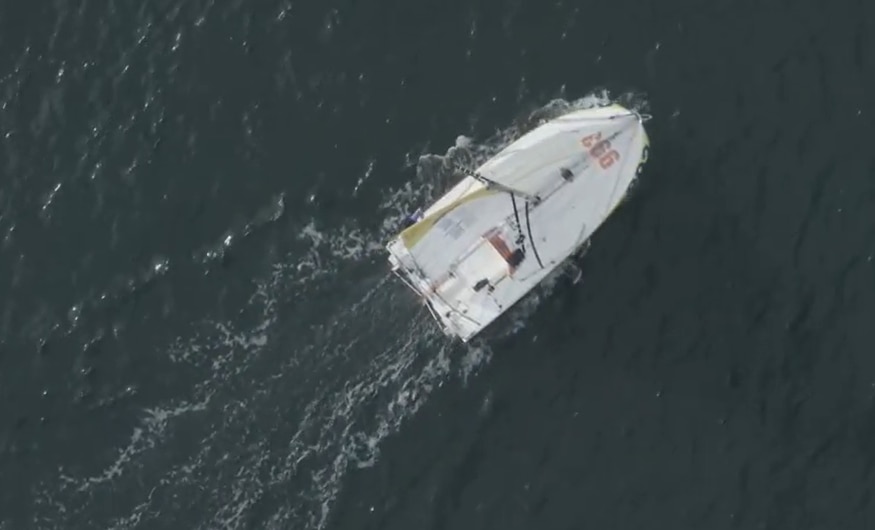
The auto-pilot is an element that he defines “his best friend” during sailing, as it allows him to leave the wheel and rest or focus on weather conditions especially on demanding regattas like the Transat, where one-person sailing and no phone/computer or technical support aside from tracking are the main requirements.
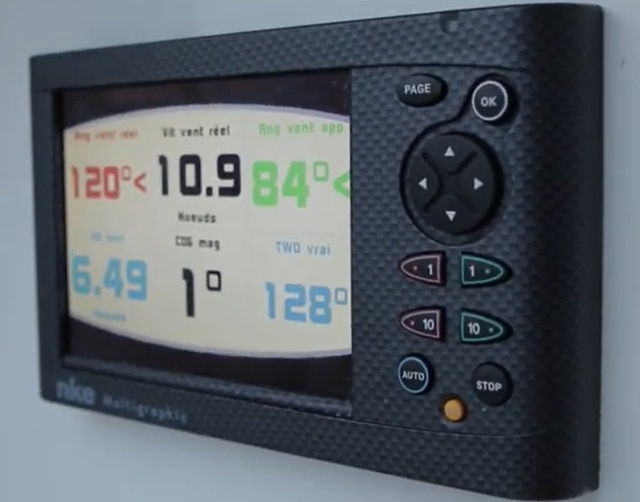
image

Interface for AutoPilot 

In light of all the characteristics that distinguish this challenge, such as passion, determination, performance, resilience and technology, Farnell decided to partner with Alberto and help him by opening the project up to our open-source design community to redesign his autopilot. As technologies develop further and faster, we are confident that our electronics enthusiasts could highly improve it to achieve higher performances with better cost efficiency.
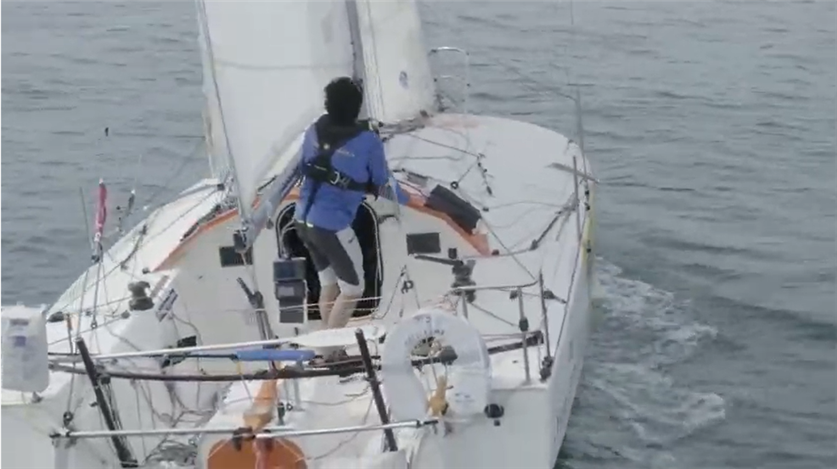
image

Among the improvements Alberto would add, he would certainly focus on changing the current screen (which was an additional cost on the overall system) in favour of taking advantage of new smart phone technologies. Connecting a smart phone to the automatic navigation system could allow to cut a big part of development and budget effort, as it would allow to use the embedded characteristics of modern displays such as waterproofness and mechanical resistance, and make it further flexible and efficient.

Join Alberto in his challenge!

Auto Pilot Components

What do you need for a boat to sail its self? 

The autopilot is made by two parts: The data acquisition and the control part.
Several sensor are connected to the system to perform the vectorial calculation of the wind and gain information about the heading of the boat: IMU compass, wind sensor, boat speed sensor and a rudder sensor.

The calculated variables are used to keep the boat on a particular true wind angle or on a particular course. Two nested PID controllers allow the boat to keep the desired route moving the rudder through a linear actuator.

The first PID calculates the desired rudder angle. The second PID, thanks to the rudder angle sensor feedback, drives the motor of the actuator to the desired rudder angle.

The first controller can be set to follow a particular reference: TWA (True Wind Angle), AWA (Apparent Wind Angle), Internal Gyro Compass (preferred choice), Fixed Rudder Angle (debugging purpose).


Ancient mariners would tie the rudder with a rope but this could run them into rocks in their sleep. 
Alberto has used electronics to monitor the wind, position and control it all with an Arduino 

image

Components 

Learn more about the components used in this build

image image image image image
Arduino Max232 Driver Interface 12v-5v DC to DC Converter H-Bridge Motor Drivers Resistors 

Arduino

Driver Interfaces DC to DC Converters Motor Drivers Resistors

Are you ready for Tomorrow? 

Competition

Global Competition
Winner
riky_electronicmarine 
Australia and New Zealand
Winner
Gough Lui 

India
Winner
rsjawale24 

Greater China
(China, Taiwan, Hong Kong)
Closed

ASEAN
(Singapore, Malaysia, Phillipines, Vietnam, Thailand) + Korea

Winner
abyraj 
image image image image image


Enter our "Ready for Tomorrow" competition for a chance to win a prize from our prize pool

Multicomp Pro Handheld Oscilloscope - Hand Held Oscilloscope
Multicomp Pro PC USB Oscilloscope - USB Oscilloscope
Multicomp Pro Soldering Station - Soldering Station

Mulitcomp Pro Handheld Multimeter - Multimeter


Details of your answers and contact details can be shared with element14 Avnet Group


  • ReadyForTomorrow
  • Share
  • History
  • More
  • Cancel
  • Sign in to reply

Top Comments

  • e14phil
    e14phil over 3 years ago +2
    Congratulation to the Winners of the following Challenges: Global Competition Winner - Will win the full Global Competition Prize pool riky_electronicmarine Australia and New Zealand Winner - Will win…
  • riky_electronicmarine
    riky_electronicmarine over 3 years ago +1
    ok who won the prises?
  • rsjawale24
    rsjawale24 over 3 years ago in reply to dougw +1
    Thanks! Really excited to see what prize do I get from the pool! A handheld oscilloscope would be nice as I don't have a scope with a screen yet..I just received my USB scope as project14 prize
  • rsjawale24
    rsjawale24 over 3 years ago in reply to Gcaravello

    Great suggestions. However, having wifi and other wireless connectivity will consume more power. Since, the system is going to be installed on a boat with limited power supply, I think the entire design needs to be calculated for it's power budget along with it's cost.

    • Cancel
    • Vote Up 0 Vote Down
    • Sign in to reply
    • More
    • Cancel
  • Ewaryst
    Ewaryst over 3 years ago

    I think what you should do is to think of some kind of redundant path for making a decision regarding course correction. I see this functionality as minimum SIL B if not SIL C especially if it will be used during user's sleep time :-). Some redundancy in sensors should also be considered in my opinion. Good luck !! Super fascinating project!!!

    • Cancel
    • Vote Up 0 Vote Down
    • Sign in to reply
    • More
    • Cancel
  • Gcaravello
    Gcaravello over 3 years ago

    As I understood there are two purposes in this challenge: the first one is the improvement of the control architecture of the autopilot regarding performance and price, the second one is the improvement of the entire data acquisition instrumentation and the remotion of the display with an Android app.

    The advices really depend on the architecture, so it would have been useful to have some additional information on the bus communication. It is a NMEA2000 bus or it is a serial communication bus like NMEA0183? The image of the instrumentation used is very poor. I didn’t understand if there is a wind vane on the masthead (I supposed yes) and I don’t understand the use of the Wheatstone bridge.

    Anyway, due the presence of the MAX232 device I think there are several serial lines and one central unit (Arduino?). I have three possible solutions to improve the architecture:

    1. Use an ESP32 board like (https://it.farnell.com/dfrobot/dfr0478/mcu-iot-firebeetle-esp32-arduino/dp/3517881?gclid=Cj0KCQjwxtSSBhDYARIsAEn0thR1tDv59YzjDuK_kV4BZsTfwRBufm--mijJbVa-AWRUeiGyLioI8dQaAoDSEALw_wcB&mckv=s_dc|pcrid|579368398304|plid||kword||match||slid||product|3517881|pgrid|123818254960|ptaid|aud-912823420205:pla-339536341562&CMP=KNC-GIT-GEN-SHOPPING-SMEC-01-Mar-2021_Low-Desktop&gross_price=true) or adding an ESP01 module to your Arduino board and implement and MQTT protocol. Then implement an interface on your android with Node-Red. Node-Red is an open source browser-based flow editing and it is easy to understand and use.

    Here there is a good example: https://create.arduino.cc/projecthub/officine/interfacing-arduino-mkr-or-esp-via-mqtt-node-red-101-4833bc.

    If you have a NMEA2000 network consider to follow the example on github.com/ttlappalainen. 

    1. Use a raspberry Pi and Openplotter (https://openplotter.readthedocs.io/en/2.x.x/). Openplotter is an interesting project with a lot of example and features. It is easy to configure and you can connect a lot of devices via USB, I2C, SPI or CAN/NMEA2000.  

    image

    You don’t have to manage all single device but the system export data in the signalK server which is a new communication standard based on JSON format.

    image

    There are a lot of plugins that you can use like Node-Red or Grafana for the dashboard and Inluxdb (database, see figure below).

    image

    Finally, you can see directly the monitor or you can see the webpage/dashboard (see figure below).

     imageimageimage

    1. Use Arduino/ESP32 to control the autopilot and the raspberry as central unit. The first solution is more deterministic and fast (ESP32 is dual core) however if you want to add some sensor you have to write code and test, moreover, use Wi-Fi fill performance. The second solution is powerful but I am not sure about its deterministic behaviour, specially if you have to control the pilot with a frequency higher than 2-5 Hz. On my opinion is more reliable to use a power board like Due or Teensy to directly control the pilot and acquire signals from serial lines from wind sensors and heading/GPS. Then, this board must send data to the raspberry which should: log data, expose a human interface for your mobile, perform some additional information like drift or tie and finally manage extra sensors (I2C) and interface (openCPN).

    Beyond the architecture I think that the most challenging problem for the good implementation of an autopilot is the correct estimation of the wind. As mentioned, you can choose the setpoint based on the heading angle or wind angle. If you use the pilot during sailing, obviously, you cannot ignore the wind direction because the risk is sailing against the wind or do some involuntary manoeuvres. The first suggestion is to adding a gyro to the magnetometer and compass (https://it.farnell.com/dfrobot/sen0142/sensore-6dof-fermion-mpu-6050/dp/3769961?gclid=Cj0KCQjwxtSSBhDYARIsAEn0thRg2Y3E7HietmkYoC3oYQp4dcbgECyGZQyc3GJ-FE8pZ1yxu3V8YggaAngJEALw_wcB&mckv=_dc|pcrid|533562556786|plid||kword||match||slid||product|3769961|pgrid|126448169642|ptaid|pla-1385743302654&CMP=KNC-GIT-GEN-SHOPPING-SMART-Development-Tools-Software_10-Jan-22&gross_price=true) to the masthead or directly to raspberry because with this you can correct the error derived from yaw and pitch of the boat. However, the error of the wind vane still remain and it is more challenging to fix (maybe adding some AI). One way you can test if it work fine is to check the TWD before and after the tack, if it remain the same you have a good measurement.

    Further, I suggest adding a bme280 or bme680 to take trace of environmental data. During an ocean sailing it is very useful because the weather is dominated by cyclones and anticyclones and visualize the trend of, for example, pressure could help you to predict rapid wind variation to avoid stressing the controller.

    I think that the real problem of the project isn’t on the human interface but on the tuning of the controller and the damping of the measurement. A simple safe strategy could be using the heading for the feedback and at the same time monitor the wind in order to send alarm and avoid unsafe navigation after this several tests must be carried out to test the pilot in different weather condition and for this reason the key is storing the data.

    On my opinion, my solution is cheap:

    • ESP32 (optional) 11€
    • Raspberry 50-70 €
    • MPU 9250 or similar 20 €
    • BME280 15€

    I think this is a very interesting project and if you want, Alberto, I would be glad to help with data or set-up.

    • Cancel
    • Vote Up 0 Vote Down
    • Sign in to reply
    • More
    • Cancel
  • dougw
    dougw over 3 years ago

    I would suggest to switch to an E-Ink display - this will be more visible in daylight and lower power.

    Another suggestion is to improve the onboard power systems as mentioned by colporteur . Starting with a solar panel. Maybe a solar powered Qi charging station so it can be totally waterproof. This means any battery powered devices would also need a wireless charging coil inside. The power management system could keep track of (and display) the state of charge of all devices and estimated run time, even if the a wired solution is chosen. Depending on solar power availability the electronic systems could automatically switch to power saving modes - at night for example. Display backlights could be voice or button activated at night.

    A barometer was not mentioned, but presumably that is already a necessary instrument. The barometric pressure could be displayed with all the other weather and nautical info.

    It might be useful to have some control functions under optional voice control in case he is busy with something when controls or autopilot settings need to be changed.

    • Cancel
    • Vote Up 0 Vote Down
    • Sign in to reply
    • More
    • Cancel
  • Thomashawson
    Thomashawson over 3 years ago

    Brian falconer from of the beaten track engineering help me think up that little idea so would share any prize with him

    • Cancel
    • Vote Up 0 Vote Down
    • Sign in to reply
    • More
    • Cancel
  • Thomashawson
    Thomashawson over 3 years ago

    I have been thinking of designing and making a mechanical servo pendulum auto pilot for my sigma 38 ood. Reading about the subject and talking to an engineering friend he suggested incorporating a PID. So the large energy force required to steer the boat is provided by the servo pendulum rudder and it is set by a wind vain and would work as a stand alone machanical system, but it would additionally use a PID circuit using low power from solar to add through differential machanical link driven by small low power liner actuator. The PID and actuator powered by solar could be a stand alone system. 

    • Cancel
    • Vote Up 0 Vote Down
    • Sign in to reply
    • More
    • Cancel
  • me_Cris
    me_Cris over 3 years ago

     I think a development board like Nicla Sense MenRF52832 would be a plus in the project.
    This development board incorporates several sensors that could be used as ease in Alberto's project; we have a small board that can be used for wireless sensor networks, as well as artificial intelligence and so on, plus it is compatible with the Arduino IDE programming environment.
    We have a sensor from Bosch - BHl260AP - Al smart sensor hub with integrated IMU, accelerometer and gyroscope;
    Bluetooth connection;
    BMP390 High-performance pressure sensor, wide measuring range, fairly good accuracy, good resolution as well;
    3-axis magnetometer - BMMISO;
    We also have Bosch BME688 Environmental sensing with artificial intelligence, sensor for pressure, humidity, temperature, gas sensor, air quality index;
    Pretty good microcontroller with computing power.
    A choice to consider.

    • Cancel
    • Vote Up 0 Vote Down
    • Sign in to reply
    • More
    • Cancel
  • Jan Cumps
    Jan Cumps over 3 years ago in reply to embeddedguy

    GPS seems to be excluded in the contest rules.

    • Cancel
    • Vote Up 0 Vote Down
    • Sign in to reply
    • More
    • Cancel
  • embeddedguy
    embeddedguy over 3 years ago

    Great work Alberto Riva. I am sure Alberto is doing his best to achieve his dreams come true. 

    The first thing I assume is that the Autopilot system is equipped with GPS so Alberto has his real-time location and real velocity estimates.

    If not GPS, as in Aeroplanes they use Kalman filtering and calibrated data to estimate things like wind speeds and true ground speed. It would be tough to add such complex things for his project while he already has option for GPS.

    One more thing is that he can use or create a mobile BLE application. Where he can collect the sensor data and send it over BLE to display on screen. This would give him simple communication interface to Autopilot system he already has. WiFi or some other communication will be complex and not so nicely fit for his use case. Though he might thing on this something like MQTT etc.

    • Cancel
    • Vote Up 0 Vote Down
    • Sign in to reply
    • More
    • Cancel
  • fmilburn
    fmilburn over 3 years ago

    Four years ago I published a series of blogs on element14 about the development of a low-powered AIS alarm that warns sailors of other ships or boats that are in close proximity when they are away from the helm or in bad conditions.  The alarm can run on batteries when other power is unavailable or being conserved and is very low cost compared to commercial options.  There is a "snooze" option that turns the alarm off for a preset period of time before alarming if the other vessel is still in range.

    image

    The initial post describes the start of the project along with a list of subsequent development posts and can be found here.  The alarm is an add-on that connects via serial to the tiny dAISy AIS radio and fits inside the radio's case.  Additional information on the inexpensive dAISy radios can be found here. They can be fitted with NMEA 0183 / RS-422 adapters and dual-channel versions are available as stand-alone models or as Raspberry Pi hats.  They have an easy-to-use serial connection and can be fitted with BLE and WiFi adapters.

    The alarm I created was designed for low-powered battery standalone use without the need for a connection to a computer.  It uses a Texas Instruments MSP430 microcontroller (dAISy uses a TI MSP430 with SiLabs radio) and development was done in C with Code Composer Studio.  Alarms are indicated with a buzzer and LED.  For your use, an alarm might also be sent to a phone.  The image below shows a prototype run I made along with a dAISy single-channel radio with an alarm installed.

    image

    The project was well advanced and working when I mothballed it.  If you are interested in the AIS alarm I will send you the design files and code as well as a populated board and faceplate at no cost.

    The proven dAISy radios are inexpensive and start at $59 at the link above and are also available worldwide from distributors.  I've known Adrian, the creator of dAISy, for several years and he is a friend but I'll receive no financial compensation for this endorsement :-)  He has worked with a number of others on various marine projects and is definitely worth contacting if you have an interest in integrating AIS into your project.

    Note to e14:  No need to consider me for prizes as I am well equipped with the nice items being offered.

    • Cancel
    • Vote Up 0 Vote Down
    • Sign in to reply
    • More
    • Cancel
<>
element14 Community

element14 is the first online community specifically for engineers. Connect with your peers and get expert answers to your questions.

  • Members
  • Learn
  • Technologies
  • Challenges & Projects
  • Products
  • Store
  • About Us
  • Feedback & Support
  • FAQs
  • Terms of Use
  • Privacy Policy
  • Legal and Copyright Notices
  • Sitemap
  • Cookies

An Avnet Company © 2026 Premier Farnell Limited. All Rights Reserved.

Premier Farnell Ltd, registered in England and Wales (no 00876412), registered office: Farnell House, Forge Lane, Leeds LS12 2NE.

ICP 备案号 10220084.

Follow element14

  • X
  • Facebook
  • linkedin
  • YouTube