element14 Community
element14 Community
    Register Log In
  • Site
  • Search
  • Log In Register
  • Community Hub
    Community Hub
    • What's New on element14
    • Feedback and Support
    • Benefits of Membership
    • Personal Blogs
    • Members Area
    • Achievement Levels
  • Learn
    Learn
    • Ask an Expert
    • eBooks
    • element14 presents
    • Learning Center
    • Tech Spotlight
    • STEM Academy
    • Webinars, Training and Events
    • Learning Groups
  • Technologies
    Technologies
    • 3D Printing
    • FPGA
    • Industrial Automation
    • Internet of Things
    • Power & Energy
    • Sensors
    • Technology Groups
  • Challenges & Projects
    Challenges & Projects
    • Design Challenges
    • element14 presents Projects
    • Project14
    • Arduino Projects
    • Raspberry Pi Projects
    • Project Groups
  • Products
    Products
    • Arduino
    • Avnet & Tria Boards Community
    • Dev Tools
    • Manufacturers
    • Multicomp Pro
    • Product Groups
    • Raspberry Pi
    • RoadTests & Reviews
  • About Us
  • Store
    Store
    • Visit Your Store
    • Choose another store...
      • Europe
      •  Austria (German)
      •  Belgium (Dutch, French)
      •  Bulgaria (Bulgarian)
      •  Czech Republic (Czech)
      •  Denmark (Danish)
      •  Estonia (Estonian)
      •  Finland (Finnish)
      •  France (French)
      •  Germany (German)
      •  Hungary (Hungarian)
      •  Ireland
      •  Israel
      •  Italy (Italian)
      •  Latvia (Latvian)
      •  
      •  Lithuania (Lithuanian)
      •  Netherlands (Dutch)
      •  Norway (Norwegian)
      •  Poland (Polish)
      •  Portugal (Portuguese)
      •  Romania (Romanian)
      •  Russia (Russian)
      •  Slovakia (Slovak)
      •  Slovenia (Slovenian)
      •  Spain (Spanish)
      •  Sweden (Swedish)
      •  Switzerland(German, French)
      •  Turkey (Turkish)
      •  United Kingdom
      • Asia Pacific
      •  Australia
      •  China
      •  Hong Kong
      •  India
      • Japan
      •  Korea (Korean)
      •  Malaysia
      •  New Zealand
      •  Philippines
      •  Singapore
      •  Taiwan
      •  Thailand (Thai)
      • Vietnam
      • Americas
      •  Brazil (Portuguese)
      •  Canada
      •  Mexico (Spanish)
      •  United States
      Can't find the country/region you're looking for? Visit our export site or find a local distributor.
  • Translate
  • Profile
  • Settings
Passive Components
  • Technologies
  • More
Passive Components
Forum Seeking Proposals for Capacitor, Inductor or Resistor Projects
  • Blog
  • Forum
  • Documents
  • Quiz
  • Events
  • Polls
  • Members
  • Mentions
  • Sub-Groups
  • Tags
  • More
  • Cancel
  • New
Join Passive Components to participate - click to join for free!
Actions
  • Share
  • More
  • Cancel
Forum Thread Details
  • Replies 22 replies
  • Subscribers 113 subscribers
  • Views 3403 views
  • Users 0 members are here
  • passive_featured
Related

Seeking Proposals for Capacitor, Inductor or Resistor Projects

rscasny
rscasny over 7 years ago

I am looking to sponsor passive components projects. It can be anything involving capacitors, inductors or resistors.


If you are instrested, please offer your project ideas in the comments below. Also, give me a rough idea of the BOM.


Randall

  • Sign in to reply
  • Cancel

Top Replies

  • shabaz
    shabaz over 7 years ago +7
    Hi Randall, I'm planning on making a single-reference resistor standard, but I've already purchased the bits and pieces.It uses a single precision resistor - I thought it would be useful to have around…
  • fmilburn
    fmilburn over 7 years ago +5
    Using supercapacitors to store energy and power project along the lines of the Solar Bubble Blaster project that I did. The circuit consists of capacitors and diodes. If you add diodes then there are a…
  • baldengineer
    baldengineer over 7 years ago +5
    Having worked at a capacitor company, I can suggest projects like these where the caps are, relatively speaking, critical. Or at least, they are not an after-thought. Power Banks Sometimes these are called…
  • luislabmo
    luislabmo over 7 years ago

    Hi Randall,


    I'd love to build a custom PCB to implement a more permanent solution to a Split-core current sensor to be used in DIY projects -I used one in one of my projects. My idea is basically to work in two different approaches: with and without GND reference.


    The sensor probably is the main component but the rest of the components are resistors and capacitors. A burden resistor dictates the resolution of the measurements and the max current that can be sensed safely, also uses other concepts like a resistor divider.


    Luis

    • Cancel
    • Vote Up +4 Vote Down
    • Sign in to reply
    • Cancel
  • baldengineer
    baldengineer over 7 years ago

    Having worked at a capacitor company, I can suggest projects like these where the caps are, relatively speaking, critical. Or at least, they are not an after-thought. image


    Power Banks

    Sometimes these are called "hold-up" circuits. Situations that require a large bank, or reserve, of energy but batteries, are not suitable. A common one is

    UPSes (uninterrupted power supplies) which may have large banks of aluminum electrolytic or supercapacitors that provide energy until the batteries can start supplying it. SSDs are another one. SSD drives generally have large capacitor banks so that their TOC can be flushed to flash memory when the rails drop.


    Variable Frequency Drives

    With the popularity of electric vehicles, "DC Link" capacitors have been popular as well. In a motor drive (or inverter, or VFD) you typically have an incoming voltage and frequency (aka supply) with an output voltage and frequency (aka output). In between are inverters to convert the incoming AC (if it is AC) to DC and then the output stage is DC to AC. That conversion allows for changing the output's voltage and frequency. In between the stage sits huge capacitors. For electric vehicles, windmills, and solar panels this can be 10s of thousands of microfarads. But any situation where you are driving something with variable speed, you need a capacitor for more than just "decoupling."


    IoT / Harvesting

    On the smaller end of the scale are IoT devices. In this case, I mean the types that harvest energy from the environment. They might include a piezo element that captures energy from vibration. Or, more commonly, solar panels. Storing that energy in a battery is sometimes costly, regarding power, because of the electrochemical process. So instead, energy is stored in a capacitor. The challenge here is designing a capacitor bank that has very low leakage. (In this situation, ceramics are good, (wet) aluminum electrolytics are not.)


    Switched Capacitor Power Supply

    An idea that keeps floating around power supply engineers is to eliminate inductors by using a "switched capacitor" design. It might be interesting to look at a DC-DC converter for a project like a small robot (something with high current motors and relatively high current microcontroller). You could build a traditional inductor based DC-DC converter as well as a switched capacitor design to compare efficiency, size, cost, etc.


    Just a few to think about. Hopefully, someone can build something more creative on top of those.

    • Cancel
    • Vote Up +5 Vote Down
    • Sign in to reply
    • Cancel
  • actionkindaguy
    actionkindaguy over 7 years ago

    Hi Randall,

    I am working on an rfid chessboard project I designed utilizing 125 Khz rfid technology. The main chessboard, for each of the 64 squares, has passive components consisting of a coil and capacitor and fast switching diode. The chessboard scanning is accomplished by multiplexing a few active components, capacitors, and resistors and only requires a few GPIO pins from a micro controller (esp32). The micro controller takes care of deciphering the data stream, chessboard scanning, and signal generation. The micro controller really could be any out there but I wanted to utilize the built-in Bluetooth and wifi that comes with the esp32 later in the project.

    So far approx BOM:

    (64 1n4154 fast switching diodes

    (64) coils ~ 275 uH,

    (70) capacitors

    (15) resistors

    (1) LM324

    (4) 74hc4066

    (2) 74HC595

    (1) 2N7000

    (1) ESP32 sparkfun module

    • Cancel
    • Vote Up +3 Vote Down
    • Sign in to reply
    • Cancel
  • Jan Cumps
    Jan Cumps over 7 years ago

    A few ideas:

    ... make lab instruments with Wheatstone bridge, Maxwell bridge, ... to measure unknown components.

    ... play with inductors, capacitors, resistors and opamps to show different filter types and configurations.

    ... show ripple filtering

    • Cancel
    • Vote Up +4 Vote Down
    • Sign in to reply
    • Cancel
  • avnrdf
    avnrdf over 7 years ago

    I'm in the design stages (a month or two till we order components) of a power electronics project for multiphase, interleaved boost converters.. which means inductors & capacitors!


    I'm also working on a power metering project which uses current transformers or Rogowski coils to measure current, though I'm not sure these apply.

    • Cancel
    • Vote Up +1 Vote Down
    • Sign in to reply
    • Cancel
  • 14rhb
    14rhb over 7 years ago in reply to baldengineer

    Hi James,


    You said "An idea that keeps floating around power supply engineers is to eliminate inductors by using a "switched capacitor" design" - do yuo know why that is?


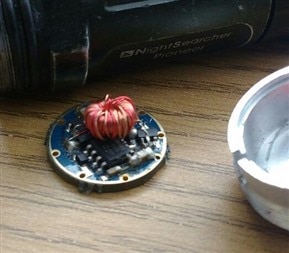
    Perhaps inductors, due to their series resistance, are inherently less efficient at storing/returning energy than the best electrolytics ?  Maybe they are also heavier - adding net weight to the design and also being more at risk of damage if the device is dropped. I dropped my LED totch a few weeks ago whilst under the car, the torch stopped working and upon dismantling I found an inductor as been ripped off the PCB by the force of the impact. When I repair it I will be adding a good blob of adhesive or encapsulate it completely.

    image


    On a reliability viewpoint, I would have thought that inductors are far more reliable than electrolytics (blown ends, high ESR).


    Rod

    • Cancel
    • Vote Up +2 Vote Down
    • Sign in to reply
    • Cancel
  • 14rhb
    14rhb over 7 years ago in reply to Jan Cumps

    Good ideas Jan,


    For aesthetics, as the Whetstone Bridge was invented in the 1800's it would need to be mounted in a polished hardwood case image.


    The filtering examples would be great if repeated in a PC simulation to show theoretical vs. practical.


    Rod

    • Cancel
    • Vote Up +1 Vote Down
    • Sign in to reply
    • Cancel
  • baldengineer
    baldengineer over 7 years ago in reply to 14rhb

    ... eliminate inductors by using a "switched capacitor" design" - do yuo know why that is?

    It is the usual design reasons, cost, parasitic losses, and physical size. Also, if you look at a coil manufacturer, the reason there are so many variations within a catalog series is that some application required a minor tweak. As a result, they add the "new" part number to the catalog. It makes multi-sourcing the inductor difficult because they are effectively custom designed.


    The sourcing concern may not be an issue in most applications. But for the ones pushing the limits of power density, it is a significant problem.


    On a reliability viewpoint, I would have thought that inductors are far more reliable than electrolytics


    The applications where this technique might work wouldn't use electrolytics. It'd be high-frequency wide bandgap converters using ceramics. Large banks of C0G ceramics.

    • Cancel
    • Vote Up +2 Vote Down
    • Sign in to reply
    • Cancel
  • 14rhb
    14rhb over 7 years ago in reply to baldengineer

    James, thank you for all the useful info.

    • Cancel
    • Vote Up +1 Vote Down
    • Sign in to reply
    • Cancel
  • shabaz
    shabaz over 7 years ago in reply to rscasny

    Just as a kind of precursor to the resistance standard project, I wrote up a 4-wire measurement project here:

    Building Kelvin (4-Wire) Test Leads

    • Cancel
    • Vote Up +5 Vote Down
    • Sign in to reply
    • Cancel
<>
element14 Community

element14 is the first online community specifically for engineers. Connect with your peers and get expert answers to your questions.

  • Members
  • Learn
  • Technologies
  • Challenges & Projects
  • Products
  • Store
  • About Us
  • Feedback & Support
  • FAQs
  • Terms of Use
  • Privacy Policy
  • Legal and Copyright Notices
  • Sitemap
  • Cookies

An Avnet Company © 2026 Premier Farnell Limited. All Rights Reserved.

Premier Farnell Ltd, registered in England and Wales (no 00876412), registered office: Farnell House, Forge Lane, Leeds LS12 2NE.

ICP 备案号 10220084.

Follow element14

  • X
  • Facebook
  • linkedin
  • YouTube