element14 Community
element14 Community
    Register Log In
  • Site
  • Search
  • Log In Register
  • Community Hub
    Community Hub
    • What's New on element14
    • Feedback and Support
    • Benefits of Membership
    • Personal Blogs
    • Members Area
    • Achievement Levels
  • Learn
    Learn
    • Ask an Expert
    • eBooks
    • element14 presents
    • Learning Center
    • Tech Spotlight
    • STEM Academy
    • Webinars, Training and Events
    • Learning Groups
  • Technologies
    Technologies
    • 3D Printing
    • FPGA
    • Industrial Automation
    • Internet of Things
    • Power & Energy
    • Sensors
    • Technology Groups
  • Challenges & Projects
    Challenges & Projects
    • Design Challenges
    • element14 presents Projects
    • Project14
    • Arduino Projects
    • Raspberry Pi Projects
    • Project Groups
  • Products
    Products
    • Arduino
    • Avnet & Tria Boards Community
    • Dev Tools
    • Manufacturers
    • Multicomp Pro
    • Product Groups
    • Raspberry Pi
    • RoadTests & Reviews
  • About Us
    About the element14 Community
  • Store
    Store
    • Visit Your Store
    • Choose another store...
      • Europe
      •  Austria (German)
      •  Belgium (Dutch, French)
      •  Bulgaria (Bulgarian)
      •  Czech Republic (Czech)
      •  Denmark (Danish)
      •  Estonia (Estonian)
      •  Finland (Finnish)
      •  France (French)
      •  Germany (German)
      •  Hungary (Hungarian)
      •  Ireland
      •  Israel
      •  Italy (Italian)
      •  Latvia (Latvian)
      •  
      •  Lithuania (Lithuanian)
      •  Netherlands (Dutch)
      •  Norway (Norwegian)
      •  Poland (Polish)
      •  Portugal (Portuguese)
      •  Romania (Romanian)
      •  Russia (Russian)
      •  Slovakia (Slovak)
      •  Slovenia (Slovenian)
      •  Spain (Spanish)
      •  Sweden (Swedish)
      •  Switzerland(German, French)
      •  Turkey (Turkish)
      •  United Kingdom
      • Asia Pacific
      •  Australia
      •  China
      •  Hong Kong
      •  India
      •  Japan
      •  Korea (Korean)
      •  Malaysia
      •  New Zealand
      •  Philippines
      •  Singapore
      •  Taiwan
      •  Thailand (Thai)
      •  Vietnam
      • Americas
      •  Brazil (Portuguese)
      •  Canada
      •  Mexico (Spanish)
      •  United States
      Can't find the country/region you're looking for? Visit our export site or find a local distributor.
  • Translate
  • Profile
  • Settings
Power & Energy
  • Technologies
  • More
Power & Energy
Blog Farmers in Egypt Use Solar Panels to Grow Crops
  • Blog
  • Forum
  • Quiz
  • Documents
  • Polls
  • Events
  • Mentions
  • Sub-Groups
  • Tags
  • More
  • Cancel
  • New
  • Share
  • More
  • Cancel
Toptech-Voices
Group Actions
  • Group RSS
  • More
  • Cancel
Engagement
  • Author Author: Catwell
  • Date Created: 17 Sep 2026 8:00 AM Date Created
  • Views 11 views
  • Likes 0 likes
  • Comments 0 comments
  • Agrovoltaics
  • alternative energy
  • farming
  • power
  • energy
  • solar
  • innovation
Related
Recommended

Farmers in Egypt Use Solar Panels to Grow Crops

Catwell
Catwell
17 Sep 2026

image

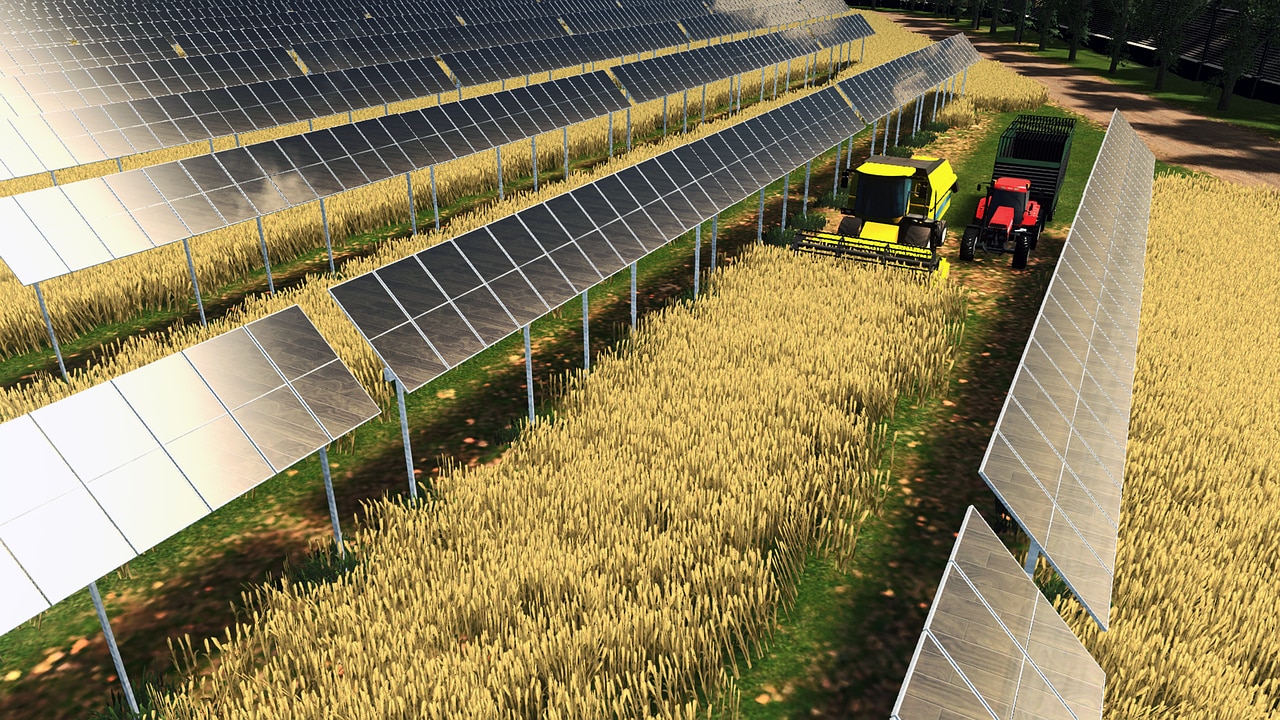
Agrovoltaics. (Image Credit: ADMC/pixabay)

For thousands of years, Egypt has made agriculture work in its harsh environment. Nowadays, however, farmers are facing more challenges: water scarcity and increasing temperatures that damage crops. Agrovoltaics can help with those issues. Solar panels generate electricity over farmland and shade the plants and soil, keeping them cooler. Initiatives in Egypt supported by funders and partnering organizations have been testing this technique in small farms.

South Sinai is using a 6kWp installation for research and demonstration, while a 100kWp implementation is being deployed in Al Moghra, Marsa Matrouh.

The good part about this is that solar panels don’t compete with crops for sunlight. Sometimes, placing panels in certain areas can lead to more ideal growing conditions for plants. Scientists are testing various configurations. And one of them has checkerboard-style layouts that are being considered in Egypt. This means more sunlight reaches the crops compared to standard solar farms. At the same time, these don’t produce as much electricity since there’s more space between each panel. 

Extra shade is beneficial since water doesn’t evaporate as quickly. In the United States, agrovoltaics’ shading actually reduced the plants’ requirement for water and improved water-use efficiency. It also keeps them safe from the heat and sometimes extreme winds. Researchers are trying out transparent solar panels so light can pass through as it generates power.  

We can’t rely on a single formula for solar power and agriculture. Different crops need different light in addition to temperature and water. Ideally, panels should be set up based on the farm type. Projects like those in Egypt and other places have used different methods to collect data on how well the solar panels and crops are doing. Those results help farmers and scientists determine how they can best adapt agrovoltaics to crops and local conditions.

Evaluating exactly how crops respond to these panels will take time. These projects are also determining whether the generated power benefits the communities. So far, the power is used for running irrigation equipment. It may even support desalination plants to convert the brackish water in the area to water for agriculture.  

New farming opportunities could arise in areas where water and electricity are valuable. Egypt’s agrivoltaics experiments may show others how solar power can be added to agriculture without making local communities choose between food and power production.

“At 3E, we believe in a world powered by renewable energy. Yet too often, the communities that could benefit the most remain beyond the reach of innovation and support. Through the support of the Government of Flanders, Belgium and strong collaboration with research partners, we have been able to bring state-of-the-art solar design and digital solutions to a nomadic community in South Sinai. Our ambition is to see this initiative scale and evolve into a community-driven model that delivers lasting energy access, resilience, and local economic value,” says Gofran Chowdhury, Head of Innovation at 3E.

Have a story tip? Message me here at element14.

  • Sign in to reply
element14 Community

element14 is the first online community specifically for engineers. Connect with your peers and get expert answers to your questions.

  • Members
  • Learn
  • Technologies
  • Challenges & Projects
  • Products
  • Store
  • About Us
  • Feedback & Support
  • FAQs
  • Terms of Use
  • Privacy Policy
  • Legal and Copyright Notices
  • Sitemap
  • Cookies

An Avnet Company © 2026 Premier Farnell Limited. All Rights Reserved.

Premier Farnell Ltd, registered in England and Wales (no 00876412), registered office: Farnell House, Forge Lane, Leeds LS12 2NE.

Follow element14

  • X
  • Facebook
  • linkedin
  • YouTube