element14 Community
element14 Community
    Register Log In
  • Site
  • Search
  • Log In Register
  • Community Hub
    Community Hub
    • What's New on element14
    • Feedback and Support
    • Benefits of Membership
    • Personal Blogs
    • Members Area
    • Achievement Levels
  • Learn
    Learn
    • Ask an Expert
    • eBooks
    • element14 presents
    • Learning Center
    • Tech Spotlight
    • STEM Academy
    • Webinars, Training and Events
    • Learning Groups
  • Technologies
    Technologies
    • 3D Printing
    • FPGA
    • Industrial Automation
    • Internet of Things
    • Power & Energy
    • Sensors
    • Technology Groups
  • Challenges & Projects
    Challenges & Projects
    • Design Challenges
    • element14 presents Projects
    • Project14
    • Arduino Projects
    • Raspberry Pi Projects
    • Project Groups
  • Products
    Products
    • Arduino
    • Avnet & Tria Boards Community
    • Dev Tools
    • Manufacturers
    • Multicomp Pro
    • Product Groups
    • Raspberry Pi
    • RoadTests & Reviews
  • About Us
    About the element14 Community
  • Store
    Store
    • Visit Your Store
    • Choose another store...
      • Europe
      •  Austria (German)
      •  Belgium (Dutch, French)
      •  Bulgaria (Bulgarian)
      •  Czech Republic (Czech)
      •  Denmark (Danish)
      •  Estonia (Estonian)
      •  Finland (Finnish)
      •  France (French)
      •  Germany (German)
      •  Hungary (Hungarian)
      •  Ireland
      •  Israel
      •  Italy (Italian)
      •  Latvia (Latvian)
      •  
      •  Lithuania (Lithuanian)
      •  Netherlands (Dutch)
      •  Norway (Norwegian)
      •  Poland (Polish)
      •  Portugal (Portuguese)
      •  Romania (Romanian)
      •  Russia (Russian)
      •  Slovakia (Slovak)
      •  Slovenia (Slovenian)
      •  Spain (Spanish)
      •  Sweden (Swedish)
      •  Switzerland(German, French)
      •  Turkey (Turkish)
      •  United Kingdom
      • Asia Pacific
      •  Australia
      •  China
      •  Hong Kong
      •  India
      •  Japan
      •  Korea (Korean)
      •  Malaysia
      •  New Zealand
      •  Philippines
      •  Singapore
      •  Taiwan
      •  Thailand (Thai)
      •  Vietnam
      • Americas
      •  Brazil (Portuguese)
      •  Canada
      •  Mexico (Spanish)
      •  United States
      Can't find the country/region you're looking for? Visit our export site or find a local distributor.
  • Translate
  • Profile
  • Settings
Power & Energy
  • Technologies
  • More
Power & Energy
Forum What's in a power supply.....your design ideas
  • Blog
  • Forum
  • Quiz
  • Documents
  • Polls
  • Events
  • Mentions
  • Sub-Groups
  • Tags
  • More
  • Cancel
  • New
Actions
  • Share
  • More
  • Cancel
Forum Thread Details
  • Replies 6 replies
  • Subscribers 283 subscribers
  • Views 201 views
  • Users 0 members are here
  • power supply circuit
  • power supply
Related

What's in a power supply.....your design ideas

colporteur
colporteur 15 days ago

image

What do you include in your power supply design? For years, I use a LM7805 regulator with an input and output capacitor as my simple 5V power supply on PCB's. (top drawing) Itypically plug in a 12VDC wall wart as a source. I use the same 12V to feed the Arduino. No AC design needed. 

I discovered after my Spring Clean project, it would be nice to have power supply indicators. I seem to recall Shabaz had some nifty things he did with zenor diodes on power supplies. Great protection, little cost. I can't find my notes on that idea. A search for power supplies in the community I came across this.  An isolated low noise +/-5V DC power supply From the post I added the indicators and the protection diodes to mine. (bottom drawing)

I've seen designs with an LM317 regulator, looks cool. I have a bag of LM7805 components I have to use up so regulator changes are not a high priority. I find it hard to walk away from components that are bought and sitting on the shelf. 

I recalled when I worked in Engineering during the 80's, new Electrical Engineers assigned to a project would always start trying to improve the power supply. Our derogatory comment, there is a new power supply born for every Engineering graduate. As an Engineering Technologist I never understood why you would design something you could buy off the shelf.

For a few buck you can get a DC to DC power supply with indicators and other bells and whistles. Why build your own. I just like a 5V supply on my designs. 

My goal is to enhance my current power supply design with some bells and whistles. Identify the parts and then perfect a PCB layout I can replicate in the future. My first step in any KiCAD project is copy the power supply. With that done I can start step 2. If you have insight to share that would be great. If you have a KiCAD drawing to share that is even greater. I'm no above begging to get ahead.

  • Sign in to reply
  • Cancel

Top Replies

  • ralphjy
    ralphjy 15 days ago +3
    You need to flip the LEDs over in your schematic so they are forward biased.
  • michaelkellett
    michaelkellett 15 days ago +1
    What you put in a power supply must surely depend on the specification. Input voltage range Output voltage (range if adjustable) Output current Input transient protection Output over-voltage…
  • ralphjy
    ralphjy 15 days ago

    You need to flip the LEDs over in your schematic so they are forward biased.

    • Cancel
    • Vote Up +3 Vote Down
    • Sign in to reply
    • Cancel
  • michaelkellett
    michaelkellett 15 days ago

    What you put in a power supply must surely depend on the specification.

    Input voltage range

    Output voltage (range if adjustable)

    Output current

    Input transient protection

    Output over-voltage protection

    Noise

    Max inrush current

    Efficiency

    Cost

    and many others.

    I very often end up with an LD1117 in a SOT223 package and aluminium electrolytic caps on input and output but quite recently I did this:

    image

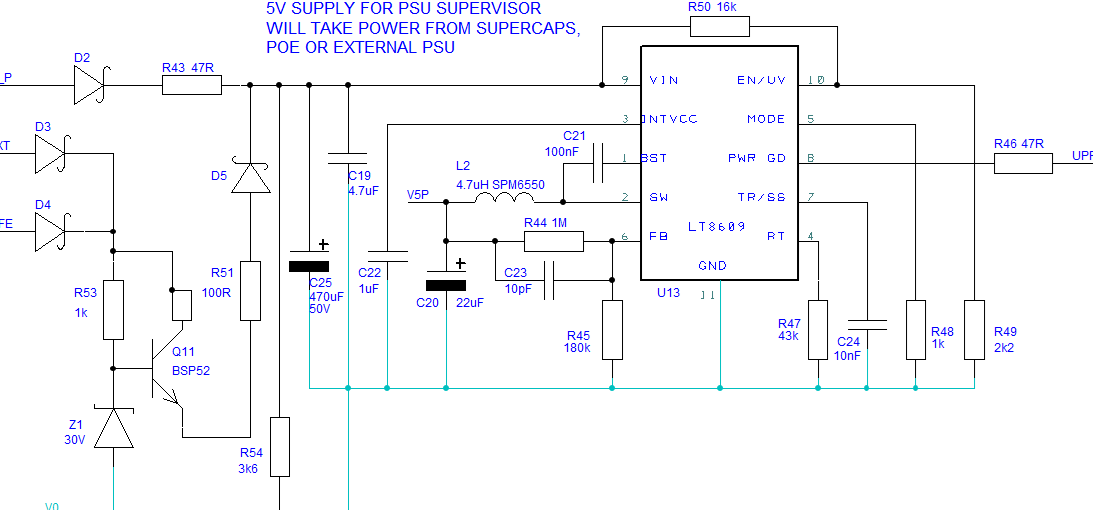
    It's a 5V internal supply which is part of a much more complex power supply. It can get input power from three different sources. When running from super-caps it needs very low current drain and may need to work with an input as low as 6V and up to 30V, from the external PSU it may get anything from 24 to 48V and from POE anything from 24 - 70V with 80V surges)

    I couldn't find a switcher that could do everything including the 80V input so I had to use the Q11 pre-regulator on that power source.

    A more general purpose tip that I can offer is that when you are using  a mains supply with a transformer, bridge rectifier and big capacitor followed by a ciruit like your standard one then a common source of noise is ringing where the transformer inductance interacts with the rectifier diodes switching. An easy fix is to put snubber caps across the rectifier. 

    (See Art of Electronics 3, The X chapters, chapter 9x.6 page 410)

    I try to remember this whenever I design a mains powered supply.

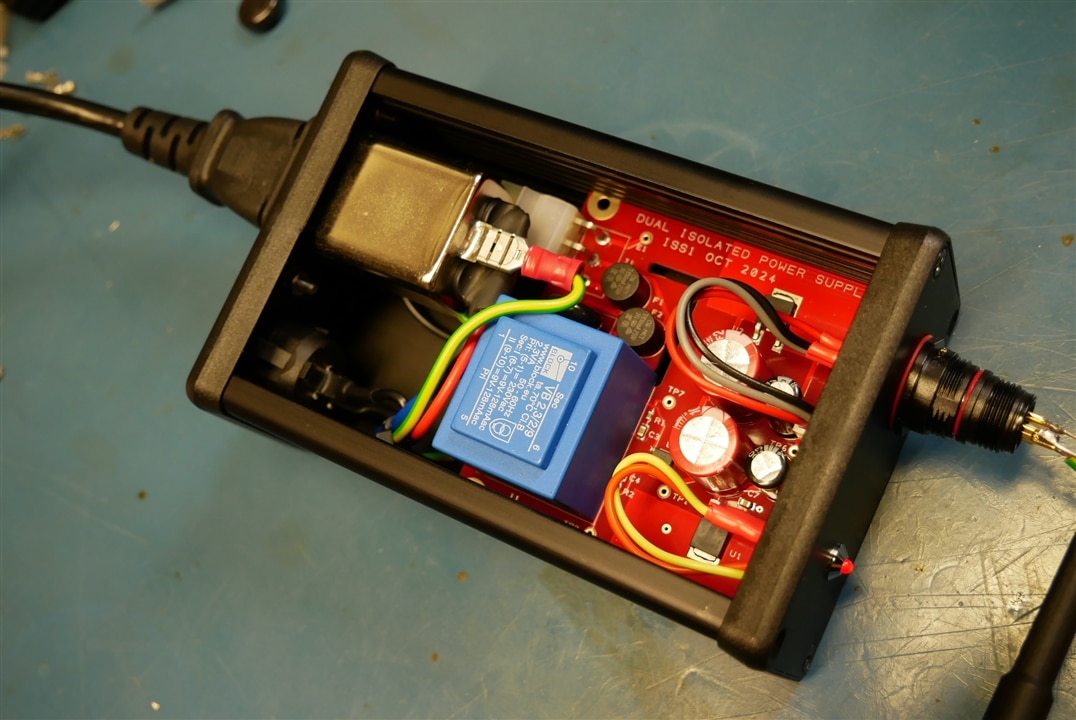
    image

    image

    This PSU was designed to power some current sense buffer amplifiers which needed an isolated low noise supply.

    MK

    • Cancel
    • Vote Up +1 Vote Down
    • Sign in to reply
    • Cancel
  • colporteur
    colporteur 14 days ago in reply to michaelkellett

    Power supply design is an electronics art on itself. The supplies found in rack servers blow me away. A little overkill for a simple Arduino project.

    I've just started chapter 9 in the book you mentioned. It has contributed to this redesign motivation. My son-in-law pokes fun at me because the book is my go to bathroom reading material.

    I included the protection diode ideas from the second drawing in my upgrade.

    image

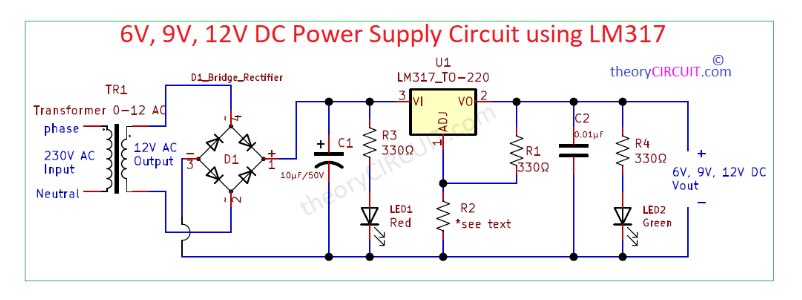
    I found an LM317 circuit drawing that holds some promise. Changing two resistor to get a different O/P voltage. This redesign is to create the ubiquitous P.S. for projects. I can't recall the last time I used an O/P other than 5V. It would be nice to have a 3.3V option. Maybe this circuit with the protection diodes from your second drawing is an option. Humm wonder how it layouts on a PCB?

    • Cancel
    • Vote Up 0 Vote Down
    • Sign in to reply
    • Cancel
  • michaelkellett
    michaelkellett 14 days ago in reply to colporteur

    If you do a pcb for it I suggest that you add the 2 RCs across the rectifier - if they don't do any good then you don't need to fit them.

    Referring to your circuit above, 10uF on the input looks very small.

    I think the LM317 can manage 1.5A.  At 50Hz you might expect to see 750V ripple (assuming a conduction time of 5ms).

    4V ripple at 1.5 A sounds more reasonable so C1 = 1.5 / 4 * 0.005 = 1875uF - use 2000, 2200 or maybe 1800.

    You can scale with current -  so if the max current you will draw  = 500mA then a 680uF will be fine for C1.

    MK

    • Cancel
    • Vote Up 0 Vote Down
    • Sign in to reply
    • Cancel
  • colporteur
    colporteur 14 days ago in reply to michaelkellett

    At one point in my electronics lifecycle I could do those goes-into calculations. Now I use resources of digi-key when I think about it. You mention 1.5A. I need to look at the wall warts ( collection of phone chargers) I'me using. I think they are less than 0.5amps.

    • Cancel
    • Vote Up 0 Vote Down
    • Sign in to reply
    • Cancel
  • colporteur
    colporteur 13 days ago

    Yeah that ain't going to work. The indicator diodes are reversed. Working the schematic in KiCAD and found the oops.

    • Cancel
    • Vote Up 0 Vote Down
    • Sign in to reply
    • Cancel
element14 Community

element14 is the first online community specifically for engineers. Connect with your peers and get expert answers to your questions.

  • Members
  • Learn
  • Technologies
  • Challenges & Projects
  • Products
  • Store
  • About Us
  • Feedback & Support
  • FAQs
  • Terms of Use
  • Privacy Policy
  • Legal and Copyright Notices
  • Sitemap
  • Cookies

An Avnet Company © 2026 Premier Farnell Limited. All Rights Reserved.

Premier Farnell Ltd, registered in England and Wales (no 00876412), registered office: Farnell House, Forge Lane, Leeds LS12 2NE.

ICP 备案号 10220084.

Follow element14

  • X
  • Facebook
  • linkedin
  • YouTube