element14 Community
element14 Community
    Register Log In
  • Site
  • Search
  • Log In Register
  • Community Hub
    Community Hub
    • What's New on element14
    • Feedback and Support
    • Benefits of Membership
    • Personal Blogs
    • Members Area
    • Achievement Levels
  • Learn
    Learn
    • Ask an Expert
    • eBooks
    • element14 presents
    • Learning Center
    • Tech Spotlight
    • STEM Academy
    • Webinars, Training and Events
    • Learning Groups
  • Technologies
    Technologies
    • 3D Printing
    • FPGA
    • Industrial Automation
    • Internet of Things
    • Power & Energy
    • Sensors
    • Technology Groups
  • Challenges & Projects
    Challenges & Projects
    • Design Challenges
    • element14 presents Projects
    • Project14
    • Arduino Projects
    • Raspberry Pi Projects
    • Project Groups
  • Products & Partners
    Products & Partners
    • Arduino
    • Avnet & Tria Boards Community
    • Dev Tools
    • Manufacturers
    • Multicomp Pro
    • Product Groups
    • Raspberry Pi
    • RoadTests & Reviews
  • About Us
    About the element14 Community
  • Store
    Store
    • Visit Your Store
    • Choose another store...
      • Europe
      •  Austria (German)
      •  Belgium (Dutch, French)
      •  Bulgaria (Bulgarian)
      •  Czech Republic (Czech)
      •  Denmark (Danish)
      •  Estonia (Estonian)
      •  Finland (Finnish)
      •  France (French)
      •  Germany (German)
      •  Hungary (Hungarian)
      •  Ireland
      •  Israel
      •  Italy (Italian)
      •  Latvia (Latvian)
      •  
      •  Lithuania (Lithuanian)
      •  Netherlands (Dutch)
      •  Norway (Norwegian)
      •  Poland (Polish)
      •  Portugal (Portuguese)
      •  Romania (Romanian)
      •  Russia (Russian)
      •  Slovakia (Slovak)
      •  Slovenia (Slovenian)
      •  Spain (Spanish)
      •  Sweden (Swedish)
      •  Switzerland(German, French)
      •  Turkey (Turkish)
      •  United Kingdom
      • Asia Pacific
      •  Australia
      •  China
      •  Hong Kong
      •  India
      •  Japan
      •  Korea (Korean)
      •  Malaysia
      •  New Zealand
      •  Philippines
      •  Singapore
      •  Taiwan
      •  Thailand (Thai)
      •  Vietnam
      • Americas
      •  Brazil (Portuguese)
      •  Canada
      •  Mexico (Spanish)
      •  United States
      Can't find the country/region you're looking for? Visit our export site or find a local distributor.
  • Translate
  • Profile
  • Settings
Sensors
  • Technologies
  • More
Sensors
Blog Researchers Develop a Ring-Laser Gyroscope That Measures Rotational Speeds as Slow as 37 Degrees Per Hour
  • Blog
  • Forum
  • Documents
  • Quiz
  • Events
  • Polls
  • Members
  • Mentions
  • Sub-Groups
  • Tags
  • More
  • Cancel
  • New
Join Sensors to participate - click to join for free!
  • Share
  • More
  • Cancel
Group Actions
  • Group RSS
  • More
  • Cancel
Engagement
  • Author Author: Catwell
  • Date Created: 22 Oct 2026 7:10 PM Date Created
  • Views 33 views
  • Likes 2 likes
  • Comments 2 comments
  • university of california
  • on_campus
  • gps
  • Santa Barbara
  • university
  • sensor
  • innovation
  • navigation
Related
Recommended

Researchers Develop a Ring-Laser Gyroscope That Measures Rotational Speeds as Slow as 37 Degrees Per Hour

Catwell
Catwell
22 Oct 2026

image

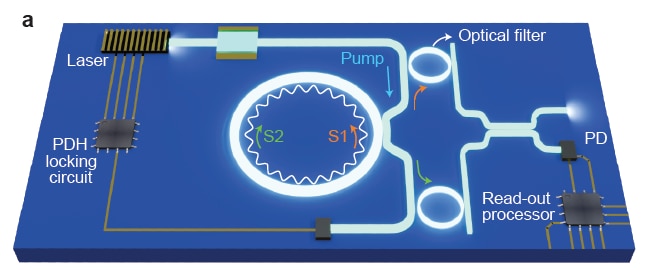
Schematic of the optical ring-laser gyroscope. (Image Credit: Kerry Vahala, California Institute of Technology)

Scientists recently built a chip-scale optical ring-laser gyroscope with slow-rotating measurement capabilities. It’s nearly 2,000 times more sensitive than the team’s earlier silicon nitride Brillouin gyroscope. This device, which records rotations as slow as 37 degrees/hour, could be practical for precision navigation and orientation systems.  

The optical ring-laser gyroscope is made by combining Brillouin laser technology with a photonic integrated circuit comprised of silicon nitride waveguides. With this technique, the device confines light with low loss within a ring-shaped microresonator. Light can then make multiple passes around the ring, which makes it highly sensitive when slight changes occur due to rotation. The team says the circuit is compatible with standard CMOS chip-production processes.   
image
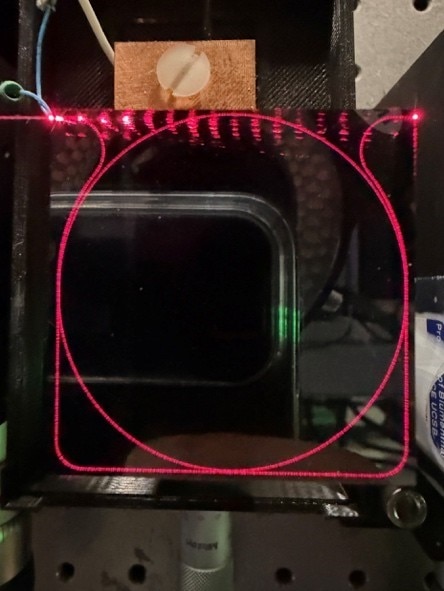
A large optical ring improves the sensitivity of the device. (Image Credit: Daniel J. Blumenthal, University of California, Santa Barbara)

The ring-shaped optical circuit, which measures 24 mm across, functions as the sensing mechanism. Two semiconductor lasers direct light through the ring in opposite directions. Interactions between the light and vibrations in the waveguides generate stable Brillouin laser signals.

Both lasers’ signals have nearly the same frequency when the device doesn’t rotate. While it turns, the frequencies slightly change relative to each other. The gyroscope then finds that difference and calculates the rotation speed. While the large ring improves the small movement detection capability, the silicon nitride resonator reduces optical losses. Thanks to the quality factor reaching above 163 million, the resonator isolates a 2 MHz bandwidth from a 200 THz optical signal as it retains photons for nearly 100 nanoseconds.

They assessed the packaged chip’s performance by mounting it on a piezoelectric rotation stage, moving it at controlled frequencies. An optical interferometer measured the motion, which was then compared to the gyroscope’s readings. It had a linear response and sensed rotations as slow as 37 degrees per hour.

The team is improving the device’s stability by reducing pump light scattering in the resonator. They are also working on a compact unit to test the device in the real world before all the optical components are integrated into a chip.

Have a story tip? Message me here at element14.

  • Sign in to reply
  • DAB
    DAB 10 hours ago

    One of my old bosses went to Honeywell to work on the ring laser gyroscope back in the mid 1970's.

    He was a very good physicist and a good friend. 

    He is now in his 80's, slowing down, but still going.

    • Cancel
    • Vote Up 0 Vote Down
    • Sign in to reply
    • More
    • Cancel
  • ralphjy
    ralphjy 10 hours ago

    Like a blast from the past.  I was in the R&D group at Litton Guidance and Control Systems in the mid 1970’s when our instrument group was developing RLGs.

    • Cancel
    • Vote Up 0 Vote Down
    • Sign in to reply
    • More
    • Cancel
element14 Community

element14 is the first online community specifically for engineers. Connect with your peers and get expert answers to your questions.

  • Members
  • Learn
  • Technologies
  • Challenges & Projects
  • Products
  • Store
  • About Us
  • Feedback & Support
  • FAQs
  • Terms of Use
  • Privacy Policy
  • Legal and Copyright Notices
  • Sitemap
  • Cookies

An Avnet Company © 2026 Premier Farnell Limited. All Rights Reserved.

Premier Farnell Ltd, registered in England and Wales (no 00876412), registered office: Farnell House, Forge Lane, Leeds LS12 2NE.

Follow element14

  • X
  • Facebook
  • linkedin
  • YouTube