


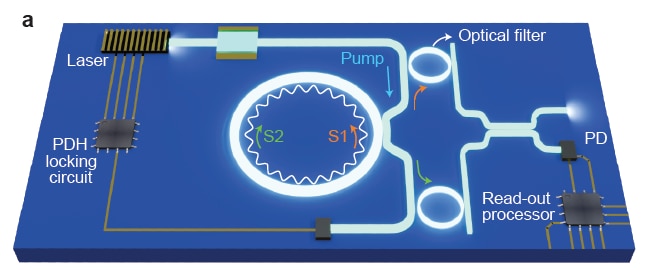
Schematic of the optical ring-laser gyroscope. (Image Credit: Kerry Vahala, California Institute of Technology)
Scientists recently built a chip-scale optical ring-laser gyroscope with slow-rotating measurement capabilities. It’s nearly 2,000 times more sensitive than the team’s earlier silicon nitride Brillouin gyroscope. This device, which records rotations as slow as 37 degrees/hour, could be practical for precision navigation and orientation systems.
The optical ring-laser gyroscope is made by combining Brillouin laser technology with a photonic integrated circuit comprised of silicon nitride waveguides. With this technique, the device confines light with low loss within a ring-shaped microresonator. Light can then make multiple passes around the ring, which makes it highly sensitive when slight changes occur due to rotation. The team says the circuit is compatible with standard CMOS chip-production processes.
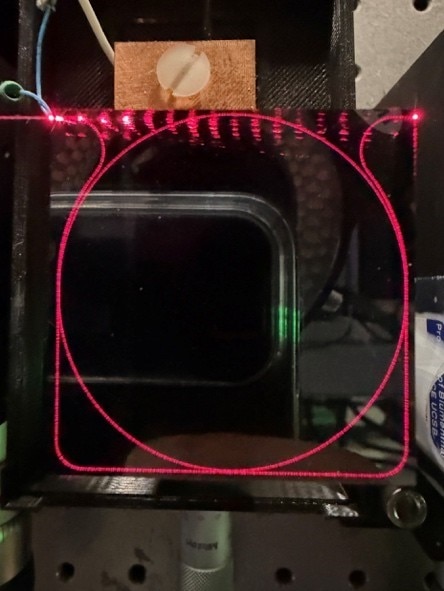
A large optical ring improves the sensitivity of the device. (Image Credit: Daniel J. Blumenthal, University of California, Santa Barbara)
The ring-shaped optical circuit, which measures 24 mm across, functions as the sensing mechanism. Two semiconductor lasers direct light through the ring in opposite directions. Interactions between the light and vibrations in the waveguides generate stable Brillouin laser signals.
Both lasers’ signals have nearly the same frequency when the device doesn’t rotate. While it turns, the frequencies slightly change relative to each other. The gyroscope then finds that difference and calculates the rotation speed. While the large ring improves the small movement detection capability, the silicon nitride resonator reduces optical losses. Thanks to the quality factor reaching above 163 million, the resonator isolates a 2 MHz bandwidth from a 200 THz optical signal as it retains photons for nearly 100 nanoseconds.
They assessed the packaged chip’s performance by mounting it on a piezoelectric rotation stage, moving it at controlled frequencies. An optical interferometer measured the motion, which was then compared to the gyroscope’s readings. It had a linear response and sensed rotations as slow as 37 degrees per hour.
The team is improving the device’s stability by reducing pump light scattering in the resonator. They are also working on a compact unit to test the device in the real world before all the optical components are integrated into a chip.
Have a story tip? Message me here at element14.
-

DAB
-
Cancel
-
Vote Up
0
Vote Down
-
-
Sign in to reply
-
More
-
Cancel
Comment-

DAB
-
Cancel
-
Vote Up
0
Vote Down
-
-
Sign in to reply
-
More
-
Cancel
Children