element14 Community
element14 Community
    Register Log In
  • Site
  • Search
  • Log In Register
  • Community Hub
    Community Hub
    • What's New on element14
    • Feedback and Support
    • Benefits of Membership
    • Personal Blogs
    • Members Area
    • Achievement Levels
  • Learn
    Learn
    • Ask an Expert
    • eBooks
    • element14 presents
    • Learning Center
    • Tech Spotlight
    • STEM Academy
    • Webinars, Training and Events
    • Learning Groups
  • Technologies
    Technologies
    • 3D Printing
    • FPGA
    • Industrial Automation
    • Internet of Things
    • Power & Energy
    • Sensors
    • Technology Groups
  • Challenges & Projects
    Challenges & Projects
    • Design Challenges
    • element14 presents Projects
    • Project14
    • Arduino Projects
    • Raspberry Pi Projects
    • Project Groups
  • Products
    Products
    • Arduino
    • Avnet & Tria Boards Community
    • Dev Tools
    • Manufacturers
    • Multicomp Pro
    • Product Groups
    • Raspberry Pi
    • RoadTests & Reviews
  • About Us
    About the element14 Community
  • Store
    Store
    • Visit Your Store
    • Choose another store...
      • Europe
      •  Austria (German)
      •  Belgium (Dutch, French)
      •  Bulgaria (Bulgarian)
      •  Czech Republic (Czech)
      •  Denmark (Danish)
      •  Estonia (Estonian)
      •  Finland (Finnish)
      •  France (French)
      •  Germany (German)
      •  Hungary (Hungarian)
      •  Ireland
      •  Israel
      •  Italy (Italian)
      •  Latvia (Latvian)
      •  
      •  Lithuania (Lithuanian)
      •  Netherlands (Dutch)
      •  Norway (Norwegian)
      •  Poland (Polish)
      •  Portugal (Portuguese)
      •  Romania (Romanian)
      •  Russia (Russian)
      •  Slovakia (Slovak)
      •  Slovenia (Slovenian)
      •  Spain (Spanish)
      •  Sweden (Swedish)
      •  Switzerland(German, French)
      •  Turkey (Turkish)
      •  United Kingdom
      • Asia Pacific
      •  Australia
      •  China
      •  Hong Kong
      •  India
      •  Japan
      •  Korea (Korean)
      •  Malaysia
      •  New Zealand
      •  Philippines
      •  Singapore
      •  Taiwan
      •  Thailand (Thai)
      •  Vietnam
      • Americas
      •  Brazil (Portuguese)
      •  Canada
      •  Mexico (Spanish)
      •  United States
      Can't find the country/region you're looking for? Visit our export site or find a local distributor.
  • Translate
  • Profile
  • Settings
Sensors
  • Technologies
  • More
Sensors
Blog Sensor Array Discovers an Underground Reservoir at Old Faithful
  • Blog
  • Forum
  • Documents
  • Quiz
  • Events
  • Polls
  • Members
  • Mentions
  • Sub-Groups
  • Tags
  • More
  • Cancel
  • New
Join Sensors to participate - click to join for free!
  • Share
  • More
  • Cancel
Group Actions
  • Group RSS
  • More
  • Cancel
Engagement
  • Author Author: Catwell
  • Date Created: 4 Sep 2026 10:28 PM Date Created
  • Views 23 views
  • Likes 3 likes
  • Comments 1 comment
  • old faithful
  • national park
  • usa
  • environmental sensor
  • earth
  • sensor
Related
Recommended

Sensor Array Discovers an Underground Reservoir at Old Faithful

Catwell
Catwell
4 Sep 2026

image

(Image Credit JillWellington/pixabay)

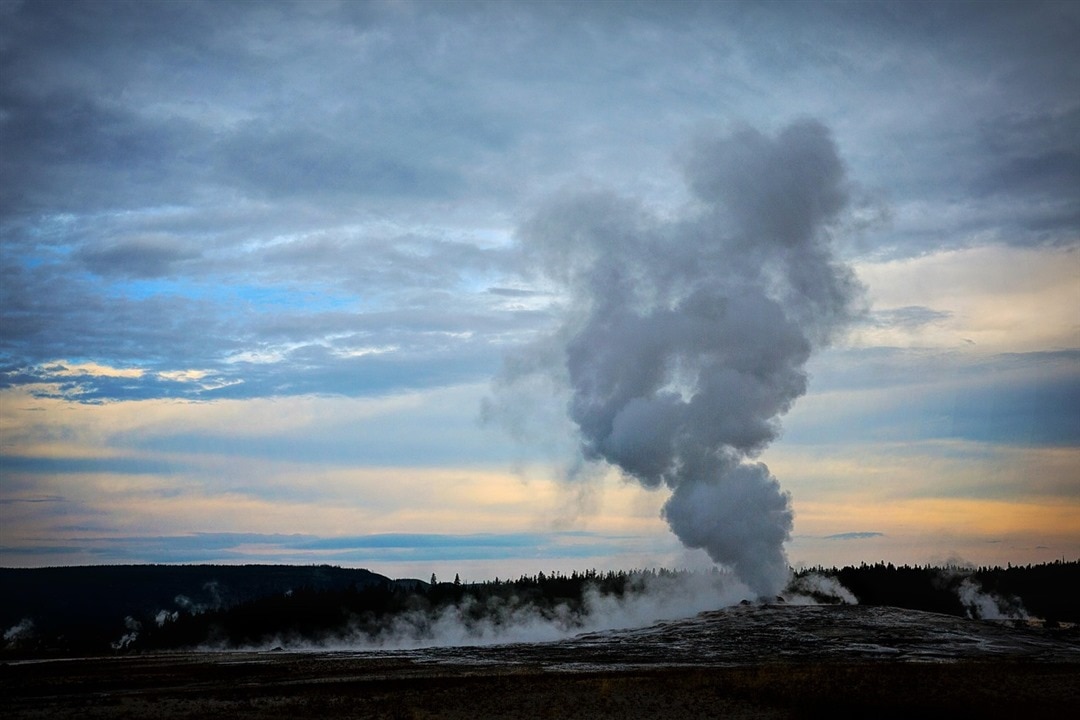
The Old Faithful geyser has a secret. And University of Utah scientists uncovered it. Beneath the area around the geyser lies a network of fractures and pores that forms part of its hydrothermal system. This contains hot water that helps fuel the eruptions. Using seismic sensors, the team mapped the shallow subsurface around the geyser. They discovered a large hydrothermal reservoir within the fractured rock.  

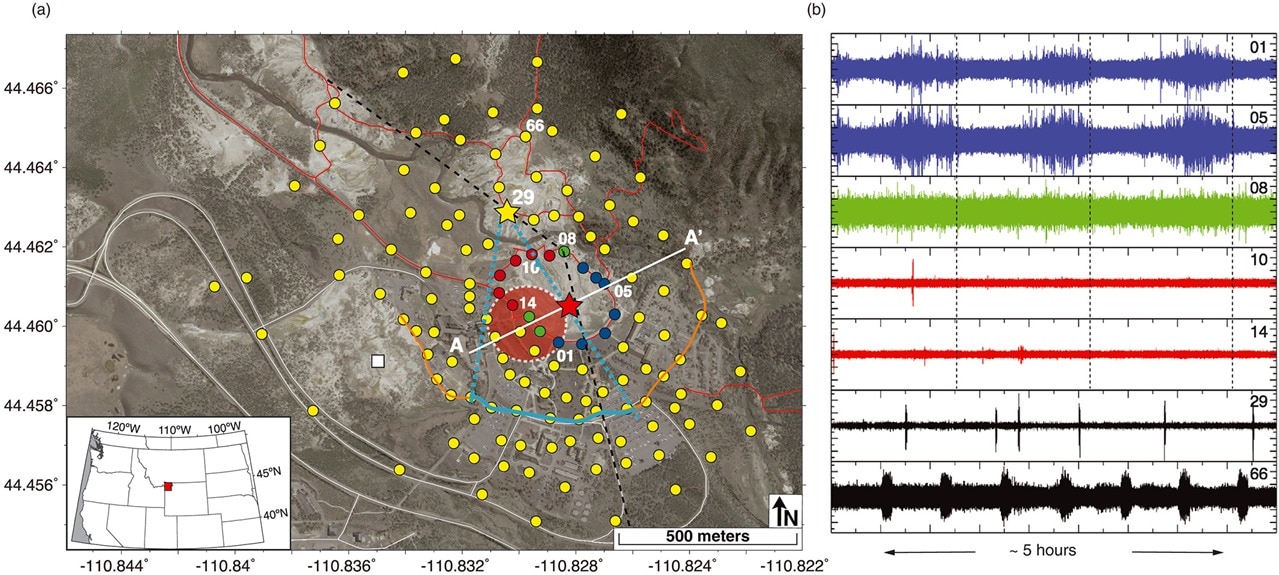
To characterize the hydrothermal system under Old Faithful, the researchers deployed an array of 133 autonomous three-component 5 Hz nodal geophones. These instruments, spaced 50 metres apart, were spread out across a 1 km-wide area in Yellowstone’s Upper Geyser Basin. Each geophone measured ground motion in three directions. Then, the scientists measured how seismic waves traveled through the subsurface.

Scientists relied on the vibrations generated by Yellowstone’s hydrothermal activity instead of creating seismic signals. These signals were produced by hydrothermal fluid and steam migration, while higher-frequency signals come from boiling water and bubbles collapsing. Researchers recorded those signals for 13 days and used the seismic waves as a source to image the subsurface.
image
The 133 seismic array around Old Faithful. It also shows hydrothermal seismic signals detected at different stations. (Image: Advanced Earth and Space Sciences)

They used ambient-noise seismic methods, such as cross-correlation of signals recorded at different stations, for analysis. Comparing seismic waves detected by varying sensors made it possible to measure their travel speeds. The researchers evaluated Rayleigh waves at different frequencies, which are sensitive to varied depths. Seismic velocity variations helped differentiate between rock types and locate hydrothermally altered zones.  

Imagery revealed a strong variation in velocities between the northeastern and southwestern portions of the study zone. Higher seismic velocities in the northeast were consistent with solid rhyolitic lava flows. Meanwhile, slower southwest-based velocities corresponded to glacial deposits in the Firehole River valley. At certain frequencies, the velocity difference between the two regions reached 40%. Results showed the geological boundary at the surface continued below the ground.

An underground 200-metre-wide hydrothermal reservoir was found by seismic imagery. It extends from 10 to 60 meters and is centered around 100 metres southwest of the geyser. Based on a 30% estimated porosity, the researchers calculated that it holds 300,000 m3 of water. It has fractures and pores inside the surrounding rock.

Additionally, the data revealed that Old Faithful’s eruption tremor differed across the array. 16 geophones placed within 120 metres of the geyser detected signals at 10-20 Hz. The signals happened on a 93-minute eruption cycle. Stations west of Old Faithful picked up weaker tremors than those to the east, suggesting the western subsurface strongly attenuates seismic waves. The team believes this attenuation is caused by the highly fractured and porous rock in the hydrothermal zone.

The seismic measurements point to complex fractures supplying Old Faithful. Analyzing the natural waves helped the scientists assess the subsurface structure. They also found evidence that the hydrothermal reservoir provides a steady influx of fluid to the shallower plumbing system.

Have a story tip? Message me here at element14.

  • Sign in to reply
Parents
  • Qbit
    Qbit 6 hours ago

    Awesome technique!

    • Cancel
    • Vote Up 0 Vote Down
    • Sign in to reply
    • More
    • Cancel
Comment
  • Qbit
    Qbit 6 hours ago

    Awesome technique!

    • Cancel
    • Vote Up 0 Vote Down
    • Sign in to reply
    • More
    • Cancel
Children
No Data
element14 Community

element14 is the first online community specifically for engineers. Connect with your peers and get expert answers to your questions.

  • Members
  • Learn
  • Technologies
  • Challenges & Projects
  • Products
  • Store
  • About Us
  • Feedback & Support
  • FAQs
  • Terms of Use
  • Privacy Policy
  • Legal and Copyright Notices
  • Sitemap
  • Cookies

An Avnet Company © 2026 Premier Farnell Limited. All Rights Reserved.

Premier Farnell Ltd, registered in England and Wales (no 00876412), registered office: Farnell House, Forge Lane, Leeds LS12 2NE.

Follow element14

  • X
  • Facebook
  • linkedin
  • YouTube