


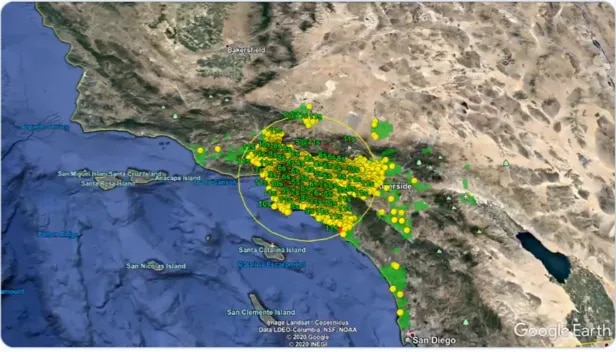
In 2020, Southern California experienced a 4.5-magnitude earthquake. Android phones were notified when the quake hit. (Image Credit: Google)
Small earthquakes, which cause little to no damage, happen every day. Occasionally, stronger ones strike. This includes those in Venezuela, Japan, California, and the Philippines. For people living there, speed matters to keep them safe. Seconds before those quakes hit, Android users received an alert that an earthquake had begun and were instructed to drop, cover, and hold on. Countries like the United States and Japan have an Early Earthquake Warning (EEW) system. However, EEW doesn’t exist in Venezuelan. Instead, it used Google’s Android Earthquake Alerts System.
It works by turning Android smartphones into a distributed seismic sensor network. Android smartphones feature an accelerometer, which senses P-waves, the tiny vibrations that occur when an earthquake starts. This allows the system to detect an earthquake and send alerts before the more intense shaking begins.
Instead of relying on a single phone to do all the work, the system uses millions. These phones are in the same area and transmit anonymous motion data to Google’s servers if unusual shaking is detected. Afterward, the software searches for groups of similar reports (crowdsourced data) from nearby devices. This pattern ensures that it doesn’t report other tiny vibrations caused by a car driving by or a phone dropping to the ground. If enough phones pick up the early earthquake vibrations and report them at the same time, the system determines that an earthquake is occurring. It also projects the location and magnitude of the quake.
When it completes that estimate, Android users receive notifications if they are in the region where shaking is expected to occur. Since the alert delivery system is electronic, it travels faster than seismic waves. So, even a short delay won’t interfere with warning others. Those who are farther away from the epicenter may receive an alert for several seconds. People who are closer may get very few warnings or none at all. Alerts in this case are intended to be urgent. Stronger ones can bypass phone settings to instruct users to take shelter.
Have a story tip? Message me here at element14.