element14 Community
element14 Community
    Register Log In
  • Site
  • Search
  • Log In Register
  • Community Hub
    Community Hub
    • What's New on element14
    • Feedback and Support
    • Benefits of Membership
    • Personal Blogs
    • Members Area
    • Achievement Levels
  • Learn
    Learn
    • Ask an Expert
    • eBooks
    • element14 presents
    • Learning Center
    • Tech Spotlight
    • STEM Academy
    • Webinars, Training and Events
    • Learning Groups
  • Technologies
    Technologies
    • 3D Printing
    • FPGA
    • Industrial Automation
    • Internet of Things
    • Power & Energy
    • Sensors
    • Technology Groups
  • Challenges & Projects
    Challenges & Projects
    • Design Challenges
    • element14 presents Projects
    • Project14
    • Arduino Projects
    • Raspberry Pi Projects
    • Project Groups
  • Products
    Products
    • Arduino
    • Avnet & Tria Boards Community
    • Dev Tools
    • Manufacturers
    • Multicomp Pro
    • Product Groups
    • Raspberry Pi
    • RoadTests & Reviews
  • About Us
    About the element14 Community
  • Store
    Store
    • Visit Your Store
    • Choose another store...
      • Europe
      •  Austria (German)
      •  Belgium (Dutch, French)
      •  Bulgaria (Bulgarian)
      •  Czech Republic (Czech)
      •  Denmark (Danish)
      •  Estonia (Estonian)
      •  Finland (Finnish)
      •  France (French)
      •  Germany (German)
      •  Hungary (Hungarian)
      •  Ireland
      •  Israel
      •  Italy (Italian)
      •  Latvia (Latvian)
      •  
      •  Lithuania (Lithuanian)
      •  Netherlands (Dutch)
      •  Norway (Norwegian)
      •  Poland (Polish)
      •  Portugal (Portuguese)
      •  Romania (Romanian)
      •  Russia (Russian)
      •  Slovakia (Slovak)
      •  Slovenia (Slovenian)
      •  Spain (Spanish)
      •  Sweden (Swedish)
      •  Switzerland(German, French)
      •  Turkey (Turkish)
      •  United Kingdom
      • Asia Pacific
      •  Australia
      •  China
      •  Hong Kong
      •  India
      •  Japan
      •  Korea (Korean)
      •  Malaysia
      •  New Zealand
      •  Philippines
      •  Singapore
      •  Taiwan
      •  Thailand (Thai)
      •  Vietnam
      • Americas
      •  Brazil (Portuguese)
      •  Canada
      •  Mexico (Spanish)
      •  United States
      Can't find the country/region you're looking for? Visit our export site or find a local distributor.
  • Translate
  • Profile
  • Settings
Test & Tools
  • Technologies
  • More
Test & Tools
Blog OpAmp basics: unbalanced to balanced signal with dual OpAmp
  • Blog
  • Forum
  • Documents
  • Files
  • Members
  • Mentions
  • Sub-Groups
  • Tags
  • More
  • Cancel
  • New
Join Test & Tools to participate - click to join for free!
  • Share
  • More
  • Cancel
Group Actions
  • Group RSS
  • More
  • Cancel
Engagement
  • Author Author: Jan Cumps
  • Date Created: 28 Aug 2022 4:32 PM Date Created
  • Views 16669 views
  • Likes 16 likes
  • Comments 13 comments
  • opamp
Related
Recommended

OpAmp basics: unbalanced to balanced signal with dual OpAmp

Jan Cumps
Jan Cumps
28 Aug 2022
OpAmp basics: unbalanced to balanced signal with dual OpAmp

A little OpAmp circuit to turn an unbalanced signal into a balanced one.
An unbalanced signal is the typical signal coming out of a signal generator, consumer audio equipment, headphone jacks.
A balanced signal uses two separate wires, with the same signal 180° inverted. It's used in RF, and professional audio equipment. It has some advantages, e.g. allows for less noise. But that's not the topic of this post.
What I show here is a common circuit to convert from unbal to bal.
image
I did this to test the little breakout board I made for a TI OPA2170. It's a dual OpAmp, and I wanted a neat circuit with two OpAmps to test it.

The circuit

I took an example from tina.com: 10. Amplifiers with balanced Inputs or Outputs.
image
source: tina.com Amplifiers with balanced Inputs or Outputs

It's a very simple circuit, where the output of the first OpAmp is identical to the input signal - but buffered. The second OpAmp is an inverting buffer and delivers the input signal, 180° phase shifted.
Together, these two signal form a buffered rendition of the input signal, with two times the amplitude.

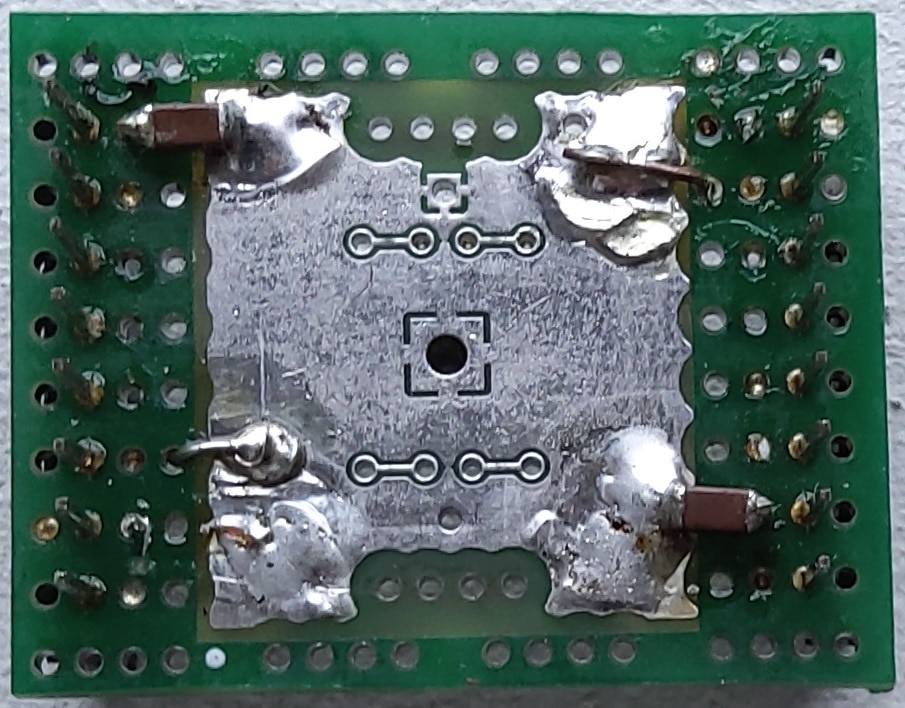
I used a TI OPA2170 dual OpAmp. It's a low power device, with decent noise specs. Bandwidth up to 1.2 MHz. On the breakout board that I made, I soldered two 1 µF decoupling capacitors.
image
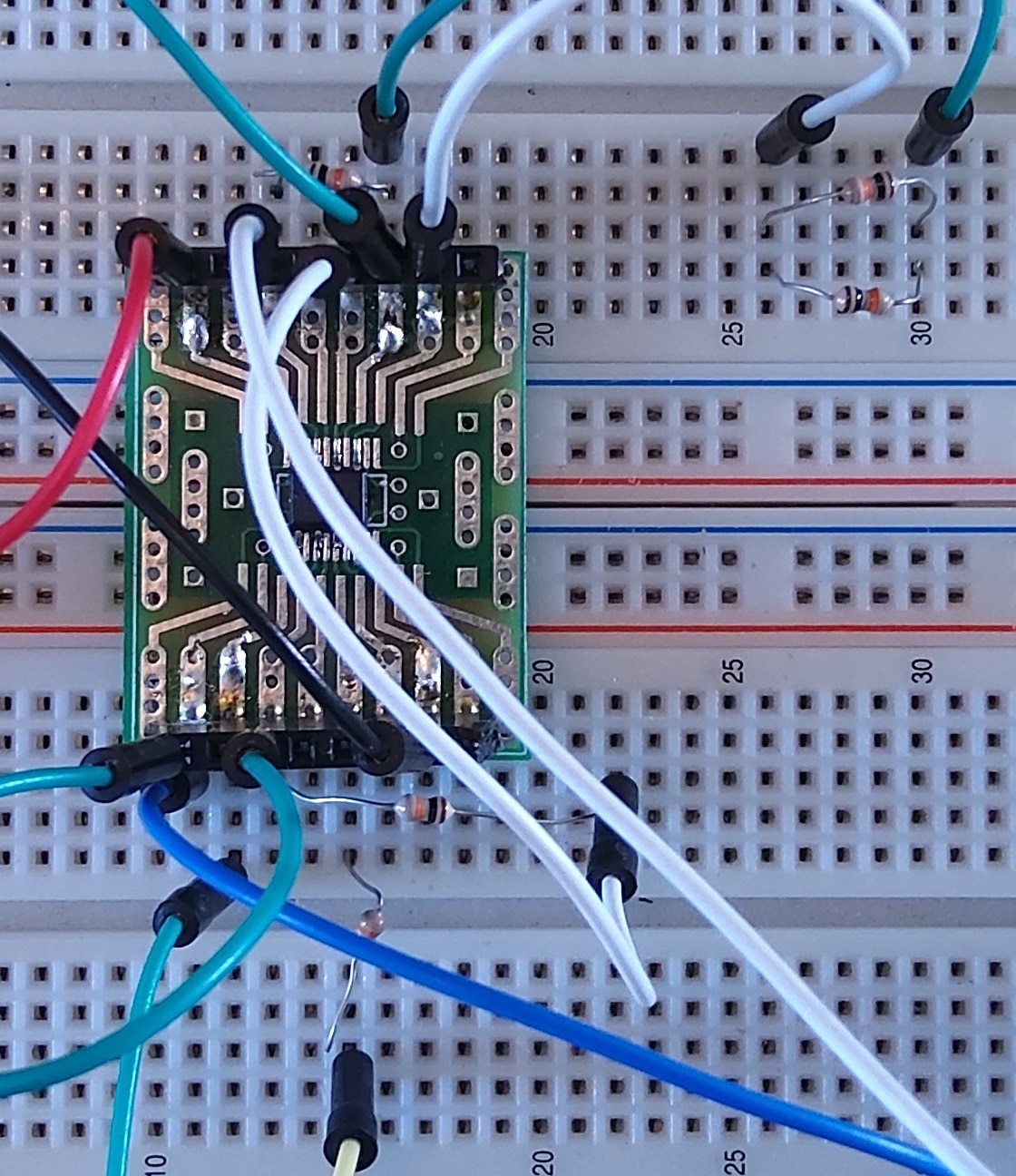
I used 5 10K resistors. One for the input, two in parallel for the 5K resistor, and the remaining ones for the two 10K resistors of the circuit.
This design is high impedance input. The input resistor can be made much higher than the 10K I used. In my case it wasn't critical. The unbalanced input comes from a function generator. So I just took the same value as all other resistors.

I built the circuit on a breadboard. Good enough in this case, where I use a 5 KHz signal.
image
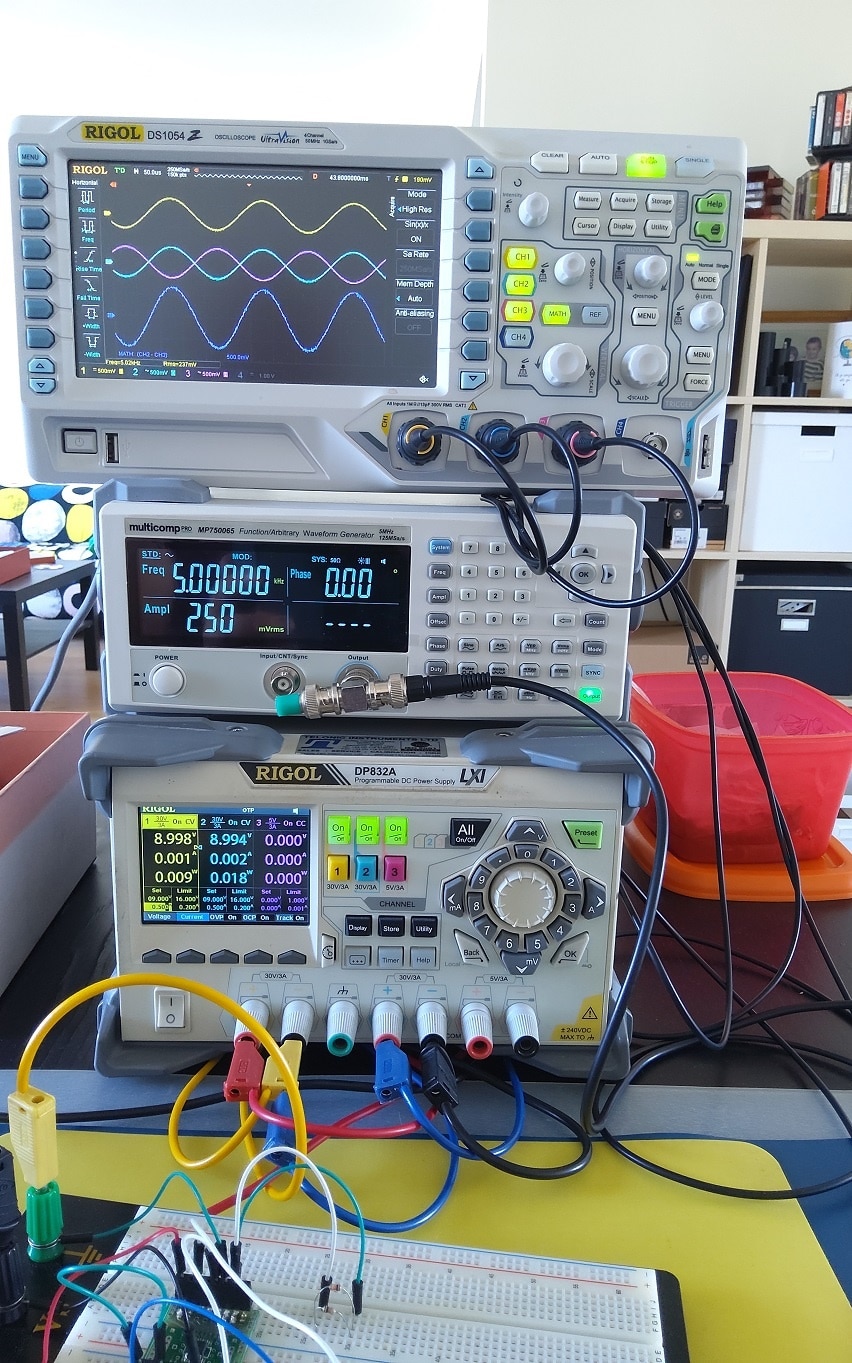
I used a balanced lab supply, set it to +9V / -9V. The function generator (the unbalanced source signal) is connected between ground and input, set to 5 KHz, 250 mVRMS, 0 V offset.

Probing a balanced signal

It's easy to probe an unbalanced signal. Connect the probe ground to ground, probe pin to the signal, and you have it.
A balanced signal runs over two wires, and none of these are ground. So you can't put your probe ground on one part, and probe pin on the other*.
A solution is to use two oscilloscope channels, and probe each of the two signals with one signal, as usual. Then use the oscilloscope's MATH function to show the difference of the two.
image
You see the result in the scope capture above. Channel 1 (yellow) is the unbalanced input - the signal coming out of the generator.
Channel 2 (cyan) the output of the left OpAmp. It's the bufffered input signal, and forms one part of the balanced output.
Channel 3 (magenta) is the output of the right OpAmp, and is the inverted component of the balanced output.
The difference between the two is the balanced signal. I used the Math (purple) difference (A - B: channel2 - channel 3) function to show it. Because both balanced halves have the same amplitude as the source - and are 180° inverted, the total balanced signal  has double the amplitude of the input.

One of the properties of a balanced signal is that the inversion removes noise. External noise will impact both components of the balances signal almost the same. When you then take the difference, identical noise on the lines cancels itself out, while the signal keeps its form. 
image

*you can. I leave it to fellow community members to put possibilities in the comments


  • Sign in to reply
Parents
  • jc2048
    jc2048 over 3 years ago

    Hello Jan. Did you notice the voltage noise plot in the datasheet?

    image


    Above 10kHz, the noise starts going up (that's an unusual feature). That will add quite a lot of high-frequency noise to the outputs. If you assumed the noise stopped at the 1MHz limit of the graph (it doesn't), that still looks like at least 70uV or 80uV of noise into the load with the two op-amps (in practice it could be a couple of hundred uV). Not really a problem for you experimenting with the circuit, but it might be a bit of a concern in some applications, depending on what you were doing with it.

    BTW be cautious of the spice model. Although they've characterised the noise, it looks like the high frequency end, above 10kHz, is somewhat different to the datasheet. In a simulation of your circuit, I get a total of 2mV of noise into the load. Let's hope it's the datasheet that's accurate and not the model.

    A second thing to note is that these op amps can only drive 300pF, so watch out if you are intent on attaching long cables to the outputs.

    • Cancel
    • Vote Up 0 Vote Down
    • Sign in to reply
    • More
    • Cancel
Comment
  • jc2048
    jc2048 over 3 years ago

    Hello Jan. Did you notice the voltage noise plot in the datasheet?

    image


    Above 10kHz, the noise starts going up (that's an unusual feature). That will add quite a lot of high-frequency noise to the outputs. If you assumed the noise stopped at the 1MHz limit of the graph (it doesn't), that still looks like at least 70uV or 80uV of noise into the load with the two op-amps (in practice it could be a couple of hundred uV). Not really a problem for you experimenting with the circuit, but it might be a bit of a concern in some applications, depending on what you were doing with it.

    BTW be cautious of the spice model. Although they've characterised the noise, it looks like the high frequency end, above 10kHz, is somewhat different to the datasheet. In a simulation of your circuit, I get a total of 2mV of noise into the load. Let's hope it's the datasheet that's accurate and not the model.

    A second thing to note is that these op amps can only drive 300pF, so watch out if you are intent on attaching long cables to the outputs.

    • Cancel
    • Vote Up 0 Vote Down
    • Sign in to reply
    • More
    • Cancel
Children
No Data
element14 Community

element14 is the first online community specifically for engineers. Connect with your peers and get expert answers to your questions.

  • Members
  • Learn
  • Technologies
  • Challenges & Projects
  • Products
  • Store
  • About Us
  • Feedback & Support
  • FAQs
  • Terms of Use
  • Privacy Policy
  • Legal and Copyright Notices
  • Sitemap
  • Cookies

An Avnet Company © 2026 Premier Farnell Limited. All Rights Reserved.

Premier Farnell Ltd, registered in England and Wales (no 00876412), registered office: Farnell House, Forge Lane, Leeds LS12 2NE.

ICP 备案号 10220084.

Follow element14

  • X
  • Facebook
  • linkedin
  • YouTube