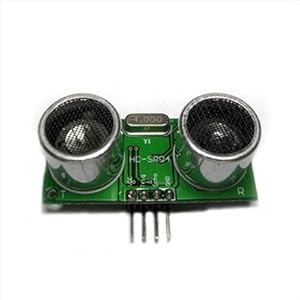
Ultrasonic was a suggestion for the motion detection. Like a security light. Any thoughts?
C
Saturation,
Can you elaborate more on your idea?
Cabe
You might be looking for something like this:
http://www.amazon.com/Mace-80357-Wireless-Motion-Detector/dp/tech-data/B000WKPHK6
In fact if any one you know uses that Glade automatic air freshener you might be able to strip the motion detector that they have (not all models have this). I am not familiar with this particular sensor, so I don't know if it will have the range that you need. If you do use a PIR (Passive Infra Red) sensor, make sure that you keep the fresnel lens, or get one to go withthe barebone sensor. This lense helps in the detection process.
You can also use an ultrasonic rangefinder - like theone that Saturation recommends.
Truth be told, there isn't one detector that can work 360 degrees. Either you rotate the sensor using a turret or you have 2 or 3 sensors, each pointing outwards. Of course, since you are sensing motion within a circle 20 feet in diameter, the sensor can be outside this area. This way you can monitor the entire area inside the circle from the outside. Of course, I don't know if this scenario is acceptable since you did not provide much detail. Good luck with your project! Salvador
Sure. For example see the spec sheet of:
http://www.maxbotix.com/products/LV.htm
You can detect distance as analog output voltage of ~ 0.01Vdc per inch from the sensor. This gives a maximum range, within the sensor envelope of the example detector, of about 1 inch to 41 feet, in 1 inch increments. Below are the detection envelopes for various models of this vendor.
You can also use the module to take a digital PWM output to be interpreted by a uC of your choice, rather than using your uC internal ADC to interpret the Vdc, and avoid conversion errors.
To detect from 90, 180, and 360 degrees, simply add as many modules needed to 'broaden' the envelope or find a specific US detector with such a field. The graphic shows samples of the different dispersion patterns.
For longer distance ranging, laser ranging can interpret distance farther than US, but at higher cost.
http://www.bhphotovideo.com/c/product/611165-REG/Newcon_LRF_MOD2CI_LRF_MOD_2CI_Laser.html
The complete modules do a similar thing, depending on maker, but typically they output serial data that requires a uC or laptop to interpret the data and convert to range.
My error, I suggested IR detects farther I think IR is nearest, US intermediate, and laser the farthest.