element14 Community
element14 Community
    Register Log In
  • Site
  • Search
  • Log In Register
  • Community Hub
    Community Hub
    • What's New on element14
    • Feedback and Support
    • Benefits of Membership
    • Personal Blogs
    • Members Area
    • Achievement Levels
  • Learn
    Learn
    • Ask an Expert
    • eBooks
    • element14 presents
    • Learning Center
    • Tech Spotlight
    • STEM Academy
    • Webinars, Training and Events
    • Learning Groups
  • Technologies
    Technologies
    • 3D Printing
    • FPGA
    • Industrial Automation
    • Internet of Things
    • Power & Energy
    • Sensors
    • Technology Groups
  • Challenges & Projects
    Challenges & Projects
    • Design Challenges
    • element14 presents Projects
    • Project14
    • Arduino Projects
    • Raspberry Pi Projects
    • Project Groups
  • Products
    Products
    • Arduino
    • Avnet & Tria Boards Community
    • Dev Tools
    • Manufacturers
    • Multicomp Pro
    • Product Groups
    • Raspberry Pi
    • RoadTests & Reviews
  • About Us
  • Store
    Store
    • Visit Your Store
    • Choose another store...
      • Europe
      •  Austria (German)
      •  Belgium (Dutch, French)
      •  Bulgaria (Bulgarian)
      •  Czech Republic (Czech)
      •  Denmark (Danish)
      •  Estonia (Estonian)
      •  Finland (Finnish)
      •  France (French)
      •  Germany (German)
      •  Hungary (Hungarian)
      •  Ireland
      •  Israel
      •  Italy (Italian)
      •  Latvia (Latvian)
      •  
      •  Lithuania (Lithuanian)
      •  Netherlands (Dutch)
      •  Norway (Norwegian)
      •  Poland (Polish)
      •  Portugal (Portuguese)
      •  Romania (Romanian)
      •  Russia (Russian)
      •  Slovakia (Slovak)
      •  Slovenia (Slovenian)
      •  Spain (Spanish)
      •  Sweden (Swedish)
      •  Switzerland(German, French)
      •  Turkey (Turkish)
      •  United Kingdom
      • Asia Pacific
      •  Australia
      •  China
      •  Hong Kong
      •  India
      • Japan
      •  Korea (Korean)
      •  Malaysia
      •  New Zealand
      •  Philippines
      •  Singapore
      •  Taiwan
      •  Thailand (Thai)
      • Vietnam
      • Americas
      •  Brazil (Portuguese)
      •  Canada
      •  Mexico (Spanish)
      •  United States
      Can't find the country/region you're looking for? Visit our export site or find a local distributor.
  • Translate
  • Profile
  • Settings
Test & Tools
  • Technologies
  • More
Test & Tools
Forum Test Board for Amplifying Bipolar Pulse from Arbitrary Function Generator?
  • Blog
  • Forum
  • Documents
  • Files
  • Members
  • Mentions
  • Sub-Groups
  • Tags
  • More
  • Cancel
  • New
Join Test & Tools to participate - click to join for free!
Actions
  • Share
  • More
  • Cancel
Forum Thread Details
  • State Verified Answer
  • Replies 23 replies
  • Answers 4 answers
  • Subscribers 365 subscribers
  • Views 4043 views
  • Users 0 members are here
  • amplifier
  • amplifying_pulses
  • arbitrary_function_generator
  • high_voltage_pulse
Related

Test Board for Amplifying Bipolar Pulse from Arbitrary Function Generator?

JRR
JRR over 14 years ago

Hi,


My electronics knowledge is limited, so I am framing my question with the information I have.  I am not sure if I am in the right forum to post this question, so if I am very off, please guide me in the right direction.


I want to find a test board /chip combination to amplify a bipolar waveform.  The reason I want to try a board is because if I find the right one, and it works for my application, at the end of the day, I will be a step ahead with the amplifer electronics I need.  I've also looked at amplifying test equipment that could cost as much as US$2,500.  I could probably test 100 different boards with that much money, which I don't have eitherway.


Here is the description of my project, what I already have, including some of the equipment and information:


Equipment I already have:

- USB powered Osciloscope/wave generator combo product, which has an arbitrary wave generator.  The specs for the wave generator are here:

  Syscomp CRG-101 Datasheet

  It works pretty well, but I realized I need more power for my application.


Application:

- Electrokinetics to move fluid though a wet porous material (the Resistance of my electrode system is below)


What my function generator puts out (from the datasheet above):

- Square pulse

- Max. pulse amplitude 6 Vpp


Description from the pulse I need:

- Square pulse, bipolar

- Frequency between 1Hz&100kHz (I might need something close to DC, and then some at AC)

- Amplitude: 100 Vp-p

- the resistance of my system is below

- I don't need the pulse to have very high resolution / precission


Description of the characteristics of my system:

- Resistance has ranges between (given by my material and my electrode geometry)

  1. Wet = 10kOhm

  2. Semiwet = 100kOhm


Some information I have already looked at but have not fully understood:

- The waveform generator vendor's recommendations for amplification:

   Increasing output current from Signal Generator (Syscomp)

- The two sets of product descriptions I have been browsing (not all have test boards) :

   1. Analog Devices High Voltage Amplifiers

   2. Analog Devices High Supply Voltage Amplifiers


So Finally the question is:

- If you had to pick a testboard/chip combination that met my requirements, which one should it be?


Thank you very much in advance,


J.

  • Sign in to reply
  • Cancel

Top Replies

  • michaelkellett
    michaelkellett over 14 years ago +1
    If you could live with a reduced frequency range I would suggest that an audio amplifier might be a cheap way round your problem. Farnell owned CPC sell a DA500 power amplifer for £99 which should be able…
  • michaelkellett
    michaelkellett over 14 years ago in reply to JRR +1 verified
    Hello - look up all you can on National Semiconductor's LME49830. None of the AD parts in your references will do but the LME49830 can meet your spec. NS give a pcb layout in the data sheet - you can buy…
  • RWM
    RWM over 14 years ago in reply to JRR +1 suggested
    In fact, LME49830 without output MOSFET stage would be sufficient (as it has 47mA minimum output current, page 5 in http://www.national.com/ds/LM/LME49830.pdf ), but amp module will be easier to use. Alternatively…
Parents
  • Former Member
    0 Former Member over 14 years ago

    Hi J,

    Not  the cheapest solution but great value for money,

    http://uk.farnell.com/agilent-technologies/dsox2002a/oscilloscope-2-channel-70mhz/dp/1859768

    The 70MHz 2 channel DSOX2002A from Agilent is £830 for a high specification oscilloscope and you can unlock the waveform generator option

    Order Code: 1904004 for an additional £337.

    http://www.element14.com/community/message/37679#37679/l/infiniivision-x-series-from-agilent-dso-and-mso-msox3000-dsox3000-msox2000

    Please see the above blog and watch the video for more information. this way you can get 2 new toys in one!

    I hope this helps

    Peter

    • Cancel
    • Vote Up 0 Vote Down
    • Sign in to reply
    • Verify Answer
    • Cancel
  • michaelkellett
    0 michaelkellett over 14 years ago in reply to Former Member

    Sorry Peter - is it my brain failure or yours -  how can the OP use a scope as an amplifier ?


    Michael Kellett

    • Cancel
    • Vote Up 0 Vote Down
    • Sign in to reply
    • Verify Answer
    • Cancel
  • JRR
    0 JRR over 14 years ago in reply to michaelkellett

    Michael, all,


    I received the Pyle 15W per channel amplifier.  I conneted it up to the function generator and oscilloscope combo, and started testing it.  I found out the following:

    1. If I went below 10Hz, it would not amplify as well, and it would only reproduce square waves correctly above 20Hz.  Makes sense since the amplifier's frequency response is 20Hz-20kHz I believe.  The LME89430 in the module's specification for frequency response starts at 1Hz.

    2. The Voltage is limited to 10V for the 15W amplifier.  This seems to be because of a constrain with the speaker resistance of 8ohm.  Based on this the next point. (I could post the scopes screenshots if anybody is interested).

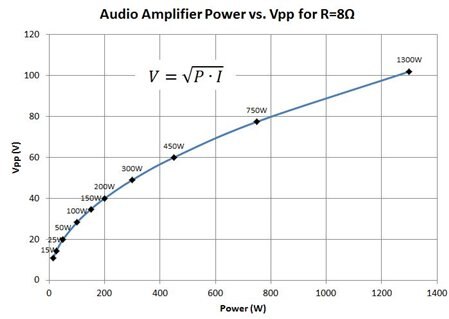
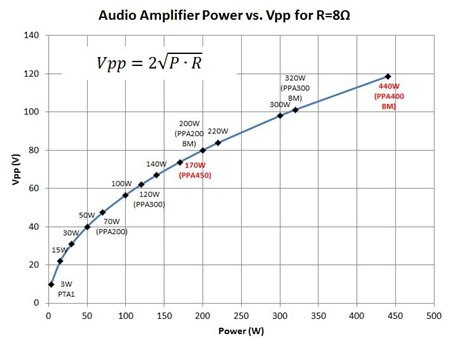
    3. I made a graph to see what sort of pre-made audio amplifier I would have to buy to reach my wanted Voltage based on the 8ohm impedance/resistance, and it didn't make me very positive about buying a high W amplifier, because it seems they mostly have this 8ohm restriction.  See graph below:

    image

    According to this graph I made, it seems I would need a 1300W amplifier.  Maybe this safety limiting factor can be removed from the module (which seems to have it as well).  Or I might be totally wrong here as well?

    4. I contacted the person with the LME89430 module and asked a few questions til I bored him.  He said his module should work, although now that I went to the specs again, it seems to also have the limiting voltage because of the 8ohm speaker protection.  If this is the case for the modules as well, can they be modified to change this restriction?

    5. I found another site that has other modules based on similar chips as well.  They have a 500W module based on the LME49810TB/NOPBLME49810TB/NOPB.  Here is their relevant list of modules:

    http://connexelectronic.com/index.php/cPath/39_40


    Thanks very much in advance,


    J.

    • Cancel
    • Vote Up 0 Vote Down
    • Sign in to reply
    • Verify Answer
    • Reject Answer
    • Cancel
  • RWM
    0 RWM over 14 years ago in reply to JRR

    As you have stated in first post:

    - Resistance has ranges between (given by my material and my electrode geometry)

      1. Wet = 10kOhm

      2. Semiwet = 100kOhm

    So you don't need 1300W amplifier because you will have load resistance 10kOhm minimum, but you need Vpp 100V. As your load resistance is over 1000 times higher than 8 ohm, you need not such high output current which is needed for 8ohm. You need power amplifier with LME and output transistos which can withstand over 100V of source-drain voltage. Amplifier stated in fourth post http://www.audiomodule.com/amp37.html is good as it has 200V IRFP240/9240 transistors.


    Power limitations and protections are valid for 8 ohm load, in your case (10 kohm) output current and power  should be over 1000 times lower than for 8 ohm.


    As to low frequency limitations, you should change input and loop capacitors to 20 times bigger or remove them. If I would have schematic, I could point them.

    • Cancel
    • Vote Up +1 Vote Down
    • Sign in to reply
    • Verify Answer
    • Cancel
  • JRR
    0 JRR over 14 years ago in reply to RWM

    RWM,


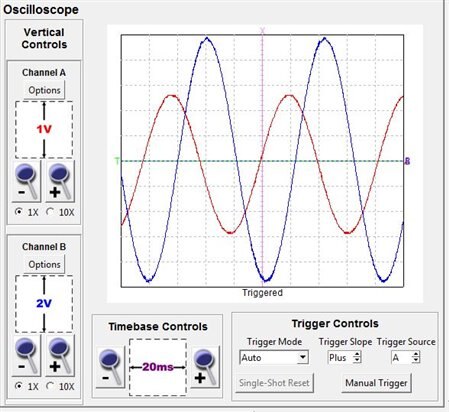
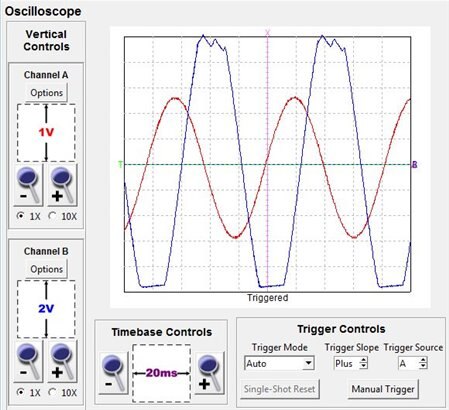
    Yes, that is why my 15W amplifier should work, but it doesn't.  It will not go over 10V.  I am running the amplified signal over a 1000ohm load, and the maximum voltage I can get is 10Vpp.  Here is the graph of my signals (original in red, amplified in blue) at 12Hz, and then the same signal when I crank the volume up on the amplifier.  Look at how it finds a ceiling and floor at +/- 10V.  My input is about a Vpp = 5.4V, and the output of the 15W amplifier can reach 10Vpp without distrotion, but, if I try to get more out of it, I get the image on the right, where the voltage never exceeds 10Vpp.  if you continue, you just get sort of a square wave that does not exceed that 10Vpp limit.  If it wasn't for this, my 15W, US$20 would be more than enough.  At 10kOhm, 1W would be enough to drive 100Vpp.


    imageimage

    • Cancel
    • Vote Up 0 Vote Down
    • Sign in to reply
    • Verify Answer
    • Reject Answer
    • Cancel
  • RWM
    0 RWM over 14 years ago in reply to JRR

    J Rey,


    according to manual

    http://www.pyleaudio.com/sku/PCA1

    Pyle PCA1 "2x15W" has 2x3W of output power at 1% THD image Anyway, amplitude of output voltage of 15W amplifier is SQRT(2*P*R)=SQRT(2*15*4)=11V, in case of 3W amplifier it is SQRT(2*3*4)=5V so your 10Vp-p of amplitude is right. 1W would be enough to drive 100Vpp but only if this amplifier would be designed for nominal 10 kohm load. If it is designed for 8 ohm and you will use it with 10 kohm, you need ampifier with supply voltage like amplifier 1300W/8 ohm but you need not high output current.


    Amplifier like this

    http://www.audiomodule.com/amp37.html

    with suppy voltages about +60Vand -60V should be sufficient. With 10 kohm load it will have about 1W of output power, so big heatsink is not needed.

    • Cancel
    • Vote Up +1 Vote Down
    • Sign in to reply
    • Verify Answer
    • Cancel
  • michaelkellett
    0 michaelkellett over 14 years ago in reply to RWM

    @J Rey,

    Is it essential that one side of the load should be grounded ?

    If not you can use a bridge amplifier, ie two amplifiers driven in anti-phase so that when the output of one is +50V the other is -50V giving +100V across the load, on the opposite cycle the first amplifier output is -50V and the second is +50V giving you -100V across the load. Now you need amplifiers which can manage +/-50V peak whch is equivalent to 160W RMS into an 8R load. (preceding figures for 100V pk or 200V p-p)

    I notice in the original discussion you wanted 100V p-p which is 50V peak and the amplifier I suggested would do that. Your estimate of 1300W amplifier is based on peak power for 100V pk or 200Vp-p. Audio amplifiers are usually rated  for "RMS power" with a 1kHz sine wave which excactly 50% of the peak (sine wave) power.

    In conclusion, you can do what you orignally asked with a 160W (into 8R) amplifier, you get double the voltage if use a bridge configuration (but you will have  a floating load and will need the antiphase drive). Audio amplifiers won't work well below 20Hz. If you need to work at 1Hz you will need to be prepared to modify an audio amplifer or to design something of your own.

    • Cancel
    • Vote Up +1 Vote Down
    • Sign in to reply
    • Verify Answer
    • Cancel
  • michaelkellett
    0 michaelkellett over 14 years ago in reply to michaelkellett

    @J. Rey,


    Just remembered these:

    http://www.cirrus.com/en/products/high-voltage_operational_amplifiers.html


    Not cheap - I looked up one at random and the chip is $200 one off from Digikey, so you might be better off with an audio amp.

    • Cancel
    • Vote Up +1 Vote Down
    • Sign in to reply
    • Verify Answer
    • Cancel
  • RWM
    0 RWM over 14 years ago in reply to michaelkellett

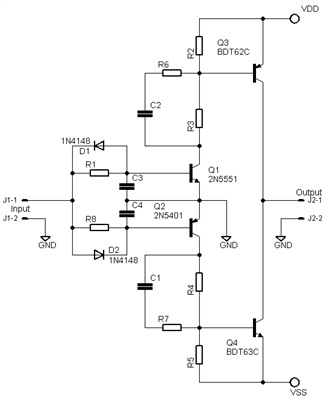
    I think square wave driver up to 120Vp-p can be made as follows:

    image


    It should be cheap but soldering skills are needed.

    • Cancel
    • Vote Up 0 Vote Down
    • Sign in to reply
    • Verify Answer
    • Cancel
  • michaelkellett
    0 michaelkellett over 14 years ago in reply to RWM

    Hello RVM,

    Your circuit will probably work but you could help JR out by giving some component values. It's a bit risky running a 120V (Q3,Q4) rated part with a 120V supply - I would suggest +/- 50V max. Then to adjust the output amplitude the power supply will need to be adjusted. Output short cicruit protection might be a good plan (1K resistor ?)


    The power supply will need to be regulated to control the pulse amplitude.

    48V switching DC-DC converters are easily obtained so 2 could be connected in series.


    Michael Kellett

    • Cancel
    • Vote Up +1 Vote Down
    • Sign in to reply
    • Verify Answer
    • Cancel
Reply
  • michaelkellett
    0 michaelkellett over 14 years ago in reply to RWM

    Hello RVM,

    Your circuit will probably work but you could help JR out by giving some component values. It's a bit risky running a 120V (Q3,Q4) rated part with a 120V supply - I would suggest +/- 50V max. Then to adjust the output amplitude the power supply will need to be adjusted. Output short cicruit protection might be a good plan (1K resistor ?)


    The power supply will need to be regulated to control the pulse amplitude.

    48V switching DC-DC converters are easily obtained so 2 could be connected in series.


    Michael Kellett

    • Cancel
    • Vote Up +1 Vote Down
    • Sign in to reply
    • Verify Answer
    • Cancel
Children
  • JRR
    0 JRR over 14 years ago in reply to michaelkellett

    Michael, RWM,


    I like the audio module solution (LME49830) by Michael for more serious testing because it meets all (and goes beyond) specs, and the HV square pulse generation by RWM for a production prototype (which if the experiments work, is far down the line for me).  Although more expensive, the Cirrus chip looks like it would be an excellent testing solution (because of what it can do), and the ultrasound generator board shares a lot of specs with what I want (and generates the pulse).


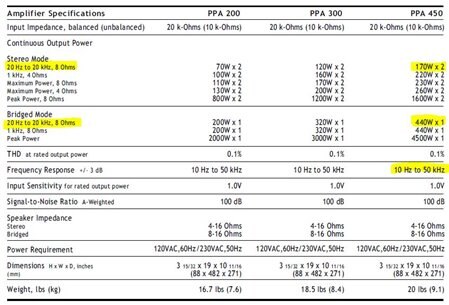
    The out of the box amplifier is however a faster (cheaper if you count manhours), so I ordered another audio amplifier.  I think I can live with higher than 20Hz waveforms and do my experiments with an audio amplifier with enough power.  I am thinking about buying the Pyle PPA450 which claims  to be 170W single channel at 8ohm, which should give me ~74Vpp, and if in bridge mode 440W which should be ~118Vpp.  It claims a frequency response between 10Hz and 50kHz, but then in the detailed power specs claims 20Hz to 20kHz.  The specs are below:

    image

    image


    Thanks very much for all your help.  If things go the right way I will follow up here,


    J.

    • Cancel
    • Vote Up 0 Vote Down
    • Sign in to reply
    • Verify Answer
    • Cancel
  • RWM
    0 RWM over 14 years ago in reply to michaelkellett

    Hi J Rey,


    good luck with your experiments!


    Hi Michael,


    BDT63C/62C are good for 100Vp-p, for higher voltage for example 2SD1857A/2SB1236A can be used (160V and faster). I think BDT can withstand 120V because usually VCER>VCE0 but it is safe to have safety margin. Short circuit protection is a good idea. At the moment J Rey needs ready-made solution, so if later my proposal will be needed, I will calculate component values.


    It is interesting what is the capacity of electrodes because charging and discharging needs some current (which increases with frequency).

    • Cancel
    • Vote Up +1 Vote Down
    • Sign in to reply
    • Verify Answer
    • Cancel
  • michaelkellett
    0 michaelkellett over 14 years ago in reply to JRR

    Hello J Rey,


    The amp you suggest should do, actually 170W into 8R implies 51V pk or 102V p-p.

    Put a 1K (at least 5W rating) resistor in series with the amplifier to protect it, you and your experiment. If you use the bridge set up put 1K in series with each amplifier output.


    Michael Kellett

    • Cancel
    • Vote Up +1 Vote Down
    • Sign in to reply
    • Verify Answer
    • Cancel
  • JRR
    0 JRR over 14 years ago in reply to michaelkellett

    Michael,


    Thanks also for the safety suggestion.  I will definately follow it.


    J.

    • Cancel
    • Vote Up 0 Vote Down
    • Sign in to reply
    • Verify Answer
    • Cancel
element14 Community

element14 is the first online community specifically for engineers. Connect with your peers and get expert answers to your questions.

  • Members
  • Learn
  • Technologies
  • Challenges & Projects
  • Products
  • Store
  • About Us
  • Feedback & Support
  • FAQs
  • Terms of Use
  • Privacy Policy
  • Legal and Copyright Notices
  • Sitemap
  • Cookies

An Avnet Company © 2025 Premier Farnell Limited. All Rights Reserved.

Premier Farnell Ltd, registered in England and Wales (no 00876412), registered office: Farnell House, Forge Lane, Leeds LS12 2NE.

ICP 备案号 10220084.

Follow element14

  • X
  • Facebook
  • linkedin
  • YouTube