element14 Community
element14 Community
    Register Log In
  • Site
  • Search
  • Log In Register
  • Community Hub
    Community Hub
    • What's New on element14
    • Feedback and Support
    • Benefits of Membership
    • Personal Blogs
    • Members Area
    • Achievement Levels
  • Learn
    Learn
    • Ask an Expert
    • eBooks
    • element14 presents
    • Learning Center
    • Tech Spotlight
    • STEM Academy
    • Webinars, Training and Events
    • Learning Groups
  • Technologies
    Technologies
    • 3D Printing
    • FPGA
    • Industrial Automation
    • Internet of Things
    • Power & Energy
    • Sensors
    • Technology Groups
  • Challenges & Projects
    Challenges & Projects
    • Design Challenges
    • element14 presents Projects
    • Project14
    • Arduino Projects
    • Raspberry Pi Projects
    • Project Groups
  • Products
    Products
    • Arduino
    • Avnet & Tria Boards Community
    • Dev Tools
    • Manufacturers
    • Multicomp Pro
    • Product Groups
    • Raspberry Pi
    • RoadTests & Reviews
  • About Us
  • Store
    Store
    • Visit Your Store
    • Choose another store...
      • Europe
      •  Austria (German)
      •  Belgium (Dutch, French)
      •  Bulgaria (Bulgarian)
      •  Czech Republic (Czech)
      •  Denmark (Danish)
      •  Estonia (Estonian)
      •  Finland (Finnish)
      •  France (French)
      •  Germany (German)
      •  Hungary (Hungarian)
      •  Ireland
      •  Israel
      •  Italy (Italian)
      •  Latvia (Latvian)
      •  
      •  Lithuania (Lithuanian)
      •  Netherlands (Dutch)
      •  Norway (Norwegian)
      •  Poland (Polish)
      •  Portugal (Portuguese)
      •  Romania (Romanian)
      •  Russia (Russian)
      •  Slovakia (Slovak)
      •  Slovenia (Slovenian)
      •  Spain (Spanish)
      •  Sweden (Swedish)
      •  Switzerland(German, French)
      •  Turkey (Turkish)
      •  United Kingdom
      • Asia Pacific
      •  Australia
      •  China
      •  Hong Kong
      •  India
      • Japan
      •  Korea (Korean)
      •  Malaysia
      •  New Zealand
      •  Philippines
      •  Singapore
      •  Taiwan
      •  Thailand (Thai)
      • Vietnam
      • Americas
      •  Brazil (Portuguese)
      •  Canada
      •  Mexico (Spanish)
      •  United States
      Can't find the country/region you're looking for? Visit our export site or find a local distributor.
  • Translate
  • Profile
  • Settings
Wireless
  • Technologies
  • More
Wireless
Blog Broadband Sensor Networks
  • Blog
  • Forum
  • Documents
  • Polls
  • Quiz
  • Events
  • Mentions
  • Sub-Groups
  • Tags
  • More
  • Cancel
  • New
Join Wireless to participate - click to join for free!
  • Share
  • More
  • Cancel
Group Actions
  • Group RSS
  • More
  • Cancel
Engagement
  • Author Author: gervasi
  • Date Created: 26 Apr 2013 12:12 AM Date Created
  • Views 730 views
  • Likes 0 likes
  • Comments 2 comments
  • uwb
  • sensor_networks
Related
Recommended

Broadband Sensor Networks

gervasi
gervasi
26 Apr 2013

The past two weeks this blog has focused on how data and power add up in mobile data networks.  This is true for large sensor networks as well.


Sensor networks used in oil and gas exploration require geophone sensors to be distributed in densities of 1000-2000 nodes/sqkm over areas of at least 40 sqkm.  Connecting these 40,000 to 80,000 sensors by wires is difficult.  Some systems require as many as 300,000 nodes.  Future systems are expected to use one million nodes.  Oil companies are hoping wireless technology will be able to connect the sensors.  image
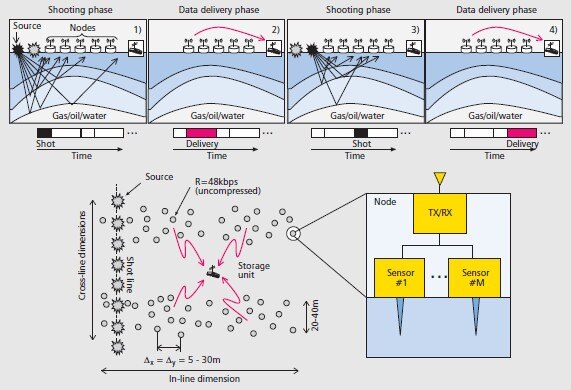
 

The geophones are typically sampled at 2 samples per millisecond, with each sample containing 24 bits.  A system with 100,000 nodes would generate a total of 4.8Gb/s.  Even with compression this will require well over 500MHz of spectrum, making it ultra-wide band (UWB).  There are no inexpensive UWB transceivers available because Wi-Fi data rates have increased and provide for the consumer market with sufficient throughput. 


Another issue in a system with so many nodes is channel access.  Wi-Fi, for example, uses a distributed coordination function (DFC) to prevent collisions.  In this scheme, nodes do a clear channel assessment (CCA) by listening prior to transmitting.  If the packet is not ACKed, it retries it a configurable number of times using a random backoff algorithm.  The system works well, even in the presence of non-Wi-Fi interferers.  It starts to fall apart, however, if there are too many nodes in one area.  A system to collect data from thousands of sensors will need to have some centrally coordinated scheme to prevent collisions. 


I asked Dr. Savazzi, one of the authors of a paper on this topic in the most recent issue of IEEE Communications Magazine, why they cannot simply buffer the data and why they can’t use direct communication with no multihop.  Then they could use low-throughput systems.  They could in theory, but some systems require listening to the echos from multiple excitation events that happen quickly one after another.  The reason for using multihop is the network is spread over many miles, which is only practical in the VHF band.  Communicating over those distances in the GHz would require antennas on tall towers and higher output power (to overcome free-space path loss, which increases as the square of frequency).


My guess is the oil and gas exploration industry will find ways to use 80MHz single-stream Wi-Fi defined in 802.11(ac) for this application because the chipsets will inexpensive enough to deploy in a large-scale sensor network. 


For the first time I believe in the danger of RF spectrum scarcity.  There is plenty of unused spectrum, but the amount of data people find reasons to transmit wirelessly is increasing rapidly.   


Further Reading

Ultra-Wid Band Sensor Networks in Oil and Gas Explorations, IEEE Communications Magazine, April 2013

For those without access to IEEE journals, a similar article by the same authors from 2009 can be found here: Synchronous Ultra-Wide Band Wireless Sensors Networks for oil and gas exploration

  • Sign in to reply
Parents
  • shabaz
    shabaz over 12 years ago

    Hi,

    Interesting article. (Slight typo, I think you meant 2 samples per millisec (not sec) to get the 4.8Gbps). It's a huge amount of data. Maybe they need to process it from groups of nodes and just transmit the results, and then download detail as required. But I guess maybe they need complicated computing to perform the calculations, or need data from all nodes to do the calculations.

    • Cancel
    • Vote Up 0 Vote Down
    • Sign in to reply
    • More
    • Cancel
  • gervasi
    gervasi over 12 years ago in reply to shabaz

    Thanks for catching the error. 


    I asked the Dr. Savazzi, author of the IEEE Communications Magazine article, why they couldn't just buffer the data.  He said that would be fine for intermittent acquisitions.  In other applications they want to get all the data before the next shooting (excitation).  I still don't understand why they couldn't buffer multiple data from shootings.  Memory is cheap.

    • Cancel
    • Vote Up 0 Vote Down
    • Sign in to reply
    • More
    • Cancel
Comment
  • gervasi
    gervasi over 12 years ago in reply to shabaz

    Thanks for catching the error. 


    I asked the Dr. Savazzi, author of the IEEE Communications Magazine article, why they couldn't just buffer the data.  He said that would be fine for intermittent acquisitions.  In other applications they want to get all the data before the next shooting (excitation).  I still don't understand why they couldn't buffer multiple data from shootings.  Memory is cheap.

    • Cancel
    • Vote Up 0 Vote Down
    • Sign in to reply
    • More
    • Cancel
Children
No Data
element14 Community

element14 is the first online community specifically for engineers. Connect with your peers and get expert answers to your questions.

  • Members
  • Learn
  • Technologies
  • Challenges & Projects
  • Products
  • Store
  • About Us
  • Feedback & Support
  • FAQs
  • Terms of Use
  • Privacy Policy
  • Legal and Copyright Notices
  • Sitemap
  • Cookies

An Avnet Company © 2025 Premier Farnell Limited. All Rights Reserved.

Premier Farnell Ltd, registered in England and Wales (no 00876412), registered office: Farnell House, Forge Lane, Leeds LS12 2NE.

ICP 备案号 10220084.

Follow element14

  • X
  • Facebook
  • linkedin
  • YouTube