


shamelessly taking some extra time to complete the project as per the discussion in Challengers, Post your Projects!
Recap
Can random Vape Cells with unknonw histories be bundled into a smart battery system to ultimately power an EV, power wall or other device?
- Vape Cell EV - part I - What’s in a Vape
- Vape Cell EV - part II - RS485 comms
- Vape Cell EV - part III - INA219 power monitor
- Vape Cell EV - part IV - INA219 on battery charging
18650 vs Vape Cell
I setup a charging and discharging circuit controlled by the UNO Q, tracking using the INA219 power monitor and added a few relays to control cycling between charging (up to 4.2V and currnet draw down to 150mA) and discharging (down to 3.0V). The setup was far from pretty:

I hooked up a cheap AliExpress 18650 — label reads 2600 mAh 3.7 V 9.62 Wh

and got the following results:
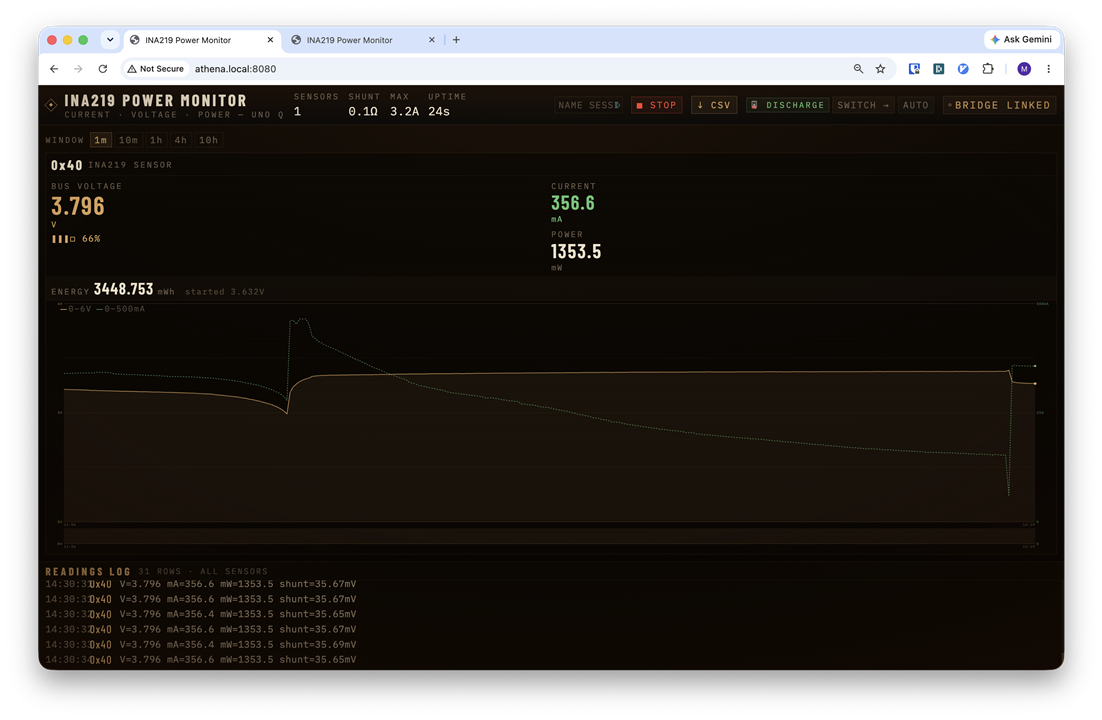
Running a full charge then discharge at ~350 mA (10 Ω resistor):
| Metric | AliExpress “18650” | Genuine 18650 (ref) |
|---|---|---|
| Claimed capacity | 2,600 mAh (9.62 Wh) | 2,000–3,600 mAh |
| Measured capacity | 617 mAh | 2,000–3,600 mAh |
| Claimed vs measured | 24% of label | ~100% |
| Discharge time to 3.0 V | 107 min | ~430 min |
| Avg discharge current | ~347 mA | — |
| Voltage sag (full cycle) | 0.85 V over 617 mAh | ~0.3 V |
| IR drop at switch-on | 284 mV → ~0.81 Ω | < 100 mΩ |
| Flat discharge plateau | none — linear drop | 3.5–3.7 V |
| CC charge current | 460 mA | — |
| Charge time (CC + CV to 200 mA) | ~154 min | — |
| Charge accepted | ~604 mAh | — |
No flat discharge plateau, ~8× the internal resistance of a real cell, and only 24% of the claimed capacity — consistent with a re-wrapped 18350 cell (or a badly degraded pouch cell) inside an 18650 shell. The label’s 9.62 Wh figure is exactly 2,600 mAh × 3.7 V, confirming the capacity claim; neither figure is anywhere near what the cell actually delivers.
I hooked up a Vape Cell — label reads 18450 S50 3.7 V 5.18 Wh (~1,400 mAh claimed)
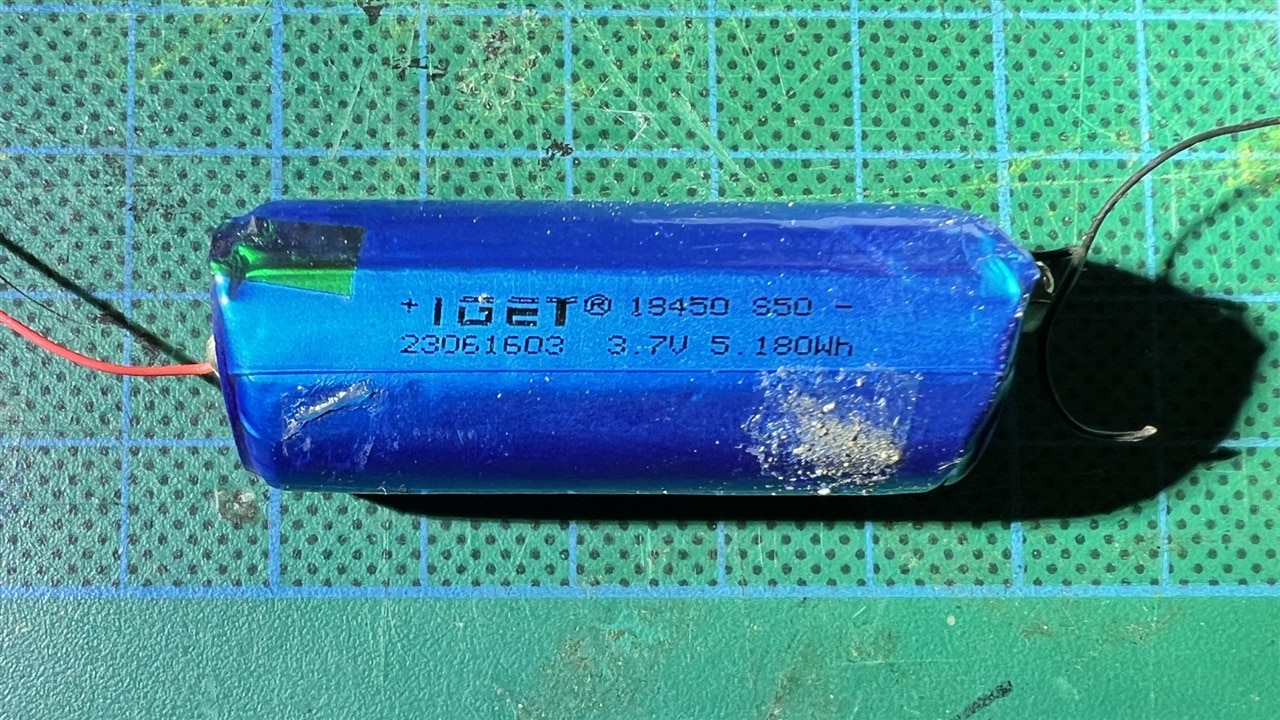
and got the following results:
| Metric | Vape Cell (18450 S50) | AliExpress “18650” |
|---|---|---|
| Claimed capacity | ~1,400 mAh (5.18 Wh) | 2,600 mAh (9.62 Wh) |
| Measured capacity | ~480 mAh (projected¹) | 617 mAh |
| Claimed vs measured | ~35% of label | 24% of label |
| Discharge time to 3.0 V | ~92 min (est.) | 107 min |
| Avg discharge current | ~320 mA | ~347 mA |
| Starting voltage under load | 3.35 V | 3.85 V |
| Voltage sag (full range) | 0.35 V over ~480 mAh | 0.85 V over 617 mAh |
| IR drop at switch-on | 725 mV → ~2.2 Ω² | 284 mV → ~0.81 Ω |
| Flat discharge plateau | none — linear drop | none |
| CC charge current | ~460 mA | ~460 mA |
| Charge time (CV to 200 mA) | ~71 min (CV only) | ~154 min (CC + CV) |
| CV taper rate | k ≈ 0.011 /min | k ≈ 0.012 /min |
¹ Projected from 7 min of stable discharge data at −3.5 mV/min; actual result expected ~14:00–16:00 UTC. ² Instantaneous IR at load switch-on; CV slope method gives ~0.21 Ω — the large discrepancy reflects polarisation overpotential built up during the 71-min CV charge phase.
The 18450 is a real cell format (18 mm × 45 mm vs 65 mm for 18650) — a genuine 18450 typically delivers 650–1,100 mAh. At 1,400 mAh claimed, the label is optimistic. At ~480 mAh measured it sits at 35% of that claim — a pattern eerily similar to the 18650’s 24%.


Conclusion
Both cells tell the same story: wildly inflated labels, real-world capacity a fraction of what’s printed.
The 18650 came in at 24% of its 2,600 mAh claim. The vape cell looks set to land at ~35% of its 1,400 mAh claim. Neither cell has a flat discharge plateau — a hallmark of healthy lithium chemistry. Both start discharging well below where a genuine cell would: the fake 18650 at 3.85 V under load, the vape cell at only 3.35 V (despite being fully charged to 4.13 V moments earlier).
One genuinely interesting finding: both cells have near-identical CV taper kinetics (k ≈ 0.012 /min). Different form factors, different histories, same electrochemical decay rate — the underlying chemistry is consistent even if the capacity isn’t.
For an EV or power wall application, neither cell is usable as-is. The fake 18650 delivers about 2.2 Wh; the vape cell about 1.6 Wh. A genuine 18650 would deliver 7–13 Wh. You’d need 4–8 of these salvaged cells to match one good one — and that’s before accounting for the matching problem, the safety risk of unknown-history cells, and the cycle life you’d be starting with.
The house didn’t burn down 

 , winning!!
Next
I now have a bunch of vape cells that I need to prevent their terminals shorting, no doubt I will have to continue in some fashion to make this experiment come to a safe ending. Although I didn’t achieve all I wanted, I certainly made a solid dint in my knowledge of battery charging and some positive looking results.
