


Sensor Fusion and Continuous Learning in Tiltie
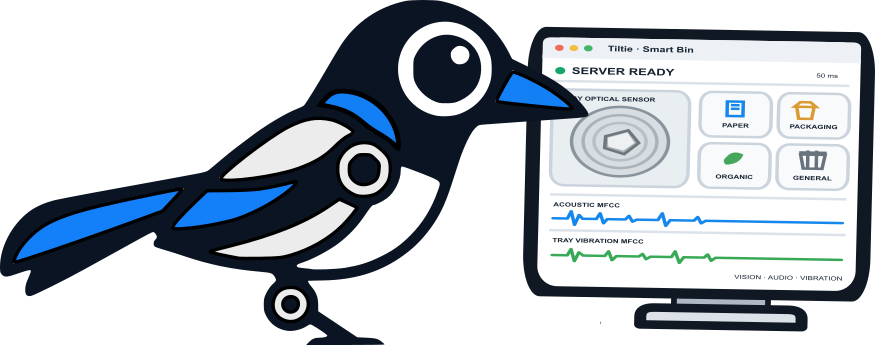
In previous updates I've mainly focused on the mechanical side of Tiltie: how to detect waste and move it to the correct compartment.
But Tiltie is not just a machine that moves a tray. Besides seeing, hearing and sensing vibrations, Tiltie is designed to learn from experience.
To make that possible, the project is divided into three main parts:
- A mechanical controller responsible for moving the tray and recording impacts and vibrations.
- A main system that detects waste, analyzes images, sounds and vibrations, and makes decisions.
- A classification service that helps when Tiltie is unsure and enables knowledge sharing between multiple units.
Alongside the classification service, I have also built a web-based simulator. This allows me to experiment with classification, sensor fusion, learning and collaboration between different devices before integrating everything into the physical prototype.
In this update, I'll show how the service works, how new knowledge is collected, and how Tiltie is gradually evolving from a smart bin into a learning platform.
The following two-minute video provides a quick overview of the system in action, including classification, sample management and continuous learning.
Why build a separate classification service?
My initial idea was to perform all classification directly inside Tiltie. However, the more tests I run, the more I realize that waste classification is more challenging than it first appears.
Some objects require more examples, more training, and a convenient way to correct mistakes. That's why I decided to separate the intelligence from the hardware and develop a standalone classification service.
This allows me to centralize samples, corrections and new data so the system can continuously improve over time.
From a smart bin to a learning network
Each Tiltie can send its classification results to the service together with information about the unit that generated them.
This allows multiple Tilties to share knowledge and contribute to a common dataset. A lesson learned by one Tiltie can benefit all the others.
And that's one of the ideas I find most exciting about this project: the more Tilties participate, the smarter the platform becomes.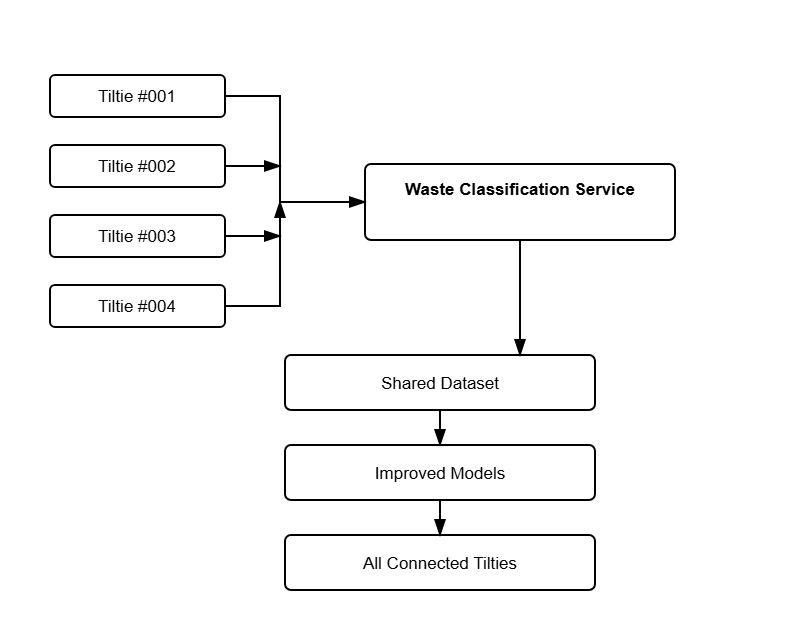
The Classification Workbench
To develop the classification service, I built a web application that serves as my testing platform.
From this interface I can analyze samples, experiment with different classification approaches, and prepare data for future training. This allows me to continue developing Tiltie's intelligence without constantly relying on the physical hardware.
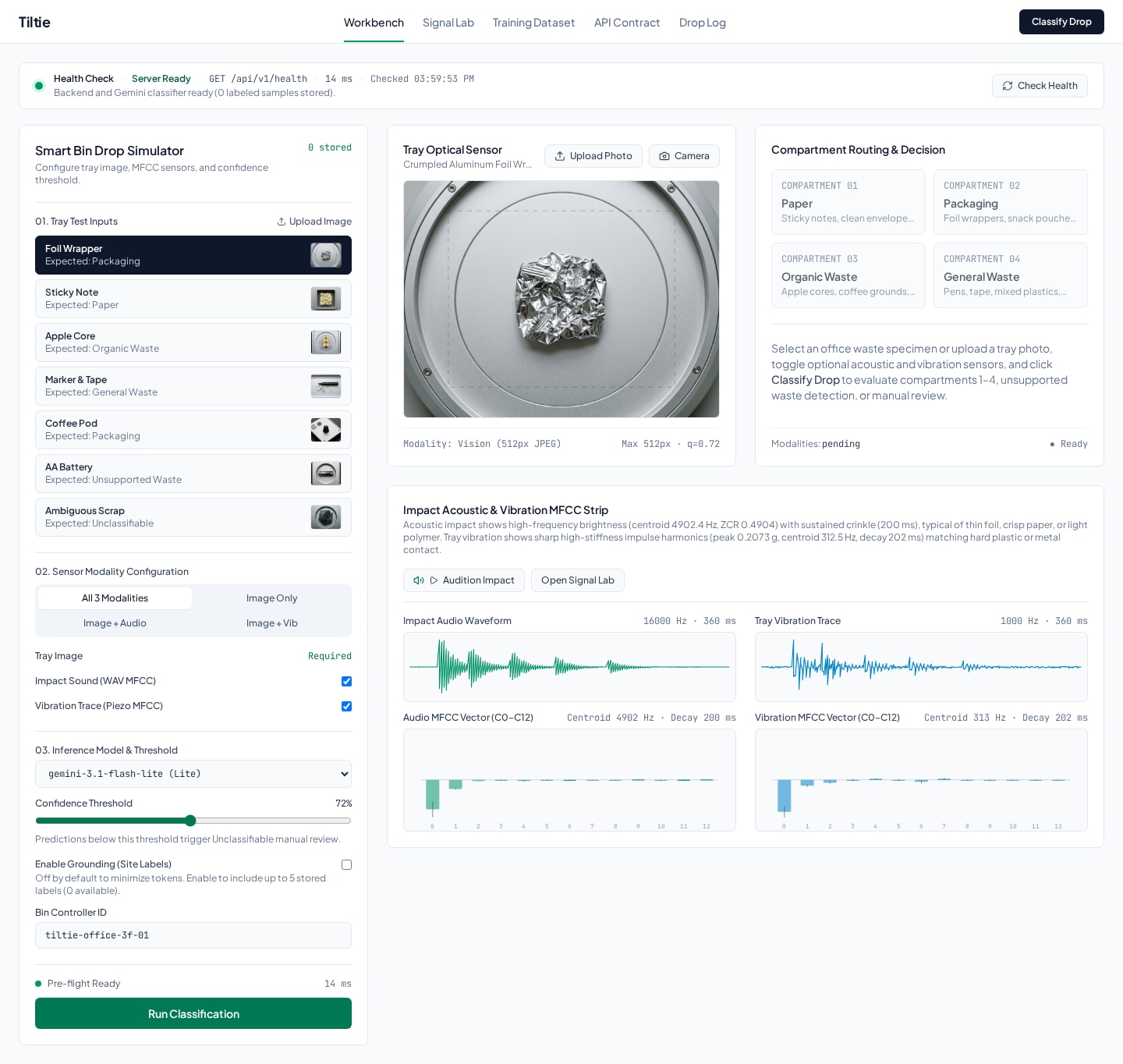
Running a Classification
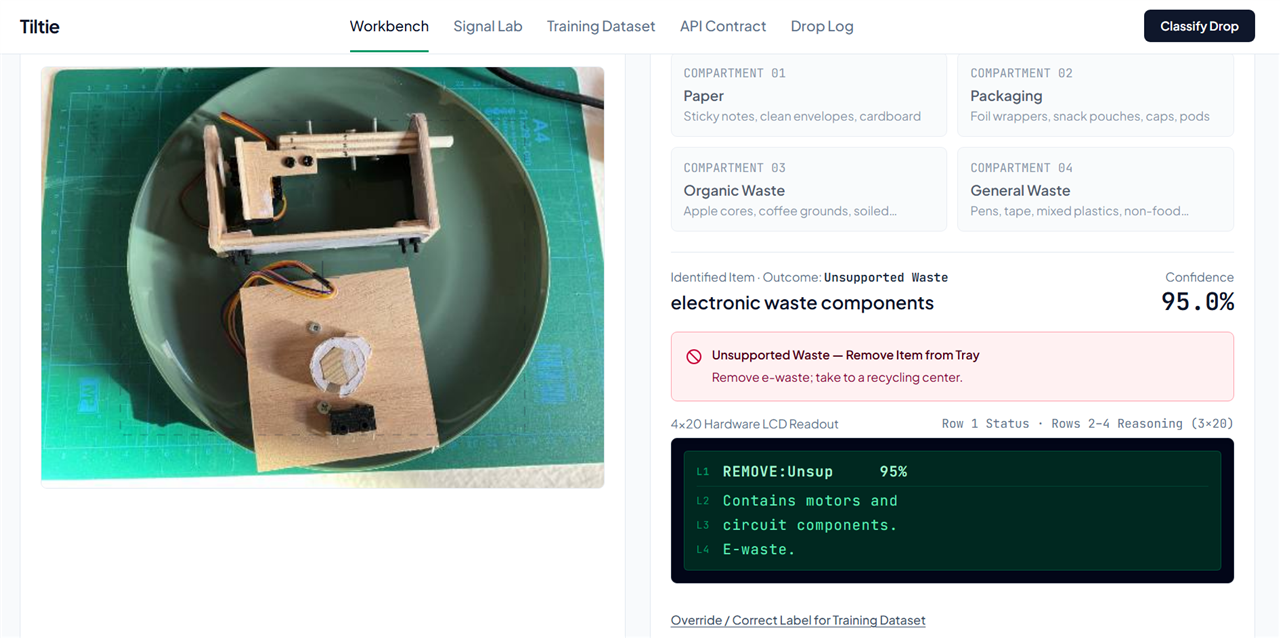
Once a sample has been selected, the service analyzes the available information and determines the most likely waste category.
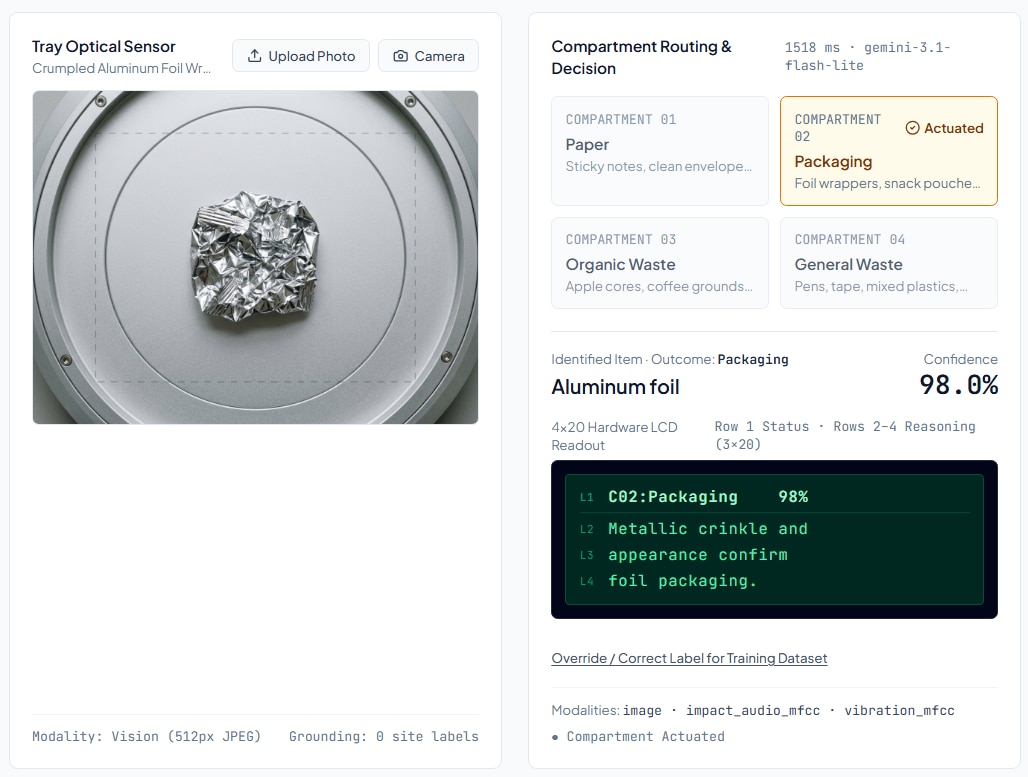
In addition to the classification itself, it generates a confidence score, a routing decision, and the information that would be presented to the user.
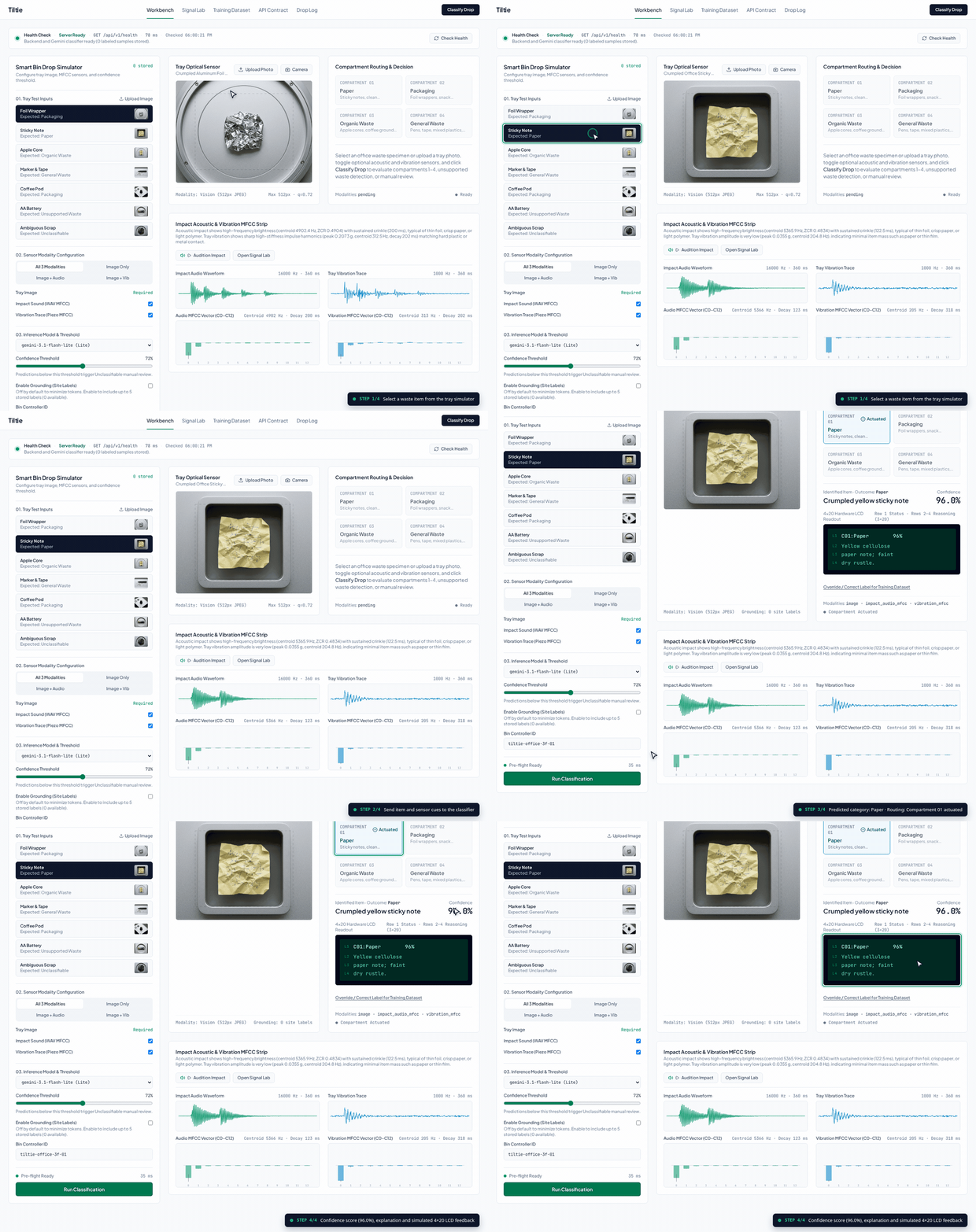
For now, this process takes place entirely inside the simulator, but the goal is for the physical hardware to follow exactly the same workflow.
Combining Multiple Sensors
From the beginning, the goal has not been to rely exclusively on computer vision. My aim is to combine multiple sources of information to build a more complete description of each item of waste.
The camera provides visual information, but I can also capture the sounds and vibrations generated when an object lands on the tray. In some cases, these signals may contain clues that are not obvious from an image alone.
For that reason, the service includes tools for exploring and analyzing acoustic and vibration signals, including waveforms, spectral analysis, and features extracted using MFCCs (Mel-Frequency Cepstral Coefficients).
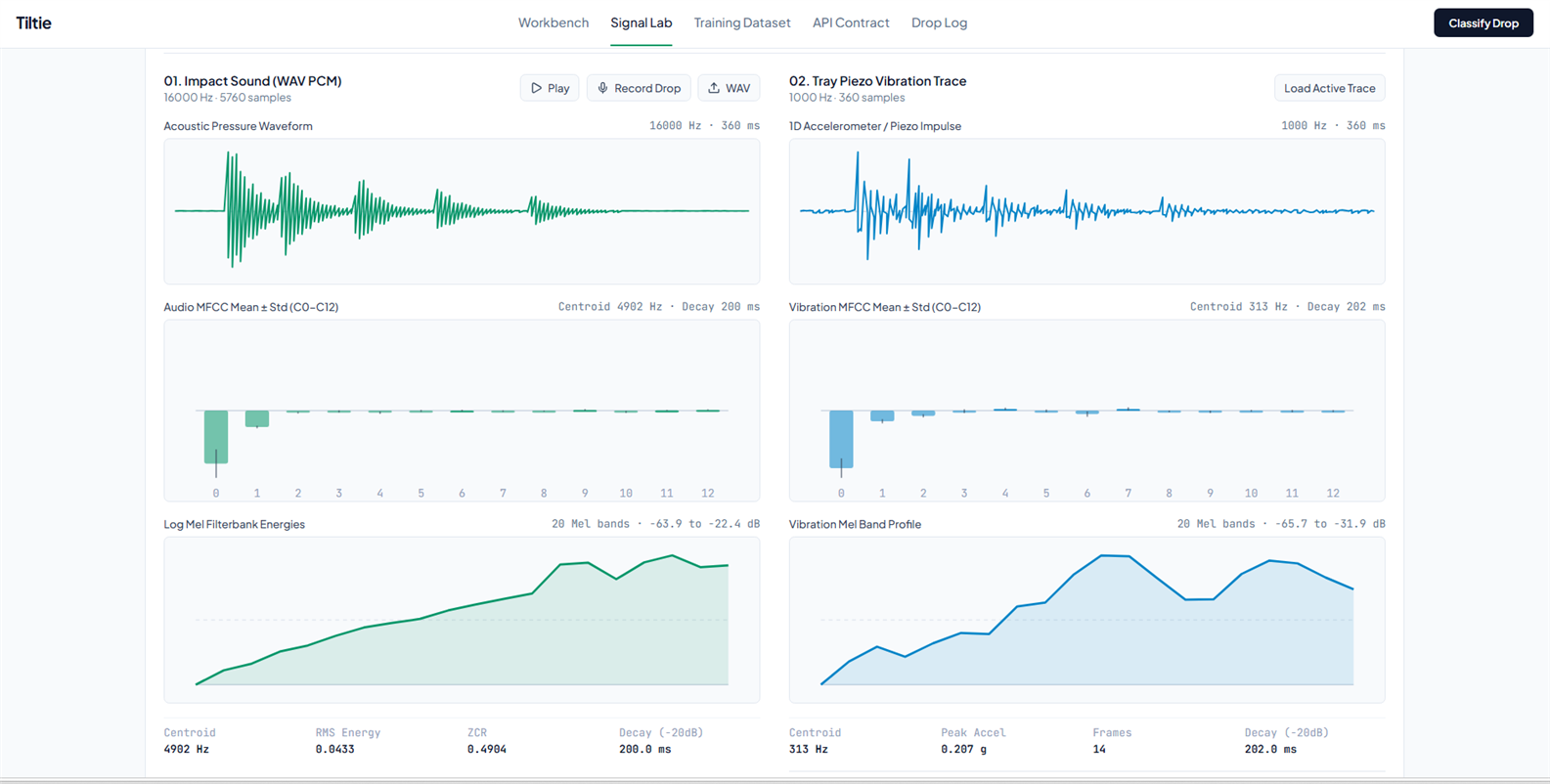
I'm still investigating how much these additional signals can improve classification accuracy, but the idea is for Tiltie to make decisions based on all available sensors, not just what the camera sees.
Learning from Mistakes
No classifier gets everything right. Sooner or later, the system will encounter an object it has never seen before or a case where it is simply unsure.
When that happens, I would rather have Tiltie ask for help than make the wrong decision. From the Workbench, I can correct the classification and save the result as a new labelled sample.
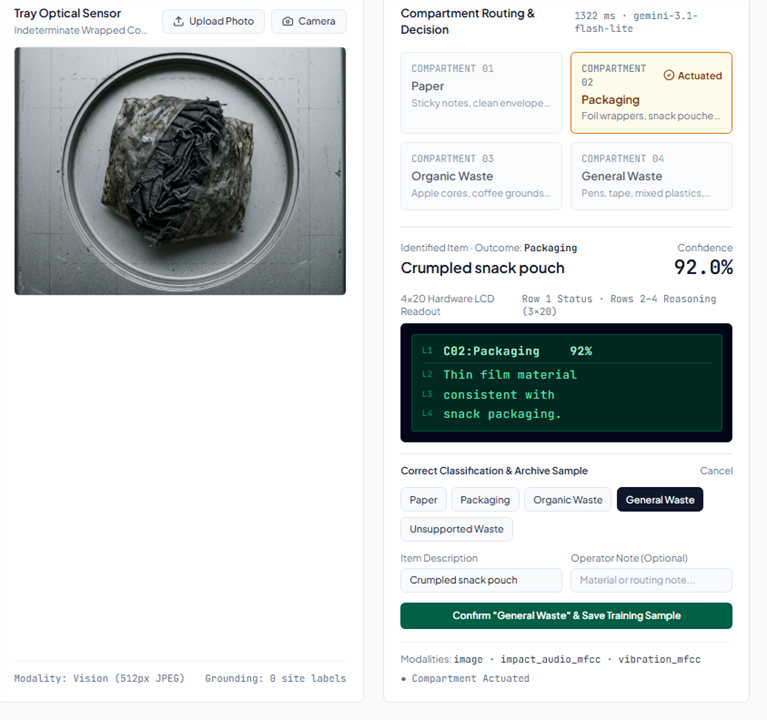
Each correction becomes part of the training dataset, together with the image and any additional signals captured during the classification process.
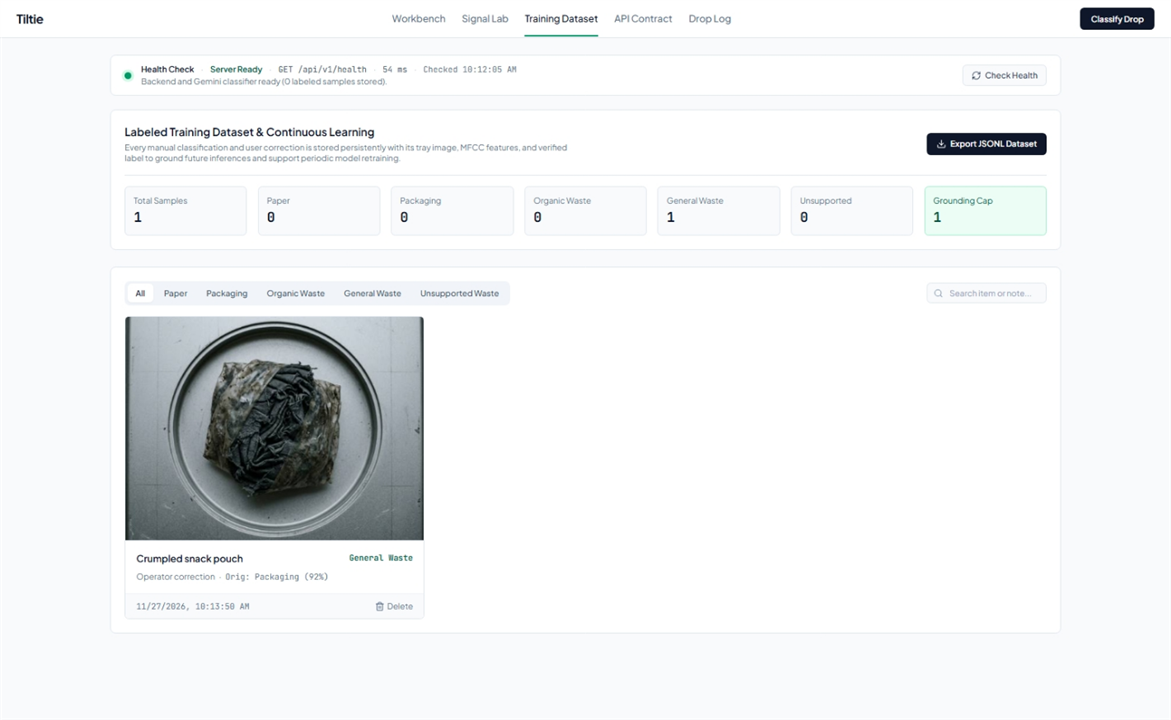
This is one of my favorite aspects of the project. The service does more than classify waste; it also accumulates knowledge. Over time, those corrections can be used to train better models and make future classifications more reliable.
And if several Tilties eventually share the same platform, a correction made by one unit could benefit all the others.
API-First Design
From the beginning, I've tried to treat the classifier as an independent service rather than a feature embedded inside the web application.
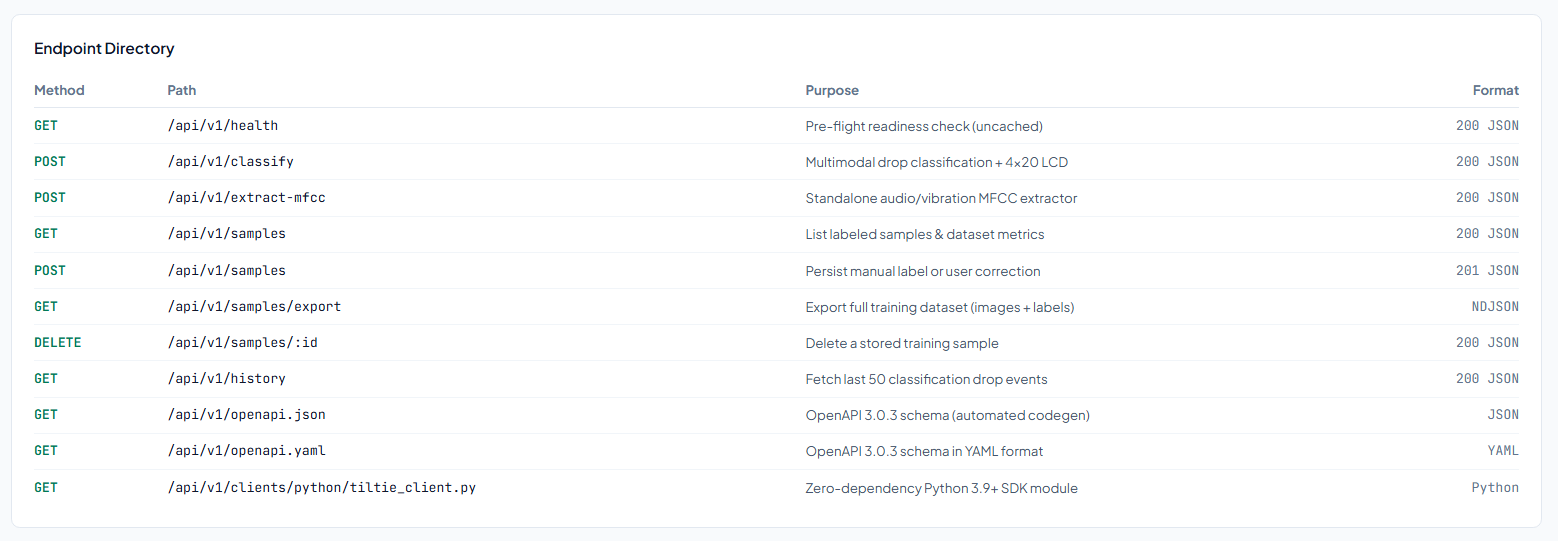
That's why the project includes an OpenAPI-documented REST API and a small Python SDK. Both the simulator and future Tiltie units use the same contract to communicate with the service.
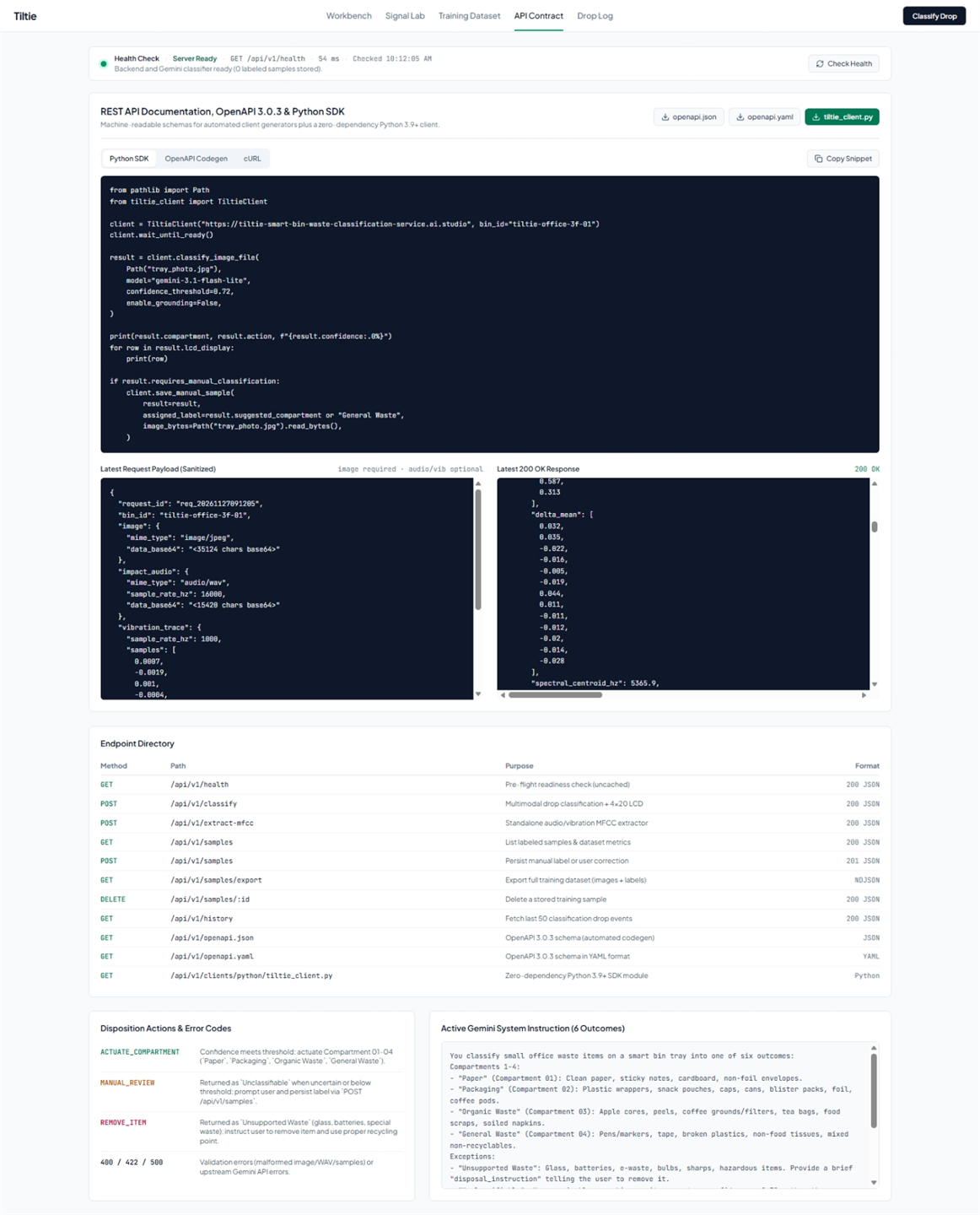
This allows me to develop and test each component independently while keeping the classification logic separate from the hardware that will eventually use it.
Challenges and Open Questions
Although the service is already functional, there are still several open questions I'm exploring.
Some waste items are surprisingly ambiguous. A crumpled wrapper, for example, may look like paper in an image while its acoustic or vibration signature suggests a completely different material. This raises an interesting question: how should the system combine information coming from different sensors when they disagree?
Another challenge is deciding when the classifier should ask for human intervention. Requesting manual verification can improve accuracy, but doing so too frequently would reduce the user experience.
And finally, there is the question I am most interested in answering: how much does sensor fusion actually improve classification performance? The platform is now capable of combining images, audio and vibration data, but I still need many more samples before I can draw any meaningful conclusions.
Current Project Status
While I continue developing the software side of the project, Tiltie's mechanical construction is also moving forward in parallel.
The videos included in this update show two of the system's key movements. The first demonstrates the tray's yaw movement driven by the stepper motor. It also shows how the mechanism finds its home position using the CamdenBoss CSM40500A microswitch supplied by element14 as part of the "My Project is Trash" challenge kit.
The second video shows the tray's tilt movement driven by a servo motor. Although there is still integration work ahead and a few problems left to solve, the initial results are encouraging.
The good news is that the mechanism designed to actuate the microswitch has enough force and is operating reliably. The tilt mechanism is also able to guide waste into the selected compartment and then return the tray to its starting position without issues.
There is still plenty of work to do before everything comes together. The mechanics, electronics, classification service and sensor fusion components are all evolving simultaneously.
A few weeks ago Tiltie was little more than a tilting tray and a collection of ideas. Today it can classify waste, learn from corrections, and experiment with combining information from multiple sensors.
There is still a long way to go, but Tiltie is starting to look very much like the system I imagined at the beginning of the challenge.
Want to Follow the Complete Journey?
This is the fith article in the Tiltie series. You can find all previous and future project updates in the Tiltie tag page:
See you in the next update!