element14 Community
element14 Community
    Register Log In
  • Site
  • Search
  • Log In Register
  • Community Hub
    Community Hub
    • What's New on element14
    • Feedback and Support
    • Benefits of Membership
    • Personal Blogs
    • Members Area
    • Achievement Levels
  • Learn
    Learn
    • Ask an Expert
    • eBooks
    • element14 presents
    • Learning Center
    • Tech Spotlight
    • STEM Academy
    • Webinars, Training and Events
    • Learning Groups
  • Technologies
    Technologies
    • 3D Printing
    • FPGA
    • Industrial Automation
    • Internet of Things
    • Power & Energy
    • Sensors
    • Technology Groups
  • Challenges & Projects
    Challenges & Projects
    • Design Challenges
    • element14 presents Projects
    • Project14
    • Arduino Projects
    • Raspberry Pi Projects
    • Project Groups
  • Products
    Products
    • Arduino
    • Avnet & Tria Boards Community
    • Dev Tools
    • Manufacturers
    • Multicomp Pro
    • Product Groups
    • Raspberry Pi
    • RoadTests & Reviews
  • About Us
    About the element14 Community
  • Store
    Store
    • Visit Your Store
    • Choose another store...
      • Europe
      •  Austria (German)
      •  Belgium (Dutch, French)
      •  Bulgaria (Bulgarian)
      •  Czech Republic (Czech)
      •  Denmark (Danish)
      •  Estonia (Estonian)
      •  Finland (Finnish)
      •  France (French)
      •  Germany (German)
      •  Hungary (Hungarian)
      •  Ireland
      •  Israel
      •  Italy (Italian)
      •  Latvia (Latvian)
      •  
      •  Lithuania (Lithuanian)
      •  Netherlands (Dutch)
      •  Norway (Norwegian)
      •  Poland (Polish)
      •  Portugal (Portuguese)
      •  Romania (Romanian)
      •  Russia (Russian)
      •  Slovakia (Slovak)
      •  Slovenia (Slovenian)
      •  Spain (Spanish)
      •  Sweden (Swedish)
      •  Switzerland(German, French)
      •  Turkey (Turkish)
      •  United Kingdom
      • Asia Pacific
      •  Australia
      •  China
      •  Hong Kong
      •  India
      •  Japan
      •  Korea (Korean)
      •  Malaysia
      •  New Zealand
      •  Philippines
      •  Singapore
      •  Taiwan
      •  Thailand (Thai)
      •  Vietnam
      • Americas
      •  Brazil (Portuguese)
      •  Canada
      •  Mexico (Spanish)
      •  United States
      Can't find the country/region you're looking for? Visit our export site or find a local distributor.
  • Translate
  • Profile
  • Settings
Twist, Turn and Move Design Challenge with TE Robotics
  • Challenges & Projects
  • Design Challenges
  • Twist, Turn and Move Design Challenge with TE Robotics
  • More
  • Cancel
Twist, Turn and Move Design Challenge with TE Robotics
Blog ARDUMOBO blog 2: Testing
  • Blog
  • Forum
  • Documents
  • Polls
  • Files
  • Leaderboard
  • Mentions
  • Sub-Groups
  • Tags
  • More
  • Cancel
  • New
  • Share
  • More
  • Cancel
Group Actions
  • Group RSS
  • More
  • Cancel
Engagement
  • Author Author: a33333
  • Date Created: 14 Aug 2022 12:54 PM Date Created
  • Views 819 views
  • Likes 6 likes
  • Comments 2 comments
Related
Recommended

ARDUMOBO blog 2: Testing

a33333
a33333
14 Aug 2022

Preliminary work

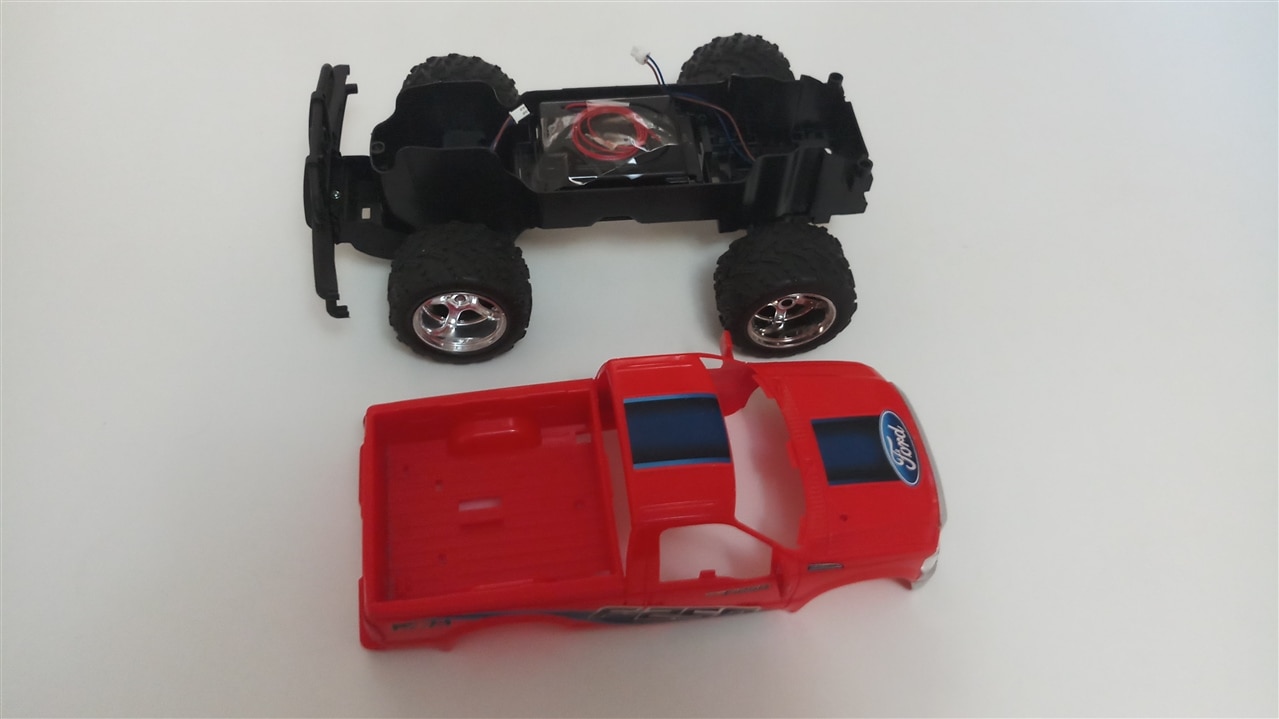
I removed the cabin of the truck and took out the windshield so I have more room for mounting the control hardware and power supplies on the truck.
image

I then tested the remote controlled car. It is in working condition. Car is powered by 5 AA batteries in series (7.5V). I made a couple of measurements: the two engines (direction and traction) are controlled by applying a 7.5V voltage directly to the engine. To reverse traction (forward/reverse) and steering (left/right), the polarity of the control voltage is changed. 

I plan to use two independent power supply for the Arduino and the two engines:

  • one 5V power bank to power up the Arduino Uno.
  • one 6V power supply. (4 AA batteries in a plastic case with an on/off switch) to power up the two electric motors.   

I disconnected the cables from the two motors and connected them to the 6V power supply. I measured the current through the engines: 460mA for the direction engine, 350mA for the steering engine. When powered from 6V the steering engine does not turn the wheel to the maximum steering angle but I think that the smaller steering angle might be enough for my robot. If a larger steering angle is needed, I will have to use a higher voltage power supply.

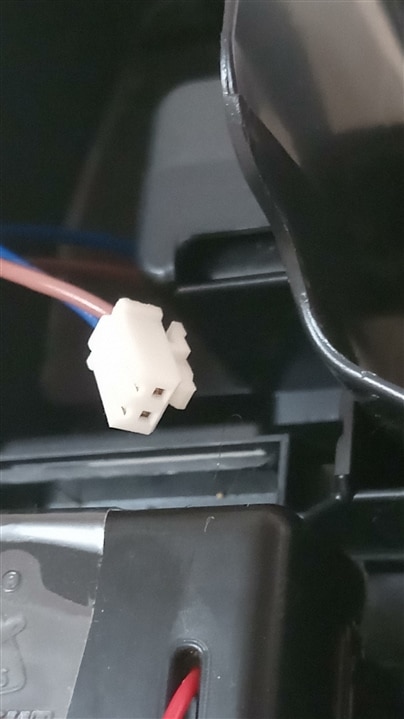
I would like to keep the existing female connectors on the engine wires so that I can restore the truck to its original condition, just in case future younger generations in my family would favor manual control over autonomous robot control for this toy truck. Luckily I found a matching set of male contacts in my parts box (no idea of type/brand) and built two pairs of cables to connect the engines to the Arduino driver shield.
  image

After the testing is completed, I will start using the connectors from the kit.  

Testing

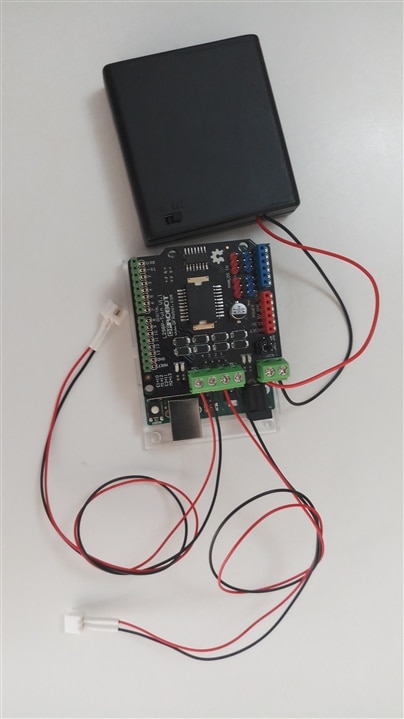
I plugged the DFROBOT DRI0017 shield into the Arduino Uno, connected the engines wires and the power supply to the shield.
image

I wrote an Arduino sketch that loops through this testing sequence:

  • turn traction engine in forward mode for 3 seconds
  • stop for 3 seconds
  • turn traction engine in reverse mode for 3 seconds
  • stop for 3 seconds
  • turn steering engine right for 3 seconds
  • stop for 3 seconds
  • turn steering engine left for 3 seconds
  • stop for 3 seconds

The following clip shows the testing sequence.

You don't have permission to edit metadata of this video.
Edit media
x
image
Upload Preview
image


  • Sign in to reply
  • a33333
    a33333 over 3 years ago in reply to robogary

    Thanks for the link. Nice project!

    • Cancel
    • Vote Up 0 Vote Down
    • Sign in to reply
    • More
    • Cancel
  • robogary
    robogary over 3 years ago

    Depending on the The 5V power bank ratings,  may have enough guts to power the motors as well. Yes it wont be fast but saves the weight of 4 AA batteries. The steering motor in the smaller cars just use a DC motor and drive it until it stalls into the return spring. A smaller voltage gives smaller stall current. A these small amps, a boost power supply can be used too.   You can also reference a similar past project if it can be helpful.  /challenges-projects/project14/radiocontrol/b/blog/posts/rc-toy-hack---rc-car-rescue-restore-recycle-retrofit

    • Cancel
    • Vote Up 0 Vote Down
    • Sign in to reply
    • More
    • Cancel
element14 Community

element14 is the first online community specifically for engineers. Connect with your peers and get expert answers to your questions.

  • Members
  • Learn
  • Technologies
  • Challenges & Projects
  • Products
  • Store
  • About Us
  • Feedback & Support
  • FAQs
  • Terms of Use
  • Privacy Policy
  • Legal and Copyright Notices
  • Sitemap
  • Cookies

An Avnet Company © 2026 Premier Farnell Limited. All Rights Reserved.

Premier Farnell Ltd, registered in England and Wales (no 00876412), registered office: Farnell House, Forge Lane, Leeds LS12 2NE.

ICP 备案号 10220084.

Follow element14

  • X
  • Facebook
  • linkedin
  • YouTube