
element14 Community
element14 Community
    Register Log In
  • Site
  • Search
  • Log In Register
  • Community Hub
    Community Hub
    • What's New on element14
    • Feedback and Support
    • Benefits of Membership
    • Personal Blogs
    • Members Area
    • Achievement Levels
  • Learn
    Learn
    • Ask an Expert
    • eBooks
    • element14 presents
    • Learning Center
    • Tech Spotlight
    • STEM Academy
    • Webinars, Training and Events
    • Learning Groups
  • Technologies
    Technologies
    • 3D Printing
    • FPGA
    • Industrial Automation
    • Internet of Things
    • Power & Energy
    • Sensors
    • Technology Groups
  • Challenges & Projects
    Challenges & Projects
    • Design Challenges
    • element14 presents Projects
    • Project14
    • Arduino Projects
    • Raspberry Pi Projects
    • Project Groups
  • Products
    Products
    • Arduino
    • Avnet & Tria Boards Community
    • Dev Tools
    • Manufacturers
    • Multicomp Pro
    • Product Groups
    • Raspberry Pi
    • RoadTests & Reviews
  • About Us
    About the element14 Community
  • Store
    Store
    • Visit Your Store
    • Choose another store...
      • Europe
      •  Austria (German)
      •  Belgium (Dutch, French)
      •  Bulgaria (Bulgarian)
      •  Czech Republic (Czech)
      •  Denmark (Danish)
      •  Estonia (Estonian)
      •  Finland (Finnish)
      •  France (French)
      •  Germany (German)
      •  Hungary (Hungarian)
      •  Ireland
      •  Israel
      •  Italy (Italian)
      •  Latvia (Latvian)
      •  
      •  Lithuania (Lithuanian)
      •  Netherlands (Dutch)
      •  Norway (Norwegian)
      •  Poland (Polish)
      •  Portugal (Portuguese)
      •  Romania (Romanian)
      •  Russia (Russian)
      •  Slovakia (Slovak)
      •  Slovenia (Slovenian)
      •  Spain (Spanish)
      •  Sweden (Swedish)
      •  Switzerland(German, French)
      •  Turkey (Turkish)
      •  United Kingdom
      • Asia Pacific
      •  Australia
      •  China
      •  Hong Kong
      •  India
      •  Japan
      •  Korea (Korean)
      •  Malaysia
      •  New Zealand
      •  Philippines
      •  Singapore
      •  Taiwan
      •  Thailand (Thai)
      •  Vietnam
      • Americas
      •  Brazil (Portuguese)
      •  Canada
      •  Mexico (Spanish)
      •  United States
      Can't find the country/region you're looking for? Visit our export site or find a local distributor.
  • Translate
  • Profile
  • Settings
Vision Thing
  • Challenges & Projects
  • Project14
  • Vision Thing
  • More
  • Cancel
Vision Thing
Documents Project14 | Vision Thing: Beaglebone AI Your Vision Thing Project!
  • Blog
  • Forum
  • Documents
  • Events
  • Polls
  • Files
  • Members
  • Mentions
  • Sub-Groups
  • Tags
  • More
  • Cancel
  • New
Join Vision Thing to participate - click to join for free!
Actions
  • Share
  • More
  • Cancel
Engagement
  • Author Author: tariq.ahmad
  • Date Created: 9 Sep 2019 7:08 PM Date Created
  • Last Updated Last Updated: 5 Nov 2019 10:25 PM
  • Views 6402 views
  • Likes 12 likes
  • Comments 57 comments
Related
Recommended

Project14 | Vision Thing: Beaglebone AI Your Vision Thing Project!

image

Vision Thing

Enter Your Project for a chance to win an Oscilloscope Grand Prize Package for the Most Creative Vision Thing Project!

Back to The Project14 homepage image

Project14 Home
Monthly Themes
Monthly Theme Poll


In the Comments Below: Tell Us How You Would Use the BeagleBone AI for Your Vision Thing Project!


We'll Send Out Boards for Project Proposals that Use Them! 



image


You don't have permission to edit metadata of this video.
Edit media
x
image
Upload Preview
image


We are offering up to 20 FREE Beaglebone AI Boards in exchange for Vision Thing projects that use them!


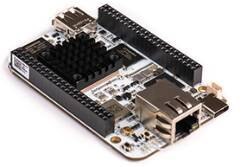
Beaglebone AI Cooling Cape Addon Available from mayermakes:  BB AI cooling Addon board available
image
Buy NowBuy Now
We are offering up to 20 FREE Beaglebone AI Boards in exchange for Vision Thing projects that use them!


What is a Vision Thing project and how do you use the BeagleBone AI to do one?


There's a lot of variety with how you choose to implement your project.  It's a great opportunity to do something creative that stretches the imagination of what hardware can do.  Your project can be either a vision based project involving anything that is related to Computer Vision and Machine Learning , Camera Vision and AI based projects, Deep Learning, using hardware.  Or, it can be a graphics project involving something graphical such as adding a graphical display to a microcontroller, image processing on a microcontroller, image recognition interface a camera to a microcontroller,  or FPGA - camera interfacing/image processing/graphical display.


What makes the Beaglebone AI suitable for Vision Thing  Projects?


BeagleBone AI is a high-end board for developers building artificial-intelligence and computer-vision applications. Its main AI features include a Texas Instruments (TI) AM5729 system on chip (SoC), TI C66x digital-signal-processor (DSP) cores and embedded-vision-engine (EVE) cores. The board has the same form-factor as the popular and cheap BeagleBone Black but with much higher specifications.


  • It features a completely open source design: https://github.com/beagleboard/beaglebone-ai


The AI-ready board comes with 1GB RAM and 16GB on-board eMMC flash with a high-speed interface, a USB Type-C port for power and a dual-role controller, and a USB Type-A host. There's also Gigabit Ethernet and Wi-Fi. With preinstalled software, the BeagleBone AI also saves buyers from having to download equipment to get the device up and running.

image
The Most Creative Vision Thing Wins a Keysight DSOXO11G Oscilloscope!

Learn more by visiting:

  • BeagleBoneRegistered AI - Technical Specifications
  • BeagleBoneRegistered AI - Frequently Asked Questions (FAQ)
  • BeagleBoneRegistered Black, Blue, Wireless, Industrial, Green, AI Comparison Chart
  • BeagleBoneRegistered AI - Getting Started

So: what do you have to do to be in the running for one of the brand new Beagleboard AI? Just follow the instructions below!


1. Register and/or log-in to the element14 Community

2. Leave a comment on this post or on Project14 | Vision Thing: Build Things Using Graphics, AI, Computer Vision, & Beyond!  telling us what you'd like to build for your Vision Thing project with the new Beagleboard AI!

3.  Once you receive a new board submit your finished Vision Thing  project for a chance to win a Keysight DSOXO11G Oscilloscope!


The Most Promising Vision Thing Project Proposals Win a Free Beaglebone AI to Use In Your Vision Thing Project!


Submit Your Completed Project in Vision Thing  for a Chance to Win a Keysight DSOXO11G Oscilloscope!

  • image processing
  • competition
  • digital-signal processor
  • visionthingch
  • dsoxo11g oscillocope
  • keysight
  • soc
  • usb type-c
  • system on a chip
  • beaglebone ai
  • graphical display
  • emcc flash
  • image recognition
  • beaglebone ai vision thing
  • microcontroller
  • embedded-vision-engine
  • camera interfacing
  • Share
  • History
  • More
  • Cancel
  • Sign in to reply

Top Comments

  • dubbie
    dubbie over 6 years ago +5
    Having more-or-less decided on something for the Vision Thing based on Arduino and possibly Processing as well, I have just seen this opportunity to use the BeagleBone AI. Being mostly used to using Arduino…
  • Fred27
    Fred27 over 6 years ago +5
    A friend is heavily involved in canoe racing. Apparently the timing is a haphazard affair with people pressing stopwatches, writing down the number on the canoe, entering it into Excel, etc. It's fraught…
  • kk99
    kk99 over 6 years ago +3
    Few years ago I saw attempt to use neural networks for image classification for computer aided diagnosis (CAD) e.g. initial check for the presence of *** cancer on images.
Parents
  • anil1234
    anil1234 over 6 years ago

    Portable ECG machine with CNN based automatic diagnostics


    Problem: India, being a vast country, still faces issues in delivering affordable healthcare to all its villages and remote locations. Skilled medical professionals are unwilling to setup medical facilities in these areas which don't have proper infrastructure & connectivity. Timely diagnosis of heart conditions would help the patient seek necessary medical attention from a professional.


    Proposed solution: Portable, easy to use, ECG machine which gives diagnosis based on pre-trained Convolutional Neural Network. Using it, ECG data can be gathered by medical assistants to give timely warning to the patient and data can be further analyzed by a medical expert.


    Abstract: The Beaglebone-AI possesses the necessary processing power and real-time signal processing abilities to perform both signal analysis and run the CNN. It would make an ideal choice to make a low-cost and portable ECG machine. The display capabilities of the BB-AI is used to interface with a touchscreen based UI. The control abilities of the Cortex-M4s can be used to collect & store ECG data from an multi-channel ADC. The PRUs can efficiently handle buttons and rotary knobs.


    How the different components of BB-AI will be used:


    -> Dual Cortex-M4: The BB-AI will be paired with a SPI based daughter board. The daughter board will contain Instrumentation amplifiers as well as 12-channel 24-bit ADC. Upto 12 ECG leads can be attached which will be sampled at a rate of 5KSa/s. The 10secs of ECG data will be gathered and stored in memory by the Cortex-M4s using the SPI interface.


    -> Dual C66x DSP The signals will be subject to preliminary processing to eliminate noise and enhance important features of the signal such as QRS-complex. The C66x will perform signal segmentation to divide ECG data into beats. The beats will be subjected to Discrete Wavelet Transform (DWT) which will present the data in a Time-vs-Frequency paradigm, which is easier to process by the CNN. It will also collect waveform statistics like amplitude levels and feature intervals.


    -> Dual Cortex-A15: They will perform dual roles. They will run the pre-trained CNN for classifying the ECG of the patient. The CNN is trained using data available from free global databases like PhysioNet. Their second role is to run a lightweight touchscreen based UI. The UI will make it easy to view the waveforms from the 12 probes. The UI will expose simple tasks such as maintaining patients record, saving in PDF format, uploading data to cloud etc.


    -> Dual PRUs: They will manage real-time control tasks like buttons, rotary knobs and LEDs.


    The whole system is battery powered and can upload the ECG data to cloud through WiFi. I estimate the entire system to weigh less than 2Kgs. I also think adding a camera to the system would be beneficial to capture patient image or take pictures of any anomalous body signs. A monochrome USB mini thermal printer can also be added to print ECG reports.


    We have already successfully implemented an algorithm to extract features from an ECG signal and classify it. Currently it runs on MATLAB. However, BB-AI looks like the perfect solution to make it embedded. The Raspberry-Pi lacks features to interface with external multichannel ADCs to capture data in real-time. Its nice to see BB-AI possesses the Cortex-M4s to do that.


    Hope my idea gets selected!

    • Cancel
    • Vote Up +1 Vote Down
    • Sign in to reply
    • More
    • Cancel
Comment
  • anil1234
    anil1234 over 6 years ago

    Portable ECG machine with CNN based automatic diagnostics


    Problem: India, being a vast country, still faces issues in delivering affordable healthcare to all its villages and remote locations. Skilled medical professionals are unwilling to setup medical facilities in these areas which don't have proper infrastructure & connectivity. Timely diagnosis of heart conditions would help the patient seek necessary medical attention from a professional.


    Proposed solution: Portable, easy to use, ECG machine which gives diagnosis based on pre-trained Convolutional Neural Network. Using it, ECG data can be gathered by medical assistants to give timely warning to the patient and data can be further analyzed by a medical expert.


    Abstract: The Beaglebone-AI possesses the necessary processing power and real-time signal processing abilities to perform both signal analysis and run the CNN. It would make an ideal choice to make a low-cost and portable ECG machine. The display capabilities of the BB-AI is used to interface with a touchscreen based UI. The control abilities of the Cortex-M4s can be used to collect & store ECG data from an multi-channel ADC. The PRUs can efficiently handle buttons and rotary knobs.


    How the different components of BB-AI will be used:


    -> Dual Cortex-M4: The BB-AI will be paired with a SPI based daughter board. The daughter board will contain Instrumentation amplifiers as well as 12-channel 24-bit ADC. Upto 12 ECG leads can be attached which will be sampled at a rate of 5KSa/s. The 10secs of ECG data will be gathered and stored in memory by the Cortex-M4s using the SPI interface.


    -> Dual C66x DSP The signals will be subject to preliminary processing to eliminate noise and enhance important features of the signal such as QRS-complex. The C66x will perform signal segmentation to divide ECG data into beats. The beats will be subjected to Discrete Wavelet Transform (DWT) which will present the data in a Time-vs-Frequency paradigm, which is easier to process by the CNN. It will also collect waveform statistics like amplitude levels and feature intervals.


    -> Dual Cortex-A15: They will perform dual roles. They will run the pre-trained CNN for classifying the ECG of the patient. The CNN is trained using data available from free global databases like PhysioNet. Their second role is to run a lightweight touchscreen based UI. The UI will make it easy to view the waveforms from the 12 probes. The UI will expose simple tasks such as maintaining patients record, saving in PDF format, uploading data to cloud etc.


    -> Dual PRUs: They will manage real-time control tasks like buttons, rotary knobs and LEDs.


    The whole system is battery powered and can upload the ECG data to cloud through WiFi. I estimate the entire system to weigh less than 2Kgs. I also think adding a camera to the system would be beneficial to capture patient image or take pictures of any anomalous body signs. A monochrome USB mini thermal printer can also be added to print ECG reports.


    We have already successfully implemented an algorithm to extract features from an ECG signal and classify it. Currently it runs on MATLAB. However, BB-AI looks like the perfect solution to make it embedded. The Raspberry-Pi lacks features to interface with external multichannel ADCs to capture data in real-time. Its nice to see BB-AI possesses the Cortex-M4s to do that.


    Hope my idea gets selected!

    • Cancel
    • Vote Up +1 Vote Down
    • Sign in to reply
    • More
    • Cancel
Children
No Data
element14 Community

element14 is the first online community specifically for engineers. Connect with your peers and get expert answers to your questions.

  • Members
  • Learn
  • Technologies
  • Challenges & Projects
  • Products
  • Store
  • About Us
  • Feedback & Support
  • FAQs
  • Terms of Use
  • Privacy Policy
  • Legal and Copyright Notices
  • Sitemap
  • Cookies

An Avnet Company © 2026 Premier Farnell Limited. All Rights Reserved.

Premier Farnell Ltd, registered in England and Wales (no 00876412), registered office: Farnell House, Forge Lane, Leeds LS12 2NE.

ICP 备案号 10220084.

Follow element14

  • X
  • Facebook
  • linkedin
  • YouTube