element14 Community
element14 Community
    Register Log In
  • Site
  • Search
  • Log In Register
  • Community Hub
    Community Hub
    • What's New on element14
    • Feedback and Support
    • Benefits of Membership
    • Personal Blogs
    • Members Area
    • Achievement Levels
  • Learn
    Learn
    • Ask an Expert
    • eBooks
    • element14 presents
    • Learning Center
    • Tech Spotlight
    • STEM Academy
    • Webinars, Training and Events
    • Learning Groups
  • Technologies
    Technologies
    • 3D Printing
    • FPGA
    • Industrial Automation
    • Internet of Things
    • Power & Energy
    • Sensors
    • Technology Groups
  • Challenges & Projects
    Challenges & Projects
    • Design Challenges
    • element14 presents Projects
    • Project14
    • Arduino Projects
    • Raspberry Pi Projects
    • Project Groups
  • Products
    Products
    • Arduino
    • Avnet & Tria Boards Community
    • Dev Tools
    • Manufacturers
    • Multicomp Pro
    • Product Groups
    • Raspberry Pi
    • RoadTests & Reviews
  • About Us
  • Store
    Store
    • Visit Your Store
    • Choose another store...
      • Europe
      •  Austria (German)
      •  Belgium (Dutch, French)
      •  Bulgaria (Bulgarian)
      •  Czech Republic (Czech)
      •  Denmark (Danish)
      •  Estonia (Estonian)
      •  Finland (Finnish)
      •  France (French)
      •  Germany (German)
      •  Hungary (Hungarian)
      •  Ireland
      •  Israel
      •  Italy (Italian)
      •  Latvia (Latvian)
      •  
      •  Lithuania (Lithuanian)
      •  Netherlands (Dutch)
      •  Norway (Norwegian)
      •  Poland (Polish)
      •  Portugal (Portuguese)
      •  Romania (Romanian)
      •  Russia (Russian)
      •  Slovakia (Slovak)
      •  Slovenia (Slovenian)
      •  Spain (Spanish)
      •  Sweden (Swedish)
      •  Switzerland(German, French)
      •  Turkey (Turkish)
      •  United Kingdom
      • Asia Pacific
      •  Australia
      •  China
      •  Hong Kong
      •  India
      • Japan
      •  Korea (Korean)
      •  Malaysia
      •  New Zealand
      •  Philippines
      •  Singapore
      •  Taiwan
      •  Thailand (Thai)
      • Vietnam
      • Americas
      •  Brazil (Portuguese)
      •  Canada
      •  Mexico (Spanish)
      •  United States
      Can't find the country/region you're looking for? Visit our export site or find a local distributor.
  • Translate
  • Profile
  • Settings
microbit
  • Learn
  • Learning Center
  • STEM Academy
  • microbit
  • More
  • Cancel
microbit
Documents Join The micro:bit Summer Code Club Challenge!
  • Blog
  • Forum
  • Documents
  • Events
  • Polls
  • Files
  • Members
  • Mentions
  • Sub-Groups
  • Tags
  • More
  • Cancel
  • New
Join microbit to participate - click to join for free!
Actions
  • Share
  • More
  • Cancel
Engagement
  • Author Author: jlucas
  • Date Created: 11 Apr 2019 1:49 PM Date Created
  • Last Updated Last Updated: 17 Sep 2019 1:34 PM
  • Views 7756 views
  • Likes 13 likes
  • Comments 61 comments
Related
Recommended

Join The micro:bit Summer Code Club Challenge!

image
imagemicro:bit Summer Code Club Challenge

About Summer Code Club | micro:bit | STEM Academy


WINNERS HAVE NOW BEEN SELECTED! SEE THEM HERE:


micro:bit Summer Code Club Challenge - Winners Announced!


Back in Autumn 2018, the element14 community ran the Great micro:bit Education Giveaway - a program dedicated to helping educators around the world to introduce coding to the classroom using the micro:bit.


From code clubs in New Zealand to creative design projects in Romania and gaming workshops in the USA, our giveaway inspired successful applicants to pursue a wide range of exciting projects with their students.


With summer around the corner, we're excited to announce the next phase of our micro:bit education mission - the Summer Code Club Challenge!


In association with Kitronik, we're challenging our members to set up their own summer code clubs in their local communities. Whether you're a teacher, a parent or somebody with a passion for STEM, simply tell us about your summer code club plans and we'll supply successful applicants with the kits they'll need to run a full course of exciting and engaging projects for children and young adults.


How it works


If you think you've got what it takes to set up a summer code club in your local community, leave a comment underneath this blog post. Let us know where, when and how you plan to run your code club, how many students you anticipate attending and why you think you'd be a good candidate.


Applications close at 23.59 on Friday 7th June 2019, after which successful parties will receive a batch of micro:bit devices and Kitronik Inventor Kits, providing all the components you'll need to develop a full curriculum of simple experiments - including LEDs, jump wires, resistors and an easy-to-follow tutorial book. The number of devices and kits you will receive will be appropriate to the anticipated attendance of your code club. We will consider applications for clubs of all sizes. Established code clubs and first time instructors are all welcome to apply for this program.


Requirements


Selected applicants will be required to publish a minimum of three blogs posts to the element14 community, documenting the progress of their code club and their project work. Please include images and video where appropriate, but be sure to obtain the express permission of parents of any minors who are filmed or photographed.  See the terms and conditions attached at the bottom of this document.


The Summer Gaming Challenge


At the conclusion of your summer code club, we would like participants to work with their students to develop a simple interactive game using the micro:bit and the resources provided by the element14 community and Kitronik. Please publish details of this game as part of your blog posting. At the end of the summer, our panel of judges will select one gaming project for special recognition and a prize package of 10x Raspberry Pi 3 Model B+ Starter Kits, to help your students to take their coding to the next level.


Two additional projects will also be awarded a runners-up prize consisting of micro:bit project and development kits from Binary Bots, Kitronik and more.


Important Dates


Enrollment BeginsMonday 13th May 2019
Enrollment EndsFriday 7th June 2019
Contestants AnnouncedMonday 10th June 2019
All Blogs DueMonday 30th September 2019
Summer Gaming Challenge Winners AnnouncedMonday 9th September 2019


The Kit


Successful applicants will receive micro:bit club packs and Kitronik Inventor's Kits appropriate to the size of their code clubs.


micro:bit Club pack


image

Perfect for sharing the micro:bit with friends, the micro:bit club is a 10 pack containing all the pieces needed to enjoy micro:bit in STEM groups, coding clubs, school classes and more.


Contains:


10x BBC micro:bits

10x USB cables

10x Battery holders

20x AA batteries


Kitronik Inventor's Kits


image


The Kitronik Inventor's Kit is the perfect way to get started with programming and hardware interaction with the micro:bit. This affordable package includes a variety of experiments, designed to familiarise the user with the many features and functionality of the micro:bit itself. The kit contains all the items you'll need to complete ten simple experiments, plus an easy-to-follow tutorial book to guide the user through the programming process.


Projects include dimming an LED using a potentiometer, using a transistor to drive a motor, using analogue inputs with an LDR and much more. No previous experience is required to get started with the Kitronik Inventor's Kit, making it ideal for introducing new students to the fundamentals of programming and creating circuits. There's no soldering required - all you need is a micro:bit, a couple of screwdrivers and a micro USB cable to set up any of the featured experiments in a matter of minutes.


Contains:


1 x Mounting Plate.

1 x Potentiometer & Finger Adjust Spindle.

2 x Plastic Spacer 10mm.

1 x Sticky Fixer for Battery Pack.

1 xSmall Prototype Breadboard.

1 xTerminal Connector.

4 xPush Switch.

1 xMotor.

1 xTransistor.

2 xRed 5mm LED.

2 xOrange 5mm LED.

2 xYellow 5mm LED.

2 xGreen 5mm LED.

1 xRGB 5mm LED.

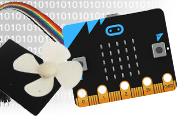
1 xFan Blade.

5 x2.2KΩ Resistor.

5 x10KΩ Resistor.

5 x47Ω Resistor.

1 xEdge Connector Breakout Board for BBC micro:bit.

1 xMiniature LDR.

10 xMale to Male Jumper Wires.

10 xMale to Female Jumper Wires.

1 x470uF Electrolytic Capacitor.

1 xPiezo Element Buzzer.

4 xPan Head M3 Machine Screw.


Our goal for the micro:bit Summer Code Club challenge is to help teachers, parents and STEM ambassadors all over the world to promote coding and digital literacy in their local communities. Whether you're a code club veteran or an aspiring educator who just needs the resources to get your dream summer club off the ground, we'd love to help out - so apply today and start spreading the power of coding to the next generation!


micro:bit Resources


http://microbit.org/guide/


10 micro:bit Projects in 10 Days


An Introduction to Computer Science with BBC micro:bit: The Full Curriculum


BBC micro:bit Poster | Free Download for your Classroom


micro:bit Basics for Teachers

Attachments:
imagemicrobit-summer-code-club-challenge-termsconditions.pdf
  • join the micro:bit summer code club challenge
  • microbit
  • summer_code_club
  • stem projects
  • Share
  • History
  • More
  • Cancel
  • Sign in to reply

Top Comments

  • balearicdynamics
    balearicdynamics over 6 years ago +7
    The place where the club will run: Ghent (Belgium) Reference: The Art-a-Tronic interactive exhibition will close the first two months session at Depot 09 (in Ghent, too) on next May 31. The exhibition…
  • drsujit
    drsujit over 6 years ago +6
    We have been running the Cambourne Electronics and Robotics Club (CERC) in Cambridge with more than 100 kids registered in the age group of 7-14 years since September 2017. CERC meets every fortnight to…
  • gusmerckel
    gusmerckel over 6 years ago +4
    Hi everyone, I'm Gus Merckel, Programm Director at Jacaranda Education (jacarandaeducation.org), an NGO that works with 21st Century Learning and Maker Ed. We are also Growth Leaders from the Code Club…
  • julianrendell
    julianrendell over 6 years ago

    Hi everyone - where ever these kits go, they're going to be put to good use!


    In our case, should we be selected, they'd be coming to Courtenay, Vancouver Island, BC, Canada. We are already planning two summer code & build camps for 8+ year olds, which will include using Microbits. These kits would let us further explore what can be done with MicroBits - especially if we have enough to distribute them around a physical space. I think there's real potential to make some sort of augmented reality game/experience!


    Our camps will be for up to 8 participants at a time, and last a week. But having access to some more 'bits would allow us to also create some more informal 1-2 hour sessions on Saturdays; and these sessions would be all ages- there are a lot of adults, and retirees who are interested, but more scared than kids are to try their hand at programming and electronics. It's super fun watching someone discover a new way to play and imagine. Microbits are so easy and friendly that they're a great starting point for explorers of all ages! Our Saturday sessions are sometimes a bit hectic (up to 25 participants), but typically are more manageable with around 10 people participating.


    There are is also a brand new makerspace (SparQ) on a nearby island - the grand opening is next Wednesday - and another about an hour away; in principle more microbits might allow us to share our kits when we're not using the microbits ourselves. We would also be willing and able to do some remote mentoring thanks to videoconferencing and that all the code is in the cloud. This would be a stretch goal; we've done some remote sessions with one of the spaces. But I'd love a good reason to stretch the technology we have further! (And it presumes that they would be interested, and be able to find staff/volunteers to put on sessions. All TBD!)


    I have a fairly broad background and tend to set up sessions with a general goal, and supporting reference material, but encourage participants to come up with their own projects. And then we start building and exploring.


    If we were to be selected, the supporting material and information will be well documented, and made available to the community. Here's an example: Micro:Bit Creatures - creating a kinetic scene with Micro:Bits


    Thanks to Element14 for creating these opportunities to help facilitate people of all ages to discover electronics and explore technology and engineering!


    Good luck to everyone, and I look forward to seeing the games and activities that are created!!!

    • Cancel
    • Vote Up +2 Vote Down
    • Sign in to reply
    • More
    • Cancel
  • MARK2011
    MARK2011 over 6 years ago

    Hi,

    I'm an Msc(Eng) with over 20 years experience in HVAC industry. Besides, privately, I'm electronic enthusiast at all.

    Thanks to cooperation with University of Technology I work with students. It gave me quite wide didactic skills. Moreover and the most important in that project I’m involved in some IT/education projects in my childrens school. My role in these projects is supervising of  learning programme preparation and support of students learning path. Simple coding entering into the IoT realm; arduinos raspberries and even Lego Mindstorm classes - that is the basis and support for our new Summer project. Generally speaking that activity is related i quite similar to STEM Club idea...

    Micro:bit and Kitronic kits are addressed to beginners of coding,  carefully entering in the realm of programming and robotics… wrong! - not at all careful - but with children's passion and enthusiasm, voraciously and chaotic but with great charm… and rumor as well. The only caution is required of the teacher to not spoil student’s original rush to gain knowledge. Quite serious task isn’t it? Frankly I’m ready to fulfill these requirements as I cooperate with small school helping in informatic lessons. But my strongest reference are my robotic projects we prepare with my daughters.

    Our humble “lab” is perfect electronic/ robotic kindergartenimage

    Here you can see my last roadtest report dedicated to Ti Robotics System Learning Kit accompanied with complete classroom curriculum.

    https://www.element14.com/community/roadTestReviews/2777/l/ti-robotic-systems-learning-kit-ti-rslk-review. Although it is intended for older students, some experiments and “classes” were conducted together with my child’s. It was an extraordinary experience indeed! On the picture below you can see our attempt to combine “raw” Ti robotic system with “toy - like” but likewise advanced Lego Mindstorm system.


    image


    The Project

    Participants: a group of 10 children 8-12y.

    Formula: 3 hour classes three or twice a week.


    The micro:bit / Kitronic kit project for my students is relative simple but effective in my opinion.

    Theory isn’t bad!:

    We will start with a short introduction in the realm of electricity, electronic and robotic as well. Multimedia presentation and some examples from my drawer, would be helpful (I hope not to bore the group for a start).

    Then we will identify the contents of the box.

    I plan to select and explain a few examples from the manual. First experiment we will conduct together after that children would be ready to act more independently.

    The group will benefit from programming skills and will now become familiar with “hardware”.

    Probably I would introduce my favourite example - led chaser - very simple to code but impressive indeed!

    I prefer projects involved students working together. Simple communication examples seem to be perfect here.

    Is micro:bit  Scratch compatible? Yes, Great!!! my students love Scratch !!! let’s use it.

    Final project:

    Every student then would consider (with my support) the final project - it could be selected example from manual/ something from internet (https://microbit.org/ideas/ is the great resource!) or individual child's project (my favourite idea).

    Completion:

    And a great exhibition of robots with the presentation of children's designs for parents, teachers and colleagues - a great robotic show.


    Thank you for the great support of education in the field of IT and electronic.

    Marek

    • Cancel
    • Vote Up +1 Vote Down
    • Sign in to reply
    • More
    • Cancel
  • karthickiot
    karthickiot over 6 years ago

    Hi,

    I am Dr. Karthick working as Asst. Professor in IIIT and in-charged as Lab Coordinator in University Engineering Institution. I had experience in Hardware and Software, also 10 Years of teaching and Research Experience and my specialization in Masters degree is Digital electronics and Advanced communication systems and in Doctoral Degree in Data Acquisition Systems and Data Analysis in Designing IoT based solutions for the Homes, College, Offices, Medical, industries, agriculture, factories etc. IIIT University students get college seat in the Andhra Pradesh State, India because they secured 10 out of 10 grade points in their SSC (10th) level and are from rural stations. Institute is providing free laptop and Internet facility to make them skilled in IT sector. They are learning PYTHON, C in their academic curriculum.


    I had won a half dozens of prizes for the project in Design contest from Hackster, All about circuits, RS Design Spark, Electromaker and Element 14 and hardware kits for the ideas. I use to make students to learn new concepts in technology and implement them in online simulators, physical hardware they cannot afford because they are from rural areas and their family financially backward. I determined to help them to provide hardware by joining in The micro:bit Summer Code Club Challenge! Every year 1000 students are going to join in the institute so it will be good opportunity for me to expose the hardware and run practical projects with the Micro:bit kits.


    If I receive the kits, I would like to run special coding class on hardware on every Sunday to cover all the students in the academic year apart from this summer code club challenge. So when they are coming to final year they can implement their own projects as a project Thesis.  My moto is to encourage the rural students and make them skilled and worthy. This will be the first time running code course in our University if the hardware was won and I hope definitely their will be good encouragement from the management by the success of this Micro:Bit Summer code club challenge as a inital step.


    Every year University is conducting Tech Fests to encourage and to expose their talent on latest technology around the globe. It will be good opportunity for the students to present their projects in those events and get appreciation. Before that they need an exposure on the coding and implementing. As the Micro:bit hardware is having On-board features like 25 LED display, Compass & Accelerometer Sensors, communication to remote devices via Bluetooth wireless. Along with Micro:Bit, Kitronik Inventor's Kit is also offered which is having a handful of components to create beautiful DIY projects.


    It will be a great opportunity for students and us to incorporate the practical lab sessions with micro:bit, which we have not worked with yet. Micro:bit is one of the most advanced educational development kit for visual programming, and the Micro Python capability looks very promising as well – it helps the faculty to learn as well and improve their teaching skills. It drawn interest towards micro:bit's is it has vide applications in robotics and wearables devices. Our faculty designed a schedule in those fields and hope to do a lot more in the future.


    If a batch of students are learning then they can act as a trainers to their junior and there is a chance to attain vast knowledge and creativity.


    Hope for the good.

    Thanking you.

    • Cancel
    • Vote Up +2 Vote Down
    • Sign in to reply
    • More
    • Cancel
  • philomath
    philomath over 6 years ago

    I am part of a Linux User Group in Delhi, India and as a co-organizer, I(we) envisions to create a place for all the makers, and innovators from every background to be part of this STEM and Open Source culture.


    ILUG-D is a non-profit, volunteer driven User group, with attendees varying from a wide age group and background. Many of us are veterans who contributes in upstream projects (varying from pandas, kde and Yocto) regularly and few of us have just started their journey in high school or college. ILUG-D has a long history way back to late 90s (http://www.linux-india.org/about-us/raj-mathur/), and was reinstated in year 2016. We have conducted many workshops, and events to spread the knowledge among each other, including RPI Jam Workshops for the last 2 years.


    At ILUG-D, this summer (July-September 2019), we were determined to start something for the benefit of the whole community and many ILUG-D summer projects (all open projects, made by community and for the community) were born out of this vision. The projects were planned by the community members and are open to all to join.


    These summer projects, can be titled as code clubs (since the aim is to teach and learn throughout the journey) as well. We plan to run these projects in an open way, transparent to all but structed enough to be stable and with the current response, we expect a lot of participation in these projects (realising the vision). ILUG-D is a volunteer driven community (mostly students) and is always in search of sponsors for our venue, food and hardware (ofc). Getting selected for this programme will help our current hardware hackers to explore more and teach new members about the wonders we all can do with these boards.


    Projects part of the community:

    * Scribe: Live event streamer on the website using RPI and RPI cam.

    * Splatter: Automatic Poster generation

    * Birdman: Automatic social media and Mail handler


    There is another game project, laser balloon popper, which requires hardware to build, which we are always in search. And this might be our player in Summer Gaming Challenge, or may be something even better, if we get selected image


    ILUG-D website: http://www.linuxdelhi.org/

    ILUG-D youtube: https://www.youtube.com/channel/UCQ4jkid1GjrmEQxWZCbD_Eg

    ILUG-D twitter: https://twitter.com/ilugdelhi

    ILUG-D projects: https://github.com/ILUGD

    Few highlights by ILUG-D:

    * https://photos.app.goo.gl/NCc7smkMCFEsGPfY6

    * https://photos.app.goo.gl/Z6y06SBQyCUiHnTg2

    * https://www.youtube.com/watch?v=n5ql1Kzd-Yo


    The official blog is under construction. For the time being, blogging is one of the basic skill we teach and share among all our members and many of us write regular blogs, from technical to personal ones. Few of them are as:

    * https://iayanpahwa.github.io/

    * https://hellozee.github.io/

    * https://phi2infinity.blogspot.com/

    * https://nk521.github.io/

    • Cancel
    • Vote Up +1 Vote Down
    • Sign in to reply
    • More
    • Cancel
  • cuc_fab_lab
    cuc_fab_lab over 6 years ago

    Location: Urbana Neighborhood Connections Center - Digital Learning Garage, Urbana, Illinois, United States

    Dates: Late June through the end of July 2019

    Age Ranges: 10-14

    Number of Participants: Maximum 30, split into two groups of 15


    image

    Background: The Urbana Neighborhood Connections Center partners with the Champaign-Urbana Community Fab Lab to offer digital literacy and educational programming for youth ages 10-14. UNCC is an after-school center that provides educational, social-emotional, spiritual and recreational enrichment to an estimated 150-175 youth in the Urbana community. UNCC’s current participants are over 95% African American and over 80% from low income families. The CU Community Fab Lab is an organization that enables access to digital design and maker experiences for all ages in the Champaign-Urbana Community. The goals of our partnership are to teach digital literacy with a STEAM focus, reinforce basic computing skills and academic achievement, and promote learning strategies such as problem solving, persistence, curiosity, collaboration, and design thinking.


    Summary of Programming - The Fab Lab runs a weekly after-school program for students age 10 - 14 at the Digital Learning Garage within the UNCC facility during the course of the school year. Each week, instructors develop curriculum that builds students’ design and technology skills through a variety of softwares and tools. In the past semester, students have engaged with subjects such as the chemistry behind bath bombs, converting photographs to 3D prints, coding sound-reactive lights, screen-printing t-shirts, and digital embroidery.


    image


    What micro:Bits has to offer- Through our programming at UNCC, we have developed an established group of youth who regularly engage in design and maker-oriented programming. In these programs they gain experience with technology, creative expression, collaboration, and problem solving that they do not get in their public school settings. A large focus of our work is in developing the skills and characteristics that contribute to success in any environment- i.e. persistence, resilience,  adaptability, and the ability to problem-solve, think creatively, and overcome the fear of failure.


    image

    One challenge we’ve repeatedly noticed during coding-centric activities is the significant differences in experience with programming, as well as in basic computer literacy. For many students, syntax and typing the code lines are a huge obstacle in navigating these programs and creating functional code. Therefore, we believe that the interface and hardware of micro:Bits will be more understandable and versatile for our students. This will aid them in moving confidently from the concepts (what the code is doing) to the code syntax itself, and will encourage them to write more code from scratch.


    The additional advantage of micro:Bits is that its UI allows users to toggle between block and JavaScript views. Being able to compare the two different styles of code will further aid in comprehension of code reading and writing. We’ve noticed that discouragement and frustration is a major enthusiasm destroyer. When the student is confident in their comprehension, they are more engaged and willing to take risks and be creative. The less barriers to them actualizing their ideas, the easier it is for them to execute their ideas. There’s nothing more confidence boosting than making something as you imagined it and being able to say, “I made that and it’s cool!”


    Micro:Bits Program Proposals: Escape Room in a Box


    Our proposed program will have participants using traditional codes, cyphers, and puzzles in collaboration with micro:Bits to create an “Escape Room in a Box.” Students will be divided into

    two different groups, and each group will construct their own series of puzzles to be solved. Each puzzle will utilize one or more micro:Bits. In creating their puzzles, they will learn how to code the micro:Bits, including, but not limited to:

    • Sending and Receiving radio signals for the micro:Bits to show clues across the room
    • Utilizing the compass capabilities on the micro:Bits  to make puzzles that require artifacts to be turned in specific directions, or placed in a certain array.
    • Building circuits with switches, so the micro:Bit can check voltage across the pins for a “completed” circuit and reveal the next clue.
    • Creating button sequences to reveal a secret number or code on the LED matrix
    • Using the light sensor to detect if an area has been covered up, triggering the next step
    • Measuring movement with the accelerometer; i.e. shake an object quickly to trigger a clue reveal.

    Alongside this, participants will work on crafting the stories and themes that make up the “Escape Room”, play-testing puzzles and games, and focusing on the flow of the player through the experience. At the end, the groups will switch and compete to try and solve the opposite group’s puzzles in the allotted time frame. 


    You don't have permission to edit metadata of this video.
    Edit media
    x
    image
    Upload Preview
    image

    image

    image

    • Cancel
    • Vote Up +3 Vote Down
    • Sign in to reply
    • More
    • Cancel
  • catarrowood
    catarrowood over 6 years ago

    I am a homeschooling parent in Chapin, SC (US) who coordinates a homeschool coop with 10-15 students who are all very interested in learning the basics of coding and programming. The age I am targeting for this particular activity is 10-13 year olds. Many of them have experience working with circuits, motors and some very basic robotics and are looking for ways to continue their learning.

    • Cancel
    • Vote Up +1 Vote Down
    • Sign in to reply
    • More
    • Cancel
  • Fred27
    Fred27 over 6 years ago

    I'm not entering the challenge as I'm not a teacher, but I thought I'd let you know what my kids are up to. I recently got 7 bargain micro:bits - they're Farnell returns that run hot and I intend to try repairing them. In the mean time they do work, so my kids (7 and 5 years old) have been playing with them. You know what kids can be like. They'll either take to it or not be interested, so these are a cheap way to find out first.


    They seem to be enjoying it so far and have a few friends with techie parents who might also get the bug. Rather than give them blank ones, they want to program them with a surprise with hidden messages before I hand them out. It's great for my kids to have a goal. A project always helps focus the mind and help you learn. Hopefully the personal touch might encourage the recipient too.

    • Cancel
    • Vote Up 0 Vote Down
    • Sign in to reply
    • More
    • Cancel
  • rjwhite023
    rjwhite023 over 6 years ago

    I teach engineering and technology to middle school students in Georgia. With school out already I want to start a community club for students at schools where we live and invite them to come in and be introduced to Raspberry Pi, Arduino, circuits, and other activities that have to do with physical computing and coding that reaches outside of a computer screen. I would hold our club meetings at a local public library and invite students via our connection to parents through our local PTSA. I anticipate 20-25 students that would attend over the summer and lessons would carry over into the school year where possible. This would also allow me to establish a STEM club focused on coding and circuits in my daughter's school next year and it would work with their current coding club and sponsor. In our area girls are often not interested in these activities because they are dominated by boys, I want to open this up to as many girls as possible and ensure that they are comfortable learning and participating. Our area is really diverse, so having these clubs helps introduce students from many backgrounds to computing and coding.

    • Cancel
    • Vote Up +1 Vote Down
    • Sign in to reply
    • More
    • Cancel
  • bigbluec
    bigbluec over 6 years ago

    Currently teaching in a STEM capacity at a Boys boarding school in NZ.


    The students exposure to digital tech to date has been  absorbed within other curriculum areas with varying but limited degrees of success.


    With a new compulsory digital tech curriculum being introduced in 2020, I have developed and piloted computational thinking and creative digital tech projects using online resource offerings.


    During the first part of this academic year I have observed some significant digital citizenship challenges particularly with the distractions students encounter  while working exclusively online. I have also noticed that students tend to be better  engaged creativly during tactile activities.


    I will be running two junior code club groups (code club NZ) in term three and would like to investigate through action research whether the blending of tactile+online activities improves engagement and digital citizenship versus the current approach of exclusively using online resources and simulators.


    Two groups have been formed. 15 year 9 students and 15 year 10.


    It is my endeavor to shift the student mindset away from a culture of consuming technology towards creatinge technology solutions and provide evidence to support the funding of a well resourced technology department that shares the ambitions embedded in NZs vision for a creative tech enabled generation of problem solvers.

    • Cancel
    • Vote Up +1 Vote Down
    • Sign in to reply
    • More
    • Cancel
  • bigbluec
    bigbluec over 6 years ago in reply to rancell

    Thank you Robert. I am inspired by the work you are doing up the road on this eastern most edge of our world.


    I nearly did not apply on the suggestion that this is a 'summer' code club initiative. I can think of a good few northern hem places chillier in the summer than NZ in the winter.


    Thanks for sharing your knowledge and learning experiences. I look forward to reciprocating.

    • Cancel
    • Vote Up 0 Vote Down
    • Sign in to reply
    • More
    • Cancel
<>
element14 Community

element14 is the first online community specifically for engineers. Connect with your peers and get expert answers to your questions.

  • Members
  • Learn
  • Technologies
  • Challenges & Projects
  • Products
  • Store
  • About Us
  • Feedback & Support
  • FAQs
  • Terms of Use
  • Privacy Policy
  • Legal and Copyright Notices
  • Sitemap
  • Cookies

An Avnet Company © 2026 Premier Farnell Limited. All Rights Reserved.

Premier Farnell Ltd, registered in England and Wales (no 00876412), registered office: Farnell House, Forge Lane, Leeds LS12 2NE.

ICP 备案号 10220084.

Follow element14

  • X
  • Facebook
  • linkedin
  • YouTube