element14 Community
element14 Community
    Register Log In
  • Site
  • Search
  • Log In Register
  • Community Hub
    Community Hub
    • What's New on element14
    • Feedback and Support
    • Benefits of Membership
    • Personal Blogs
    • Members Area
    • Achievement Levels
  • Learn
    Learn
    • Ask an Expert
    • eBooks
    • element14 presents
    • Learning Center
    • Tech Spotlight
    • STEM Academy
    • Webinars, Training and Events
    • Learning Groups
  • Technologies
    Technologies
    • 3D Printing
    • FPGA
    • Industrial Automation
    • Internet of Things
    • Power & Energy
    • Sensors
    • Technology Groups
  • Challenges & Projects
    Challenges & Projects
    • Design Challenges
    • element14 presents Projects
    • Project14
    • Arduino Projects
    • Raspberry Pi Projects
    • Project Groups
  • Products
    Products
    • Arduino
    • Avnet & Tria Boards Community
    • Dev Tools
    • Manufacturers
    • Multicomp Pro
    • Product Groups
    • Raspberry Pi
    • RoadTests & Reviews
  • About Us
    About the element14 Community
  • Store
    Store
    • Visit Your Store
    • Choose another store...
      • Europe
      •  Austria (German)
      •  Belgium (Dutch, French)
      •  Bulgaria (Bulgarian)
      •  Czech Republic (Czech)
      •  Denmark (Danish)
      •  Estonia (Estonian)
      •  Finland (Finnish)
      •  France (French)
      •  Germany (German)
      •  Hungary (Hungarian)
      •  Ireland
      •  Israel
      •  Italy (Italian)
      •  Latvia (Latvian)
      •  
      •  Lithuania (Lithuanian)
      •  Netherlands (Dutch)
      •  Norway (Norwegian)
      •  Poland (Polish)
      •  Portugal (Portuguese)
      •  Romania (Romanian)
      •  Russia (Russian)
      •  Slovakia (Slovak)
      •  Slovenia (Slovenian)
      •  Spain (Spanish)
      •  Sweden (Swedish)
      •  Switzerland(German, French)
      •  Turkey (Turkish)
      •  United Kingdom
      • Asia Pacific
      •  Australia
      •  China
      •  Hong Kong
      •  India
      •  Japan
      •  Korea (Korean)
      •  Malaysia
      •  New Zealand
      •  Philippines
      •  Singapore
      •  Taiwan
      •  Thailand (Thai)
      •  Vietnam
      • Americas
      •  Brazil (Portuguese)
      •  Canada
      •  Mexico (Spanish)
      •  United States
      Can't find the country/region you're looking for? Visit our export site or find a local distributor.
  • Translate
  • Profile
  • Settings
Community Hub
Community Hub
Member Blogs Using an ADALM1000 to Measure Bipolar Transistor Gain versus Collector Current
  • Blog
  • Forum
  • Documents
  • Quiz
  • Events
  • Leaderboard
  • Polls
  • Files
  • Members
  • Mentions
  • Sub-Groups
  • Tags
  • More
  • Cancel
  • New
Join Community Hub to participate - click to join for free!
  • Share
  • More
  • Cancel
Group Actions
  • Group RSS
  • More
  • Cancel
Engagement
  • Author Author: jc2048
  • Date Created: 21 Jul 2023 9:46 PM Date Created
  • Views 3434 views
  • Likes 16 likes
  • Comments 19 comments
  • transistor
  • DC gain
  • beta
  • adalm1000
  • jc2048
Related
Recommended

Using an ADALM1000 to Measure Bipolar Transistor Gain versus Collector Current

jc2048
jc2048
21 Jul 2023

I'm having fun experimenting with an ADALM1000. Whilst its spec is nothing like that of a professional SMU, it is an interesting way to explore the world of electronics, though with a certain level of frustration when it gets difficult to do things that, with a real SMU, would be a matter of clicking a few buttons.

For this blog, I thought I'd have a go at measuring the DC gain (beta) of a transistor (used common-emitter) versus the collector current, using the built-in functions rather than by scripting anything. How hard could that be? Actually it turned out to be quite difficult, though some of that might be down to the dunderhead that we've got operating the equipment.

My first attempt was the simple, straightforward approach. Source a current to the base of the transistor (via a 220R resistor, as a little insurance in case the output did anything silly before the current regulation began), and source a voltage to the collector whilst measuring the current on the same pin. Unfortunately, the result left a lot to be desired.

image

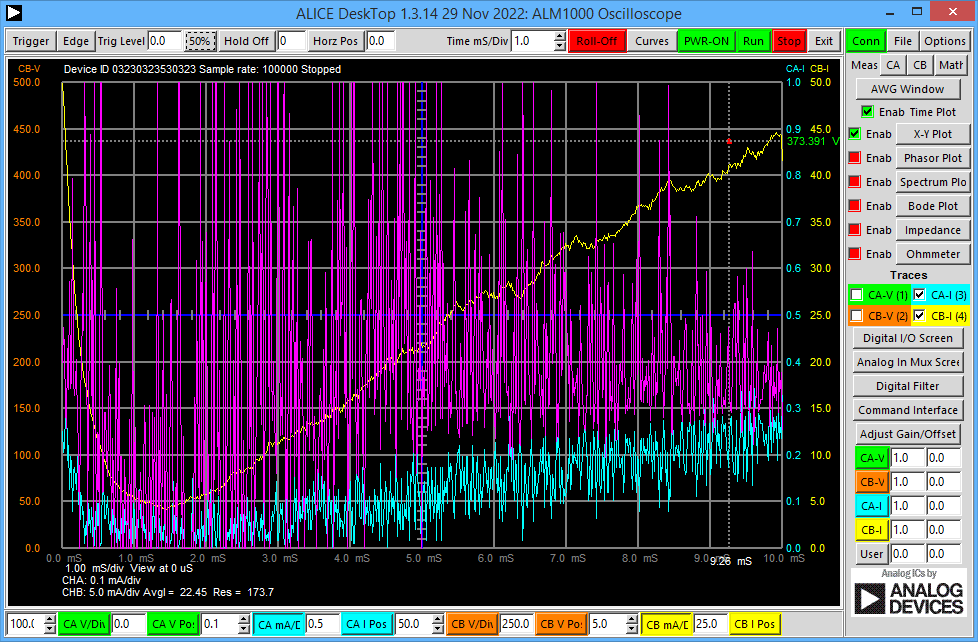
That's supposed to be a nice curve for a 2N3904 transistor, with collector current (in mA) on the X axis, and the gain on the Y axis. We can see better what's going on if I show you the oscilloscope view.
image

The cyan trace is the base current, the yellow trace is the resulting collector current, and the purple trace is the gain computed with the math function.

It's a mess because of all the noise on the lowish current (<1mA) that's driving the base.

There are a couple of other problems, too. One is that because I'm using a sawtooth waveform, the slew at the start messes up the first part of the curve. A second problem is that, as I don't know the gain ahead of time, I ended up adjusting the range the base current sweeps over to give a reasonable range on the collector current.

So, can I do better? Perhaps I can cobble together something with an op amp.

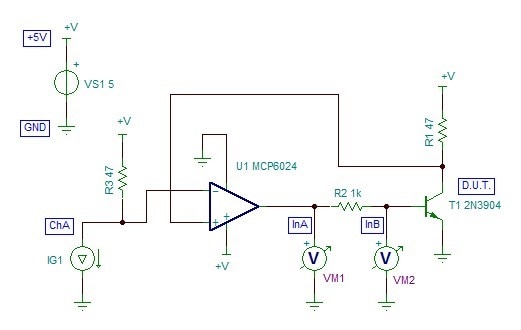
My next attempt was with this circuit.
image

This is a form of driven bridge. An output pin (ChA) of the ADALM1000 sinks current through a 47R resistor. The op-amp compares the resulting voltage to that from a 47R dropping the collector current of the transistor and adjusts the transistor base drive to make them match. When the ADALM1000 sweeps the current, the collector current will follow, and it will be less noisy than before because the current is now up in the mA area. The base current I'm measuring with a resistor and the two inputs of the ADALM1000.

That results in this for the curves for a 2N3904 and a BC549C

image

It's quieter than before, but there's still noise. A disadvantage of doing a differential measurement using two inputs is that it doubles up the noise. A second (hidden) disadvantage is that the ADALM1000 inputs have quite a bit of capacitance (390pF, and whilst the op amp seems to manage, it's not ideal to have that hanging on its output)

Since it was a dual op amp, I decided to instead try a simple differential amplifier with the other half and then I would only need to use one input on the ADALM1000 driven from an op-amp output. Here's the circuit:

image

That gives me these curves.

image

It still suffers from the slew in the region up to 4mA, though, whilst it's still not exactly professional level, we're getting a better idea of the shape of the transistor characteristics now. I've thrown in a 2N2222A for good measure.

I wasn't expecting the hump in the curve for the BC549C, so that might indicate a problem of some sort with the test.

Here is the sweep extended up to 100mA:

image

Keep in mind that they will all be suffering from self-heating at the top end, the 2N3904 and the BC549C in particular where they are above the max dissipation limit. Also, because with my circuit the collector voltage falls with current, I'm not measuring at a constant Vc.

Hope that was of some interest. Although not spectacularly successful, it gives an idea of the kind of things that can be done with the device and a little extra circuitry.

Update 28th July 2023

I've reworked the circuit, to lose the embarrassing high-frequency oscillation (discussed in comments below), by building an integrator around the op amp like this:
image
Not sure that's the best way to compensate it, but it does seem to give enough extra phase margin at the top end to stop the oscillation and allow the op amp to do its job of mirroring at the transistor collector what is happening at the input.

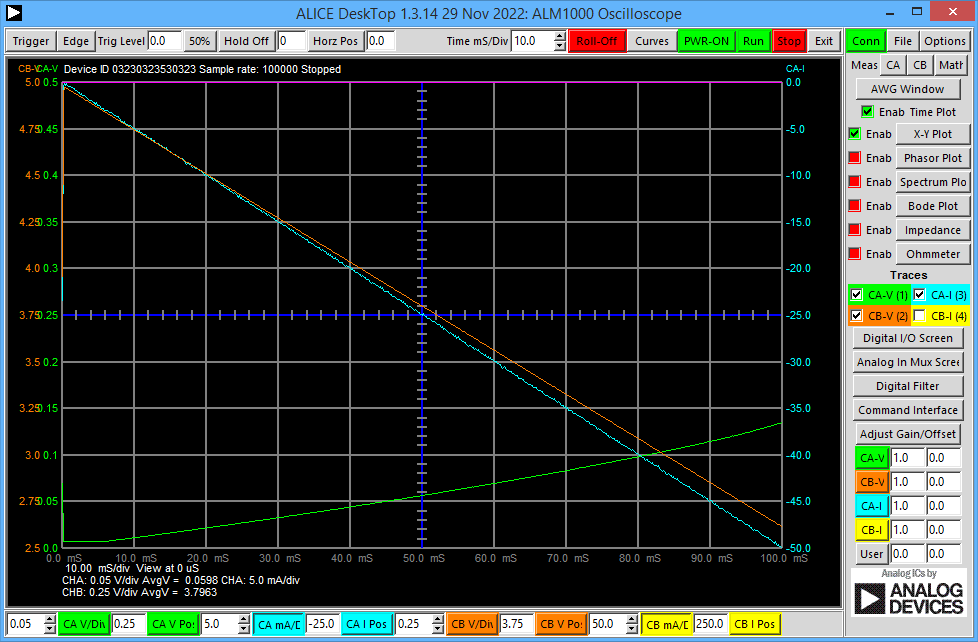
Here are the 'scope view' traces. Now the collector voltage trace (orange) is a straight line as the input sweeps the current [cyan trace]. The green trace is the output of the differential amplifier, where the resulting voltage is proportional to the transistor base current.

image


That gives this for the plot of transistor gain against collector current.


image


Leaving aside the mess up to about 5mA, the noise on the current output from the ADALM1000 affecting the calculation of the gain quite badly at lower currents, and the untidy lines from the 'fly-back' at the end, that's not too bad.

Previous blogs

A Short Informal Review of the ADALM1000 from Analog Devices

Experimenting With an All-Pass Filter using the ADALM1000 from Analog Devices

  • Sign in to reply

Top Comments

  • jc2048
    jc2048 over 2 years ago in reply to BigG +1
    Thank you. It's nice to know it was useful, though do remember that I'm just an old engineer 'noodling around' with stuff.
  • jc2048
    jc2048 over 2 years ago in reply to shabaz

    This is from an old Fairchild datasheet for an MPSA92 transistor.

    image

    That's a high voltage part (300V), so the gain is relatively low compared to the parts I was testing, but it gives an idea of the general shape and fits with the kind of thing I'm seeing. The curves are very continuous in nature, no sudden changes, so I reckon my 'hump' is a defect of what I'm doing with the test. Because it's a sweep, there's a time element that there wouldn't be to spot measurements. It's much more likely to be me than ADI. I really need to get a 'real' oscilloscope on it and look at what the collector is doing.

    I believe the semiconductor manufacturers use pulse testing to avoid the temperature effects from self-heating. You can see why when you look at how those curves move with temperature. If I scripted it, in theory I could do a pulse test for each datapoint with a lot of filtering thrown in. But that would mean my grappling with Python, so I think I'll leave that to anyone else who is interested (I've got an ICEstick board here that I haven't done anything with yet, and I think that deserves its turn).

    • Cancel
    • Vote Up 0 Vote Down
    • Sign in to reply
    • More
    • Cancel
  • shabaz
    shabaz over 2 years ago

    Just saw this nice circuit, that could be adapted for (say) 0-1mA current source, based on a control voltage:

    image

    However, something like 2 x LMC6062 (or 1 x LMC6484, but there's no stock of any of the more accurate versions at Farnell) could be a better option in that circuit, since it has higher operating voltage for a more general-purpose design.

    • Cancel
    • Vote Up 0 Vote Down
    • Sign in to reply
    • More
    • Cancel
  • DAB
    DAB over 2 years ago

    Nice test.

    I am reasonably impressed by the ADALM1000.

    • Cancel
    • Vote Up 0 Vote Down
    • Sign in to reply
    • More
    • Cancel
  • shabaz
    shabaz over 2 years ago

    Hi Jon,

    Very interesting blog. Neat trick to adjust the output based on collector current rather than directly from the base current!

    I couldn't figure out the slight anomaly on the BC549C either, I guess it could be a couple of things (e.g. may the ADALM100 itself) interacting in an unexpected way! The first op-amp circuit also had that anomaly, but it was more in the second circuit, and slightly changed position, so that's probably a clue, but I couldn't solve it. Still, the chart was very interesting. I'd always wondered how much the gain changed in that range, since a lot of datasheets only have charts that often only have a subset of this, and sometimes one may want to build for a slightly different collector current.

    For the few times I've tried to measure a semiconductor, I've been doing it manually so far, with a multimeter and a process calibrator (which is like a lower-res SMU, and much like the ADALM1000). I've got an old Yokogawa model, but the one in the screenshot below looks interesting, it's apparently quite accurate too, however it's not impulse-purchase price! so I probably won't buy it until I really need to. A couple of process calibrators would be neat for experimenting with semiconductors. 

    image

    • Cancel
    • Vote Up 0 Vote Down
    • Sign in to reply
    • More
    • Cancel
  • BigG
    BigG over 2 years ago

    This is great. As any sportsman knows, the price and brand of the sports equipment you're using does not always help that much, it is how you are able to use it that counts. And here it's similar. I really liked the way you were able to show incremental improvement and also then provided explanation along the way using the output charts from the ADALM1000. I learnt from this.

    • Cancel
    • Vote Up 0 Vote Down
    • Sign in to reply
    • More
    • Cancel
<>
element14 Community

element14 is the first online community specifically for engineers. Connect with your peers and get expert answers to your questions.

  • Members
  • Learn
  • Technologies
  • Challenges & Projects
  • Products
  • Store
  • About Us
  • Feedback & Support
  • FAQs
  • Terms of Use
  • Privacy Policy
  • Legal and Copyright Notices
  • Sitemap
  • Cookies

An Avnet Company © 2026 Premier Farnell Limited. All Rights Reserved.

Premier Farnell Ltd, registered in England and Wales (no 00876412), registered office: Farnell House, Forge Lane, Leeds LS12 2NE.

ICP 备案号 10220084.

Follow element14

  • X
  • Facebook
  • linkedin
  • YouTube